Written by: Lawyer Shao Shihui
According to media and publicly available information from the UK Crown Prosecution Service, in March 2026, the UK High Court issued an unexplained wealth order and a temporary freezing order concerning 85 properties in London owned by a Chinese citizen and associated companies, with a total value exceeding £81 million (approximately RMB 738 million). However, in this process, the Chinese citizen was not prosecuted in the UK, nor was he convicted.
Investigations revealed that the individual's true identity is Su Jiangbo, a man from Xiamen, Fujian, who has been wanted in China for over two years for engaging in online gambling and operating a casino.
Seeing this news, it's hard not to think of the Qian Zhiming case. In November 2025, Qian Zhiming was sentenced to 11 years and 8 months in the UK for money laundering-related crimes, with over 60,000 bitcoins involved, making it one of the largest bitcoin confiscation cases in UK history, with related assets also subjected to civil recovery proceedings.
These two cases together illustrate that the UK is beginning to actively use a parallel approach of civil recovery and criminal prosecution to handle and recover vast amounts of wealth that originated in China but have already flowed into the UK.
1 UK—The Preferred Destination for Global Dirty Money
The UK, especially London, has long been viewed as the "preferred destination for global dirty money."
In May 2024, a senior official from the UK Foreign Office publicly mentioned that it is estimated that 40% of global money laundering activities flow through the City of London and UK overseas territories (The Guardian, May 2024). According to estimates by the UK National Crime Agency (NCA), more than £100 billion of criminal proceeds flow into or through the UK each year.
In the real estate sector, the UK is the most concentrated and noticeable pool of capital. Compared to account funds and financial products, real estate is more stable and better suited for long-term holding, custodianship, and resale, which is why it has always been an important destination for various suspicious sources of funds.
According to data from Transparency International UK, between 2016 and 2022, at least £6.7 billion worth of UK property was purchased using suspicious wealth.
A key channel for dirty money entering the London real estate market is overseas territories such as the British Virgin Islands. Research by Transparency International shows that 494 properties in the UK, with a total value of approximately £5.9 billion, are associated with suspicious funds that flowed through UK overseas territories, with over 90% of the funds coming from the British Virgin Islands.
Reports from organizations like Transparency International have repeatedly pointed out that a significant amount of illegal funds from countries like Russia, China, and Nigeria has flooded into London’s high-end property market.
Because the UK has long been an important destination for dirty money, its enforcement agencies have recently become increasingly proactive in dealing with large amounts of unexplained wealth.
2 Why Are UK Enforcement Agencies So Proactive in Handling Unexplained Wealth?
Is this change in law enforcement merely a response to anti-money laundering pressures? Clearly not.
Financial factors are the most realistic driving force. According to publicly available data from the Crown Prosecution Service (CPS), the UK has recovered £478 million in illegal assets over the past five years. The 61,000 bitcoins seized in the Qian Zhiming case are currently worth about £5.5 billion (approximately RMB 50 billion).
For law enforcement, these cases correspond not just to "governance achievements" in the sense of anti-money laundering but also to tangible asset recovery.
Institutionally, the UK has long prepared the tools for this.
According to the UK Proceeds of Crime Act 2002 (POCA), Part 5 establishes a civil recovery system that allows law enforcement to recover criminal proceeds through civil procedures without a criminal conviction. The Criminal Finances Act 2017 further introduced Unexplained Wealth Orders (UWO), allowing law enforcement to demand explanations of asset sources if there are reasonable grounds to suspect that the relevant property is not consistent with the individual’s legitimate income; if the respondent fails to provide a reasonable explanation within the specified time, the property may be deemed recoverable (i.e., presumed to be criminal proceeds), and if the respondent cannot provide evidence, the property will subsequently enter the civil recovery process.
This means that combating money laundering can not only avoid losses but is also a means of generating income. Against the backdrop of fiscal tightening, this is undoubtedly a "win-win" business.
3 How Is Chinese Money Flowing Out?
Ultimately, the reason the UK can target these assets is that the money has already been transferred out of the country.
But how exactly does Chinese money flow out? This is also a common scenario encountered by Lawyer Shao in relevant cases.
In recent years, Lawyer Shao has represented many cases involving illegal foreign exchange transactions, coming into contact with involved parties, including intermediaries, currency exchange companies, U merchants, and underground banks.
From these cases, we can see that the common ways of exchanging currency roughly include the following:
First, Ants Moving.
This is the most common method among ordinary people. The operation usually involves borrowing and collecting the foreign exchange quotas of friends and relatives, breaking down the personal annual foreign exchange quota that should be restricted, and then transferring the funds outside the country in batches.
Second, Underground Bank Arbitrage.
This is currently one of the most common paths. Currency exchangers deposit RMB into a designated domestic account of the underground bank, while the bank then arranges personnel abroad to transfer an equivalent amount of foreign currency to a specified overseas account.
Third, Virtual Currency Channels.
Domestic funds first buy stablecoins like USDT through OTC trading, then are transferred on-chain and exchanged abroad for fiat currencies like USD or GBP. This is also a relatively common type in illegal foreign exchange cases represented by Lawyer Shao.
Especially in scenarios where domestic funds are used for overseas property purchases or asset allocations, they often work with local overseas currency exchange companies and underground banks, with the latter assisting in completing fiat currency transactions.
Fourth, Utilizing Corporate Channels.
For example, through methods such as fictitious trade or internal guarantees for external loans, typically utilizing shell companies, fabricating transaction backgrounds, and the cooperation of domestic and foreign enterprises to transfer funds that are inconvenient to directly exit the country under the guise of corporate transactions or financing.
These different illegal foreign exchange paths face the same potential risks:
Funds moved out through such means can then be "cleaned" through overseas property purchases, shareholding, and account transactions, making the already unclear source of funds even more difficult to explain.
4 Who Will Be Involved in the Legal Risk Chain of Asset Seizure?
In the entire chain of fund transfer, landing, and holding, there often corresponds a complete set of role divisions behind the scenes.
First Class: Asset Holders
The individuals transferring the assets themselves are, of course, the most direct targets. For example, Qian Zhiming is a typical case.
However, in Lawyer Shao’s view, an ironic point under the UWO and other civil recovery mechanisms is:
Under this mechanism, as long as the source of funds cannot be explained, the property will be confiscated; as long as they cooperate with the UK's law enforcement to relinquish the property, the investigated parties will not face penalties (even if their actions are considered criminal offenses in China)—in other words, law enforcement cares more about your money than your conviction.
Taking the case of Song Shijie as an example, the Anhui Securities Regulatory Bureau has imposed an administrative penalty on him, confiscating illegal gains and imposing a fine totaling about RMB 22.28 million, while the Shanghai police are also investigating him for illegal securities business and money laundering. Subsequently, the UK launched an investigation into his assets in the UK based on clues and evidence provided by the Chinese side. Ultimately, Song Shijie agreed to surrender his seven properties in London and the funds in his UK bank accounts, totaling approximately £16.7 million (about RMB 160 million).
Through this settlement, Song Shijie avoided the potential criminal charges he could face in the UK.
This case is a joint law enforcement action by the Chinese police, but as of January 2026, the RMB 22.28 million penalty demanded by the Anhui Securities Regulatory Bureau had still not been paid.
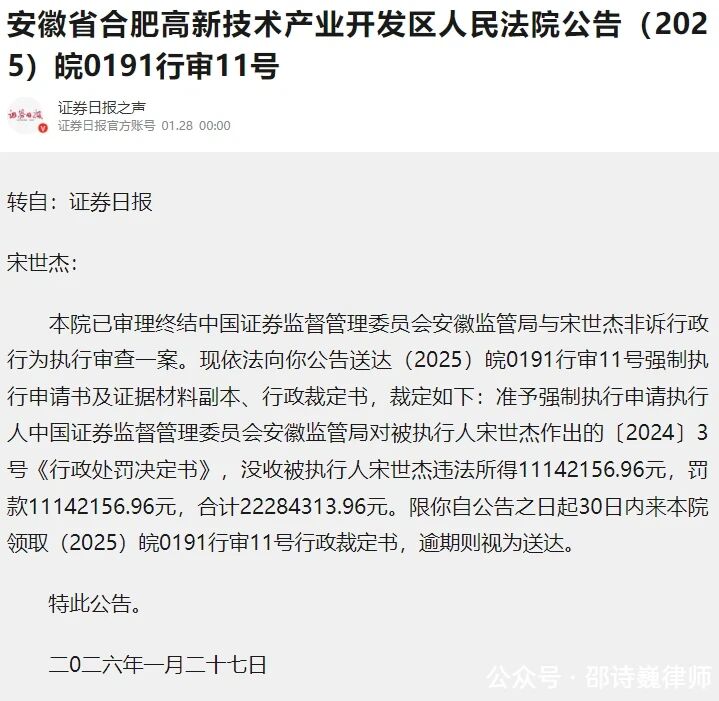
As pointed out by Caixin reports: "The Anhui Securities Regulatory Bureau has desperately tried to contact market manipulator Song Shijie, who owes the treasury RMB 22 million in fines, yet he has surrendered nearly RMB 200 million in assets as a settlement to the UK and the US."
Second Class: Intermediary Facilitators
In addition to the asset holders, those at higher risk include currency exchange companies, underground banks, OTC traders, and overseas property intermediaries who participate in facilitation.
Whether it is for overseas property purchases, fund transfers, or account landing, they often rely on the assistance of these groups.
In their own understanding, they often think they are just "helping to exchange currency," "arranging an account," or "putting funds overseas," seemingly just providing introductions or intermediary services.
However, from the perspective of criminal law risks in mainland China, these groups are most susceptible to charges associated with illegal foreign exchange trading; once the funds they help transfer possess criminal proceeds attributes, they might further face risks related to money laundering and concealing or disguising criminal proceeds.
Because from an enforcement perspective, intermediaries are a crucial link in the entire illegal foreign exchange supply chain.
Third Class: Peripheral Participants
Compared to the first two categories, peripheral participants often underestimate their own risks.
For instance, friends and family helping to divide currency exchanges, provide accounts, collect payments, hold shares, or hold properties may see their actions merely as favors, lending a card, or using a name to hold property.
However, these actions are also an essential component in the entire chain of asset transfer, landing, and concealment.
This group may not initially enter a criminal procedure but could still face various levels of legal risks regarding foreign exchange, money laundering, or illegal operations.
5 Risk Warnings for Those Transferring Funds Abroad
Through these cases, it can be seen that overseas is not the property safe haven many people imagine. In the past, a significant number of people believed that as long as funds were successfully transferred abroad and assets successfully placed under overseas accounts, properties, or other holding structures, risks would disappear.
The misconception here is that they believe that only upon criminal conviction will their property be at risk.
However, the cleverness of the UK's UWO (Unexplained Wealth Order) and civil recovery system lies in its allowance for law enforcement to first "reasonably suspect" the source of wealth and then confiscate these assets through civil procedures, without necessarily first convicting the individual.
This enforcement mechanism, while ostensibly a means of combating money laundering, in practice functions more to control and appropriate valuable assets with unclear sources without the need for a prior criminal conviction.
In the past, Chinese people found ways to get their money out; now the UK is finding ways to keep the money in its own pockets.
免责声明:本文章仅代表作者个人观点,不代表本平台的立场和观点。本文章仅供信息分享,不构成对任何人的任何投资建议。用户与作者之间的任何争议,与本平台无关。如网页中刊载的文章或图片涉及侵权,请提供相关的权利证明和身份证明发送邮件到support@aicoin.com,本平台相关工作人员将会进行核查。


