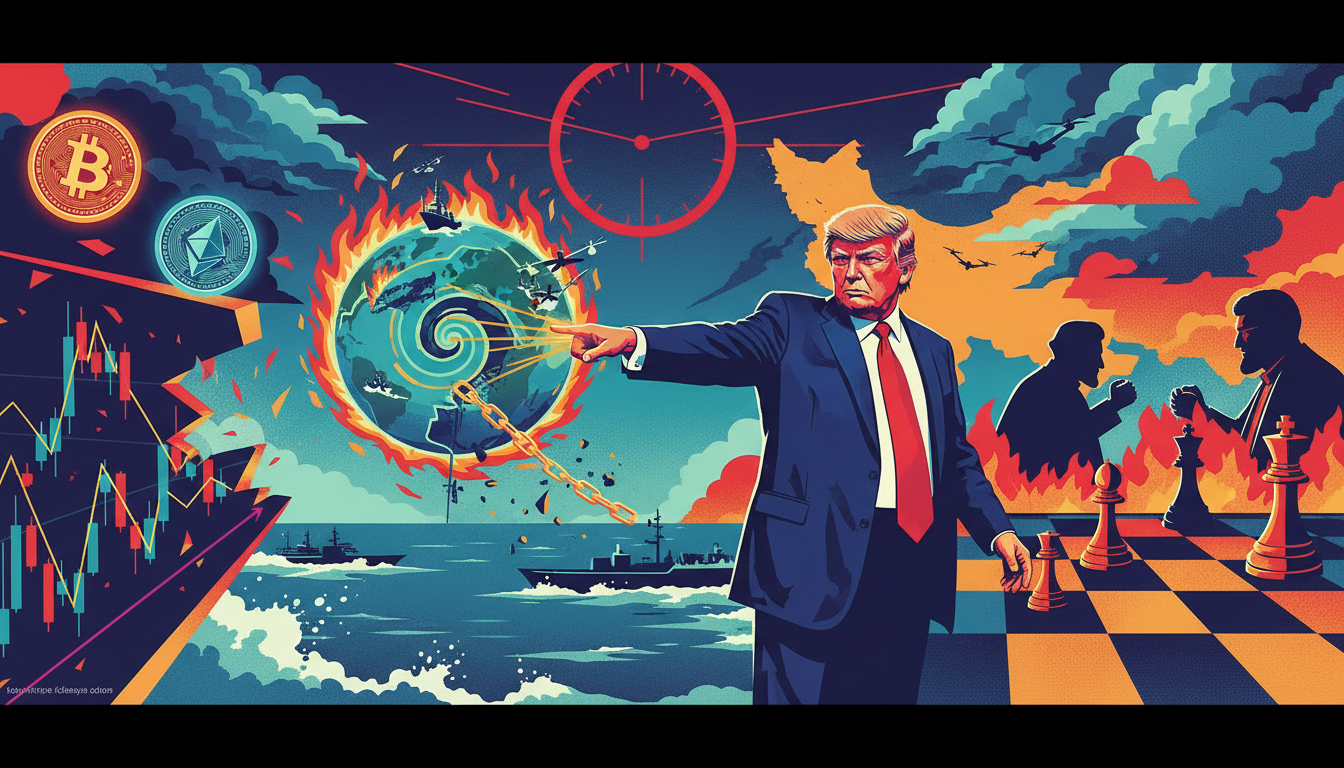
On April 3, 2026, Beijing time, a family member identified as a close female relative of Soleimani and her female descendants was arrested by federal law enforcement personnel in the United States, and her lawful permanent resident status (green card) was terminated. This action took place during the ongoing military confrontation between the U.S. and Iran, which had lasted for 36 days, and amid continued missile and drone exchanges without any sign of de-escalation. It also resonated with the domestic political maneuvers in Washington surrounding economic data and tariff agendas. This arrest intertwines the political chess game between the U.S. and Iran, the boundaries of human rights and the rule of law, and the risks of weaponizing immigration status, forming the main line of this article.
From the Battlefield to Home: The Extension of the U.S.-Iran Conflict
To understand why this arrest provoked strong upheaval in Iranian society, it is necessary to return to the symbolic significance of Soleimani himself. In the narrative constructed by Iran and certain Shia communities, he is portrayed as a "martyr" resisting extremist organizations and external intervention; whereas in Washington, he has been long depicted as a key mastermind of regional armed networks, with his name almost synonymous with the embodiment of the "Iran threat" in the eyes of the American decision-makers. This polarized narrative creates significant emotional tensions for any subsequent actions involving his family.
Over the past 36 days, the military confrontation between the U.S. and Iran has extended from direct firepower exchanges to a multifaceted escalation involving sanctions, financial blockades, and information warfare. The U.S. has continued to impose additional financial and export restrictions, while Iran has reinforced its discourse of the "axis of resistance" in media and diplomatic venues, each side pulling narratives via social networks and international platforms. When battlefield conditions and sanctions fail to immediately alter the opponent's behavior, turning attention to the relatives of "symbolic figures" becomes a more impactful operational path.
This time, the conflict is no longer confined to distant battlefields but has been directly projected onto family members. For Iranian society, the sudden arrest of a relative who has obtained lawful permanent resident status in the U.S., and the termination of her green card, can easily be understood as an extension of the blow to "collective dignity," rather than simply a case of law enforcement. The battlefield has shifted from a front in the Middle East to the "doorstep" of the American immigration system and community blocks, releasing a clear deterrent signal: political confrontation can penetrate borders and reach relatives.
Green Card as a Weapon: Immigration Status Used as Bargaining Chip
On the surface, the action on April 3 was executed by U.S. federal law enforcement personnel—an arrest target who was also stripped of her lawful permanent resident status. In public disclosures, detailed charges, evidence composition, or full indictment text have not yet been revealed, leaving the public only to see the result: a person once accepted by the U.S. immigration system has been rapidly expelled from the "quasi-citizen track." Immigration law provisions are presented as technical tools, but the motives behind them are clearly more than technical considerations.
In the absence of specific details of the charges, leveraging immigration status highlights the high entanglement of so-called "compliance" and political motivations. On one hand, authorities can invoke vague reasons such as national security, immigration fraud, or indirect support for sanctioned targets, claiming that everything is conducted within the legal framework; on the other hand, amid the current U.S.-Iran standoff and domestic electoral maneuvers, choosing to move against a highly symbolic figure's relative carries a distinct political assertion. Legal provisions provide formal legitimacy, while political choices determine "who to target and when to act."
The risk of this practice lies in establishing a highly emblematic precedent for weaponizing immigration policy. ● For other Iranian communities in the U.S., witnessing that even "lawful permanent resident" status can be swiftly revoked in times of political pressure will inevitably generate a strong chilling effect: whether to openly express political positions or maintain contact with domestic friends and family may be reconsidered as potential risk points. ● More broadly, Middle Eastern and other politically sensitive nationals may feel that the safety of their own identities is no longer guaranteed by a set of predictable legal rules, but is subject to fluctuations in the climate of international diplomacy. This uncertainty erodes the long-established image of "rule of law and refuge" that the U.S. has cultivated.
Domestic Votes First: The Unified Narrative of Employment and Tariffs
This arrest also needs to be interpreted within the context of American domestic political discourse. Surrounding the upcoming election cycle, the White House and campaign teams are consistently promoting an economic "report card": approximately 178,000 new jobs, and about a 55% decrease in trade deficit (all figures derived from single-source data), packaged repeatedly as evidence of "making America competitive again." These numbers have yet to be cross-verified against official statistics but have already undergone transformation in the political discourse from "data samples" to "political achievement symbols."
On the same timeline, hardline policies towards Iran, the imposition of tariffs, and economic data are interconnected within the same narrative framework: through external pressure and trade policies, the U.S. not only "won back" in employment and trade but also rebuilt a sense of "power" in security and deterrence. In this context, actions against Soleimani's relatives become more than just diplomatic or security incidents; they naturally fit into the continuous storyline of "confronting Iran and defending American interests," serving as a dramatic footnote that "we are tough not just at the borders and negotiation tables, but also in the judicial and immigration systems."
At the level of political mobilization, such symbolic enforcement provides an emotional outlet for specific voter groups: the complex Middle East situation is simplified into a display of "toughness against hostile regimes," while cold numbers related to employment and trade are imbued with the meaning that "this set of tough policies is working." Soleimani's relatives are thus created as objects for projecting anger and consuming narratives of victory, with their individual rights and situations often subordinated to the logic of the ballot.
Nuclear Program, Ruins, and Threats: The Combination of Hardline Strategies
In a broader security narrative, public statements such as "ending Iran's nuclear program" outline an extreme pressure strategy: through a combination of military deterrence, economic blockade, diplomatic isolation, and legal measures, Iran is compelled to yield on nuclear issues and regional policies. The arrest on April 3 occurred under the shadow of this strategy—it sends the message to Tehran that pressure does not only manifest in nuclear facilities and missile bases, but can also be reflected in the most sensitive symbolic figures and family boundaries.
At the same time, Iran continually emphasizes the costs of war that it has suffered. The Iranian Ministry of Education claims that 763 schools have been destroyed (this number currently comes from a single Iranian source and remains to be verified by more international channels), attempting to shape a tragic narrative of "the entire nation under attack" through specific and heavy losses. This narrative mirrors Washington's emphasis on "containing the nuclear program" and "preventing regional threats": one side highlights its own security demands, while the other emphasizes the destruction of civilian and infrastructure.
In such a high-pressure environment, cases surrounding Soleimani's relatives easily get incorporated into a larger game of bargaining chips regarding nuclear issues and regional security. ● For the U.S., including symbolic figures' family members within sanctions and law enforcement frameworks can be seen as a step towards "escalating pressure and increasing costs," reserving "negotiable chips" for any future negotiations. ● For Iran, such cases can be packaged into its domestic propaganda system, enhancing the victim image of "even the family members are not spared," seeking a moral foothold for its hardline stance in nuclear and security negotiations. Individual destinies are thus torn apart between two grand narratives, becoming highly manipulable symbols.
The Blurred Boundaries of Human Rights and Intimidation: The Dilemma of Allies' Silence
From the vantage of international human rights law and basic ethics, an unavoidable question arises: should relatives be subject to "collective punishment" for political and military actions? If the handling of an individual's immigration status and personal freedom is primarily based on their alleged kinship and symbolic significance, rather than their specific behavior or publicly verifiable evidence, then the distance between such practices and the logic of "collective punishment" becomes ambiguous and dangerous. This is also the core of the current controversy—are law enforcement actions punishing specific illegal behavior, or are they utilizing family relations to create a demonstration of fear?
For Middle Eastern immigrant groups in the U.S. and even broader nationals from third countries, such events further amplify their insecurities and feelings of being sacrificed. On one hand, they are incorporated into the labor force, tax contributions, and community structures of American society; on the other hand, they are constantly worried that, should relations between their country of origin and the U.S. deteriorate, they might suddenly shift from "neighbors and colleagues" to "potential threats" or "political signals." The stability of identity and the assurance of dignity appear particularly fragile in times of geopolitical tension.
For American allies, this presents a dilemma of unavoidable silence. In the U.S.-Iran confrontation, they are often tightly bound to the U.S. in terms of security dependence and economic interests, yet they face dual pressures from domestic public opinion and international agencies in terms of refugee acceptance, human rights discourse, and transnational rule of law commitments. ● If they publicly voice support for such cases, it may be perceived as weakening joint pressure on Iran; ● if they choose to remain silent or acquiesce, it may further erode their moral capital in human rights and refugee policies. In the long term, such dilemmas could reshape the trust foundation for transnational rule of law cooperation and influence future policy responses to war refugees and political asylum applicants.
From One Arrest, to the Next Round of Tool Utilization Upgrades between the U.S. and Iran
In summary, the arrest of Soleimani's relatives and the termination of their green card is not an isolated immigration case, but a complex political symbol arising from the confluence of military confrontation, economic agendas, and nuclear issues: it extends deterrence beyond the battlefield, offers a tough case in the victorious narrative of employment and trade figures, and is framed as a potential bargaining chip in the negotiations over nuclear programs and regional security. In this highly symbolic treatment, individuals are abstracted into "signals," with rights and dignity relegated to secondary positions.
In an environment where human rights disputes and domestic electoral pressures coexist, the outside world needs to seriously assess whether similar practices will be replicated and continuously escalated—expanding from the relatives of symbolic figures to a broader group of expatriates, evolving from isolated cases to a complete "risk list of citizens from politically hostile countries." Once this becomes the norm, the immigration system and legal framework will be further politicized, and the international community's trust in the predictability of the American system will also be eroded.
Several upcoming signals deserve close attention: ● First, whether the U.S. side will publicly disclose more complete legal grounds and procedural details, including specific charges, types of evidence, and spaces for appeal and judicial review, which will determine whether the outside world views this as a "highly sensitive but still law-abiding case" or "political maneuvering cloaked in legal attire"; ● Second, the intensity and rhythm of Iran's diplomatic and public responses, including whether this case will escalate into a premise for bilateral negotiations or be exposed on a large scale in multilateral venues; ● Third, the changes in the positions of U.S. allies regarding joint statements, human rights venues, and refugee policies, which will directly influence whether such practices are isolated, tacitly accepted, or quietly emulated. The next round of U.S.-Iran confrontation may very well be lurking in these seemingly technical yet highly politicized procedural details.
Join our community to discuss and become stronger together!
Official Telegram community: https://t.me/aicoincn
AiCoin Chinese Twitter: https://x.com/AiCoinzh
OKX Welfare Group: https://aicoin.com/link/chat?cid=l61eM4owQ
Binance Welfare Group: https://aicoin.com/link/chat?cid=ynr7d1P6Z
免责声明:本文章仅代表作者个人观点,不代表本平台的立场和观点。本文章仅供信息分享,不构成对任何人的任何投资建议。用户与作者之间的任何争议,与本平台无关。如网页中刊载的文章或图片涉及侵权,请提供相关的权利证明和身份证明发送邮件到support@aicoin.com,本平台相关工作人员将会进行核查。