Cause of the Incident
This document was first released by the user Chaofan Shou on X. The official npm package @anthropic-ai/claude-code version 2.1.88 included a roughly 60MB cli.js.map. This file contained both the file names and the source code contents. Once others obtained it, they could extract the code accordingly. A few hours later, the mirror repository on GitHub had already reached several thousand stars. Anthropic began deleting files and issuing DMCA takedown notices, but the spread could not be stopped.
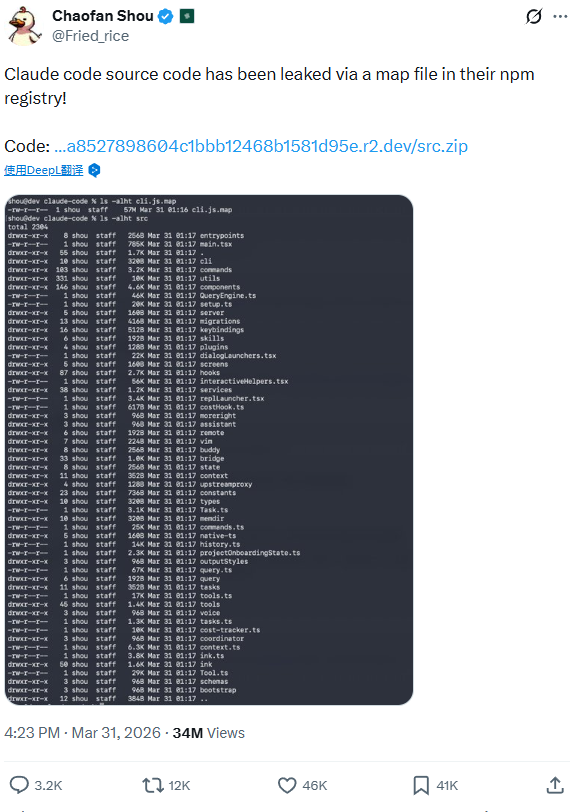
A .map File
The mechanism of this incident is quite simple. A .map file is originally intended for debugging. If it contains the source code as well, anyone who obtains this file can extract the code. There is no complicated reverse engineering process; it was just that the last check before packaging was not done properly, and the code was sent out with the package. It was a very basic mistake.
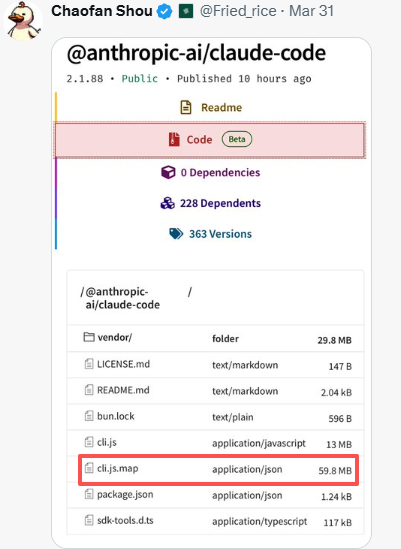
Run Logic Leaked from Claude Code
The number 512,000 lines is indeed large; a whole layer of product implementation was leaked. The materials reveal the content of 4,756 source files, of which 1,906 are code written by Claude Code itself, while the rest mainly comprise external tools and libraries it calls.
Through the code, it can be seen that the interface, execution environment, tools, center, memory, permissions, and editor bridging are all constructed separately. This makes it easier to add tools later, change behaviors, and connect new entry points. The entire system is also easier to expand further.
The interaction and execution parts are deeply binding. When a user types a line in the terminal, it directly receives and processes it, then sends back the result. This iterative process closely aligns with coding. Often while writing code, one tries and modifies continuously, observing and fixing in real-time.
In terms of tool invocation, it forms a complete set of actions. It will first read the file, then modify the code, execute the commands, check the results, and continue to the next step. Thus, it is not just processing a single response but a continuous sequence of operations.
Additionally, when faced with complex tasks, Claude's approach is to split the task among multiple agents and ultimately unify the results for further processing. This way, the context handled by individual agents is lighter. If there is an issue at any step, it is also easier to identify the location.
This is why we can see that Claude Code has now become a truly functional development tool, rather than just a model that fills in text.
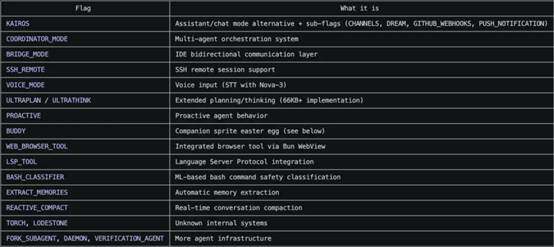
Buddy
This time, the real highlight was a previously unreleased feature—Buddy, featuring rarity and attributes along with electronic pets of 18 species.
It was an April Fool's Day egg this year. Users will see a little companion next to the input box, which blinks, makes small movements, and occasionally pops up speech bubbles. When users input /buddy pet, it will float hearts. If you call its name directly, it will also respond. It does not touch the core code; it simply serves as a companion.
Buddy is not drawn repeatedly from cards. The system takes your user ID, adds a fixed string, hashes it, and then uses a fixed random seed to generate the result. The same user ID can only obtain one, and it cannot be redrawn; what rarity you get purely depends on luck.
There are five tiers of rarity. Common accounts for 60%, uncommon for 25%, rare for 10%, epic for 4%, and the rarest, legendary, at 1%. There are a total of 18 species, including duck, dragon, hexapod dinosaur, capybara, mushroom, robot, snail, turtle, and others. There is no binding relationship between species and rarity; they are two completely independent random draws.
Buddy's eyes and hat have a chance to shine, with a shining rate of 1%. Hats will only appear in non-common tiers, including types such as crown, top hat, propeller hat, halo, wizard hat, knit cap, and duck hat. Like rarity, these appearances are generated together at the start and will not change later.
There are a total of five attributes: DEBUGGING, PATIENCE, CHAOS, WISDOM, SNARK. The system first assigns a base score according to the drawn rarity, then randomly selects a main attribute to raise, and a weak attribute to lower, with the remaining attribute values randomized between the two. The higher the rarity, the higher the overall attributes may be. There is currently no growth mechanism for attributes; they will not upgrade simply because you write code longer or more frequently.
As for whether it will be withdrawn in the future, the leaked code gives us insight. From April 1 to 7 is the warming-up phase, and the opening screen will give Buddy a rainbow alert. The comments are very straightforward, stating that Command stays live forever after; the command will continue to remain, unlike a one-time April Fool's activity.
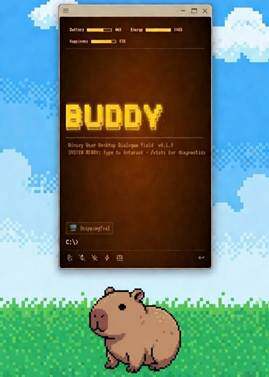
After Buddy was introduced, Claude is no longer just a tool running commands in the terminal. It began to provide a sense of companionship and indicates that Claude may start developing toward long-term presence and continued interaction.
The leak of Claude Code revealed secrets that Anthropic usually hides beneath the interface to the outside world for the first time, helping us understand the core foundation that makes Claude so useful. The incident revolves around the level of agent engineering, primarily surrounding how to connect tools, how to break down tasks, and how multiple agents collaborate. However, as we delve deeper into the code, the questions shift to another dimension: how agents' judgments are recorded long-term, how to continuously verify, how to filter through real results, and how to separate short-term performance from long-term credibility. What NeoSoul aims to achieve is precisely this dimension. Agents are no longer just tools that answer questions; instead, they embed their judgment within a continuous feedback system, result responsibility, and credit accumulation, allowing their capabilities to be compared, filtered, and accumulated over the long term.
免责声明:本文章仅代表作者个人观点,不代表本平台的立场和观点。本文章仅供信息分享,不构成对任何人的任何投资建议。用户与作者之间的任何争议,与本平台无关。如网页中刊载的文章或图片涉及侵权,请提供相关的权利证明和身份证明发送邮件到support@aicoin.com,本平台相关工作人员将会进行核查。


