Original Title: How to WIN the 2026 AI gold rush
Original Author: AI Edge
Translation: Peggy, BlockBeats
Editor's Note: As the question "Will AI replace me?" becomes a common source of anxiety, this article argues that the key is not whether you will be replaced, but whether you are using AI to amplify your own abilities.
The author breaks down opportunities into three paths: career path, income path, and venture path, which essentially involves making choices between different risks and ceilings. Instead of being troubled by "which one to choose", it is better to start quickly and continuously test and adjust through action.
In the AI era, what truly makes a difference is not information, but speed and execution.
Below is the original text:
I spent a lot of effort constructing this article; it is almost something I would recommend my 20-year-old self to read.
This article discusses the three paths to winning in the AI gold rush, as well as how to determine which one belongs to you.
Before diving deeper, I want to give a clear definition of what it means to "win the AI gold rush." If you agree with this definition and want to achieve the results mentioned in the article, I suggest you read the whole piece.
Here, "winning" means: your life has measurably improved because of AI. This can be reflected in higher income, more time, greater choices, stronger job security, and more skills. In short, AI is helping you build the life you want, and your situation will become stronger with the progress of AI, rather than weaker.
But now, most people are unwittingly "trapped" by AI. Their jobs are quietly becoming more susceptible to automation, their skills' value is declining, which is accompanied by a continuous drop in market value.
To avoid being trapped by AI, I propose three different "architect" paths—paths that ordinary people can use to leverage AI to win this gold rush and shape their ideal lives.
Next, I will guide you to understand each path and tell you how to choose the one that suits you. This is valuable for everyone—whether you are an experienced corporate financial analyst or just starting out as a young entrepreneur.
The three paths are:
Path One: Career Path (Career Architect)
Path Two: Income Path (Income Architect)
Path Three: Venture Path (Venture Architect)
Path One: Career Path (Career Architect)
This is a path that most people tend to overlook because it does not sound as exciting as starting an AI startup or going viral on X (Twitter). But in terms of risk-reward ratio, this is currently the highest probability path for the vast majority of people.
The so-called "career enhancer" is someone who utilizes AI to become the most valuable and irreplaceable person in their current company or industry.
They will not resign or pursue side hustles. On the contrary, they invest all their energy in their career, winning from within by using AI to enhance output quality and efficiency.
Who is this path suitable for?
It is most suitable for those who already recognize their industry or career direction and do not want to pivot due to AI. In other words, this group mainly consists of white-collar workers and those in jobs impacted by AI automation (in contrast, blue-collar jobs or those heavily reliant on physical operations, such as healthcare, nursing, etc., remain relatively "safe" in the foreseeable future, so this won't be elaborated here).
What should one do?
In the same company, the differences between career enhancers and others mainly manifest in three aspects:
First, build a "domain-specific" AI workflow.
Career enhancers build customized AI workflows around real company problems and specific processes (SOPs). For example, in my company, those marketers who use AI to automate content research and production processes to generate higher quality content are the ones I am focusing on retaining and promoting; whereas those employees who completely handle these tasks manually are being gradually replaced.
Second, maintain curiosity about AI and continue learning.
To build these workflows, you need sustained interest in AI and a willingness to learn proactively. For example, attending AI courses, listening to lectures, collaborating and communicating with "AI native" colleagues in the company, etc.
Third, possess a basic understanding of technology.
This does not mean you need to become a full-stack engineer.
But you need to master some basic skills, such as: building a simple n8n workflow, using Claude Skills, configuring OpenClaw agent, etc.
If you are already an engineer or in a technical role, then you should further learn AI development tools, such as Claude Code, Codex, etc.
In summary: you need to become the person in the company who truly "creates value using AI".
It should be noted that this path does not guarantee that your position will never be automated. Some roles will disappear regardless.
However, becoming a career enhancer at least allows you to possess two things that others do not:
First, a reason to stay;
Second, the ability to move to a better place even if replaced.
We are entering a new organizational form: a team that originally required 10 people is compressed to 3, and these 3 individuals can achieve the same output by leveraging AI.
The core objective of this path is to increase your chance of becoming one of those "3 individuals".
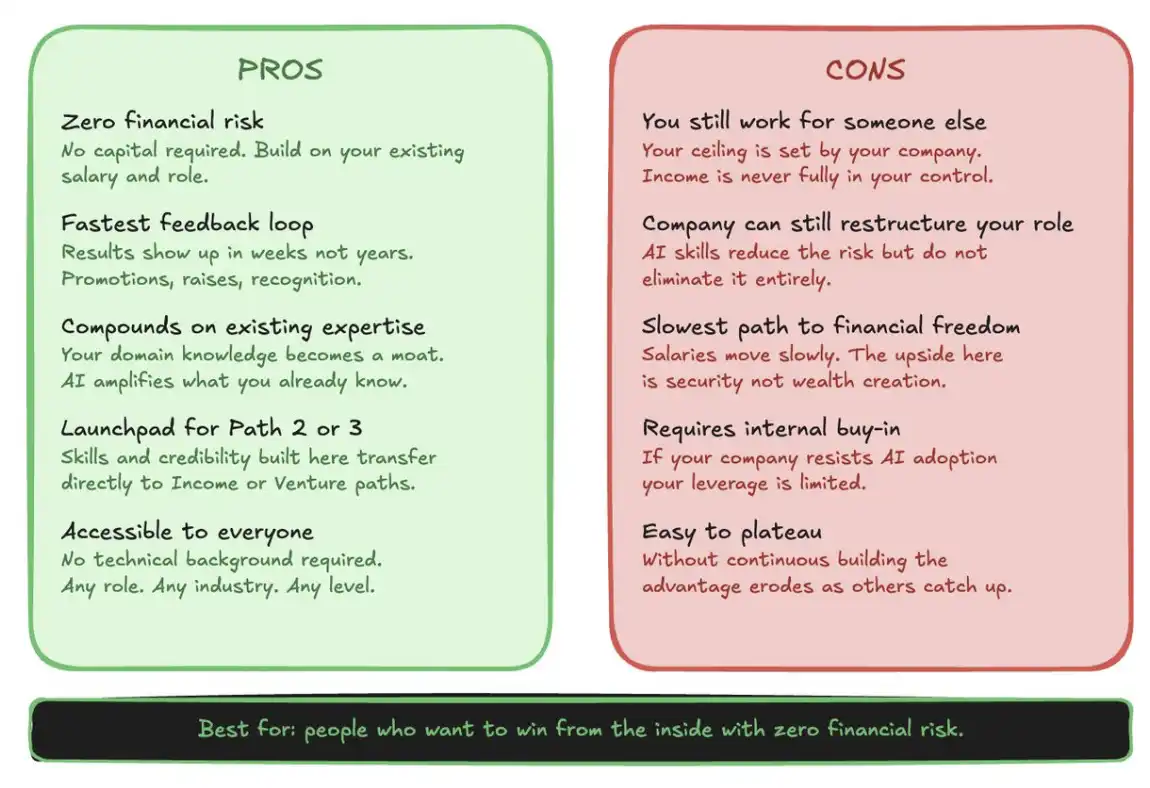
Caption: The benefits and boundaries of the career path This diagram breaks down the "career path" from three dimensions: "risk—reward—control". On one hand, this path requires almost no additional capital investment, has a short feedback cycle, and can generate compounding effects on existing professional abilities, making it the easiest entry point and highest probability for ordinary people; on the other hand, its ceiling is still limited by the company structure, and income and development space are difficult to fully control, while there is also the risk of being replaced by organizational adjustments. Overall, this is a path of "trading stability for increased certainty."
If you believe the "career path" suits you, the following article is worth further reading as it will teach you how to elevate this model to a higher level and truly become irreplaceable in the AI era.

Related Reading: How to be Irreplaceable in the AI Era
Path Two: Income Path (Income Architect)
If "career path" is about winning within a system, then the "income path" is about building an advantage outside of it. This is a type of "individual combat" where individuals create income sources independent of employers through AI.
Who is this path suitable for?
The income path suits those looking for financial independence but do not wish to take on all the risks of the venture path (Path Three).
Its characteristic is that the ceiling is higher than that of the career path, but the risk is lower than that of the venture path, which can be understood as a "middle option" among the three.
More specifically, this path is suitable for those who want to create income outside of their primary job—including university students, young entrepreneurs, or anyone motivated to use AI to build a side business.
It has a lower entry threshold, but if the path is chosen correctly, the ceiling is high. However, the prerequisite is that you need to possess a skill that the market is willing to pay for and scale it through AI.
What can be done?
I'll give you two specific directions:
1. Productized AI Services
Systematize a repeatable skill (like content creation, research analysis, outreach, design, etc.) and build an automated workflow with AI, then sell the output externally.
My suggestion is to start with a niche area, understand the real pain points, and then use AI as a "magnifier" to solve the problems. You could also target local small and medium businesses (SMBs)—competition is usually lower there.
2. Content & Audience Monetization
Build a personal brand around AI capabilities in a specific niche, turning the "audience" itself into an asset. Courses, subscriptions, consulting, and collaboration opportunities will naturally arise from the "distribution capability."
If you pay attention, you will find that this is also the direction most people on X (Twitter) are pursuing. Once you establish distribution capabilities, you will gain numerous opportunities, as well as a high-quality network.
In many cases, just accumulating 1,000–10,000 followers on X is sufficient to secure high-paying AI-related opportunities (consulting, side hustles, etc.).
Trust me, I have seen this with many people around me.
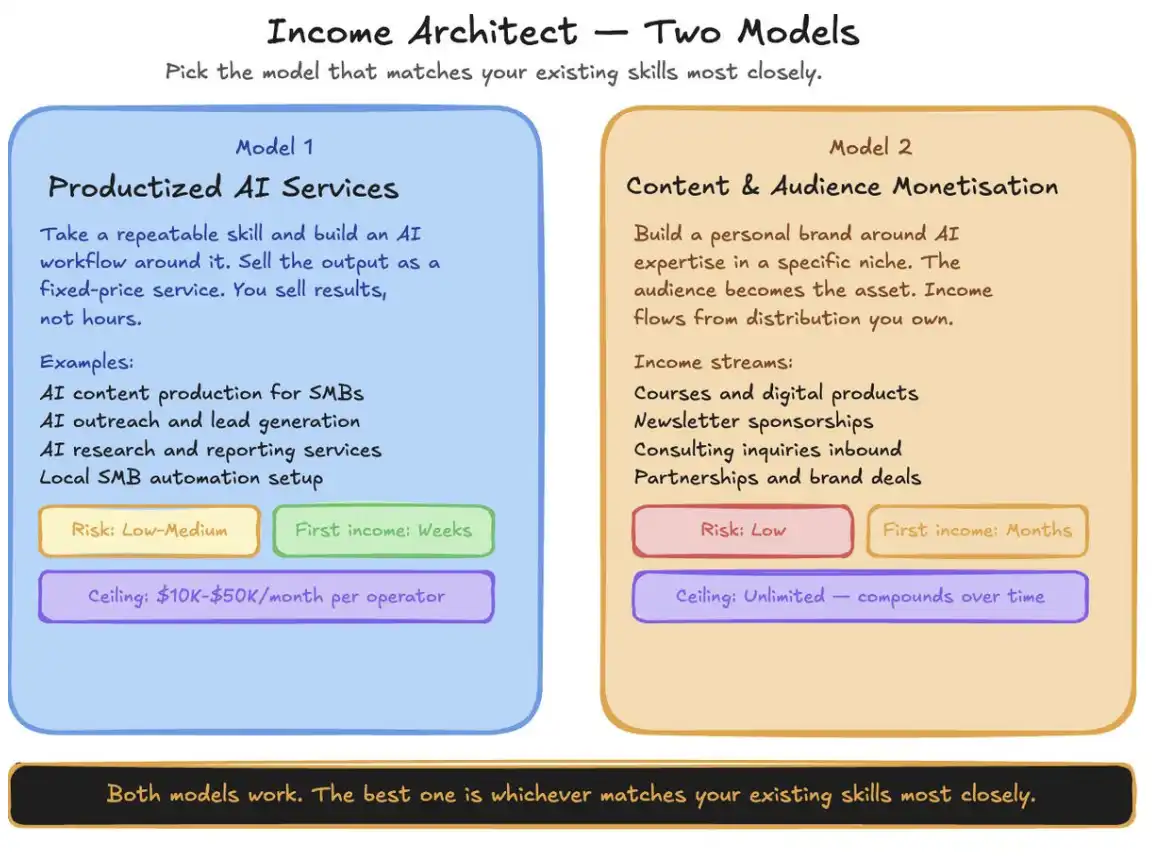
Income Path: Two Typical Models This diagram splits the "income path" into two typical models: one that productizes repeatable skills, amplifying output through AI workflows and directly selling the results, characterized by fast monetization and clear pathways, but with relatively limited income ceilings; the other builds a personal brand around a specific niche, accumulating audiences through content and distribution capabilities, transforming "traffic" into long-term assets, with slower short-term results but higher compounding effects and infinite ceilings. The two models essentially correspond to "selling efficiency" and "building assets": the former is more suitable for those with existing skills who wish to monetize quickly, while the latter is for those willing to invest long-term in building influence and network effects. The ultimate choice depends on individual ability structures and time preferences.
Of course, the business models available here are far more than these two. I have just selected the two most representative types for emphasis.
Next, I will further break down 7 high-income AI skills—if you intend to follow this path, this part is especially worth reading.
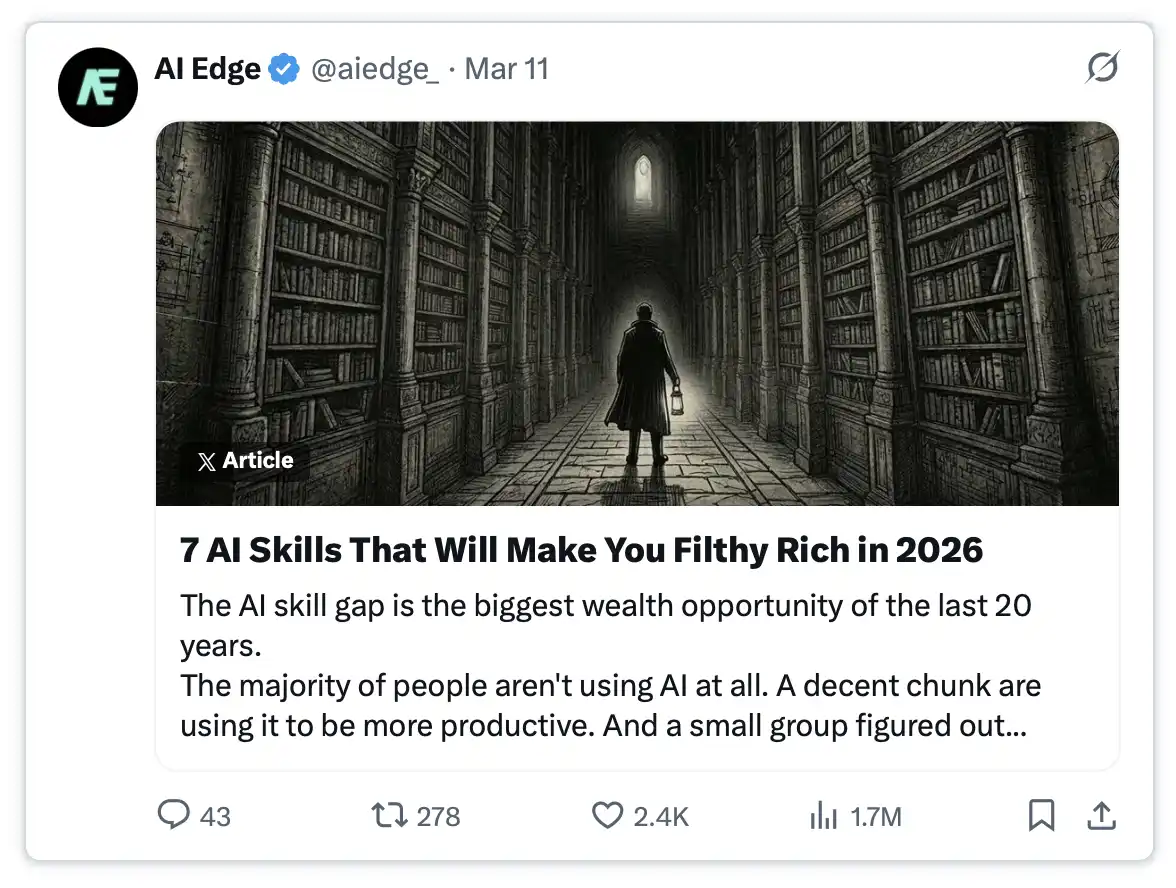
Related Reading: 7 AI Skills That Will Make You Filthy Rich in 2026
Path Three: Venture Path (Venture Architect)
This is the most difficult path, but also has the highest ceiling.
The core of the venture path is to build some scalable asset from scratch—it can be AI native products, tools, service agencies, or even a company. They are not using AI to optimize existing work, nor purely selling services, but leveraging AI to create a business system that can break through individual capability boundaries.
This path is not suitable for everyone. It requires experience, risk tolerance, and the ability to continually advance in the face of uncertainty for a prolonged period—often there is a long accumulation period before seeing real returns.
But for the right people, at the right stage, this may be the strongest wealth creation opportunity of this generation (I personally chose this path).
Who is this path suitable for?
The venture path is most suitable for those who already have experience in successful entrepreneurship and possess certain resource foundations (like capital, networks, teams, etc.).
Excellent "venture path players" are usually not first-time tryers. They often come from the "income path"—having already accumulated skills, reputation, and understanding of the market, and are ready to package these abilities into a scalable product or business.
A very realistic observation is: the entrepreneurs I respect almost all did not start from this path. They often began with path one or path two, achieving some real results first, and ultimately "had to" scale things up.
What can be done?
If this path really suits you, you probably already know what to do.
From what I have seen, the best entrepreneurs mainly focus on three directions:
1. AI Native Tools and Products
Develop software products that did not exist two years ago, fundamentally constructed around AI capabilities. For instance, I have some friends in trading who are developing an AI trading journal tool. They understand industry pain points, know how the product should be designed, and have the ability to execute and distribute.
2. AI-driven Service Agencies (AI Agency)
Build high-ticket service businesses based on AI infrastructure. If set up correctly, an AI agency can operate with far greater efficiency than traditional agencies, serving dozens of clients and achieving profit levels that traditional models find difficult to match.
3. Vertical AI Consulting and Implementation
Deep specialization in a specific industry (such as healthcare, legal, finance, logistics) and the ability to design and implement AI systems for businesses.
A suggestion
At this stage, combinations of the paths often yield better results. For example, my current AI company is involved in both AI distribution and media while also building AI products. These two paths reinforce each other, and most people in the team are also participants in the "career path" (using AI to enhance efficiency within the system).
Essentially, it combines the three paths into one to push the ceiling as high as possible.
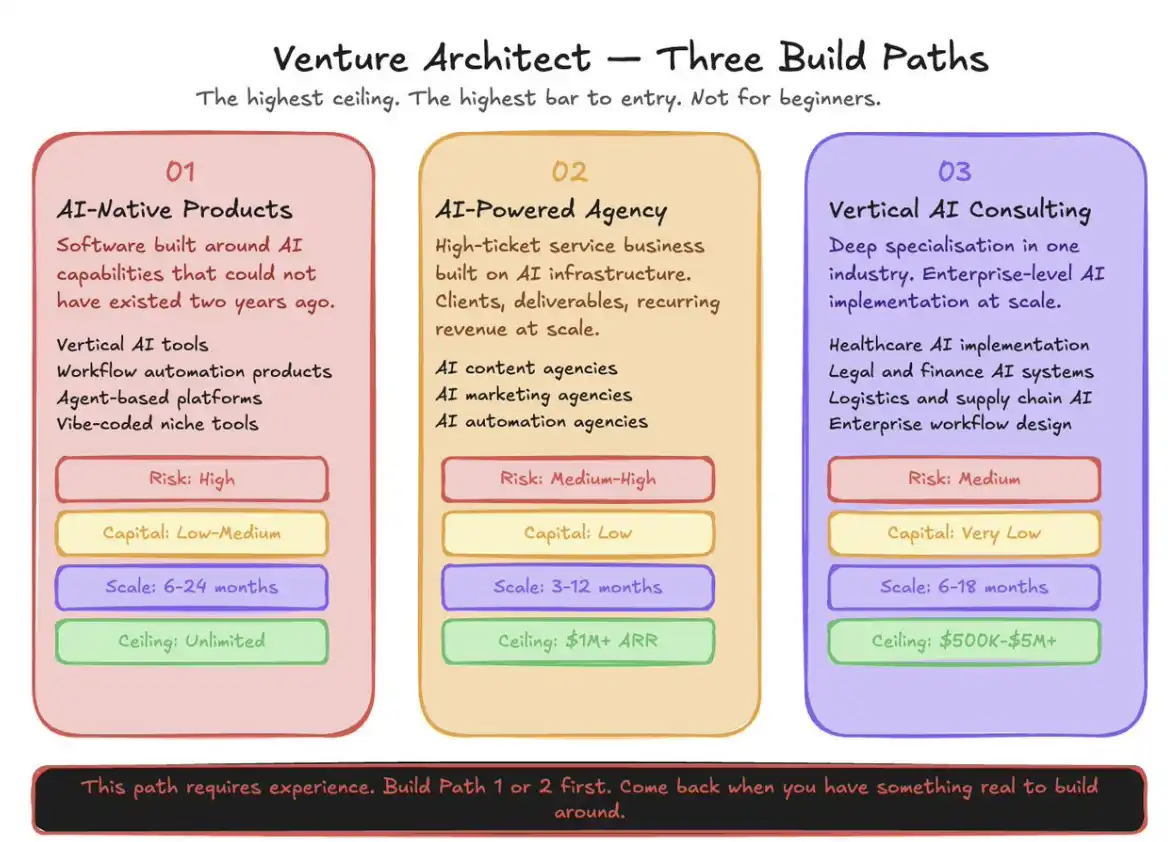
Caption: Three Building Directions of the Venture Path This diagram breaks down the "venture path" into three typical models: AI native products, AI-driven service agencies, and vertical industry AI consulting and implementation. Each corresponds to different ability structures and business logics—the product path emphasizes technology and scalability, with the highest ceiling but greatest risk and longer cycles; the AI Agency targets service through enhanced delivery efficiency and profitability achieved via AI, realizing faster monetization and scale expansion; vertical consulting relies on deep industry expertise and implementation capabilities, with the lowest capital threshold but higher requirements for professional accumulation.
Conclusion
Finally, I want to say that the most common mistake people make is trying to wait for more information, a more refined plan, or greater certainty (not just in AI, but in many matters). However, I believe that this "waiting" itself is a trap.
Those who win in the AI gold rush (or in life) often just start trying earlier—trial and error, failing, then continuously iterating until things work.
If you have finished reading this article, I believe you have a rough idea of which path suits you best. My suggestion is: start taking action from the one that resonates with you the most, and adjust your direction as necessary.
In the AI era, the greatest risk is, unexpectedly, not taking any risks. And "speed" and "initiative" are becoming unprecedentedly important.
免责声明:本文章仅代表作者个人观点,不代表本平台的立场和观点。本文章仅供信息分享,不构成对任何人的任何投资建议。用户与作者之间的任何争议,与本平台无关。如网页中刊载的文章或图片涉及侵权,请提供相关的权利证明和身份证明发送邮件到support@aicoin.com,本平台相关工作人员将会进行核查。


