Written by: Glendon, Techub News
Currently, the United States' focus on the cryptocurrency industry is deepening from the structure of the crypto market to a broader level of infrastructure sovereignty, specifically in the area of cryptocurrency mining.
Not long ago, a staff member for U.S. Senator Thom Tillis revealed that the draft bill concerning the structure of the cryptocurrency market, the “CLARITY Act,” is set to be released this week, mainly including clauses on the benefits and rewards of stablecoins. In response, U.S. Senator Cynthia Lummis stated that the latest revisions to the “CLARITY Act” draft would provide “the strongest protections ever” for DeFi innovators and developers.
For a long time, Cynthia Lummis has been actively promoting several cryptocurrency bills, including those concerning the structure of the cryptocurrency market and cryptocurrency tax reform, and has been committed to institutionalizing Trump's strategic Bitcoin reserve executive order.
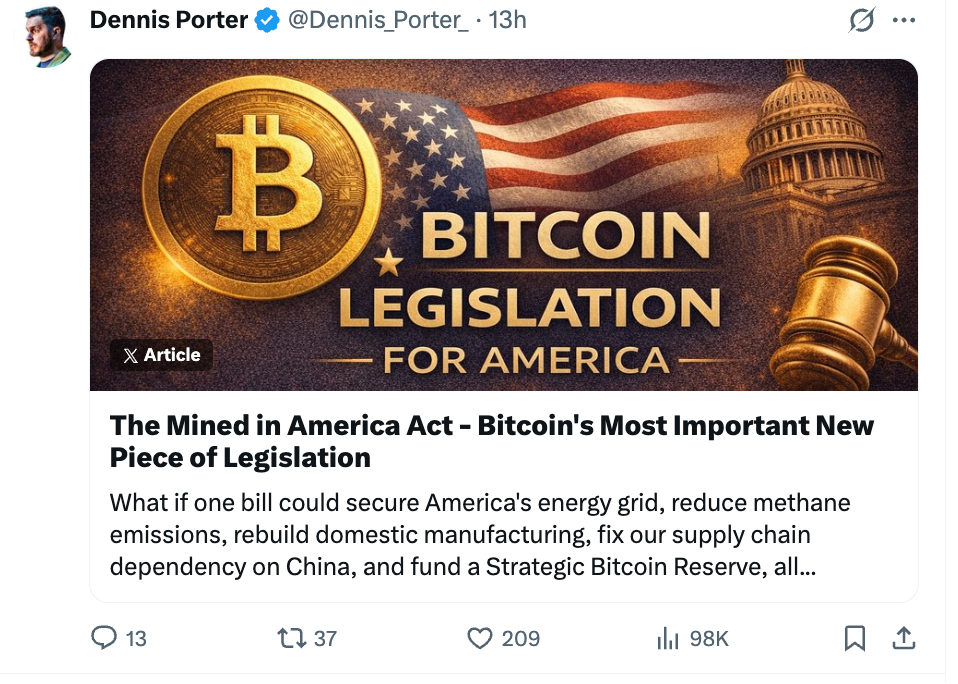
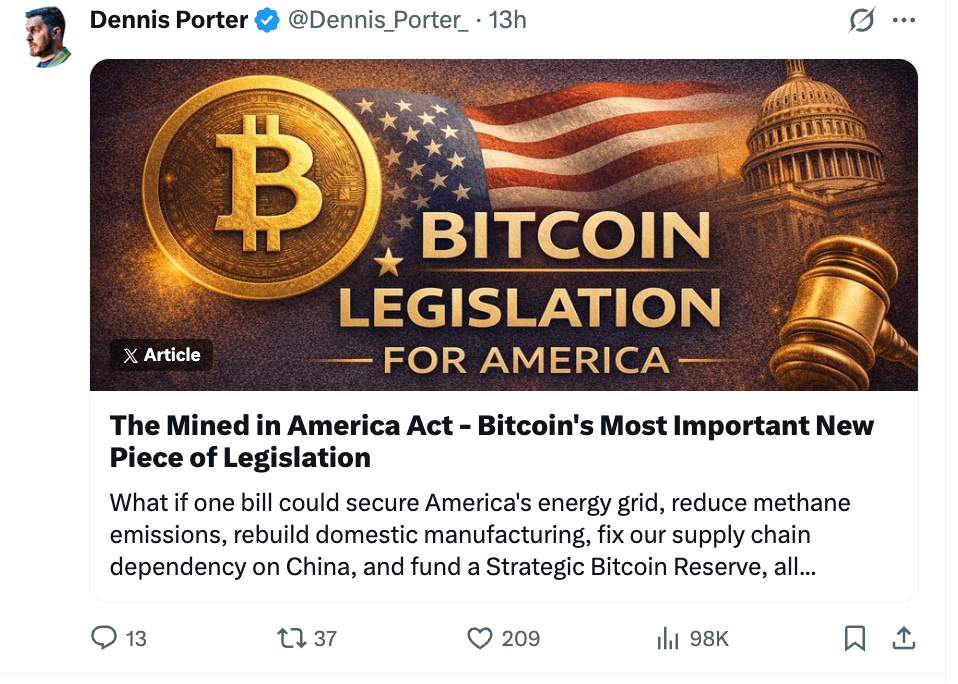
Today, she jointly proposed the "Mined in America Act" with U.S. Senator Bill Cassidy, which has already received support from the Satoshi Action Fund. As a natural extension of Lummis' policy advocacy, this act aims to comprehensively promote the development of the U.S. cryptocurrency mining industry and formally write the establishment of a strategic Bitcoin reserve executive order into the legal system. Lummis emphasized in a press release, “The Mined in America Act will bring the cryptocurrency mining industry back to the U.S. through forward-looking initiatives, ensuring the nation’s financial future.”
The Mined in America Act: A Dual Strategy of "Industry and Finance"
The proposal of the Mined in America Act is not merely a single policy adjustment in the industry, but rather a concentrated embodiment of the U.S. dual strategy of "industry and finance" in the cryptocurrency sector. In terms of industry dimension, Dennis Porter, CEO and co-founder of the Satoshi Action Fund, pointed out the current core pain point of the U.S. cryptocurrency mining industry: a heavy reliance on the hardware supply chain.
Taking Bitcoin as an example, Hashrate Index data shows that the U.S. currently controls about 37.52% of the Bitcoin hash rate, ranking first globally; Russia and China follow with 16.42% and 11.73% of the Bitcoin hash rate, ranking second and third.
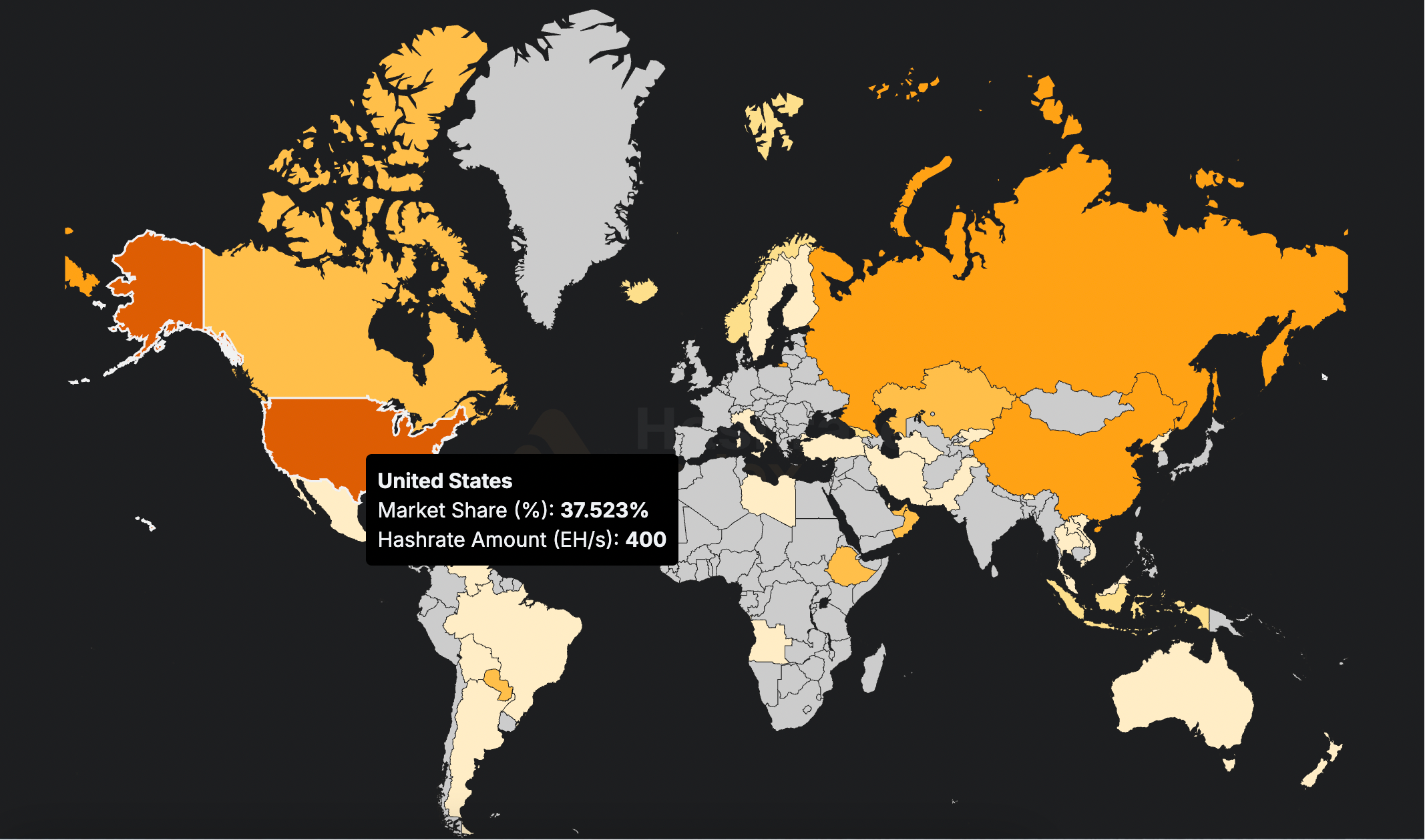
It is worth mentioning that the continued increase in the market share of Bitcoin hash rate in the U.S. is due to the comprehensive ban on Bitcoin mining by the Chinese government in the summer of 2021. This policy shift once triggered a "great escape" of global mining, with a large number of mining machines, technical teams, and capital rapidly transferring to regions with cheap electricity and lenient regulations. The U.S., with its mature grid infrastructure, relatively stable legal environment, and renewable energy resources, became the biggest beneficiary. At that time, its hash rate market share was less than 17%.
However, despite having completed its transformation from an important participant to a global leader, the U.S. still lags clearly behind in terms of basic hardware and supply chains. As Dennis Porter stated, “The U.S. controls 38% of the global Bitcoin hash rate, but 97% of the hardware supporting this hash rate comes from China. This is not a leading position but a burden.” This market pattern of “hash rate in hand, hardware abroad” is undoubtedly a potential risk for the development of the U.S. cryptocurrency mining industry. This risk is increasingly prominent against the backdrop of escalating global geopolitical competition. Should a supply chain disruption occur, the U.S. cryptocurrency mining industry would face a shrinkage crisis, subsequently affecting its influence in the cryptocurrency sector.
In terms of regulation, in March 2023, the U.S. House of Representatives passed a non-binding resolution H.Res.238, which officially recognized proof-of-work (PoW) Bitcoin mining at the federal level for the first time, highlighting its positive value for national energy efficiency, renewable energy utilization, technological innovation, and job creation. Although this resolution lacks legal force, it is the first official document from Congress affirming the economic and technological value of the mining industry, indicating a shift in its stance from “wait and see” to “acceptance,” and releasing a clear policy-friendly signal to the market.
However, aside from that, there are very few bills related to cryptocurrency mining in the U.S. Therefore, the introduction of the Mined in America Act is of great significance as it aims to establish a virtuous cycle through certification systems and policy support, breaking the U.S.'s dependency on the supply chain and promoting the return of mining hardware manufacturing to the U.S.
Specifically, the core content of this act includes four points: First, creating a voluntary “U.S. Mining” certification system: requiring the U.S. Department of Commerce to establish a voluntary certification program for cryptocurrency mining facilities and pools, regulating and managing pools and mining sites; second, phasing out mining hardware associated with “foreign adversaries”: certified mines must gradually eliminate mining equipment produced by companies linked to “foreign adversaries”; third, utilizing existing federal energy and rural programs to support the transformation, integrating certified projects into current federal programs instead of establishing new spending authorizations; fourth, supporting domestic mining hardware manufacturing: directing the National Institute of Standards and Technology and the Manufacturing Extension Partnership to assist U.S. manufacturers in developing safe and energy-efficient cryptocurrency mining equipment.
Therefore, this act attempts to reshape the U.S. mining industry chain from the source, achieving localization of core links such as equipment manufacturing and mining site operations, and constructing a complete closed loop from hardware development to hash rate output. This not only can reduce supply chain risks but also can drive related technological research and manufacturing jobs, creating new economic growth points. Cassidy emphasized, “Digital asset mining is an important part of the U.S. economic system and should be conducted domestically. This act will ensure supply chain security and support U.S. manufacturing.”
From a financial perspective, the core content of this act is to rebuild the cryptocurrency mining industry, but its ultimate goal is to achieve a national-level Bitcoin strategic reserve. As mentioned in the act: formalizing Trump’s Bitcoin strategic reserve plan by establishing a Bitcoin strategic reserve project within the Department of Treasury.
On March 6 last year, Trump officially signed an executive order, authorizing the Treasury for the first time to establish a “strategic Bitcoin reserve,” incorporating approximately 200,000 Bitcoins seized by the Justice Department into national assets. As early as July 2024, Lummis, a long-term supporter of crypto policy, proposed the “Bitcoin Strategic Reserve Act of 2024,” suggesting establishing a national strategic reserve of 1 million Bitcoins over five years at the federal level, aiming to achieve this through annual procurement.
The Mined in America Act can be viewed as a transitional phase in the evolution of this proposal. It aims to institutionalize the Bitcoin reserve system, serving as an elevation of Trump’s executive order, granting it long-term stability and legislative legitimacy to avoid the risk of policy reversal that may arise with future government transitions, and affirming that Bitcoin reserves will become a pillar of the national digital infrastructure strategy, further strengthening the U.S. commitment to becoming a global digital asset center.
Conclusion
Similar to the CLARITY Act, the proposal of the Mined in America Act is another key node in the United States' digital sovereignty strategy. It tightly binds together cryptocurrency mining companies, the hardware supply chain, and national strategic reserves for the first time, aiming to break the structural dependency dilemma of “hash rate in hand, hardware abroad” through legislative intent, pushing the U.S. to transform from passively accommodating global mining flows to actively constructing an independent industrial ecosystem.
At the same time, this act is not an isolated policy initiative but a systematic continuation of Trump’s executive order, aiming to elevate temporary administrative authorization to a long-term national will. Its significance lies not in whether it passes, but in declaring to the global market: the United States is defining the future direction of cryptocurrency through legislative language.
免责声明:本文章仅代表作者个人观点,不代表本平台的立场和观点。本文章仅供信息分享,不构成对任何人的任何投资建议。用户与作者之间的任何争议,与本平台无关。如网页中刊载的文章或图片涉及侵权,请提供相关的权利证明和身份证明发送邮件到support@aicoin.com,本平台相关工作人员将会进行核查。


