Written by: @punk2898
To conclude: Binance and OKX's biggest enemies have never been each other; they may even be mutual beneficiaries.
Recently, Binance and OKX have been competing against each other in various public forums, with people on CT comparing who is stronger and who surpasses whom every day. The BD, operations, and KOLs of both companies are secretly competing. But to say something that might offend—this mutual focus on each other is a classic "competition trap."
You focus on your biggest enemy, and as a result, get stabbed in the back by someone behind you, without knowing where the blood is coming from.
Outline of this article:
Why can't Binance and OKX destroy each other?
Second-tier exchanges: a beast that no one can ignore.
Compliance, a double-edged sword: armor can also be a shackle.
U.S. stock trading—the most terrifying battlefield shift.
Campus, altcoins, Chinese community—slowly cutting flesh.
Conclusion: An enemy's enemy is a friend.
1. Why can't Binance and OKX destroy each other?
Many people have a habitual way of thinking—market share is limited; either Binance will take it all, or OKX will take it all.
This logic sounds correct but is actually completely wrong.
Look at the current situation of these two companies:
Binance has the "endorsement" of the U.S. government (CZ has served time and moved on), and has obtained compliance licenses from more than a dozen countries worldwide.
OKX is no slouch either—European payment licenses, Dubai VASP authorization, Singapore MPI, Australia AUSTRAC, and they have also obtained federal registration licenses in the U.S.
In simple terms, both are now too big to fail.
The only thing that could bring them down is the risk posed by their founders themselves. But currently, CZ is very low-key, and Star is also quietly focusing on products; both are very conservative.
So the conclusion is simple: neither can destroy the other; market shares may fluctuate, but the overall landscape will not change.
So the question arises—if neither can defeat the other, who is eating away at the market share?
2. Second-tier exchanges: a beast that no one can ignore.
The answer lies in those second-tier exchanges that are eyeing the market intensely.
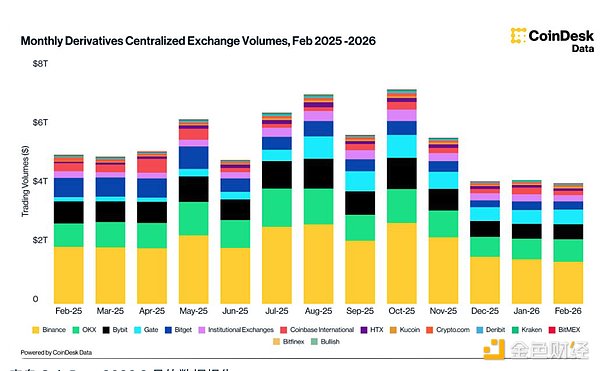
Data report from CoinDest, February 2026
Don't be fooled by their lesser visibility compared to Binance and OKX; each has carved out its niche in specific markets.
Bybit
The strongest among the second-tier in terms of combat power, excelling in refined operations. 70 million registered users, with derivatives trading volume in the global top five. Bybit is very clever, staying low-key on the PR level and quietly getting things done. Look at its contract products, copy trading system, and wealth management products; their iteration speed is even faster than OKX's (which will be explained later).
Bitget
Bitget has found its unique path—U.S. stock trading, and it's all in.
They have officially announced: "We aim to transform into a full-asset exchange," which means trading U.S. stocks. Collaborating with Ondo Global Markets, they have listed a host of tokenized U.S. stocks like Tesla, Nvidia, Apple, Microsoft, and Amazon, available for continuous trading 24 hours a day.
Were you able to trade Tesla on Binance or OKX before? No. If you want the best liquidity for trading tokenized U.S. stocks, you have to go to Bitget.
Why can only they do it?
Two words: compliance.
Binance and OKX dare not touch this area.
Note: However, in the past week or two, Binance and OKX have finally addressed the compliance issues with U.S. stock contracts.
Gate
Gate has a relatively weak presence but has done something that others are reluctant to do—being the first to list all new coins.
For projects that cannot be listed on Binance or OKX, or cannot get on Bybit or Bitget, Gate can list them promptly.
In simple terms, Gate has replaced the position that was once held by Matcha and now has taken over the role of Uniswap in the DeFi era—if you want to grab early Alpha, you have to come to Gate.
Each has its own place.
“But these positions are all slowly cutting into the flesh of Binance and OKX.”
3. Compliance, a double-edged sword: armor can also be a shackle.
Why can second-tier exchanges eat away at the first tier?
Because Binance and OKX chose compliance.
Compliance is armor, allowing them to become too big to fail and giving institutional funds the confidence to come in. But compliance is also a shackle—you want some things, you have to give up a lot of others.
When dealing with Binance and OKX, you will notice a phenomenon:
“For everything, first mention compliance, then mention other things.”
“Can this be done?”—first ask about compliance.
“Can that be pushed?”—first ask about compliance.
“Can new products be launched?”—first ask about compliance.
Compliance has become the top priority. There is nothing wrong with this; it is their foundation.
But the problem is, what compliant exchanges cannot do are often the most profitable activities.
Who is taking these activities? The second-tier exchanges.
Moreover, the more frustrating part is—when issues arise, people do not blame the second-tier exchanges; they still blame Binance and OKX.
Commercial competition is so harsh.
4. U.S. stock trading—the most terrifying battlefield shift.
What is the hottest track in 2026? Anyone can see it—it’s U.S. stocks.
Altcoins are no longer being traded, but the activity remains. Where did everyone go? They went to trade U.S. stocks.
This battlefield is being split between two companies:
Hyperliquid—the king of on-chain derivatives.
With a daily trading volume of $6.35 billion and a weekly trading volume of $15 billion, the number of active traders reached a historical high of 231,000. The market share of on-chain perpetual contracts is 44%, with Aster dropping from 30.3% to 20.9%.
What do these numbers mean? They mean a substantial amount of users, originally meant to trade contracts on Binance and OKX, have moved on-chain.
Bitget—doing the best U.S. stock trading among centralized exchanges.
The positioning of being a "full-asset exchange" is very clever; if you want to trade U.S. stocks in the crypto circle, you have no tokens available anywhere else apart from Bitget, let alone liquidity (now Binance and OKX are beginning to catch up).
Binance and OKX only launched a small number of U.S. stocks in half a day. Why? Compliance, of course.
So how can Binance fight back? There's actually a way—increasing U.S. stock trading in the Binance wallet, with Aster being the largest partner. But if you look at the promotion efforts on the market, they are very weak, not at all like Bitget's loud promotion.
This is a very clear signal: compliance is restricting their actions.
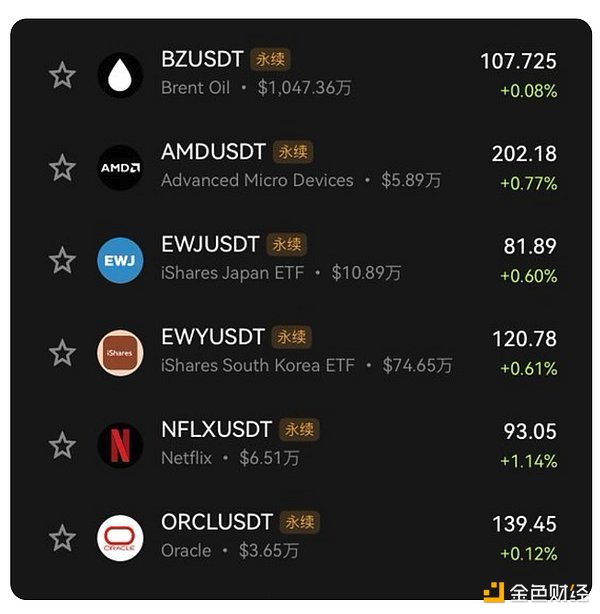
What about OKX? To be honest, they finally secured investment from the parent company of the NYSE and launched some U.S. stock contracts recently, but it is still far from enough, and the trading volume is a bit low, plus they are afraid to promote.
5. Campus, altcoins, Chinese community—slowly cutting flesh.
U.S. stocks are just the largest piece; second-tier exchanges are eating away at much more than this.
Campus ambassadors
I have to criticize this—promoting campus ambassadors to have college students trade crypto is morally wrong. Students generally don’t have much money, and trading digital currencies at this stage has more disadvantages than advantages.
But from a profit perspective? It’s completely correct.
Are you promoting when they are in school, or waiting until after graduation to promote? Clearly, promoting while they are still in school yields a higher ROI. Cultivating habits among young people means that after graduation, they will be lifelong users.
Exchanges like Bybit and Bitget are doing this.
Can Binance and OKX dare to do this? No. If you do it, you’ll be criticized, and compliance won’t allow it either. Thus, these potential new users are gradually being taken away by second-tier exchanges.
Want to win them back? You can only wait until these users mature and then find ways to transfer them to exchanges with better liquidity and security. But that’s a bit difficult; once user habits are formed, they are hard to change.
Listing new altcoins
This is another area that has been eaten away the most.
Fewer and fewer coins can be listed on Binance and OKX, and the auditing process is getting stricter. What if you can’t list them? This share is naturally given to Gate and other second-tier exchanges.
Binance has made a very clever counterattack—Binance Alpha.
By displaying and trading on-chain assets through the wallet, it allows users to be reached without going through the formal listing process. This indeed puts immense pressure on second-tier exchanges.
But what about OKX? Currently, there are no equivalents for counterattacks; they finally secured investment from the NYSE parent company, but there is still no set listing timeline.
Promotion in the Chinese community
OKX and Binance can only go through online channels and cannot boldly promote in the Chinese community. Second-tier exchanges don’t have this worry; they promote and do whatever they want.
All these factors combined make it a slow knife. Each cut is not fatal, but every knife draws blood.
Therefore, over the past year, Binance and OKX have started to value direct promotion again; why? They were driven to it.
6. Conclusion: An enemy's enemy is a friend.
At this point, the logic becomes clear:
Binance and OKX’s paths have been set—compliance, internationalization, and ultimately going public (Binance may independently go public as a U.S. company).
You can think of it as a larger imagined story about Coinbase. Coinbase can only serve U.S. users and lacks international competitiveness. But Binance has global users, and OKX offers the best product experience.
Their future is clear, but the cost is also evident—compliance means giving up.
The things given up—U.S. stocks, rapid listings of altcoins, campus promotions, marketing in gray areas—are all being taken over by second-tier exchanges.
Thus, Binance and OKX's biggest enemies have never been each other.
“The real threat is Bybit's refined operations eating into your contract users, Bitget's U.S. stock trading stealing your active traders, Gate’s rapid coin listings intercepting your Alpha coins, and Hyperliquid's on-chain derivatives bringing your users to the chain.”
And when these second-tier exchanges encounter issues, the public scrutiny still falls on Binance and OKX. If something good happens, it’s theirs; if something bad happens, it’s yours.
This is business warfare; you either survive or perish, with no moral ground.
An enemy's enemy is a friend—rather than focusing on each other, Binance and OKX should consider how to work together to face these challengers who are cutting into their flesh bit by bit.
“When the clam and the snipe contend, it's the fisher who profits.” —《Stratagems of the Warring States: Yan Strategy II》
免责声明:本文章仅代表作者个人观点,不代表本平台的立场和观点。本文章仅供信息分享,不构成对任何人的任何投资建议。用户与作者之间的任何争议,与本平台无关。如网页中刊载的文章或图片涉及侵权,请提供相关的权利证明和身份证明发送邮件到support@aicoin.com,本平台相关工作人员将会进行核查。


