Introduction: From 1887 to the AI Era
In 1887, American railroads received a piece of “good news”: Congress passed the Interstate Commerce Act in an attempt to end the chaos of fragmented state regulation—varied track gauges, fragmented rate systems, and friction in interstate transport were nearly akin to operations across different countries. The business community cheered, but they quickly realized that this was not just about order, but also a reshuffling of the power structure: they no longer had to negotiate with 50 states, but instead faced a single, centralized federal regulator.
A century and a half later, AI companies in Silicon Valley stand at a similar crossroads.
In recent years, fragmented state regulations have imposed high costs on entrepreneurs and provided opportunities for competitors from countries like China to catch up. On March 20, the White House released the National Artificial Intelligence Policy Framework, promising to establish a national uniform standard—at first glance, it appears to reduce burdens, but in essence, this is not a regulatory retreat, but a consolidation of regulatory power. In other words, Washington is not removing its hands from the steering wheel but is instead working to reclaim it: exchanging 50 uneven hands for a larger, more stable, and harder-to-evade hand.
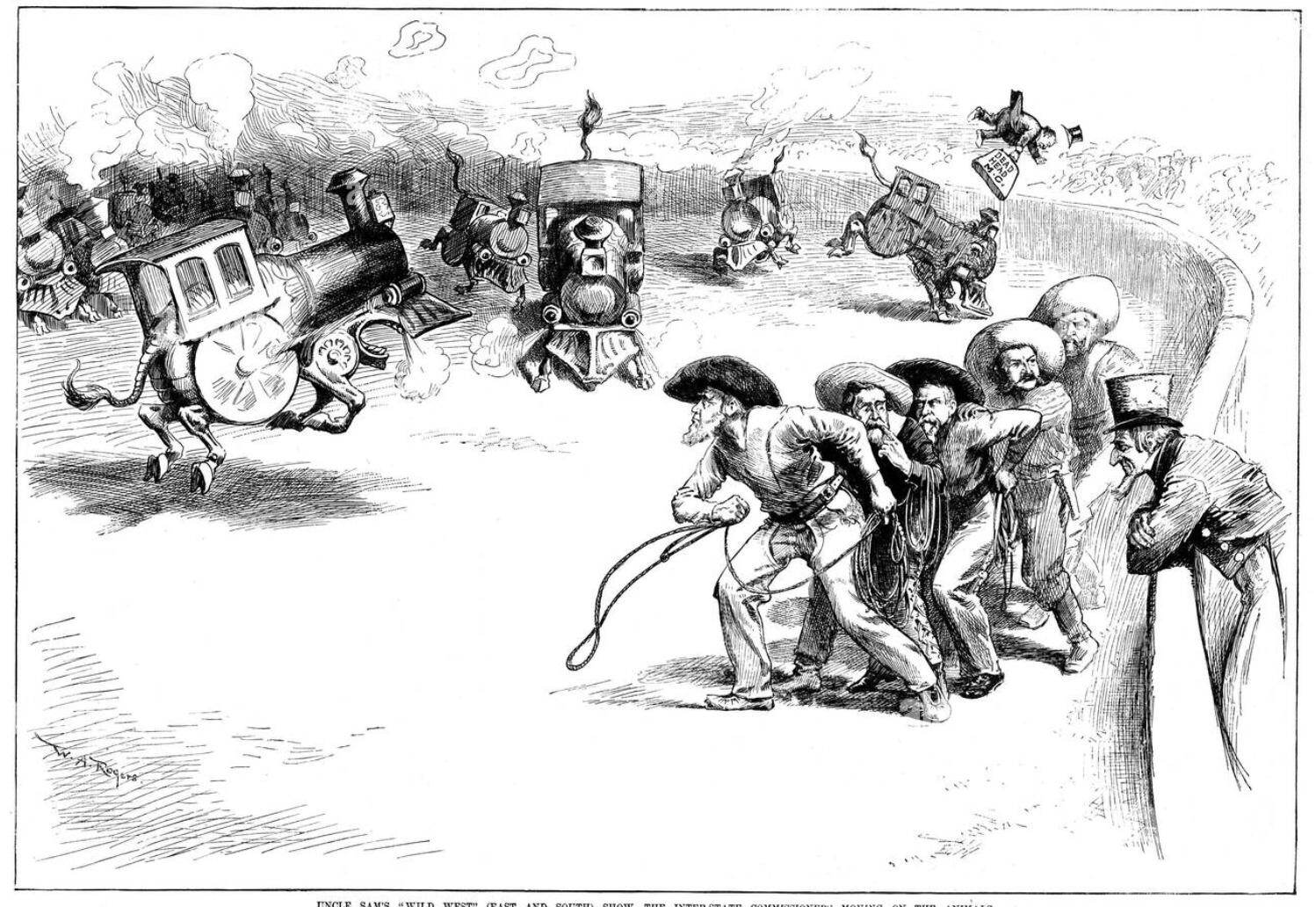
In 1887, American cartoonist W.A. Rogers used satire to depict Congress passing the Interstate Commerce Act and establishing the Interstate Commerce Commission (ICC) to regulate the railroad industry.
1. 50 Laboratories: When Federalism Meets Economies of Scale

“The states are laboratories of democracy”—this saying has been valid in the U.S. for over a century. Minimum wage, healthcare expansion, environmental standards are all tried first at the state level, allowing for local corrections to reduce losses and national replication of successes. Federalism operates well as a distributed innovation system in traditional industries.
But AI is not minimum wage, nor is it chimney emissions. It does not lend itself to “distributed trial and error.”
The core feature of AI is increasing returns to scale: the more data, the larger the market, the broader the iterations, the smarter the models become, the lower the costs, the higher the barriers to entry. In this structure, compliance is no longer merely a cost but evolves into a competitive barrier—small companies bear uncertainty, while large companies bear expenses.
Requesting a startup with ten employees to navigate 50 conflicting state laws is akin to asking it to play chess on 50 boards simultaneously: every move could trigger compliance risks in another state. Industry giants, on the other hand, can absorb auditing and legal costs into their budgets, even productizing compliance processes, which in turn creates entry barriers.
Thus, an counterintuitive result emerges: fragmented regulation in the era of AI will not lead to flourishing diversity but will instead hand the market over to those best able to manage complexity—who are often not the most creative, but the most resourced.
The framework from the White House attempts to sever this logic chain, but its method may be more alarming than the issue itself.
2. The Counterintuitive Truth: This is Not “Less Regulation,” but Reclaiming the Whistle to Washington
The core of this framework is not a specific technology standard but a legal wrench: Federal Preemption.
Simply put, federal law supersedes state law. Congress aims to abolish state-level regulations that “impose undue burdens on AI development” and establish a nationally uniform minimum burden standard. It appears to be a loosening of restrictions: the compliance manuals go from 50 to 1, and entrepreneurs no longer need to repeatedly step on landmines at state borders. But if you zoom out a little, you will find that it resembles a power reclamation: previously, there were 50 states blowing whistles and making judgments separately; now it becomes one entry point, one whistle, and one chief referee.
What’s more subtle is that today’s “light touch” could become tomorrow’s “heavy-handed approach.”
The tension lies in that a unified entry point can both facilitate smoother market operations and centralize control. Today it is packaged as a “light touch framework,” but tomorrow it could become an institutional pathway that any administration can “snatch back”—because the switch has already been installed; it just depends on who flicks it.
Historically, this script is not unfamiliar. By the end of the 19th century, the railroad industry fell into chaos under fragmented interstate regulation: rate discrimination, differential pricing for long and short hauls, and inefficient interstate transport. Congress passed the Interstate Commerce Act of 1887, establishing the Interstate Commerce Commission (ICC) as a means to consolidate regulatory powers at the federal level. Railroad companies initially welcomed this: finally, they did not have to tussle with individual states. They soon discovered they faced a stronger, more enduring, and less easily circumvented regulatory opponent.
The AI industry stands at a similar crossroads. You can view it as a relief or as the establishment of a “unified entry.” Once the entry is established, who guards it, how it is guarded, and how strictly it is guarded will no longer be determined by you.
3. Six Keys: Who Benefits, Who is Limited?
The White House distilled this line of thinking into six directions. They do not resemble a thick legal code, but rather a set of keys for opening doors—each determining who can enter more smoothly and who may face obstacles.
Federal Uniformity and State Law Preemption
Compliance manuals reduced from 50 to 1 is an immediate benefit for cross-state products. However, at the same time, your fate is more deeply tied to Congress and the federal political cycle: national uniformity means national synchronous swings. You no longer have the option of “trying another state.”
Child Protection
Requiring platforms to add age verification mechanisms is one of the few areas where bipartisan consensus can be reached. But it also clearly places the costs on consumer-facing products—especially on teams involved in B2C applications, education, and social media; compliance budgets will immediately thicken. Age verification is not a technical challenge, but a responsibility challenge: once there is an error, who takes responsibility?
Energy Cost Protection
Data centers may not pass electric fees onto residents, which sounds “friendly to the public,” but is a hard constraint for infrastructure-level businesses. Electricity, site selection, peak-load management, and contracts with local utilities all resemble regulatory rather than engineering issues. The subtext of this rule is: you can build data centers, but do not let the residents' electric bills increase.
Intellectual Property
The White House tends to view “training AI with copyrighted content as not unlawful," but acknowledges contrary views exist and leaves critical judgments to the courts. In translation: the gray area continues to exist, and the risks have not vanished; they are merely postponed to litigation and case law resolution—where the timeline for case law typically spans “years.” For entrepreneurs, this means you can continue to train models with data but must be prepared to face lawsuits at any time. What you can often do is risk management, not risk elimination.
Freedom of Speech
Prohibiting AI from censoring lawful political expression draws a red line for content moderation. For platforms, this is both a constraint and a protection: you find it harder to “proactively filter,” yet easier to use rules as a shield under political pressure. But where is the boundary for “lawful political expression?” Who defines it? This is another question left for the courts.
Labor and Education
Expanding AI skills training aims to transform social pressure into retraining programs. It does not directly resolve distribution conflicts, but at least acknowledges their existence and attempts to shorten the shock waves with policy. But can training keep pace with the speed of replacement? Historical experience does not inspire optimism.
The most “intelligent” aspect of this framework is that it deliberately does not establish a dedicated federal AI regulatory body: instead, it relies on existing laws, courts, and market self-discipline to operate—lightweight, swift, and with minimal political resistance.
However, this also results in a lack of a “dedicated safety net”: once the mechanism fails, there is no specialized agency to provide unified interpretation, quick rectification, and continuous iteration; the costs of errors might manifest as litigation, industry paralysis, or sudden policy reversals.
4. Three Global Paths: Choices of the EU, China, and the U.S.
Placing this U.S. framework into a global context clarifies that AI governance is diverging into three institutional paths.
EU: Safety First
The AI Act classifies systems by risk, with high-risk systems requiring rigorous certification. The result is higher public trust, but innovation speed and entrepreneurial flexibility are often compressed, especially unfriendly to resource-poor teams. The EU chooses to “build guardrails first, then let the vehicles run.”
China: State-Led
Resource concentration and rapid advancement can create synergy in infrastructure, data organization, and industry mobilization; however, transparency, diversity, and certain debatable boundaries may be smaller. China chooses “the state commands, the industry follows.”
U.S.: Scale First
This framework bets that a combination of “unified market + court cases + market self-discipline” can continue to attract computing power, capital, and talent. As White House AI and Crypto Affairs Special Advisor David Sacks stated, 50 sets of uncoordinated state regulations are eroding America's leading position in the AI race—especially fragile before economies of scale: if you are just a bit behind, you may never catch up.
No path is absolutely right or wrong; they simply embody different risk structures:
- If the EU fails, it may lose part of its industry, but it would enjoy higher social stability;
- If China fails, it may create an “island effect” in computing power and ecology, but its internal mobilization ability would be stronger;
- If the U.S. fails, the cost will be more “nationally synchronized”—because it actively unified the rules. If the direction is wrong, the costs of correction will be higher.
More crucially, these three paths are mutually shaping. The EU's stringent standards will push American companies to enhance compliance levels when exporting; China's state investment will accelerate technological iterations; and America's market scale will continue to attract global talent. The ultimate competition is not “whose rules are better,” but “whose rules allow the industry to run faster, more steadily, and more durably.”
5. The Real Implications for Entrepreneurs: A Window, or a New Fence?
For entrepreneurs currently in the AI industry, short-term signals are likely positive: compliance costs are decreasing, cross-state deployment is becoming more predictable, and financing narratives are smoother—“we no longer need to prepare 50 compliance plans for 50 states,” in itself, allows business plans to resemble those of a company rather than a legal exam.
However, this positivity is accompanied by three unanswered questions:
- Is the Congressional timetable reliable?
The political agenda is always crowded. AI is hot, but legislation is slow. The implementation of federal preemption requires sufficient consensus and timing, and that window is not always open. More troubling is that the legislative process itself may introduce new variables: amendments, additional provisions, lobbying by interest groups—the final version may be far from the White House framework.
- Can federal standards maintain a “light touch” long-term?
Today's promises are not constitutional firewalls. The other side of centralization is stronger reversibility: a new administration or a new committee can turn light touch into heavy pressure. And once federal preemption is established, you no longer have the option of “trying another state.”
- When will the gray area of intellectual property close?
Court rulings may take years. In the meantime, “the legality of training data” remains a variable hanging over products and financing. You can continue to train models with data, but also need to be ready to face lawsuits at any time. Investors will ask: if the rulings are unfavorable, is your moat still there?
Entrepreneurs gain a wider door, but there are still several invisible crossbeams behind it. You can run faster, but must also be ready to hit the brakes at any moment.
6. The Final Question: Closing Laboratories, Opening Factories
The era of “50 laboratories” is coming to a close. Back then, each state was a narrow door: entrepreneurs could find gaps, trial and error, and accumulate experience between states, but it was low efficiency, and the market was fragmented.
Now, Washington wants to build a “national-level AI factory”—more efficient, clearer rules, and unified standards across the country. This is a wide door: you can enter more quickly, deploy more easily across states, reduce friction, expand the market, making products truly deployable across state lines with one click.
Though the door is open, the key and switch are all in Washington's hands. You can walk in, but whether you can pass smoothly depends entirely on when they turn the lock.
The real question is not “is federal regulation good or bad,” but: when the U.S. chooses “the market is smarter than regulation,” who defines the moment of market failure?
Before that moment, the window is open;
After that moment, new laboratories—perhaps there is only this factory left.
And the key to that laboratory is not in your hands, nor in the hands of the 50 states—it's in Washington.
This is not just regulation. This is consolidation.
免责声明:本文章仅代表作者个人观点,不代表本平台的立场和观点。本文章仅供信息分享,不构成对任何人的任何投资建议。用户与作者之间的任何争议,与本平台无关。如网页中刊载的文章或图片涉及侵权,请提供相关的权利证明和身份证明发送邮件到support@aicoin.com,本平台相关工作人员将会进行核查。


