As of March 30, 2026, Beijing time, the market witnessed two notable signals of funding and business expansion on the same day: on one hand, an on-chain whale, who already held over 130,000 ETH and was under a high-leverage background with over $142.3 million in loans, again utilized about $10 million to buy ETH at a low point; on the other hand, Walmart's payment tool OnePay expanded its services within a few months from supporting only BTC and ETH to covering more than a dozen tokens, including SUI, Polygon, and Arbitrum. This simultaneous resonance of "whales leveraging bets on mainstream assets" and "traditional retail giants intensifying multi-chain entry" prompted the market to reassess ETH's relative position in mainstream assets and the penetration speed of multi-chain assets in payment and financial management scenarios. This article will follow two main lines of the whale's funding behavior and institutional layout expansion to outline their potential impact boundaries on ETH pricing and overall market sentiment, rather than providing simple buy or sell conclusions.
Whale's High-Leverage Betting on ETH with a $10 Million Bottom Fishing
According to the on-chain data tool Onchain Lens, a whale with an address starting with 0x54d2 purchased 5,039 ETH in a single transaction on March 30, valued at about $10 million at the time. It is important to emphasize that this increase in holdings primarily comes from a single data source; although it has been reported by multiple news outlets, it should still be considered a metric that needs ongoing tracking and verification in rigorous analyses. Nevertheless, such a substantial single purchase, combined with existing holdings at that address, significantly disturbed short-term market sentiment.
According to multiple reports from 律动 and 星球日报, this address currently holds approximately 138,234 ETH, valued around $27.4 million based on the day's market value, while also bearing about $142.3 million in loans. In the absence of more detailed leverage ratios and collateral structure, merely looking at the absolute scale of assets and liabilities, this address is clearly in a typical high-leverage operational state. The holding volume corresponds to about 0.1% of an estimated 120 million ETH circulation, which already constitutes a certain "quasi-institutional level" scale for an individual.
On this basis, the whale's decision to continue expanding its ETH position under high loan pressure leads to two polar interpretations regarding its risk preference and time perspective: some view it as a strong bet on medium to long-term prices, while others worry that if ETH prices see a deep pullback, closing related positions and deleveraging might amplify volatility. Due to considerations of information boundaries, this article does not extend to deducing the whale's activities on March 23, nor other related on-chain address actions, focusing instead on the existing data reported by multiple sources to avoid over-interpretation of its strategic pathway without supporting evidence.
Walmart's OnePay Intensifying Multi-Chain and Multi-Asset Layout
At the same time the whale increased its ETH position, the asset support range of the payment and financial management entry OnePay also quietly expanded. According to reports from Brief and others, when OnePay launched in January 2026, it supported only two mainstream assets, BTC and ETH, and by March 30, the media reported that it had expanded to include over twelve tokens, including SUI, Polygon, and Arbitrum. It is worth noting that details regarding the "total number of new tokens and specific varieties" primarily come from a single media source, so it should be viewed as information "pending further verification" rather than an authoritative and fully confirmed list of facts.
Despite the lack of more comprehensive official disclosures, this expansion path still carries a clear directional signal: traditional retail giants are extending their support scope from a single mainstream asset to a multi-chain and multi-ecosystem asset portfolio through their payment and financial management tools, reflecting that their penetration into the crypto ecosystem is transitioning from "testing mainstream coins" to "embracing multi-chain scenarios." Whether it's the added SUI or public chain tokens like Polygon and Arbitrum, all point to richer narratives in technology and applications, helping to integrate potential synergies between payment entries and fields like DeFi and L2 into the same narrative framework.
In the absence of a specific timeline for new token launch, user revenue flow, and contribution data, any fine estimates of OnePay's business scale are difficult to maintain rigor. Thus, the analysis should focus on trends rather than numbers. What can be relatively certain is that when traditional retail giants are willing to expand multi-asset support under regulatory compliance, their acceptance of crypto assets as an "asset class that can be integrated into everyday payment and financial management tools" is increasing, and this attitude itself will support the market's expectations for medium to long-term penetration rates.
Combined Signals of Big Holders and Institutions Intensifying Multi-Chain Demand
From a timing perspective, the whale's concentrated increase in ETH and OnePay's expansion to public chain tokens like SUI, Polygon, and Arbitrum show a certain overlap around March 30, which reinforces the market's association with "increased demand for multi-chain assets." 星球日报 cited analyst views highlighting that this increase signals the whale's strong confidence in the medium to long-term value of ETH; while panews argued that OnePay's multi-token expansion represents traditional retail giants continuing to intensify their engagement in the crypto ecosystem, both shaping bets in the same direction from the aspects of "high-leverage big holders" and "mass-oriented entry points."
On one side is a high-leverage big holder with 138,234 ETH holdings and $142.3 million in loans betting on ETH in mainstream assets; on the other side, the payment entry has added tokens like SUI, Polygon, and Arbitrum to its list of supported assets, expanding multi-asset services for everyday users. Although the two types of funding and business behaviors are structurally very different, they collectively enhance market imagination regarding the "continuing increase in crypto asset penetration": the former relates to price elasticity and the amplification of capital leverage, while the latter points to the expansion of usage scenarios and enhancement of asset accessibility.
In sharp contrast to this whale is the report that Machi Big Brother sustained an estimated $31.3 million loss (from a single source) during the same period, offering a distinctly different sample of a big holder. The former opted to increase its position and amplify bets on ETH under pressure, while the latter passively endured unrealized losses. This difference helps the market observe the choices made by various risk-centric funds during the same phase more clearly. It should be noted that the loss data related to Machi also has limited information sources and should be regarded as a reference for risk samples rather than used to deduce its complete strategic structure.
Bitcoin's Push Towards $67,000 and ETH's Relative Price Considerations
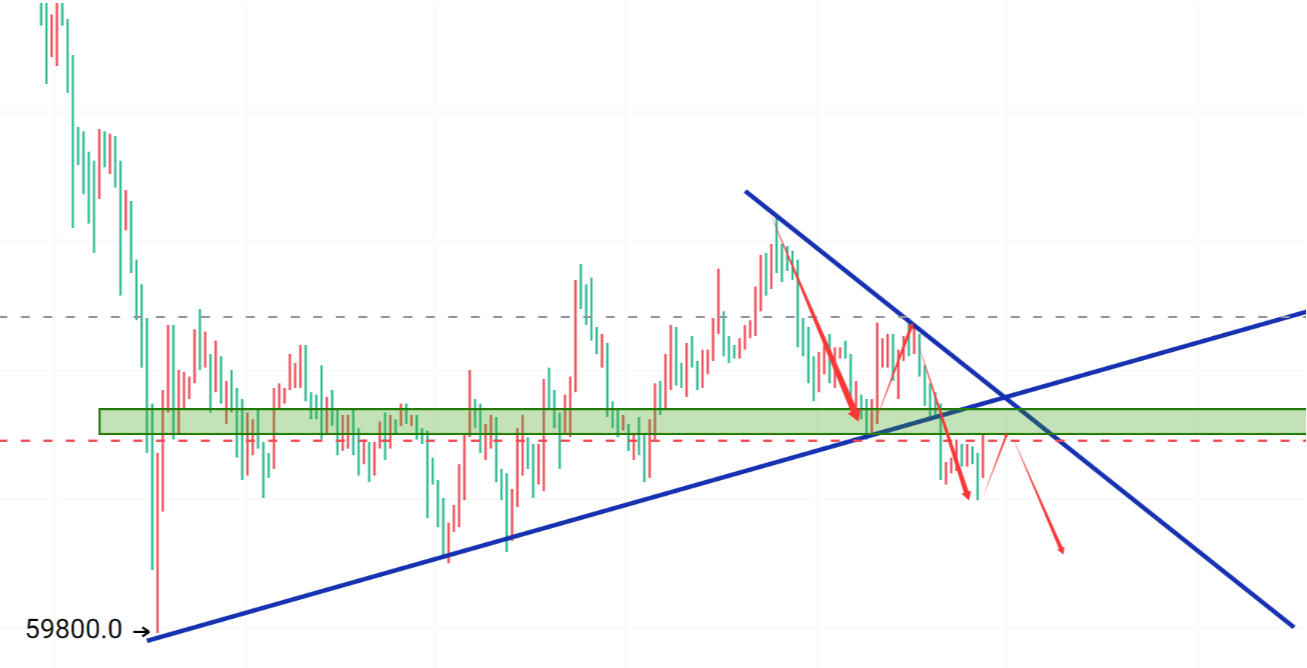
According to quotes from HTX and OKX, Bitcoin traded in a range roughly between $66,935 and $67,044 on March 30, nearing and attempting to break the crucial integer level of $67,000. In such a pricing environment, many big holders would evaluate whether to rebalance positions: when BTC reaches a new high, some funds tend to lock in part of the gains or find assets that have not yet fully reflected their expectations within mainstream assets.
Notably, as BTC approaches its near-term peak, this whale chose to increase its holdings in ETH instead of continuing to chase BTC, which may reflect its judgment on “cost-effectiveness and elasticity” within mainstream assets: on one hand, ETH, in terms of market cap and liquidity, is second only to BTC, making it a fairly typical mainstream asset; on the other hand, amid expectations driven by L2 expansion, ecological applications, and potential narratives, some funds may believe that ETH still holds a greater relative upside compared to the current stage of BTC. Of course, this interpretation is more of a cautious speculation derived from asset allocation logic and should not be perceived as a definitive description of the true intentions of a single address.
Historically, the market often shifts funds towards ETH and some public chain ecosystems during strong stages of BTC. This recent increase in holdings could be seen as one of the potential precursors to ETH's relative strength going forward, but this judgment needs to be continuously validated alongside subsequent price movements, on-chain activity, and funding inflow data. Due to the lack of multi-source data on this address's position changes over a longer period, this article only cautiously associates the day’s pricing environment and single transaction behavior, avoiding the extrapolation of a one-time action into a systemic strategy.
Signal Interpretation of High-Leverage Gambling and Retail Entry Expansion Running Parallel
Overall, on one hand, there is a whale under a $142.3 million loan that is substantially increasing its holdings in ETH under high leverage; on the other hand, OnePay is rapidly expanding its services to multi-chain tokens like SUI, Polygon, and Arbitrum. Together, they form a dual signal from both the "big holder funding end" and the "retail entry end." One side highlights high confidence in price elasticity and future returns, while the other illustrates the traditional retail system's continuous development of the availability of crypto assets, amplifying positive expectations while also bringing the leverage risks and business execution risks into focus.
Future dimensions that need to be closely monitored include at least three points: first, whether the whale's loan health and liquidation safety boundaries have changed, and whether there are any temporary reductions in positions or deleveraging actions due to ETH price fluctuations, thus determining if it leans more toward "medium to long-term layout" or "short-term speculation"; second, whether ETH’s performance relative to BTC and other public chain assets can verify if this increase in holdings tapped into a relative advantage phase over a period; third, if market volatility amplifies, any passive adjustments to high-leverage positions might have secondary impacts on prices.
In the absence of public operational data from OnePay, whether its newly added tokens can actually translate into on-chain activity and substantial funding inflows will still need time to validate. In the short term, the addition of more support means "potential capability" rather than established transaction and payment volumes. For investors, a more reasonable approach is to consider these phenomena as samples for observing the risk preferences of big holders and the penetration paths of traditional retail in crypto, rather than simple buy or sell directives. During this phase of incomplete information transparency, maintaining a cautious assessment of data sources, leverage structures, and business rollout rhythms is even more critical than merely following "big movements" themselves.
Join our community to discuss and become stronger together!
Official Telegram community: https://t.me/aicoincn
AiCoin Chinese Twitter: https://x.com/AiCoinzh
OKX Welfare Group: https://aicoin.com/link/chat?cid=l61eM4owQ
Binance Welfare Group: https://aicoin.com/link/chat?cid=ynr7d1P6Z
免责声明:本文章仅代表作者个人观点,不代表本平台的立场和观点。本文章仅供信息分享,不构成对任何人的任何投资建议。用户与作者之间的任何争议,与本平台无关。如网页中刊载的文章或图片涉及侵权,请提供相关的权利证明和身份证明发送邮件到support@aicoin.com,本平台相关工作人员将会进行核查。