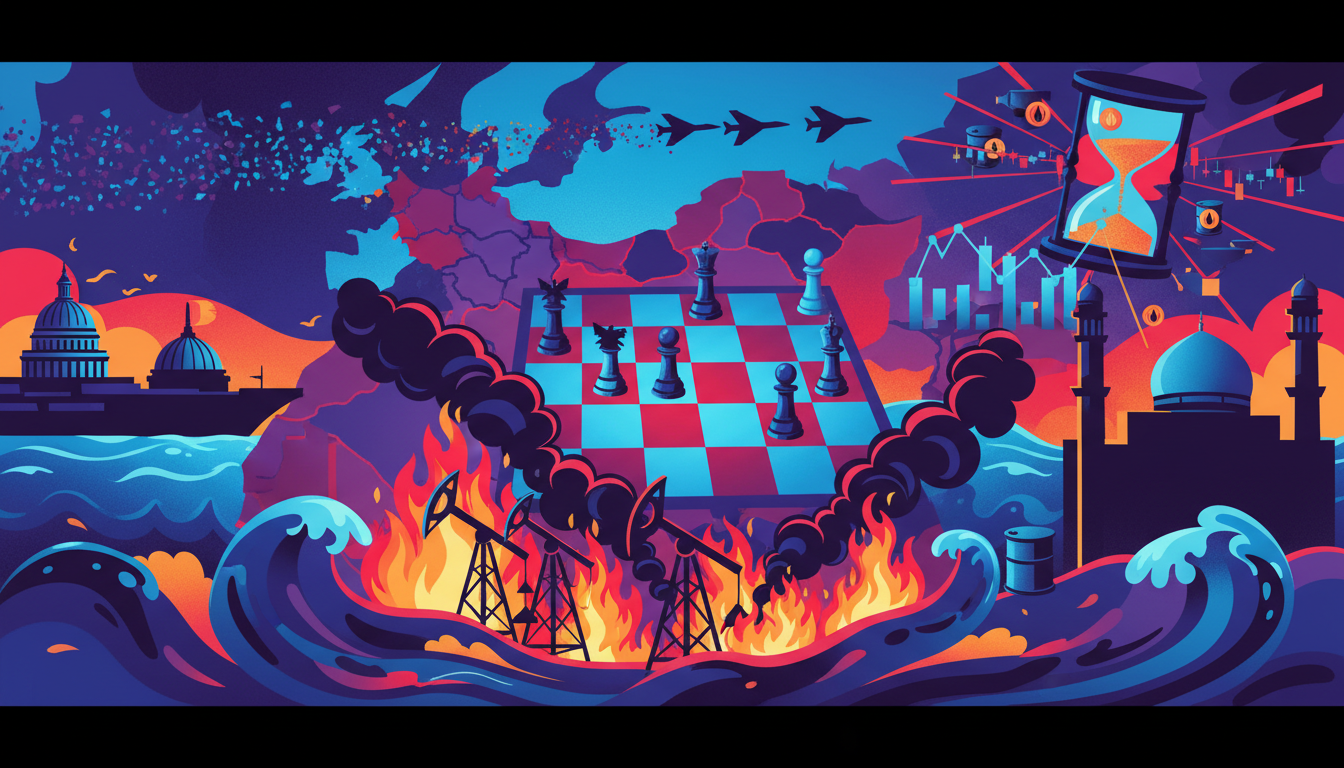
On March 29, 2026, it was revealed that the Pentagon is preparing for "a ground operation lasting several weeks" in Iran, a statement that quickly ignited the nerves of Washington and the markets. At the same time, some military sources emphasized that there is no existing plan for a "full-scale ground invasion of Iran," creating a tug-of-war between official statements and anonymous reports in the media. In the crypto world, the probability of "U.S. troops entering Iran before the end of April" on Polymarket was repriced to about 62%, while the fear and greed index plummeted to 9, indicating "extreme fear." The real military preparations and the collective bets in the predictive market are intertwined, reshaping the pricing logic of risk assets: it is not simply a matter of "will there be a strike," but rather finding the balance between "how to strike, to what extent" and "how the market prices it in advance."
From Internal Leaks to Media Reports: The Pre-War Narrative
Regarding the phrase "ground operation lasting several weeks," mainstream outlets like the Washington Post provide nuanced differences in their reports. Some articles emphasize that "U.S. officials say the Pentagon is preparing for a ground operation lasting several weeks," highlighting the signals of "preparing" and "several weeks"; other media place more emphasis in their headlines and leads on the "possible ground war," juxtaposing uncertainty with urgency. In terms of wording, every escalation from "considering options" to "preparing for" is seen by the market as a reallocation of risk scenario weights.
Alongside this, some military sources provide a "cooling version": they deny the existence of a finalized "full-scale invasion plan" against Iran, stressing that current discussions are more about option assessments and deterrent postures. This formulation of "preparations are real, but whether to take action remains undecided" highlights both the fragmentation of information and internal disagreements while also leaving significant room for political maneuvering—ranging from congressional debates, cabinet negotiations to electoral rhetoric, the focus can be on "whether to cross the red line of ground war."
It is in this gap that "preparation" and "invasion" are deliberately separated. For the military, deterrence and testing effects can be achieved through forward deployments, exercises, and public discourse without the need for immediate action; for different factions in the White House and Congress, this ambiguous state becomes a golden window for "shaping public opinion": it can simultaneously showcase a "tough stance" to domestic hawks while also reserving the option to retreat to the negotiating table with "no final decision made" if necessary. The market keenly captures this, choosing to see it as a "tail risk" needing a premium—regardless of whether a ground war ultimately occurs, as long as preparations are genuinely in place, it is sufficient to increase the geopolitical risk premium rather than passively classifying contradictory reports as "false news" and ignoring them.
Deserts and Plateaus: The Terrain of Iran
To understand the weight of the statement "the Pentagon is preparing for a ground operation in Iran lasting several weeks," one must return to the geographical reality of Iran itself. Iran features vast plateaus and mountains, as well as harsh desert regions and densely populated urban corridors; the terrain is highly diverse and has significant defensive depth. A "ground operation lasting several weeks" may be classified as limited objective warfare in textbooks, but once placed in the geographic context of Iran, it implies elongated supply lines, air defense suppression, and ground advance will simultaneously face enormous pressure.
The issue of supply is an old challenge in all Middle Eastern ground wars and is magnified in Iran. Entering a country with complex mountains and plateaus across national borders means that any armored and mechanized units will require secure logistical corridors, whereas Iran's current air defense systems and missile capabilities expose these supply lines tactically. When urban combat realities are added: once fighting shifts to the outskirts of major cities like Tehran or critical transportation hubs, urban warfare, civilian casualties, and public pressure can spiral out of control, making a "full-scale ground invasion" extremely costly militarily and politically.
Historical experience also reminds the market to remain vigilant. Over the past few decades in Middle Eastern ground operations, missions designed as "swift resolutions" have often evolved into prolonged "quagmire wars." "Several weeks of action" often serves merely as a timeline promised to domestic voters by decision-makers rather than an actual progress measure on the battlefield. Because of this, when the media mentions "a ground operation lasting several weeks," the market instinctively maintains a high degree of skepticism about this timeframe, viewing it as a prelude to potential "long-term involvement" rather than a short-term risk event that can be easily quantified.
Furthermore, due to the significant uncertainties in terrain and tactics, traditional financial markets often lag behind in pricing such scenarios characterized by "high uncertainty, low probability but high loss." In comparison, predictive markets and crypto prices resemble an off-market "expectation testing ground": participants can rapidly express their judgments about "whether, when, and to what scale to intervene in Iran" through buying and selling contracts, cutting positions, and leveraging, essentially preemptively solidifying emotions and risk expectations through price before any substantial signals of war emerge.
Betting on Polymarket...
In this round of heightened geopolitical tension, Polymarket has become an important window for tracking "collective bets." According to publicly available data, the probability of the contract "U.S. troops entering Iran before the end of March 2026" was only around 11%, whereas the probability for "entering Iran before the end of April 2026" was pushed up by traders to around 62%. The same event assigned starkly different probabilities across different time frames, reflecting the market's repricing that "the short-term risk of accidental confrontation is limited, but there is significant room for escalation in the medium to short term."
The shape of this probability curve is highly correlated with the rhythm of military and political signals. From the initial statement by anonymous officials to the media about "preparing for several weeks of ground operations," to more channels discussing the Iran issue being exposed, and then to some sources attempting to cool off the situation, the implied probability of "entering Iran before the end of April" on Polymarket gradually increased. Each report and each official statement translate into new buying and selling forces within the market, pushing odds to oscillate upward within a narrow range—the market uses real money to weight the "scenario of entering Iran" rather than passively accepting any side's narrative.
However, predictive markets have their own structural limitations. The vast majority of participants are speculators and information-sensitive traders, rather than intelligence agencies with actual operational details. The odds function more as a "composite quote of emotions and information": reflecting public news, expert interpretations, as well as panic, greed, and herd mentality. It is not a form of "official prophecy" or "leaked internal intelligence," nor can it be extrapolated into a precise military action timeline. Particularly in the absence of more verifiable data, over-interpreting numbers like "11%" or "62%" is itself a risk. What is truly worth paying attention to is the relative change of odds over time and how these changes indicate the market's step-by-step reassessment of possible paths for a ground war in Iran.
Extreme Fear Value 9: How Crypto Markets...
On the other side of the military and political narrative, the crypto market has already responded with prices and emotions. According to source A, the fear and greed index fell to 9, entering the extreme range of "extreme fear," indicating that market sentiment is currently dominated by risk aversion. Behind this emotional indicator is the collective retreat of highly volatile cryptocurrencies, passive selling of high-quality assets, and a sharp reduction in market-making and leveraged positions—the entire market is in a state where "any bad news will be amplified."
Expectations of geopolitical conflict may not directly impact the chain, but they will be transmitted through the chain of oil prices, U.S. dollar liquidity, and risk asset discounting: once the situation in Iran is viewed as a potential disturbance to Middle Eastern energy supplies, the risk premium for oil prices will rise; in turn, the rise in oil prices and inflation expectations will heighten concerns over tighter monetary policies or prolonged high interest rates, thereby suppressing risk asset valuations. Within this framework, crypto assets are often classified as "high beta risk assets," making them prone to "overreact" before traditional assets fully reprice.
At the same time, the rising probabilities on the predictive market for “entering Iran” and the falling emotional indicators create a coherent resonance: on one side, there is an increase in odds for the Iran scenario on platforms like Polymarket, and on the other side, the panic index is sliding into single-digit extremes. The combination of these factors makes the market highly sensitive to any news related to "ground operations," even minor changes in wording or statements from anonymous officials may trigger short-term volatile movements. In the stage of "information opacity + emotional amplification", rational investors need to shift their focus from the emotional extremes themselves to liquidity and position structures: paying attention to which assets are seeing shrinking volumes, which mainstream cryptocurrencies maintain firm buying support, and which derivatives markets are seeing leverage being passively unwound, rather than simply using "fear index 9" as a singular decision signal.
Political Gatherings and Capital Movement: Iran...
The Iran issue does not only exist in the war briefings; it is also an important negotiating chip in domestic political narratives in the U.S. According to source A, CPAC, as the important annual gathering for Republican lawmakers, activists, and presidential candidates, serves as a "testing ground for public opinion": how Iran is defined on such a platform becomes a lever in shaping the image of a "strong America," as well as a stage for competing candidates within the party. Whether the conflict is described as "necessary deterrence" or "dangerous adventure" directly relates to the bargaining space between hawks and doves in intra-party dynamics and electoral strategy.
Regarding "whether to engage in a ground war in Iran," hawks will emphasize the necessity of commitments to allies, regional deterrence, and "demonstrating strength," leaning toward packaging "the Pentagon preparing for ground operations" as a signal that "we must convince our adversary that we have the willingness and capability to implement." Doves, on the other hand, will approach from the angles of cost and consequence, reminding of the historical patterns where ground wars in the Middle East have often spiraled out of control, warning that ground operations could hamper the economy and electoral chances. This tug of public opinion and Congressional dynamics, in turn, influences market perceptions of the U.S. willingness to truly cross the line: when hawk rhetoric dominates in the electoral race and at gatherings like CPAC, predictive markets and capital flows often assign higher weights to more aggressive trajectories.
Movements in capital provide another perspective for observation. According to source A, World Assets, part of the World Foundation, has sold approximately $65 million equivalent of WLD tokens via OTC trading in the past week, viewed by some market participants as a representative case of high-net-worth individuals and institutions preemptively adjusting their positions amid uncertainty. Regardless of whether the selling motivation is directly related to the situation in Iran, it at least indicates that under the current environment, some large-volume funds are choosing to reduce exposure to high-volatility tokens through off-market channels, thus decreasing both book and liquidity risks.
However, it is essential to remain vigilant against simplifying the pressures of individual tokens to geopolitical events with straightforward correspondences, as this carries a risk of narrative overfitting. The OTC sales of WLD can be seen as a "corroborative indication of rising risk aversion," but it is far from constituting a definitive causal proof that "the foundation dumped due to Iranian risk." For investors, a more sensible approach would be to interpret these capital movements within a larger macro and emotional context: at the moment when the fear index falls to 9 and the probability of "entering Iran" rises on predictive markets, some early large investors choose to lock in profits and shorten duration, which is highly reminiscent of the logic traditional markets employ during periods of elevated geopolitical uncertainty.
War Expectations, Odds, and Chips: Continuation...
In summary, the market is facing a multi-layered interwoven pattern: on one side, the Pentagon is reported to be preparing for "several weeks of ground operations", while on the other side, some official and military sources deny and cool down the narrative of a "full-scale ground invasion"; at the price level, the probability of "entering Iran before the end of April" on Polymarket has been raised to about 62%, while the crypto market’s fear and greed index has plunged into an extreme fear level of 9. Military movements, fluctuations in odds, and shifts in chips collectively weave an invisible channel from combat plans to asset pricing.
In such an environment, investors need to decompose risks into three layers:
The first layer is the tactical level, which involves whether the U.S. will indeed cross into Iran in the coming weeks or months, and once inside, how the scale, objectives, and duration of involvement will evolve; the second layer is the market level, concerning how different assets price this uncertainty—from predictive market odds, oil price curves to volatility and risk premiums of mainstream crypto assets; the third layer is the narrative level, which pertains to who is leveraging this panic to push their agenda—whether candidates in electoral races, factions in Congress, or the bullish and bearish forces in capital markets, each will attempt to embed their narratives of "Iran ground war" into their respective frameworks.
Operationally, a more robust approach is to continuously compare the degree of divergence between authoritative public information and predictive market prices, rather than fixating solely on a single number. When the tone of officials and mainstream media shows significant cooling while odds remain high on platforms like Polymarket, it indicates that the market is paying a higher price for "tail risks," potentially leading to a compressing space for risk premiums; conversely, when formal statements clearly shift toward a tougher stance yet predictive odds are not fully priced in, caution is warranted regarding potential "catch-up" or "catch-up type fluctuation." Meanwhile, attention should be paid to whether there is a "fear attenuation" between the fear and greed index and trading volume—namely, if the index stays in panic territory but the volume of sell-offs begins to decrease and low-price support strengthens, this often signifies that the market is gradually adapting to high uncertainty.
Looking ahead, if by the end of April 2026 there are no substantial ground operations of U.S. troops entering Iran, the current high-risk premiums surrounding "ground war" will likely undergo a repricing cycle of "war discount unwind": the relevant contract odds in predictive markets will likely move downward, and the extreme discounts in crypto assets exaggerated for hedging extreme scenarios may also have an opportunity to be partially released. However, until that process arrives, the market will continue to be influenced by military preparations and political narratives; what truly needs to be safeguarded may not be the certainty over any single scenario, but a clear awareness of position and liquidity boundaries.
Join our community to discuss and grow stronger together!
Official Telegram community: https://t.me/aicoincn
AiCoin Chinese Twitter: https://x.com/AiCoinzh
OKX benefit group: https://aicoin.com/link/chat?cid=l61eM4owQ
Binance benefit group: https://aicoin.com/link/chat?cid=ynr7d1P6Z
免责声明:本文章仅代表作者个人观点,不代表本平台的立场和观点。本文章仅供信息分享,不构成对任何人的任何投资建议。用户与作者之间的任何争议,与本平台无关。如网页中刊载的文章或图片涉及侵权,请提供相关的权利证明和身份证明发送邮件到support@aicoin.com,本平台相关工作人员将会进行核查。