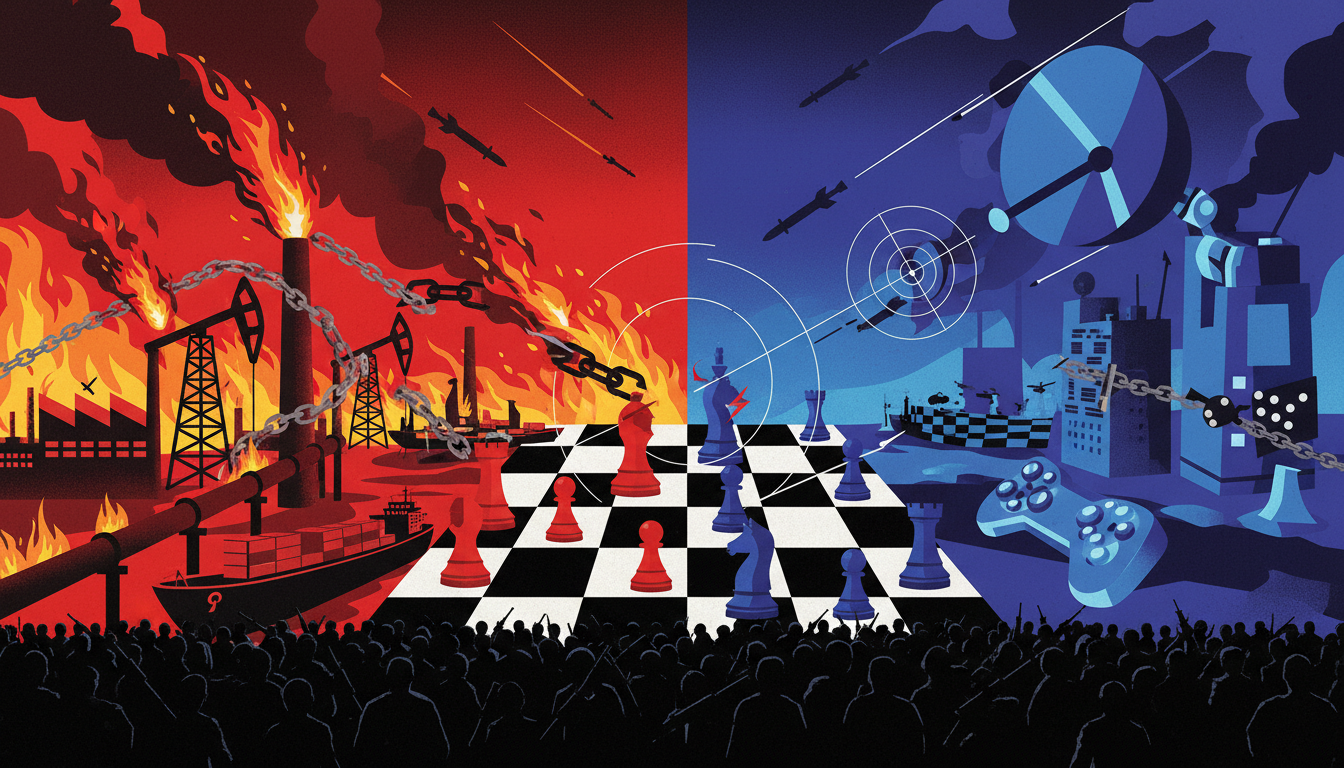
On March 27, 2026, the Middle Eastern battlefield and major power diplomacy heated up simultaneously: Russia openly warned the United States that its military actions in the Middle East constitute a "strategic mistake," the U.S. Vice President publicly questioned Israel's judgment on the Iran situation, while Iran accused the U.S. military of using "human shields" in its operations in the region, putting the civilians of Gulf Cooperation Council member states at risk. This collision from the battlefield to the discourse quickly saw feedback in asset prices: as of the close on March 27 in the UTC+8 time zone, the three major U.S. stock indices collectively fell over 1%, the Nasdaq 100 index retraced approximately 10% from its peak, and the VIX index surged 2.66 points to 30.10, indicating a sharp rise in risk aversion. The core issue has shifted from "whether a new round of war will break out" to "how the global risk appetite curve will be reshaped under the changed structure of major power competition," while Wall Street is passively yet quickly pricing this uncertainty.
Warnings and Accusations Intertwined: The Escalation of Battlefield Discourse
The Russian side chose to voice its concerns at this time, directly targeting U.S. military actions in the Middle East, characterizing them as a "strategic mistake," and drawing a comparison with U.S. military overreach in Vietnam based on a single source. The historical shadow of the Vietnam War is repeatedly evoked in Russian narratives: on one hand, it reminds Washington that ground battles and long-term occupations mean uncontrollable costs and political consequences; on the other hand, it suggests to global markets that if the U.S. falls into another "quagmire" of regional war, the existing international order and dollar assets will face new structural pressures.
In contrast to Russia's historical approach, Iran's accusations are more directly aimed at the current battlefield: Iranian Speaker Qalibaf claimed that "the U.S. cannot even protect its soldiers in bases in the region," while Iranian Foreign Minister Amir-Abdollahian accused the U.S. military of treating the civilians of Gulf Cooperation Council member states as 'human shields.' The dissemination of such rhetoric has been continuously amplified in regional media and social platforms, not only shaping an image of "the U.S. military struggling to protect itself, let alone allies and civilians," but also creating greater political and opinion pressure within Gulf states, where security issues are highly sensitive.
Meanwhile, the statement that "if the U.S. conducts ground operations in Iran, it may fall into a Vietnam-like quagmire" has been repeatedly cited in market commentary and research reports, becoming a keyword for risk scenario simulations. Such comments are not merely emotional embellishments but are used by institutions to build stress test scenarios: should conflict escalate from airstrikes and proxy conflicts to substantial ground operations, the uncontrollable costs, pressure on allied systems, and domestic political fractures akin to Vietnam's chain reactions would be embedded into yield curves and military-industrial and energy stock valuation models, thereby intensifying concerns over the repricing of long-term discount rates and risk premiums.
Cracks in the U.S.-Israel Alliance: From Private Disagreements to Public Doubts
As the security alliance publicly engages with each other, the cracks between the U.S. and Israel are moving from behind closed doors to the forefront. The U.S. Vice President publicly questioned Israel's judgment regarding the situation in Iran, conveying a signal that is no longer a procedural "friendly reminder," but rather a substantive disagreement with Israel's threat assessment and action plan. This strategic assessment divergence occurring in front of cameras disrupts the market's long-held perception that "the U.S. and Israel always closely coordinate their Iran policies."
Research briefs indicate that there is a tendency for an overly optimistic assessment within Israel regarding the possibility of "prompting regime change in Iran through military strikes or coercion." Under this narrative, short-term pressure is seen as a means to obtain long-term security dividends. However, from Washington's perspective, regime change in Iran is not a controllable variable, and over-relying on this outcome may trigger secondary or even tertiary shocks to regional order, resulting in uncertain costs that span over a decade. This different estimation of cost-benefit ratios is the source of risk in the U.S.-Israel strategic divergence.
As this rift transitions from classified briefings to media headlines, the market's assumption of "the Western camp acting in high unity" is weakened. Investors are forced to reconsider: at critical escalation points, could Israel choose a path not entirely aligned with U.S. preferences? Will the U.S. be compelled to follow suit due to domestic political and allied pressures? This series of questions makes "alliance predictability" itself a new risk factor, compounding the already complex geopolitical conflicts and raising the uncertainty discount in asset pricing.
Steel Plants as Targets of Fire: The Vulnerable Frontline of Iranian Industry
Beyond abstract strategic warnings, the specific targets being struck make the physical costs of the conflict concrete—steel plants and other industrial facilities are named as targets of attack, becoming the most prominent backdrop in news footage. This entry point outlines the vulnerability of Iran's industrial base in the context of escalating conflicts: steel, as a fundamental material, is both the backbone of domestic infrastructure and the civilian economy, as well as a vital upstream component of the military-industrial and defense industries; if production capacity suffers continuous attacks, its impact extends far beyond the economic losses of a single factory.
Damage to Iran's industrial facilities signifies that its economic and military capabilities may face dual constraints. On one hand, declining capacity and disrupted supply chains will weaken domestic employment and fiscal revenue, exacerbating the already strained macro environment under sanctions; on the other hand, the raw materials and industrial components needed for military industries may be limited in output, potentially weakening its sustained combat and deterrent capabilities in the medium to long term. This long-term consumption path linking "military capability and economy" will not fully manifest in short-term battle reports, but will subtly alter expectations of the regional power balance.
For neighboring oil-producing countries and Gulf Cooperation Council member states, attacks on steel plants are not isolated incidents but rather a clear signal of rising security risks. Once industrial infrastructure is viewed as a legitimate target for strikes, the safety boundaries of energy facilities, petrochemical parks, and port hubs also become blurred. Under this perception, these countries must reassess their strategic depth, the degree of security ties with the U.S., and the delicate balance with regional powers such as Iran, leading to more conservative plans in defense spending, diplomatic stances, and even production policies. This "security anxiety and conservative policy" chain will also be endogenous to the market, translating into higher expectations for supply disruptions and risk premiums.
Wall Street's Urgent Reevaluation of Risk: From Overvalued to Panic Indicators
The narrative of conflict did not remain at the geopolitical level, but quickly transmitted through price signals to Wall Street. As of March 27, 2026, in the UTC+8 time zone, the three major U.S. stock indices collectively fell over 1%, and given that valuations were already at relatively high levels beforehand, this synchronous adjustment has clear technical implications: it is not merely negative news for a single sector, but a broad contraction of risk appetite. More symbolically, the Nasdaq 100 index retraced approximately 10% from its peak, technically reaching the threshold of a "correction," with overvalued growth assets becoming the first risk carriers to be sold off.
In parallel with the decline of spot stock indices, the VIX index jumped 2.66 points to 30.10, returning to the "high volatility" range. The 30 threshold in market memory often corresponds to event-driven panic or a sharp increase in uncertainty, indicating that investors are willing to pay a higher premium for protective put options, significantly raising expectations for volatility over the next 30 days. From the perspective of implied volatility, the market is paying for a broader potential price distribution rather than betting on a single direction, which closely aligns with traditional hedging models.
In terms of capital flows, although specific scale data is still incomplete, based on historical experience and current price behavior, a migration path from high beta risk assets to cash, short-duration bonds, and traditional safe-haven assets is beginning to open. Growth technology and cyclical sectors are leading the decline, while defensive sectors and high-rated credit assets show relative resilience, reflecting a typical approach of portfolio managers to respond to uncertain scenarios through "deleveraging and enhancing quality." If the conflict continues to escalate, this rebalancing could further develop into systematic reductions in high-risk regional assets and those with lower liquidity, turning "geopolitical events" into a broader process of global risk asset repricing.
The U.S.-Russia Game and Ceasefire Control: Who Will Write the Next Ceasefire Agreement
Beyond the battlefield, the struggle for control over ceasefire negotiations between the U.S. and Iran is the implicit main plot of the current game structure. The U.S. hopes to bring Iran back into a controllable framework through diplomacy and sanctions, while maintaining a "tough but affordable" posture among allies and domestic voters; Iran, on the other hand, aims to escalate the conflict into a discourse struggle about sovereignty, security commitments, and regional order, avoiding a passive position in ceasefire terms by raising the stakes and pulling regional and extraregional forces. This structural opposition means that even if short-term hostilities ease, ceasefire negotiations are more likely to be marked by protracted back-and-forth rather than a single conclusive outcome.
Russia plays a highly strategic third-party role in this dynamic. According to briefings, not only does Russia publicly predict that the conflict carries long-term risks, but it also seeks to extract strategic leverage from it: on one hand, it increases its voice in regional order restructuring by offering political support, weapons, or mediation willingness to various parties in the Middle East; on the other hand, it views U.S. resource depletion in the Middle East as an indirect weakening of its pressure capacity in Europe and around Russia, thereby gaining greater maneuvering space on other fronts. This "multi-battlefield linkage" thinking leads Russia to frequently issue warnings about a "Vietnam-style quagmire" in public, while secretly reserving space for long-term competition.
On a more macro level, the multilateral game of major powers surrounding the restructuring of Middle Eastern order is deepening the "uncertainty premium" in global markets. For investors, what is being priced is not just the outbreak and ceasefire of a single conflict, but a geopolitical landscape that may experience repeated shocks over the coming years: the sustainability of ceasefire agreements, the pace of the regional arms race, the baseline of energy supply security, and the robustness of the dollar system in the Middle East's financial and settlement architecture will all be embedded in asset allocation decisions. This long-term uncertainty will not be fully manifested in daily market trends but will continuously reshape the global market ecology through higher equity risk premiums, steeper volatility curves, and more cautious cross-border capital flows.
From Battlefield to Asset Prices: The Outline of the Next Risk Aversion Cycle
A comprehensive view of current signals indicates that: the escalation of geopolitical tensions, the publicization of U.S.-Israel alliance cracks, and Russia's "strategic mistake" warning collectively form the key triggers for a new risk aversion cycle. The steel plants and bases on the battlefield, along with the accusations and doubts in the diplomatic arena, intertwine to alter the market's baseline expectations for the Middle Eastern order and the structure of U.S. global engagement in the coming years, and this adjustment of the baseline is enough to lead to a structural increase in the depreciation of global capital against unknown risks.
It is important to emphasize that the current market resembles more of a digestion of the uncertainties surrounding the rhythm of conflict and negotiation prospects, rather than betting on some extreme outcomes. The VIX rising above 30, major U.S. stock indices pulling back over 1%, and the Nasdaq 100 retracing 10% from its peak correspond to "defensive reallocation" and "volatility premium reassessments," rather than a systemic liquidity crunch or full-blown panic. In other words, asset prices have already started to account for the risks of prolonged geopolitics and policy divergences, but the market remains cautiously restrained regarding extreme scenarios such as nuclear confrontation or regional full-scale war, not viewing them as baseline paths.
Looking ahead, several possible evolutionary paths will determine the new pricing paradigm for risk assets: if military conflicts escalate further, especially if larger-scale cross-border strikes or ground actions occur, risk assets will face higher depreciation, and risk premiums in energy and defense supply chains will rise more significantly; if ceasefire negotiations achieve a phase breakthrough, even if the terms are weak, it could bring about a window of "risk aversion retreat and risk rebound," but the risk premium level after the pullback is likely to be higher than before this round of conflict; and if major powers form some limited compromise on the Middle Eastern order issue and accept a normalized situation of "low intensity and manageable" conflict, the market may enter a new normal of "high volatility and low certainty," shifting asset demands from pure returns to a greater emphasis on shock resistance and geographical diversification. Throughout this process, Wall Street is not a mere bystander but continuously prices this game across the battlefield and negotiation table through prices, volatility, and liquidity.
Join our community, let's discuss and become stronger together!
Official Telegram community: https://t.me/aicoincn
AiCoin Chinese Twitter: https://x.com/AiCoinzh
OKX benefits group: https://aicoin.com/link/chat?cid=l61eM4owQ
Binance benefits group: https://aicoin.com/link/chat?cid=ynr7d1P6Z
免责声明:本文章仅代表作者个人观点,不代表本平台的立场和观点。本文章仅供信息分享,不构成对任何人的任何投资建议。用户与作者之间的任何争议,与本平台无关。如网页中刊载的文章或图片涉及侵权,请提供相关的权利证明和身份证明发送邮件到support@aicoin.com,本平台相关工作人员将会进行核查。