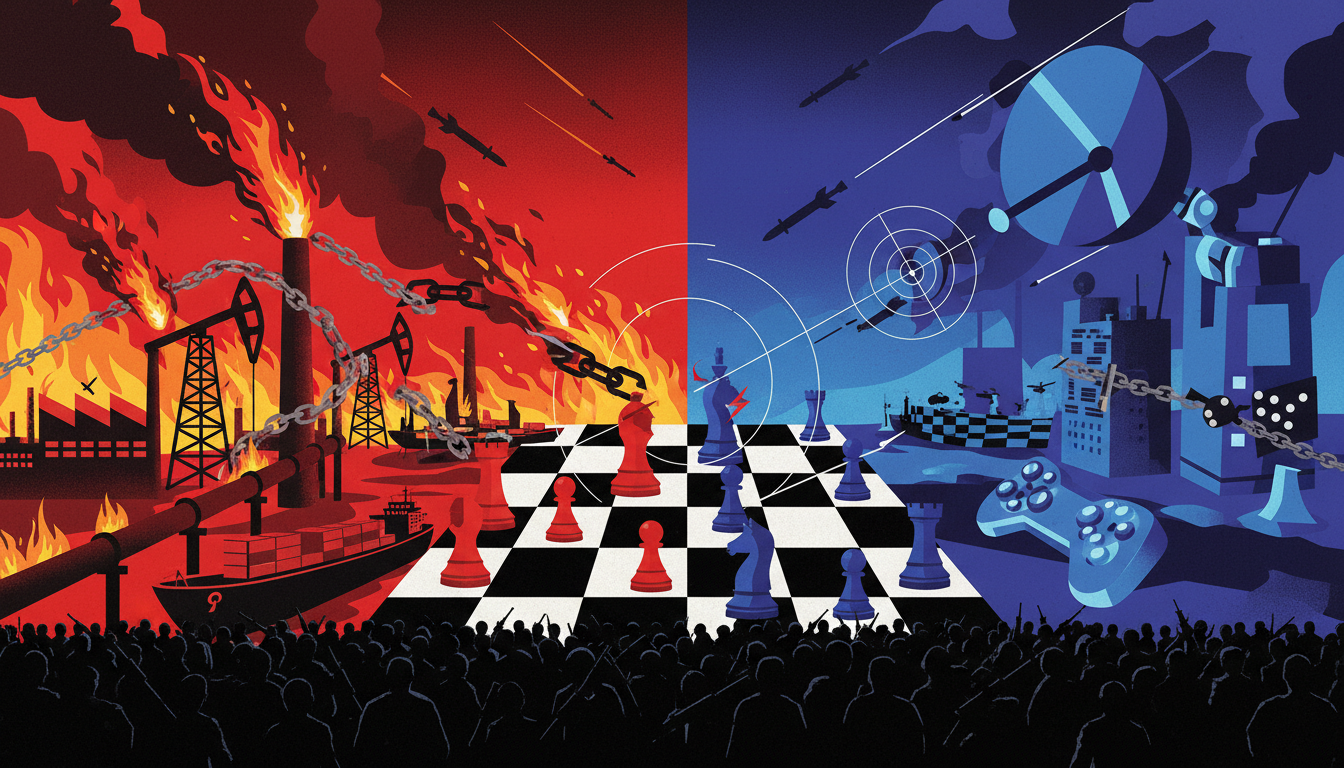
On March 27, 2026, the rumors surrounding a potential U.S. military invasion of Iran intensified, with high-level officials in Tehran sending out tough signals, further escalating an already tense situation in the Middle East. From verbal confrontations to military demonstrations, risks accumulated rapidly within a short period.
The reaction from capital markets was more direct. As of the close on March 27 Eastern Time, the prediction platform Polymarket showed that the probability of U.S. military forces entering Iran by the end of March was bet at 16%, while the probability of entering by the end of April soared to 63%. These two distinctly different time frames reflect a split pricing in the market between short-term restraint and mid-term chaos. On the same trading day, the VIX Index, which represents implied volatility in U.S. stocks, surged by 2.66 points to above 30.10, causing global risk assets to swiftly switch to a “defensive posture.”
The question was no longer just “Will there be a conflict?” but rather how this confrontation stretching from Tehran to Washington would change the market's collective expectations regarding the Federal Reserve's path and how it would reshape the narrative position of crypto assets in the global risk landscape.
Tehran's Tough Talk: Accusing the U.S. Military of Using Civilians as Shields
In the domestic narrative of Iran, politics and morality have always been closely intertwined. Around March 27, Iranian Parliament Speaker Qalibaf publicly stated, “The U.S. cannot even protect its soldiers in local bases,” portraying Washington as both powerless and reckless foreign power. This statement emphasizes that Iran is not afraid of U.S. military force while suggesting that any actions taken by the U.S. would only lead to more unnecessary sacrifices, thus framing Iran as the “victim” of invasions.
Almost simultaneously, Iranian Foreign Minister Amir-Abdollahian accused the “U.S. military of using civilians from Gulf Cooperation Council (GCC) countries as human shields.” This accusation extends from the simple U.S.-Iran confrontation to the member states of the GCC — in Iran's context, this both denies the legitimacy of U.S. forward bases and depicts the GCC countries as victims forced into conflict by U.S. coercion. Through this, Tehran conveys a message to the regional audience: Iran is not the instigator but a “representative” fighting against hegemony.
This discourse war intentionally undermines the structure of regional alliances. By tying U.S. military actions closely with GCC countries, Iran reminds those regimes hosting U.S. bases: should the situation escalate, you will not be safe havens, but rather frontline targets. This implication strengthens distrust within the region and lays the groundwork for potential diplomatic swings and security cooperation reconfigurations in the future.
However, in the context of financial markets, such high-pressure rhetoric has a direct consequence: the space for misjudgment quickly expands. The more hardline statements made, the easier it becomes for any minor skirmish to be interpreted as a prelude to “full-scale escalation.” Investors facing hard-to-quantify military risks have no choice but to “prepay” for uncertainties by raising their risk premiums, which also lays a psychological foundation for subsequent volatility and dramatic price fluctuations in risk assets.
Prediction Markets and the Fear Index: Two Timelines of Capital Bets
Bringing the timeline back to March 27, the contracts regarding “U.S. military entering Iran” on Polymarket presented two contrasting figures: 16% probability of entry before the end of March, and 63% probability of entry before the end of April. The former reflects a general market belief that there remains some room for restraint in the short term, with decision-makers likely trying to avoid immediately crossing irreversible red lines; the latter indicates concern over mid-term spiraling escalation — once the conflict enters a retaliation-reprisal cycle, political and public opinion constraints will rapidly weaken, making it harder to put the brakes on the situation.
These two probabilities do not simply answer “yes or no,” but rather imply a divergence over time: short-term bets on “testing + deterrence,” and mid-term bets on “dragging + escalation.” Funds that are highly sensitive to geopolitical risk will adjust their duration and risk preferences accordingly — short-term positions will focus more on whether there will be immediate military developments, while mid-term will start to reprice for potential impacts on supply chains, energy prices, and global growth expectations.
Meanwhile, the VIX Index, representing panic in U.S. stocks, surged by 2.66 points to 30.10, instantly jumping from the “volatile range” into the “high-pressure zone.” This level of intraday fluctuation signifies that institutions quickly raised their expectations for future volatility at the options end, with both hedging and speculative trading driving up volatility prices. In other words, global risk assets swiftly transitioned from a stance of “wait-and-see” to “defense” in a very short timeframe.
Historical experience shows that in similar geopolitical tremors, traditional safe-haven assets — such as government bonds and gold — often benefit first, whereas the performance of crypto assets becomes more complex. On one hand, the narrative of “digital gold” encourages some funds to migrate towards assets like Bitcoin amid panic; on the other hand, the high leverage and volatility characteristics of the crypto market often turn safe-haven narratives into stages for emotional amplification: in extreme fluctuations, both safe-haven buying and forced liquidations can be observed. This contradiction leaves a hint for the later discussion of crypto pricing logic.
From Tehran to the FOMC: High-Rate Lockdown Under the Shadow of War
Shifting the focus from the Middle East clouds back to Washington, the path of the Federal Reserve has undergone significant changes silently. According to the data from the FedWatch Tool, the market has largely ruled out the possibility of interest rate cuts before March 2027, and the consensus for “high rates to last longer” has almost been written into the current asset pricing framework. This means that whether it’s U.S. stocks, credit bonds, or crypto assets, all face a higher and longer-lasting discount rate environment.
In this context, the macro implications of escalating Middle Eastern conflicts are magnified. War is not just a local security event; it may evolve into a new round of imported inflation through oil prices and supply chain pressures. Iran, as an essential part of the region's energy and industry,, if caught in deeper conflicts, could lead to transportation disruptions and skyrocketing insurance costs, exacerbating market concerns about shipment safety in the Persian Gulf. Macro scholar Nouriel Roubini has already warned that a prolonged conflict “could rekindle the oil crisis of the 1970s,” and this analogy is sensitive as it directly points to the Achilles' heel of inflation expectations.
Once geopolitical shocks push up inflation, the Federal Reserve will be forced to make difficult trade-offs between “fighting inflation” and “stabilizing finance”. If it chooses to continue to confront prices sternly, even at the expense of economic growth and tighter financial conditions, then the timeline for high-rate lock-in will be further extended, and all assets relying on liquidity and growth stories — including cryptocurrencies — will face a higher discount rate penalty. Conversely, if it loosens before inflation recedes to avoid systemic pressures on the financial system, the actual purchasing power and long-term credibility of the dollar will be damaged, and global asset allocation may accelerate to seek value storage and settlement tools outside the “dollar system,” thus heightening the narrative of crypto assets as a “hedge against traditional financial system risks.”
Between Tehran and the FOMC, what appears to be two unrelated decision-making chains is, in fact, closely connected through inflation and interest rate expectations. What the market is currently betting on is not just the war itself, but how the war will reshape the benchmark coordinates of the entire asset world through prices, interest rates, and monetary credibility.
Attacks on Iranian Steel Mills and Energy Memory: An Early Sample of the Shock Chain
Among all the reports, the news that two Iranian steel mills were attacked stands out prominently. Current available information does not provide specific loss data or clear figures on the extent of production capacity damage, but the event itself can already be seen as an early signal of real economy damage: the risk of war is no longer limited to military exercises and threats but has begun to touch upon industrial facilities and production activities.
Investors’ heightened sensitivity to such news stems from the fact that Iran is not only an energy hub but also an important link in the regional industrial chain. The weight of the Middle East in global energy and related industrial chains means that any strike on infrastructure will immediately be associated with supply shocks and cost-push inflation: oil prices may rise due to transportation and security premiums, and the costs of basic industrial products like steel will transmit downstream through construction, manufacturing, and infrastructure, ultimately reflecting back to the dual pressures on CPI and PPI.
Compared to the oil crisis of the 1970s, the current world has undergone significant changes in energy structure and geopolitical landscape: on one hand, North American shale oil and renewable energy have relatively decreased the dependence of the U.S. and some economies on Middle Eastern crude oil; on the other hand, the global supply chain has become more complex and integrated, making localized shocks easier to amplify through trade and financial channels. In this context, the market faces a dual risk in “historical bets”: either overly drawing parallels and overestimating the energy shock magnitude of the current conflict, or underestimating and neglecting the fragility of modern supply chains in addressing structural disturbances in a short time frame.
For investors, the attack on the Iranian steel mills serves more as a “memory trigger”: it evokes a collective memory of oil price crises and stagflation over the past decades but fails to provide sufficiently clear quantitative data. This is precisely the state that most unsettles the market — knowing that there is a risk in direction but unclear about the scale and pace, thus they can only preemptively respond by raising risk premiums and reducing duration exposure.
Geopolitical Trading in Crypto: Safe-Haven Narrative and Volatility Reality
Returning to the crypto market, the performances of major assets like Bitcoin during past cycles of geopolitical tension have always displayed a disconnect between narrative and reality. On macro commentary and social media, the label of “digital gold” is frequently used to illustrate Bitcoin's safe-haven attributes under the triple pressure of fiat currencies, inflation, and geopolitical risks; however, from price and transaction data, whenever global risk events explode, Bitcoin exhibits both short-term upward movement similar to gold and often undergoes strong pullbacks when strong assets are first liquidated, leading to concentrated liquidations across leverage chains.
In this round of confrontation, prediction market data and VIX changes provide clear yet easily misused “external signals” for crypto traders. The high probability of mid-term conflict escalation on Polymarket, combined with VIX rapidly breaking 30, leads some funds to treat both as “dual barometers of macro and geopolitical indicators” for secondary amplification in the crypto market: betting not only on the conflict itself but also on the resulting currency and interest rate repricing. As such, the “geopolitical + macro” narrative is compounded into emotional double leverage, reflected in larger amplitudes and more frequent high-frequency entries and exits in prices.
Furthermore, potential changes surrounding Middle Eastern funds, miners, and off-market dollar flows have become important clues for observing the migration of crypto funds:
● On one hand, some Middle Eastern funds may increase their use of on-chain assets and overseas trading platforms when the situation deteriorates or expectations of capital controls rise, in order to diversify risks from local banks and capital channels; on the other hand, if the U.S. and its allies ramp up financial sanctions, related funds may also conduct value transfers through more concealed off-market networks and on-chain tools, increasing the difficulty of cross-border regulatory scrutiny.
● For miners, if conflicts and sanctions affect energy supply and electricity prices, the regional cost structure of computing power may be forced to rearrange, with some miners opting to migrate, shut down, or change their settlement currencies; this may manifest on-chain as fluctuations in computing power, changes in miner selling pressure, and short-term disturbances in transaction fees and block space competition.
● Off-market dollar flows are another key observation clue: when local dollar liquidity becomes scarce and banking channels come under pressure, the usage rate of dollar-pegged assets like Tether in underground financial networks may rise, and on-chain dollar premiums and discounts will become real-time barometers for assessing regional financial pressure and capital fleeing dynamics.
Intertwined in these actions, the crypto market is not merely a “safe-haven paradise,” but rather resembles a highly volatile liquidity buffer: it absorbs panic while amplifying profit impulses, rapidly transitioning from a “safe-haven narrative” to a “trading story” within a short timeframe.
War Probability Not Yet Realized, Financial Markets Set the Price First
From the above clues, it can be seen that the linguistic and posture standoff between Iran and the U.S. has not yet genuinely crossed the threshold of war, but the prediction markets and volatility index have already completed a “rehearsal pricing”. Polymarket has raised the mid-term invasion probability to 63%, with VIX increasing to above 30 in one day, as the market used higher implied volatility and risk premiums to pre-price extreme scenarios that have not occurred — this is both a instinctive defense against uncertainty and a subtle skepticism toward the “rational constraints” of policy and military decision-makers.
Behind the pricing of crypto assets, geopolitical risks, Federal Reserve policies, and energy prices are forming a clear chain reaction: Tehran's tough statements and regional facility attacks are prompting the market to reassess the vulnerabilities of oil prices and supply chains; inflation expectations rising once again strengthen the Federal Reserve's path of “higher rates for longer”; the high-rate environment raises the discount rate threshold for all risk assets, forcing crypto assets to use higher volatility and richer narratives to secure their place in global asset allocation.
For investors, the real test lies in distinguishing short-term trading opportunities from long-term allocation logic. Short-term positions can be strategically laid out around volatility and sentiment cycles — leveraging prediction markets, volatility indices, and on-chain capital flows to capture the rhythm of “excess panic” and “sentiment recovery”; while long-term allocations must return to a more rational proposition: in a world where inflation and war memories cyclically return and central bank credibility is sometimes questioned, in what form do crypto assets exist in asset portfolios — as high-volatility risk assets, or as allocation tools with certain institutional hedging attributes.
Those unquantifiable military uncertainties — including whether a direct confrontation will truly break out or if the conflict will spill over into a large-scale regional war — should not serve as a reason to increase leverage but rather are better suited as boundary conditions for position management and risk budgeting. The narrative is always more compelling than the data, but under the shadow of war, whether one can keep the story in research notes and entrust positions to cold risk control rules often determines which portion of investors can weather this storm woven from geopolitical and macro interconnections.
Join our community to discuss together and become stronger!
Official Telegram community: https://t.me/aicoincn
AiCoin Chinese Twitter: https://x.com/AiCoinzh
OKX Benefit Group: https://aicoin.com/link/chat?cid=l61eM4owQ
Binance Benefit Group: https://aicoin.com/link/chat?cid=ynr7d1P6Z
免责声明:本文章仅代表作者个人观点,不代表本平台的立场和观点。本文章仅供信息分享,不构成对任何人的任何投资建议。用户与作者之间的任何争议,与本平台无关。如网页中刊载的文章或图片涉及侵权,请提供相关的权利证明和身份证明发送邮件到support@aicoin.com,本平台相关工作人员将会进行核查。