Written by: Liu Honglin
In the past couple of days, a piece of news regarding Manus has been quite intriguing.
On March 26, Caixin News quoted a report from The Paper stating that at a routine press conference held by the Ministry of Foreign Affairs, in response to the Financial Times report claiming "China has prohibited two executives of the artificial intelligence company Manus from leaving the country," spokesperson Lin Jian replied that he was unaware of the situation and suggested asking the relevant Chinese departments.
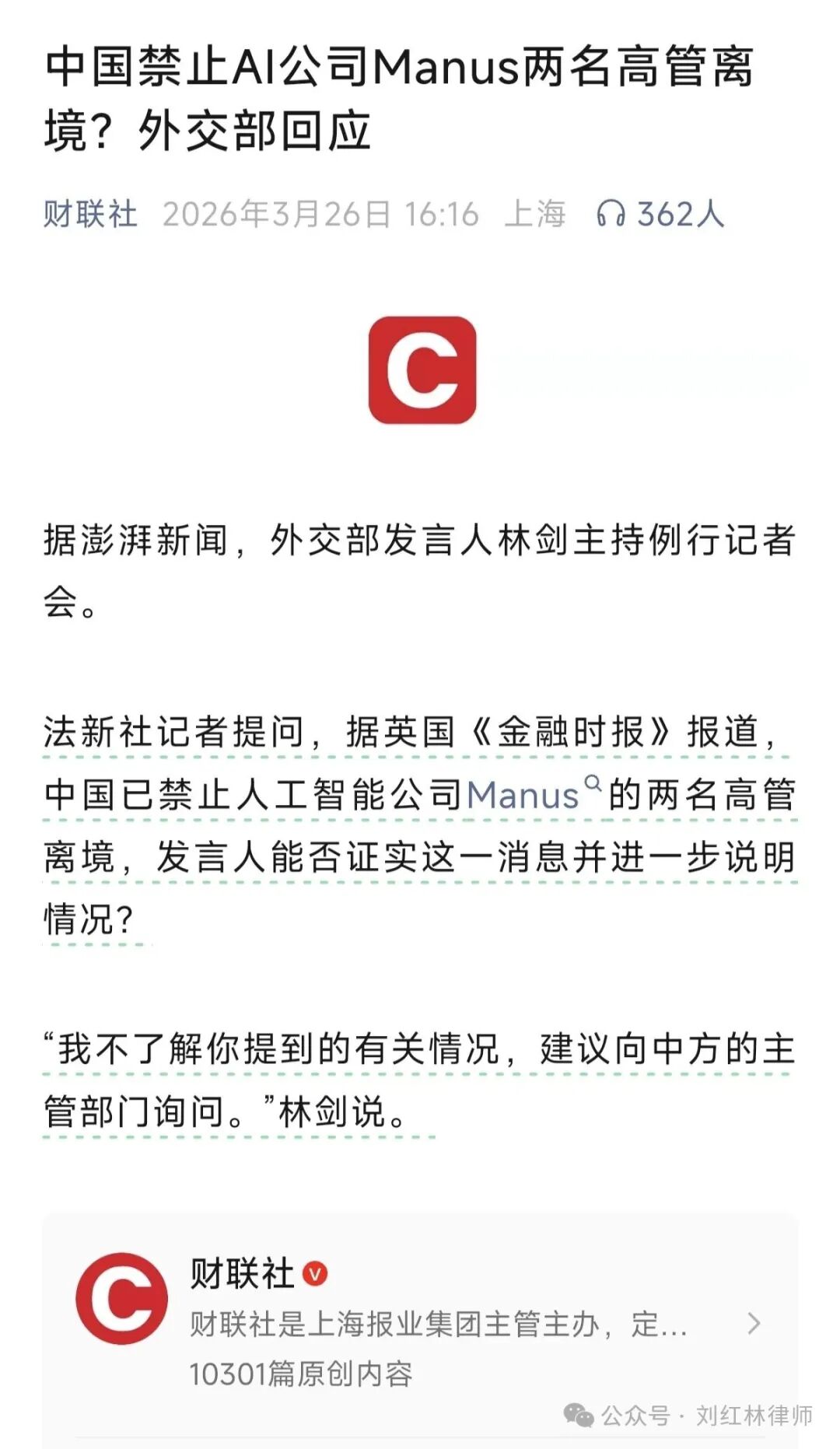
Just a day earlier, Reuters had reported, citing the Financial Times, that China was reviewing Meta's acquisition deal of Manus, amid claims that the two co-founders were restricted from leaving the country, as relevant departments were investigating whether the approximately $2 billion transaction violated investment rules. In an earlier report in January, Reuters also noted that when Chinese authorities reviewed this deal, one of the main concerns was whether Manus's relocation of certain personnel and technology to Singapore before the sale touched upon relevant regulatory issues.
If this matter were regarded as just a piece of ordinary technology merger news, it would not seem particularly significant. It is merely a case of an American tech giant acquiring an AI company with Chinese background that subsequently moved to Singapore, which sparked concern from Chinese regulators during the transaction process.
However, if we place this matter in the context of today's global AI competition, the signals it sends become quite different. It at least indicates one thing: AI has evolved from mere model parameters, paper roadmaps, and product iterations in laboratories to being increasingly intertwined with real-world issues such as cross-border capital, technology transfer, industrial security, talent mobility, and national interests.
Technology can flow, models can be invoked, but entrepreneurs, control, data, computing power, and regulation are clearly not floating in a vacuum.
This also leads to a question I've been pondering recently: Does AI have borders?
From a purely technical idealism perspective, this question doesn’t seem overly complicated. Algorithms spread, code disseminates, open-source communities are inherently global collaborations, and model capabilities can indeed be invoked by developers around the world through APIs. From this angle, AI certainly carries a strong "borderless" connotation.
Yet, the reality is that once technology enters the stage of industrialization, capital markets, and national competition, it can no longer remain merely at the level of pure knowledge sharing. Science can speak of being borderless, but industries cannot; papers can be open-sourced, but control cannot; models can be invoked globally, but computing power, data, and business implementation will always have to return to specific lands, grids, server rooms, corporate structures, and legal systems.
This is where it gets interesting.
While incidents like Manus remind us that "AI has borders," the realities on the other side indicate that AI is indeed crossing borders in unprecedented ways.
The two Reuters reports in March noted that on global platforms like HuggingFace and OpenRouter, the usage and presence of Chinese open-source models are rapidly rising. A report by a consulting agency from the U.S. Congress pointed out that China's leading position in open-source AI is creating a "self-reinforcing competitive advantage."
During the same period, Reuters Breakingviews directly mentioned that seven of the ten most popular models on OpenRouter are from China. The report also noted that companies like Siemens have openly adopted models from China because they are more attractive in terms of price and customization.
When viewed together, these two phenomena become very interesting.
On one hand, the transfer of capital and control is becoming increasingly sensitive, with nations starting to care about brain drain, technology transfer, and whether transactions circumvent regulations; on the other hand, models themselves are being invoked on a larger scale on global platforms, with developers voting with their feet and companies making choices based on cost and performance.
In other words, the current discussion on whether AI has borders can no longer be held from a simplistic technical perspective. It presents entirely different border states at different levels: a weak border at the knowledge level, a penetrable border at the invocation level, yet a strong border at the capital and regulatory levels.
The real question is not simply a matter of "yes" or "no," but rather at what level AI does not have borders, and at what level it quickly returns to bounded national contexts.
To comprehend this question fully, we need to elevate our perspective a bit more. Because at this stage of AI development, it is no longer just an issue for the tech industry; it increasingly resembles a macroeconomic issue.
For the past two decades, global divisions of labor have been rather clear. The U.S. dominates the financial system, rule-making authority, and high-end innovation, while China dominates manufacturing, engineering systems, and infrastructure provision, with other regions assuming roles in resources, markets, or low-cost labor. However, the emergence of AI has turned "cognitive ability" itself into a commodity that can be traded at scale for the first time.
In the past, when a company wanted to expand capacity, one of the core constraints was manpower. To get more customer service representatives, you needed to hire an additional batch; to gain more programmer assistance, you had to employ more engineers; to increase junior legal support, you needed to hire more people. It's different now, as an increasing amount of cognitive labor that used to depend on human effort is being standardized, quantified, and commodified through models, APIs, and tokens.
In other words, global division of labor is starting to shift from "who produces goods" to "who supplies intelligence."
Once you understand AI as a new global supply commodity, many issues suddenly become clear.
What determines success is no longer merely whether a laboratory can lead a few points on a benchmark, but rather who can consistently and stably deliver a "sufficiently strong, sufficiently stable, and sufficiently cheap" model to global developers and enterprise users. What’s at stake is not a press conference or a research paper, but whether a nation's industrial system can continuously support this supply.
On the surface, the AI industry appears to be a technological contest, but when you delve deeper, it increasingly resembles a supply-side competition. What truly determines the long-term landscape is not just technical limits, but also the supply curve. Whoever can make intelligent services into a highly available, low-cost, and sustainably expandable supply is more likely to secure a position in the next round of global competition.
And this supply-side competition will ultimately boil down to a variable many people are reluctant to discuss, but which is crucial: electricity.
AI is, at its core, energy-intensive. Training models requires electricity, providing inference services demands electricity, cooling server rooms calls for electricity, and data centers operate on electricity.
The International Energy Agency clearly states in its "Energy and AI" report that by 2030, the U.S. and China will be the two regions with the most significant increases in data center electricity consumption, together accounting for nearly 80% of the global increment. According to the IEA's baseline scenario, U.S. data center electricity use will increase by about 240 TWh by 2030 compared to 2024, while China will see an increase of about 175 TWh. This is important because it shows that while AI is undoubtedly a digital industry, its underlying foundation is simultaneously an energy industry. Computing power is not an abstract term floating in space; it ultimately depends on generation capacity, grid organization, server room construction, equipment manufacturing, and continuous operation and maintenance.
Returning to examine China's advantages in AI from this perspective, they may be more grounded than many realize.
Ember's "Global Electricity Review 2025" indicates that in 2024, China's electricity demand will reach 10,066 TWh, accounting for approximately 32.6% of the global total, which is nearly one-third of the world. This figure alone does not automatically equate to China being definitively stronger in AI, but it signifies that China indeed has significant advantages in power generation scale, grid scheduling, industrial supply, and infrastructure expansion capabilities.
In the AI era, many are focused on chips, algorithms, parameters, and hallucination rates, but what truly determines "sufficient quantity" often lies in this set of heavier, slower, and harder-to-replicate factors.
So, I have always felt that the recent phrase in the industry stating "tokens are, in a sense, allowing China's energy to go global" sounds very impactful, but it is not merely rhetoric. Behind model calls are inference costs, and behind inference costs lie computing power, which in turn relies on electricity, servers, server rooms, and engineering systems.
Today, overseas developers utilizing Chinese models may seem to be purchasing an API, but in reality, they are consuming an intelligent supply supported by Chinese energy capacity, manufacturing capability, data center construction capacity, and engineering efficiency.
For decades, China's forte has been embedding labor, supply chains, and manufacturing capacity into the global trade system; however, in the AI era, China is likely attempting to re-encode its electricity, infrastructure, and engineering systems into tokens, model services, and inference capabilities, and then sell them globally.
In the past, everyone believed that China's advantages in the global industrial chain were more reflected in tangible supplies, such as factories, equipment, logistics, infrastructure, and manufactured goods. But now, the AI industry is transforming a kind of capability that was originally difficult to transport, value, or standardize—namely computing power and cognitive ability—into supplies that can be invoked remotely, akin to water, electricity, and cloud services.
Once this logic runs through, China's position in global AI competition may not just be seen as that of a "follower," but rather a "supplier." The importance of being a supplier often exceeds that of being a follower because it influences not just a couple of metrics, but the overall market's cost expectations and usage habits.
Behind this, there is another often-overlooked but equally critical variable: talent structure.
Many people, when discussing U.S.-China AI competition, like to generalize that the U.S. has top-tier talent while China has a population advantage; however, this perspective lacks analytical depth. More accurately, the U.S. still possesses strong advantages in original fundamental research, breakthrough algorithms, cutting-edge laboratory ecosystems, and high-end chip design; but China's competitive edge lies in its large-scale engineering workforce, the ability to coordinate manufacturing systems, and the capability to quickly compress costs, rapidly deploy, and adapt technology to various scenarios.
Reuters quoted reports from American consulting agencies mentioning that China is deeply embedding AI in real scenarios such as manufacturing, logistics, and robotics; this closed-loop of "real-world deployment—data feedback—model iteration" is forming a new reinforcement mechanism. In other words, China's advantages in AI may not first manifest in "who invented cutting-edge capabilities," but more in "who can engineer, contextualize, and scale frontier capabilities more rapidly."
This is precisely an ability China has repeatedly proven in various industries. Whether it is in mobile internet, e-commerce logistics, mobile payments, or later in new energy vehicles, photovoltaics, batteries, and high-end manufacturing, the establishment of landscape often does not come from a sudden bright idea in a laboratory, but from transforming technology into engineering, turning engineering into cost advantages, and then converting those cost advantages into ecological strengths.
AI is increasingly following this trajectory. For the vast majority of global enterprise users, they do not always need the world's most expensive, strongest, or most cutting-edge model; what they need more is a model that is usable, stable, reasonably priced, and can integrate into their business processes.
Once Chinese models establish a combinational advantage on dimensions of "sufficient, cheap, and stable," their influence may not first be reflected in top-tier media narratives, but rather in developers' backends, enterprise procurement lists, and actual invocation volumes.
Once this habit of use is formed, deeper changes will occur. In industry competition, price is never merely price; it also serves as a market education tool and an ecology-shaping tool.
Today, many overseas developers utilizing Chinese models do so not necessarily because they believe Chinese models excel in all dimensions, but rather because they present a very realistic appeal in terms of cost, openness, and stability.
Once a large number of small and medium developers, startups, and vertical scenario enterprises establish dependency on Chinese models and tokens in their early phases, what changes will involve not just the shares among a few model companies, but the entire global AI market's cost expectations and usage pathways.
When users have been trained by a "sufficient quantity" of supply, the resistance to returning to a high-threshold, high-price system will grow larger. This kind of path dependency may very well be the portion of China's AI future that deserves the most attention.
That said, it would be unwise to be overly optimistic. Because the model layer and application layer are fundamentally different.
Models can be invoked across borders, open-source weights can be downloaded globally, and tokens can be billed across borders, but the application layer is different. Once an application truly enters the local market, it will immediately face issues like data compliance, content governance, consumer protection, industry regulation, liability determination, and even national security review.
The degree of internationalization of models is usually significantly higher than that of applications. A team can invite global developers to invoke its model, but that does not mean it can seamlessly replicate the entire business chain globally. This involves company structure, intellectual property arrangements, cross-border data flows, payment settlements, tax designs, and local compliance requirements.
Many people mistakenly believe that "if a model can go out, it means business can naturally go out," but this understanding often leads to pitfalls.
Returning to the initial question, my answer is not simply "yes" or "no." To be more precise, AI is an industry with "layered borders."
At the knowledge and algorithm levels, the borders are relatively weak;
at the model invocation level, the borders can be partly penetrated by commercialized services;
but when it comes to computing infrastructure, capital mergers, data governance, and application deployment, its borders become sharply clear and rigid.
My understanding is that while China may not necessarily outpace the U.S. in every cutting-edge AI metric in the coming years, it is quite likely to gradually secure a crucial position in the global AI supply system.
This position may not be the highest point that "defines all standards," but it is likely the base that "sustains the global demand for large-scale usage." The U.S. will continue to hold some dominance over high-end research, high-end chips, and top-level regulations, while China will rely on its electricity, infrastructure, engineering organization, and cost structure to become an important foundation for global large-scale AI inference services and model supply.
If we reach that point, future competition will not merely be "whose model is the smartest," but will evolve into "who can better serve the entire world in a long-term, stable, and low-cost manner." This is not a purely technical judgment but a judgment of macroeconomic, industrial capacity, and national organizational ability.
For those today looking to take AI or Web3 global, a dangerous misconception is to interpret "models have already globalized" as "business naturally globalizes."
AI will certainly cross borders, but the AI industry will not float above national boundaries. The news regarding Meta and Manus simply laid the risks of this matter out on the table.
If your team is engaged in AI going global, model services, or the intersection of AI and Web3, and involves model invocation, cross-border data, and global markets, it is advisable to clarify your company structure, compliance pathways, and intellectual property arrangements early on, as it will be far cheaper than resolving issues after they have arisen.
Lawyer Mankun has considerable experience in areas like Web3 going global, AI going global, and cross-border structural design. If there is a need, feel free to add WeChat for further communication.
免责声明:本文章仅代表作者个人观点,不代表本平台的立场和观点。本文章仅供信息分享,不构成对任何人的任何投资建议。用户与作者之间的任何争议,与本平台无关。如网页中刊载的文章或图片涉及侵权,请提供相关的权利证明和身份证明发送邮件到support@aicoin.com,本平台相关工作人员将会进行核查。


