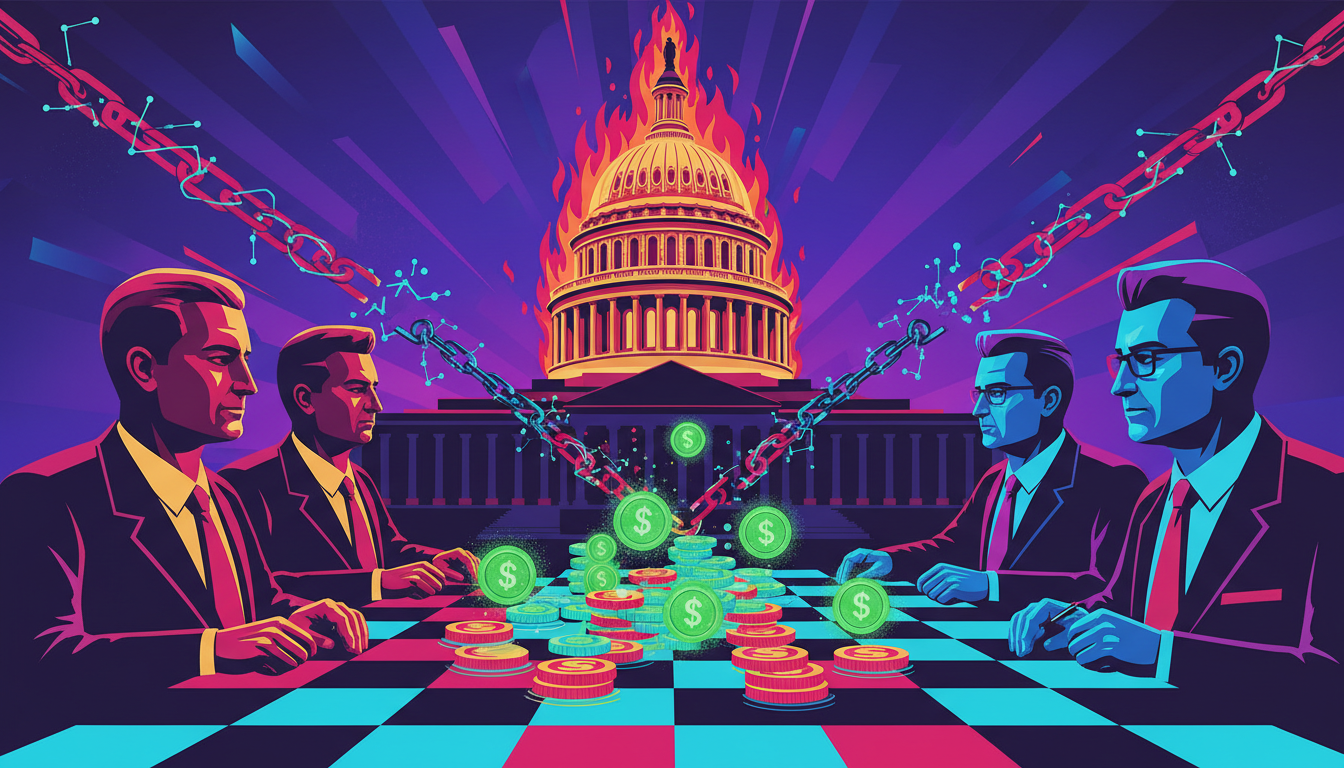
From the evening of March 26 to the early morning of March 27, Eastern Time, the official social media account of the White House experienced a bizarre time window: the account successively posted two videos with unclear meanings, along with three pixelated images in the style of Trump, all lacking titles, descriptions, or contextual explanations. The content was then quickly deleted, and the White House provided no official explanation, leaving only fragmented images and snippets of conversations that were re-shared and amplified on social media. For the highly sensitive cryptocurrency community, such "abnormal signals" are naturally seen as possible policy previews, internal hints, or even "cryptocurrency Easter eggs." Around these few pieces of content, the outside world began to pull between "technical accident," "political forecast," and "encrypted market overinterpretation," reflecting an increasingly tight coupling between the current political symbols and cryptocurrency narratives.
The White House Account's Bizarre Night: From Posting to Deletion
Looking at the timeline, between March 26 and 27, Eastern Time, the official White House account sequentially pushed out two videos and three images, overall presenting a deliberately "low-information" style. Both videos lacked accompanying text explanations, as well as common policy language or event introductions, leaving only a vague scene and a line of dialogue confirmed by multiple sources: "It will be published soon, right?" A response of "Yes" was heard off-screen. This line captured by Grok became almost the only confirmable semantic clue, yet it was too vague to point to any specific policy, document, or event.
More attention-grabbing were the three pixelated images that followed: the outline of the characters and hairstyles closely resemble the visual style of Trump, yet presented in a low-resolution pixelated manner, making them recognizable while retaining enough ambiguity. These pieces of content were uniformly deleted shortly after being published, and there were no official supplementary explanations, making the account's behavior appear like a complete "erasure" experiment or error. This combination of "untitled, unexplained, deleted, and zero explanation" left the maximum space for all speculation and formed the boundary of information uncertainty: the outside world only knows that these contents indeed existed and were removed but cannot confirm their original intent through official channels.
Cryptocurrency Community's Allergic Reaction: From the "Encrypted" White House to Conspiracy Sentiment
On social media, accounts specifically tracking the movements of political figures and institutional accounts immediately raised doubts, openly discussing whether the White House account had been hacked or was conducting some sort of encrypted signaling operation. Given that the subject of the event is the highly sensitive official institution of the White House, the cryptocurrency circle instinctively moved along its interpretative path upon seeing the combination of "abnormal behavior + pixelated Trump image": first assuming this could be some kind of "foreshadowing" related to cryptocurrency assets, regulatory attitudes, or election narratives, and then expanding around possible insider information and policy previews.
This allergic reaction is backed by a long-established interpretative inertia within the cryptocurrency community: once a political account exhibits atypical operations—whether it is ambiguous wording, abnormal deletions, or bizarre visual elements—it is often seen as "insiders leaking information," even being packaged as a "code only experts can understand." The pixelated Trump-style images quickly evoke narratives of elections and personalized political IPs; taking a step further, they can easily remind observers of meme culture, election-related tokens, or even broader power struggle topics. Some conspiracy theories and "false flag operations" associations emerged, but so far, they remain at the level of public sentiment, lacking verifiable evidence. This amplification route from "abnormal content" to "grand narratives" is precisely the cognitive trap the cryptocurrency community most needs to be cautious of.
How Political Symbols Amplify into Speculative Narratives on the Chain
To understand why the mysterious White House content could be quickly packaged as "encrypted signals," it is necessary to look back at the amplification paths of U.S. presidential statements regarding cryptocurrency in recent years. From Trump's and Biden's public comments on Bitcoin to candidates' remarks during campaigns releasing friendly or hostile sentiments towards digital assets, each instance has been narratively processed in the market: short-term fluctuations in Bitcoin prices and concentrated speculation on meme coins are often retrospectively attributed to a specific tweet or a speech excerpt, forming a causal illusion of "political language → chain-based speculative stories → price fluctuations."
In this process, political IPs and anthropomorphized images play the role of "narrative fuel." A recognizable face, along with a line of dialogue that is easily quotable and subject to remixing, can derive countless variations within the cryptocurrency world: from coins named after characters to meme projects packaged around political symbols, and to speculative stories woven around changes in regulatory tone. Their common characteristics are strong short-term emotion-driven, while the sustainability and fundamental support are extremely weak.
The content released by the White House account, due to its complete lack of context and policy explanation, is easily grafted onto existing templates: some interpret "It will be published soon" as a prelude to a policy shift, while others directly associate it with regulatory easing and a friendlier framework towards digital assets. The more ambiguous the information, the greater the space for imagination, and in the leveraged and emotionally amplified cryptocurrency market, this very imagination can be enough to stir significant emotional fluctuations, even if it may have nothing to do with real policies from the outset.
Macroeconomic Narrative Background: From Digital Credit to Institutional Bets on the Chain
If we broaden our view to a larger time scale, the current "hard narratives" surrounding digital assets are gradually taking shape. Just recently at the digital asset summit, Michael Saylor publicly stated that the next phase for digital assets will be "digital credit," which involves reconstructing the credit and leverage system on the chain. This judgment provides a framework far exceeding short-term price fluctuations: it is no longer just a discussion about spot or ETFs, but rather about how to inherently carry credit relationships, collateral structures, and risk pricing on the chain.
In-depth movements at the institutional level are reflecting this. Research reports show that a certain address bought 2000 XAUt at a price of $4390, totaling around $8.78 million. Such operations, which anchor the value of traditional commodities to the chain, essentially involve using on-chain assets to meet off-chain credit and asset allocation demands. Meanwhile, BlackRock's BUIDL Fund introducing Chronicle as a validation layer represents another form of "on-chain credit construction": through deep binding of traditional financial giants with on-chain infrastructure, it lays a foundation for larger scale fund circulation on the chain.
These advancements have clear sources of information, traceable fund scales, and explicit business logic, all pointing to institutional continued bets on digital assets and on-chain credit, forming a stark contrast to the mysterious content from the White House that lacked source explanations. The former belongs to verifiable, quantifiable "hard information," while the latter resembles "soft narratives" interpreted through emotional amplification in an information vacuum. In an environment of the coexistence of both, what investors truly need is the ability to distinguish information levels, rather than being led astray by the more dramatized end.
The Tech Capital Battlefield: Background Noise of Anthropic, X, and SpaceX
In near synchronicity with the White House account's abnormal operations, the U.S. tech capital market is also brewing its grand spectacle. According to public reports, the AI company Anthropic is considering an IPO in October, while X is laying off employees, and SpaceX is also preparing for its IPO. These movements sketch another narrative mainline in the U.S. stock market: AI, large models, and aerospace technology as the core tracks of the new round of capital chase continue to attract funds and attention.
From the informational perspective, Anthropic's IPO plan, X's organizational adjustments, and SpaceX's funding actions display the logic of "how capital selects tracks" and "how tech companies switch between the secondary market and private equity market." They do not constitute direct signals of cryptocurrency policy. However, in the narrative puzzle of cryptocurrency investors, "AI + big institutions + high technology + IPO" can easily be linked into a grand yet vague story: from "AI computing power → computing power tokens" to "aerospace technology → national strategy → more friendly or hostile regulatory deployments towards cryptocurrency," down to "platform layoffs → cost optimization → more aggressive financialization attempts," almost all news can be included in the same explanatory framework.
This tendency is driven by a typical expectation trading mentality: under conditions of incomplete information, every dynamic of high technology and large institutions is viewed as "the prelude to the next big market trend," with attempts to gain excess returns through early bets. The problem is that most of these associations are built on narrative resonance rather than causal verification. Once the market becomes accustomed to interpreting news this way, it is easy to see the White House's mysterious videos, pixelated images, and tech giants' IPOs as fragments to construct a "grand yet evidence-lacking" worldview, paying the price in terms of prices.
Trading in the Fog: Chasing Signals or Clarifying Information Levels
In summary of this event, a video with extremely poor semantics and a set of pixelated profile images, in the absence of any official explanation and context, were rapidly processed by the cryptocurrency community into "possible encrypted signals": some associated "It will be published soon" with new regulatory policies, others connected the pixelated Trump style with elections and meme coins, while some further interpreted it as false flag operations and geopolitical undercurrents. The entire process was almost completely based on serious information asymmetry and emotional amplification, and once someone is willing to believe, the market can spontaneously construct a whole logical loop.
In such an environment, the emphasis must be on risk boundaries: unverified "false flag operation" speculations and unfounded geopolitical interpretations should not become the basis for any serious trading decisions. Treating such narratives as primary investment cues is akin to using the most fragile variables to bear the greatest risks, which goes against the principles that professional investing should pursue: "information must be falsifiable, logic must be retraceable."
For cryptocurrency investors, a more pragmatic approach is to prioritize anchoring those elements that can be tracked and verified when facing highly uncertain events: verifiable on-chain data, real fund flows, adjustments to institutional product structures and governance frameworks, as in the aforementioned $10 million level purchase of XAUt, or BlackRock BUIDL introducing Chronicle validation layer, such incidents are "hard variables" that can enter risk control frameworks. As for information fogs like the mysterious White House video, they are more suitable to be categorized under sentiment observation and public opinion management, rather than acts as core bases for asset allocation.
In a market where narrative noise and price volatility are highly coupled, the real advantage often lies not in who sees the so-called "signal" first, but in who can more calmly distinguish what is a factual bet and what is merely material for storytelling.
Join our community to discuss and get stronger together!
Official Telegram community: https://t.me/aicoincn
AiCoin Chinese Twitter: https://x.com/AiCoinzh
OKX Welfare Group: https://aicoin.com/link/chat?cid=l61eM4owQ
Binance Welfare Group: https://aicoin.com/link/chat?cid=ynr7d1P6Z
免责声明:本文章仅代表作者个人观点,不代表本平台的立场和观点。本文章仅供信息分享,不构成对任何人的任何投资建议。用户与作者之间的任何争议,与本平台无关。如网页中刊载的文章或图片涉及侵权,请提供相关的权利证明和身份证明发送邮件到support@aicoin.com,本平台相关工作人员将会进行核查。