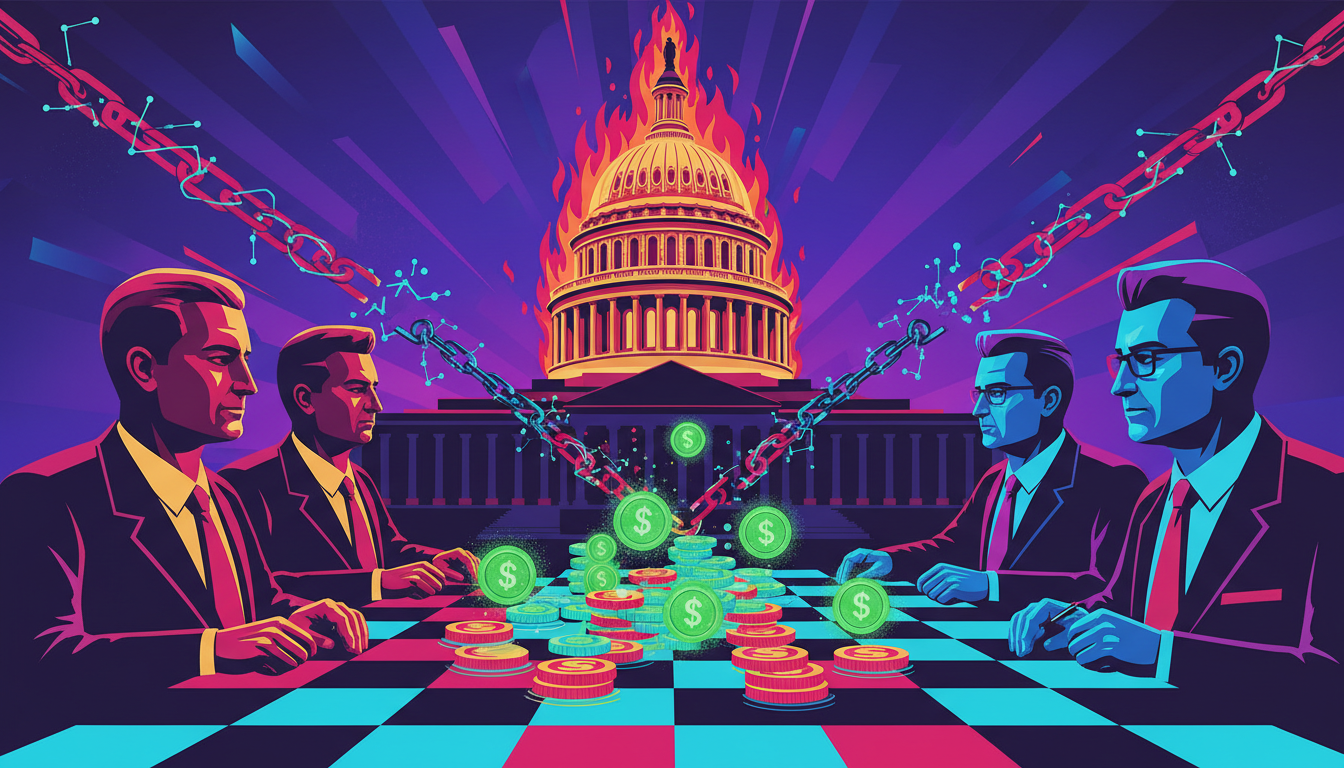
On March 27, 2026, Beijing time, around the AI ban issued by the Trump administration, a judicial counter-offensive initiated by Anthropic reached a critical point: Federal District Judge Rita Lin in San Francisco approved a preliminary injunction, temporarily pressing the pause button on the Pentagon's "ban" against its AI tools, allowing a 7-day appeal window for the U.S. Department of Justice. On one side is the presidential and defense system directive initiated under the guise of "national security" and "supply chain risk," while on the other side is the AI company claiming it is "very likely to win" on the substantive issues of the case. The discourse of national security clashes head-on with corporate freedom/speech in court. This is not only about the fate of a vendor but could also redefine how future AI companies engage with governments, releasing regulatory and compliance signals intertwined with broader AI and cryptocurrency landscapes.
The Chain from Presidential Directive to the Ban on AI Tools
This dispute can be traced back to February 27, 2026. According to existing public materials, the presidential directive issued that day and the subsequent so-called Hegseth directive were used to establish a legal and administrative basis for imposing restrictions on specific AI service providers. Within the defense system, such directives are often cascaded down through contract clauses, compliance checklists, and access controls, ultimately manifesting in the execution stage as the prohibition, suspension, or tightening of access permissions for certain tools, thus bringing Anthropic's AI tools under the restrictions.
Subsequently, on March 3, the government further included the AI military cooperation environment of Anthropic within the "risk framework" through the publicly disclosed " supply chain risk designation measures." This kind of "designation" is not merely a symbolic label but may affect military procurement lists, compliance reviews, and even carry requirements for downstream contractors, effectively placing partners using Anthropic technology under potential scrutiny, creating pressure on their commercial prospects and contract stability.
In public statements, the government has consistently packaged these actions under the narrative of "national security" and "supply chain risk management", emphasizing that in highly sensitive defense technology fields, absolute control and alternatives must be maintained for critical technology suppliers. However, from the current materials available, there are clearly ambiguous areas in the specific definitions of "risk," evidence support, and transparency standards within the directive, leaving room for outside speculation on whether there is selective application or even a preference for policy that sends "cooling signals" to uncooperative technology companies.
San Francisco Judge Temporarily Presses the Pause on Injunction
In this context, Anthropic sued the Trump administration and the Pentagon in federal court, seeking to stop the blanket ban on its AI tools. According to information disclosed at March 27, 2026, Beijing time, Federal Judge Rita Lin made a critical move: approved a preliminary injunction, suspending the government ban on Anthropic's AI tools. In simple terms, until the substantive issues of the case are thoroughly reviewed, the government cannot immediately exclude Anthropic from the usage list based on relevant directives.
It is worth emphasizing that this preliminary injunction is essentially a procedural victory, not a final ruling. At this stage, the court is merely assessing the possibility of harm, likelihood of winning, and public interest, deciding to maintain the status quo to prevent irreparable harm before the case has been fully adjudicated. The ruling also clearly states that the U.S. Department of Justice has been granted a 7-day appeal window, allowing it to challenge this pause measure in a higher court; the procedural battle has just begun, far from the moment of final settlement.
In a public statement, Anthropic provided a clear interpretation of this development, expressing " thanks to the court for its swift action... likely to win on the substantive issues of the case." Such wording carries a strong positional color within the litigation context, aiming to convey a signal of "the law is on our side" to stabilize the expectations of partners and investors. However, from the perspective of judicial procedure, the judge has not made a final determination regarding constitutionality or legality at this time, and the market and media's understanding of this statement needs to distinguish between the parties' claims and the actual court ruling.
National Security Collides with Freedom of Speech and Business Freedom
As the case becomes public, many legal and tech commentators have begun to interpret it as a direct confrontation between national security demands and the commercial freedom/speech of tech companies. On one hand, the government claims that in highly sensitive fields of defense and intelligence, it has the right to screen or even exclude specific technology suppliers based on preventive standards, even if these companies have extensive influence in the civilian market. On the other hand, Anthropic questions whether such "ban-style" measures constitute excessive intervention in normal business operations, technical expression, and customer communication from the standpoint of contractual relationships and constitutional protections.
In media commentary, some commentators place this case within the framework of "First Amendment retaliation" controversies, arguing that if the government's adverse measures against a tech company are related to the company's expressions in certain policies, business decisions, or positions on technology openness, this may touch upon the issue of "retaliation" against protected speech. It should be clarified that this statement currently represents some commentary viewpoints, and specific legal wording remains to be verified, and it cannot be equated to a conclusion already issued by the court.
Nevertheless, Judge Rita Lin used terms like "disturbing" in her public statements about government actions; such language is not taken lightly in the federal judicial context and often serves as an early warning of potential constitutional risks. The signal it sends is that the court at least considers the government actions to be questionable in terms of procedural rationality, evidentiary basis, or boundaries of power, enough to support the decision to pause execution. This also sets the stage for deeper legal confrontations surrounding the First Amendment, due process, and the boundaries of administrative power.
Exploding Old Grievances between the Trump Administration and Silicon Valley on the AI Battlefield
To understand the depth of this conflict, one cannot overlook the long-standing mistrust between the Trump administration and Silicon Valley tech companies. From early disputes regarding social media content control and algorithm transparency to repeated maneuverings around cloud computing, AI military applications, and defense contract bidding, both sides have clashed multiple times over questions like "who controls key infrastructure" and "who decides which technology serves whom."
AI military applications are one of the most sensitive points of this rift. The Trump administration emphasized that technology needs to serve the defense and geopolitical objectives of " America First" directly, harboring natural wariness towards tech companies hesitant about military projects or maintaining distance from algorithmic weaponization. The ban on Anthropic's tools and risk designation has been viewed by many observers as a continuation or even amplification of this line of contradiction: power is no longer directed at an abstract "Silicon Valley" but is focused on a specific AI supplier, exerting pressure at the contract and compliance level, attempting to reshape its behavioral boundaries.
Regardless of how this lawsuit ultimately concludes, it could have a chain reaction on how the Pentagon selects and manages AI suppliers in the future. One possible path is that the defense department will further strengthen the weight of "control" and "political reliability" assessments, incorporating more compliance and policy consistency clauses into contracts; another possible scenario is that, under the pressure of judicial and public oversight, the department is forced to enhance decision-making transparency and provide clearer mechanisms for appeals and arbitration to technology companies. No matter which direction it takes, this case is compelling the military and tech companies to redefine their rules of engagement.
Interpretation of Procedural Victory in the Market and Public Opinion Arena
In the eyes of the media and observers, this preliminary injunction was quickly endowed with symbolic significance beyond just the individual case. Some journalists and commentators—including widely cited observer @Hadas_Gold—described it as a form of "check" on government actions, believing that the judicial system still demonstrates a degree of independence in the face of national security. Such views essentially belong to commentary voices, emphasizing the logic of institutional checks and balances rather than factual adjudication of the case itself.
Because of this, many analyses view this case as the first instance of an AI company publicly opposing a government ban and achieving a procedural breakthrough. Although the injunction merely pauses execution and does not overturn the ban itself, it symbolically indicates that even when facing the strongest trump card of "national security," AI companies still have an opportunity to leverage legal means to negotiate for discourse and bargaining chips, testing the practical elasticity of regulatory and review boundaries for the entire industry.
From a broader perspective of the technology industry, other AI companies will certainly revisit their strategies regarding government contracts, compliance layouts, and speech risk assessments due to this case. This includes whether to reserve contractual protection clauses for potential policy shifts before cooperating with the government; how to reduce the probability of being labeled as a "security risk" while maintaining technical openness and business expansion; and how to balance opinions on policies with the maintenance of future cooperation space in public communications. These responses may not be immediately visible, but they are quietly changing AI enterprises' risk pricing models for "government clients."
The Crossroad of AI Regulation and Industry Post the Seven-Day Appeal Period
Procedurally, the current seven-day appeal period is just the beginning of a long tug-of-war. Whether the Department of Justice will appeal, how the appellate court will interpret the legal basis of the preliminary injunction, and the subsequent substantive hearings weighing the First Amendment, administrative power, and contract freedom all contain a high degree of uncertainty. Any specific predictions about the direction of the final ruling or whether higher-level courts will intervene go beyond the current informational boundaries.
It is anticipated that subsequent appeals and hearings will reshape the government's procurement, prohibition, and review boundaries when faced with AI technology in practice: When can national security labels override contractual and speech freedoms, what evidentiary thresholds and transparency levels need to be met for administrative directives, and can defense agencies adjust technical partnerships without being seen as engaging in "retaliatory actions." These are not simple yes-or-no questions but rather nuanced adjustments of institutional level intricacies.
For encrypted tracks that are rapidly binding with AI, this case similarly marks several noteworthy footnotes. First, compliance red lines do not only exist in financial regulatory clauses; national security and supply chain discourses can similarly change business trajectories at critical moments; second, products involving model outputs, content review, and user interaction inherently carry speech risks, and once entangled with public power, constitutional issues like the First Amendment could be activated; third, once labeled as "national security risks," their influence will often spill over into capital market pricing, partner confidence, and even long-term trust from the technical community in projects.
After the seven-day window, the story will not end; it will just continue in a different format. But for all projects exploring the intersection of AI and cryptocurrency, Anthropic's battle against the Trump AI ban has already served as an ample reminder to the industry: what truly determines survival is often not the next round of technological iteration but rather how much safety buffer you have reserved between yourself and the discourses of regulation, justice, and national security.
Join our community to discuss together and become stronger!
Official Telegram community: https://t.me/aicoincn
AiCoin Chinese Twitter: https://x.com/AiCoinzh
OKX benefits group: https://aicoin.com/link/chat?cid=l61eM4owQ
Binance benefits group: https://aicoin.com/link/chat?cid=ynr7d1P6Z
免责声明:本文章仅代表作者个人观点,不代表本平台的立场和观点。本文章仅供信息分享,不构成对任何人的任何投资建议。用户与作者之间的任何争议,与本平台无关。如网页中刊载的文章或图片涉及侵权,请提供相关的权利证明和身份证明发送邮件到support@aicoin.com,本平台相关工作人员将会进行核查。