Original author: 0xJeff
Original compilation: AididiaoJP, Foresight News
This article aims to briefly compare the Bittensor subnet and Virtuals agents, to help understand their respective flywheel mechanisms, differences, and similarities.
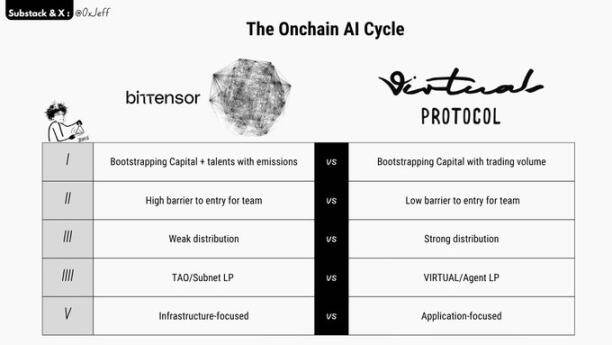
1. Guiding funds and talent through emission mechanisms vs Guiding funds through trading volume
Bittensor guides subnet development through the TAO emission mechanism. Subnets are responsible for introducing the most innovative projects (or revenue-generating businesses) and competing for a daily share of 3,600 TAO.
Subnets also guide contributors (including miners performing tasks and validators validating miners' work) through their alpha token emission mechanism. The emission mechanism and the incentive coordination mechanism among stakeholders are embedded from the beginning of the project.
Virtuals adopts a model similar to pump.fun, guiding development through trading volume. High trading activity translates into the accumulation of capital for agent projects. The agent team can use their own emission mechanisms to incentivize user participation.
During market cycles of high speculative token demand, this model has significant advantages—teams can rapidly accumulate capital, gain product attention and market interest, thereby driving project initiation and development.
2. High entry barriers vs Low entry barriers (for teams)
Launching a subnet on Bittensor requires a substantial investment. Currently, acquiring a subnet seat requires 871 TAO (approximately $300,000), with prices fluctuating according to demand and auction mechanisms. This means subnet teams typically need to have mature concepts, clear planning, and strong execution capabilities.
To successfully operate a subnet, owners must ensure that the tasks or goals they set contribute to the development of their artificial intelligence products/solutions, while also preventing miner fraud, ensuring validators effectively fulfill their verification responsibilities, and generating revenue through business development and customer cooperation, as well as maintaining investor confidence through a buyback mechanism.
The subnet token price must maintain an upward trend to attract more TAO inflows, enhance the subnet emission share, and subsequently attract higher-level contributors to participate in mining.
In contrast, the barriers to launching artificial intelligence agent tokens on Virtuals are lower, allowing initiation without initial costs, making it easier to test new ideas with less capital.
Virtuals also has a "60-day plan," allowing founders to test new ideas and issue tokens during this period. If no product-market fit is found within 60 days, the relevant funds will be returned, and investors can reclaim part of their invested capital.
3. Weaker distribution capability vs Stronger distribution capability
Bittensor operates independently on a blockchain built on the Polkadot Substrate framework, making cross-chain bridging difficult, lacking essential decentralized finance components, and not equipped with common infrastructure like the Ethereum Virtual Machine or Solana.
This results in a higher entry barrier for the Bittensor ecosystem. Additionally, the relevant learning materials are filled with complex terminology, increasing the difficulty for new users to learn and understand. Therefore, its community members are mostly specialized technical individuals who are willing to invest time in in-depth research, while retail participation is relatively low.
In contrast, the understanding barrier for Virtuals is lower. Its team excels in marketing, brand communication, and distribution, allowing retail users to intuitively understand concepts related to artificial intelligence agents, agent payments, and robots.
Since Virtuals is deployed on the Base chain, the purchasing process for artificial intelligence agent tokens is convenient. Users spend a shorter time going from understanding the project to forming a positive judgment and making a purchasing decision, which is a significant reason for its rapid adoption between the end of 2024 and early 2025 (earlier than Bittensor).
Currently, Bittensor is gradually entering mainstream visibility under the promotion of Jason, Chamath, Barry Silbert (DCG and Yuma), and the community, gaining some attention. However, the purchasing process for its subnet tokens is still quite complex, and the problems have not yet been fundamentally resolved.
4. TAO/Subnet liquidity pool vs VIRTUAL/Agent liquidity pool
Bittensor and Virtuals have key similarities in their liquidity pool flywheel mechanisms.
Investors wishing to purchase subnet alpha tokens must hold TAO to operate. Therefore, the rising demand for alpha tokens will drive up the price of TAO.
Similarly, in the Virtuals ecosystem, the increasing demand for artificial intelligence agent tokens will also drive up the price of VIRTUAL.
If the core tokens (TAO or VIRTUAL) can cycle internally within the ecosystem without flowing out (for example, projects retaining value through trading goods and services among each other), then the advantages of this mechanism will be even more apparent.
5. Infrastructure-oriented vs Application-oriented
Bittensor subnets tend to focus on infrastructure or capital-intensive businesses, such as decentralized computing, inference, training, drug development, and quantum experiments.
Since Bittensor can provide over $10 million annually in funding support for quality subnets and attract high-end talent participation, its model is suitable for promoting grand ideas that are high in difficulty and investment.
On the other hand, the agent teams of Virtuals focus more on application layers and consumer-facing intelligent agent products. With the initial price of agent tokens being relatively low, if the team can launch high-quality consumer-grade products, they can quickly attract attention and drive project development through the market hype of the tokens.
Thanks to Virtuals' advantages in distribution, the flywheel effect of artificial intelligence agent tokens shows faster growth rates and higher increases during periods of extreme market activity (such as late 2024 to early 2025).
免责声明:本文章仅代表作者个人观点,不代表本平台的立场和观点。本文章仅供信息分享,不构成对任何人的任何投资建议。用户与作者之间的任何争议,与本平台无关。如网页中刊载的文章或图片涉及侵权,请提供相关的权利证明和身份证明发送邮件到support@aicoin.com,本平台相关工作人员将会进行核查。


