Original title: how to survive what comes next (full playbook)
Original author: @hooeem
Translation: Peggy, BlockBeats
Editor's note: Against the background of AI acceleration, geopolitical conflicts, and a high-interest-rate cycle, market discussions are shifting from "how long can growth last" to a more fundamental question: what happens when a debt-based system faces deflationary technological shocks?
This article starts from a series of ongoing macro signals, such as rising sovereign debt pressures, energy price disturbances, declining consumer confidence, and changes in employment structures, outlining a more tense scenario: on one hand, AI brings unprecedented productivity gains; on the other hand, this "efficiency dividend" may translate into demand contraction and default risks in a highly leveraged system, even amplifying systemic vulnerabilities. At the same time, the evolution path of past asset bubbles provides a reference point for the current fervor surrounding AI valuations.
Within this framework, the article shifts the focus back to individuals: when structural uncertainty becomes the norm, how should individuals build "anti-cyclical capabilities" in financial, career, and cognitive aspects? From cash flow defense, skill stacking, to long-term asset allocation, the core is not about predicting turning points, but about enhancing survival and choice capabilities in uncertain environments.
Below is the original text:
We are gradually heading towards a fully erupted financial crisis. It will either make you or destroy you.
And this depends on two things: do you choose to ignore it, or do you prepare in advance?
First, I need to clarify a few points:
1. I am not a pessimist. However, some of what I will mention next may make it seem like I am being negative. But that is just reality itself; I actually view everything with a relatively optimistic attitude.
2. Am I an expert? Certainly not. But I will put my money where my judgments are—whether in market decisions or life choices.
I understand that in the short term, the market may see some relief or even an increase (some may quote this to mock me). But what I am talking about is not the market for this week, but trends over a longer cycle. Because I do spend time doing in-depth research to understand what is happening. And right now, there is a lot happening, and it is not just about the war in Iran.
But we can start from this point.
Oil, energy, and that "invisible tax"
The Middle East war, damage to key infrastructure, threats of further destruction, escalating situations while pretending to "cool down," combined with strait issues—these factors will clearly push oil prices up. And rising energy costs are essentially an "invisible tax" that will ultimately be transmitted throughout the supply chain, raising the living costs of ordinary people.
What will happen next? Interest rates will rise, and people's financial pressures will be constantly squeezed, with more and more people unable to afford their mortgages and unable to pass the refinancing affordability assessments, forced to switch to variable rates. And this rate is likely double what they paid before in the low-interest era (like the 1% fixed rate locked in last December).
Yes, the situation is not optimistic at all. In such an environment, consumer spending will obviously be compressed and may even gradually "suffocate."
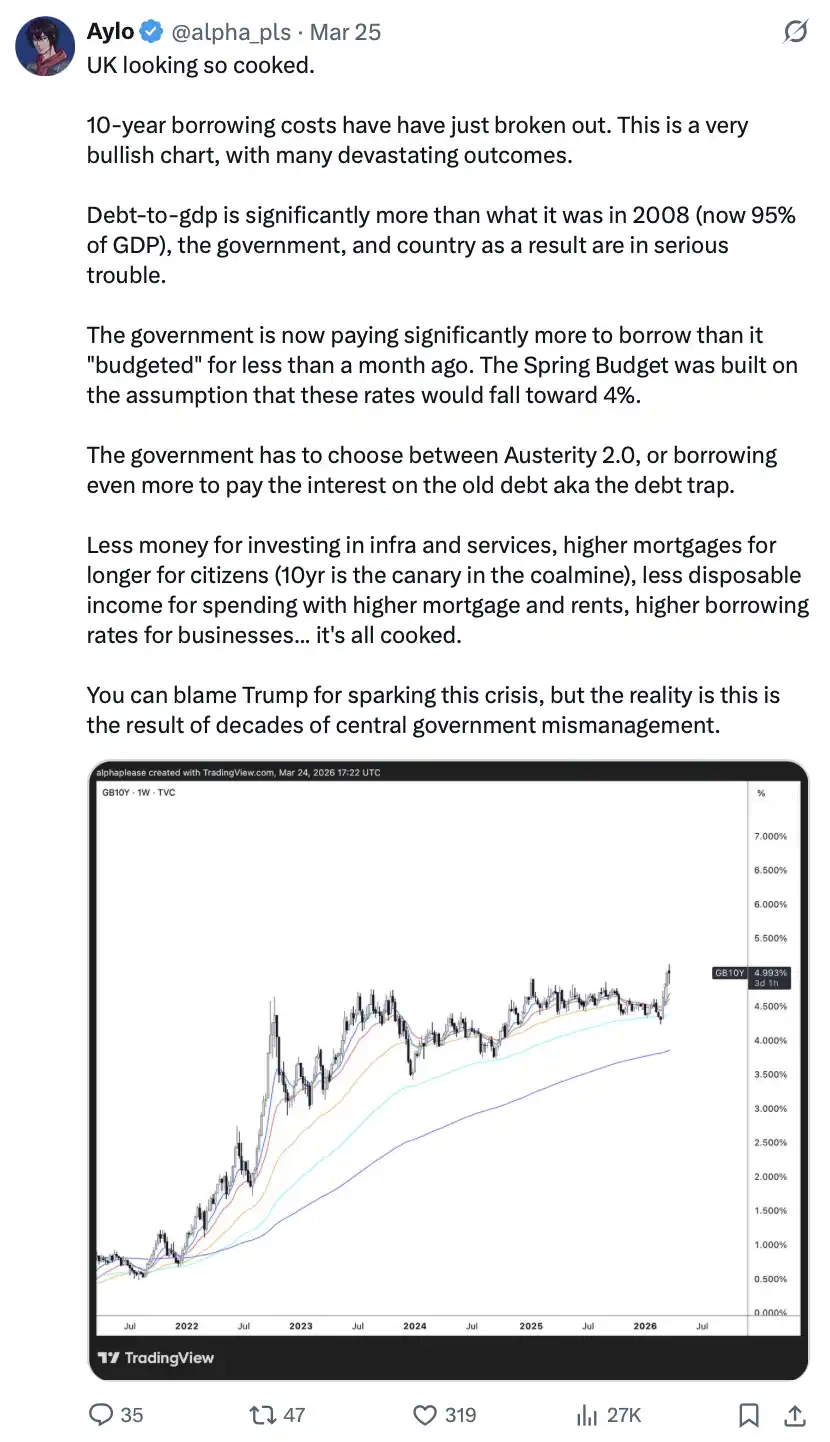
The situation in the UK can be described as "completely terrible." The cost of borrowing for 10-year loans has just shown a significant upward breakthrough. From the chart, this is a typical "bullish rate" trend, but the underlying reality corresponds to a series of potential severe consequences. Currently, Britain's debt-to-GDP ratio is far higher than it was in 2008 (now around 95%), and both the government itself and the entire country's fiscal situation are in a rather severe predicament. More critically, the government's current borrowing costs are now far above the levels set in the budget less than a month ago. The spring budget at that time was based on the assumption that rates would fall back to nearly 4%. Now, the government must choose between two unfavorable options: either restart austerity measures (Austerity 2.0) or continue to borrow more money to pay off old debt interest—essentially falling into a so-called "debt trap." The result is: funding for infrastructure and public services is reduced, residents will endure high mortgage rates for a longer time (the 10-year rate has become an important warning signal), disposable income will further decline under the rising pressure of mortgage and rent, and corporate financing costs will also continue to rise... Overall, the situation has deteriorated comprehensively. You can attribute this crisis to Trump's policy triggers, but the more realistic situation is: it is the result of years of mismanagement by the central government.
Oh, and now, the United States is doing everything possible to keep this under control...
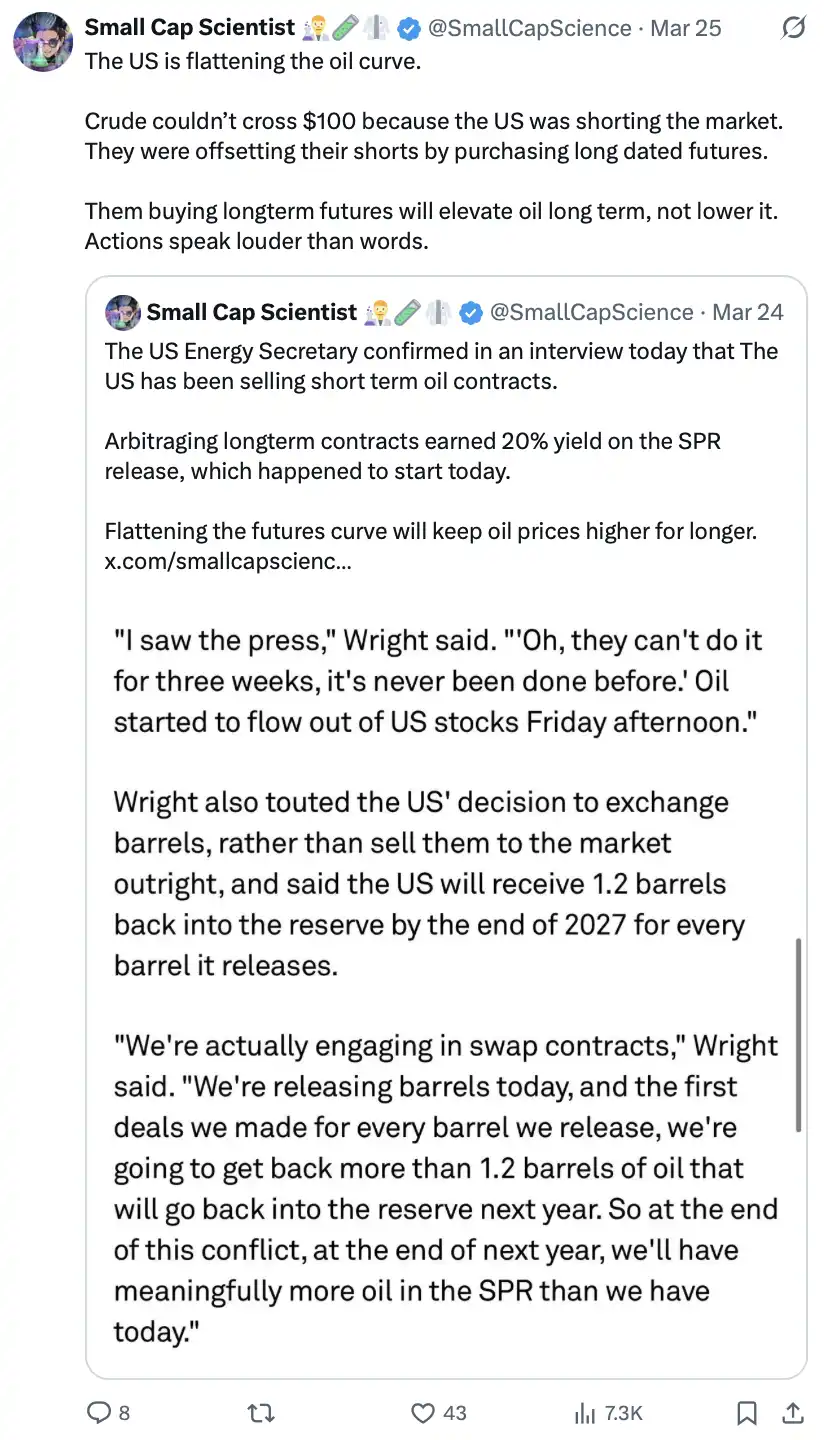
The core of this content is: the United States is "intervening" in the structure of the crude oil market through financial means. The specific approach is to short-term crude oil contracts to suppress rising oil prices (preventing them from exceeding $100) while buying long-term futures for hedging, thereby "flattening the futures curve." This operation can indeed stabilize oil prices in the short term, but it is also raising long-term oil price expectations. At the same time, the United States is also releasing strategic petroleum reserves (SPR) and using arbitrage through long and short-term contracts and "swap contracts" to achieve a release of oil while aiming to regain more reserves in the future (every barrel released will lead to an approximate return of 1.2 barrels in the future). Overall, this is a "short-term price control, long-term pressure transfer" strategy—current stability may mean higher oil prices in the future.
Sovereign Debt Death Spiral
The scale of U.S. Treasury debt has just surpassed $39 trillion. This figure alone is alarming enough.
At the same time, the government generates around $5.4 trillion in annual revenue, but expenditures are close to $7 trillion. Approximately 120% of fiscal revenue is consumed by the welfare expenditures for the baby boomer generation, historical debt interest, and defense spending.
You can view these data in real-time on @USDebtClock_org.
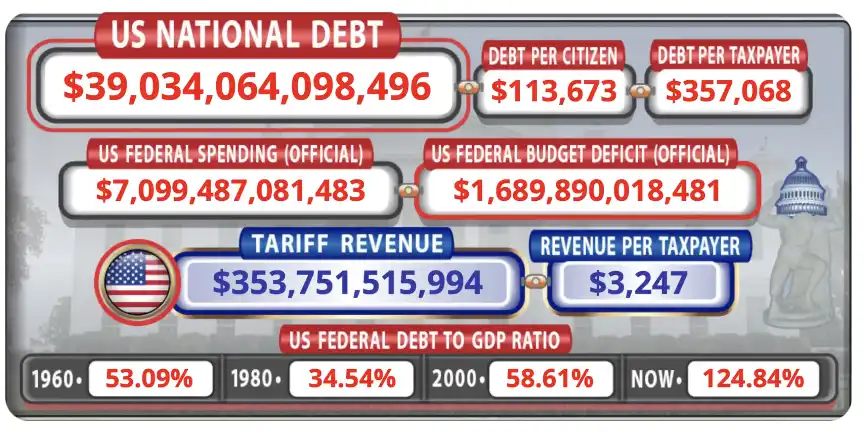
The situation will only worsen from here. If the government cuts spending, GDP will contract, resulting in a worse "deficit-to-GDP ratio," creating a trap with no clean exit.
So, when debt is mathematically unviable to repay, what do governments typically do in history? They either "print money" (creating currency out of thin air) or divert attention through war, sometimes both occur simultaneously.
And across the Atlantic, your old friend the UK has already begun to fall into a "vicious cycle": public sector wage increases surpass inflation, forcing the government to raise taxes; higher taxes stifle economic growth; a struggling economy further necessitates more "money printing." This cycle continues. Meanwhile, the yield on UK 30-year bonds has surged to its highest level since 2008, with the bond market effectively questioning the creditworthiness of the UK government.
Looking globally, the spread between U.S. 10-year Treasury yields and Japanese government bonds is narrowing, while the yen weakens, which is a textbook "sovereign debt death spiral" warning signal.
AI Deflation / Bubble Threat
AI represents the fastest technological acceleration in human history, and massive productivity gains are on the horizon. This sounds wonderful until you realize where the problems lie.
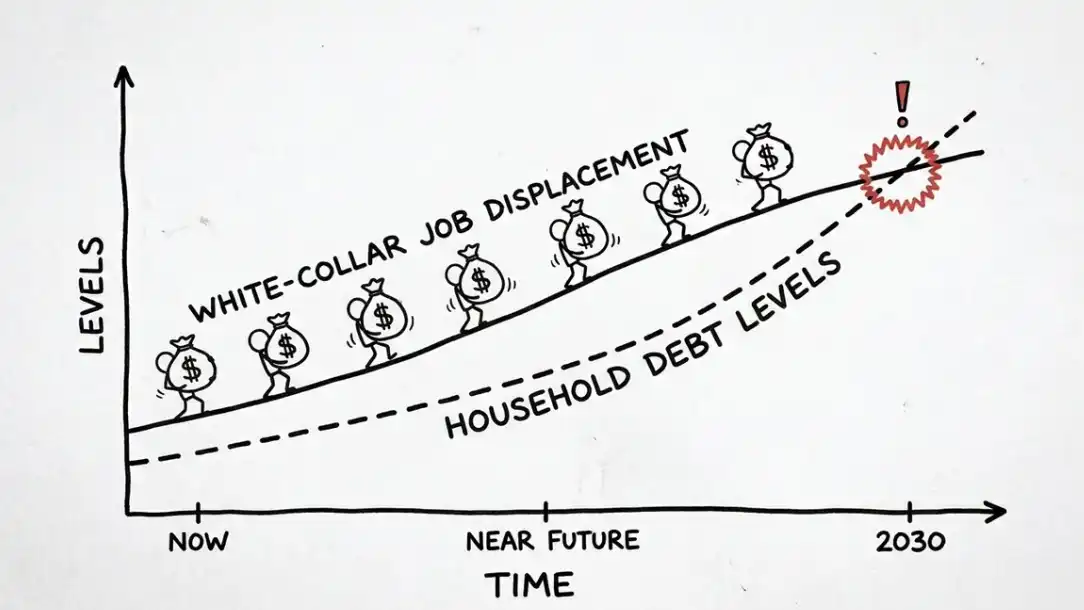
We are in a debt-based economic system. In a highly leveraged economy, large-scale "deflationary productivity improvements" do not lead to prosperity but may directly ignite the entire system. White-collar workers typically bear mortgages, car loans, and irremovable student loans. AI does not need to replace all jobs; even a small percentage of job displacement can trigger a crisis, resulting in systemic defaults at the banking level.
Read this sentence again. "What if AI itself is a bubble?" The flip side of this issue is: AI may also represent a bubble, and when bubbles burst, the consequences are never gentle.
History has provided similar paths:
1929: People borrowed to the limit to buy stocks and durable goods, and banks nearly lent every penny; when the music stopped, there was no buffer.
2000: Investors poured billions into companies just because their names had ".com"—no revenue, no plan, and it didn't matter until the cash flow broke.
2008: Banks issued mortgages to unemployed individuals, while rating agencies marked these toxic assets as "AAA," as if awarding elementary scholarships, ultimately erasing twenty million jobs worldwide.
And today? Some analysts watching AI company valuations are already starting to feel the same unease. The entire system essentially operates on a credit bubble.
Austrian school economists have warned about this for decades: either proactively pop the bubble (at the cost of a severe economic recession) or currencies themselves are destroyed (leading to hyperinflation).
You can only choose between the two.
Early Warning Signals
These are not predictions, but signals that are currently happening: consumer confidence has fallen to historical lows, and the engine of consumption is stalling.
The government bond market is exhibiting anomalies, resembling signs of "capital flight" typically seen in emerging markets.
Survival signals in daily life are becoming increasingly evident: some people are starting to use Klarna to pay for fast food and daily necessities in installments; enlistment numbers in the military have surged; graduate school enrollment has significantly increased (translation: unable to find jobs).
Corporate-level pressures are also evident: technology companies are using overseas labor or directly employing AI to replace domestic workers.
Don't believe it?
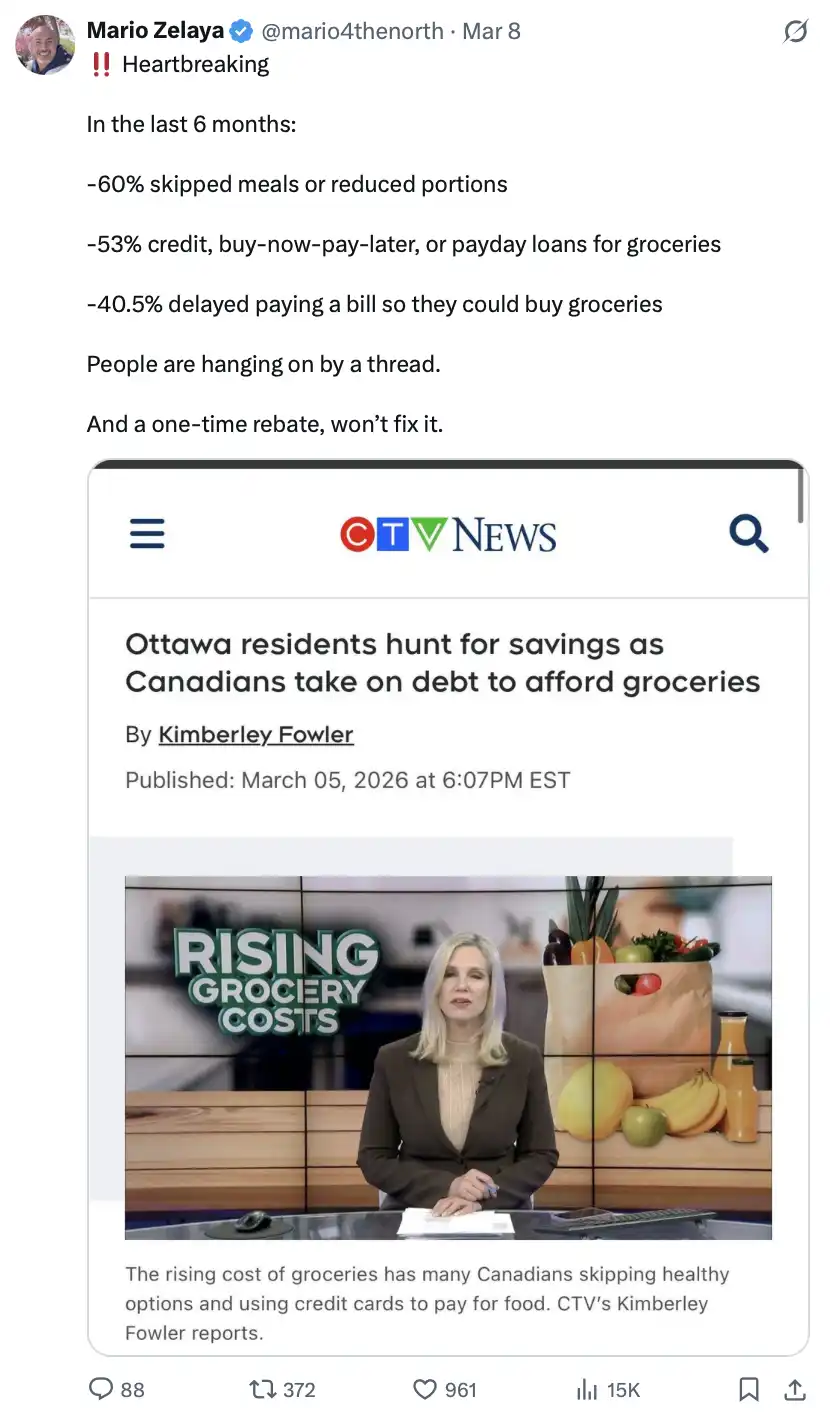
Data shows that over the past six months, 60% of individuals have reduced their food intake or portion sizes; 53% have relied on credit, installments, or high-interest loans to buy food; 40.5% have delayed paying bills to afford food. Overall, this points to one conclusion: many people are already "struggling to maintain," living on the brink of collapse, and one-time subsidy policies cannot fundamentally resolve the problem.
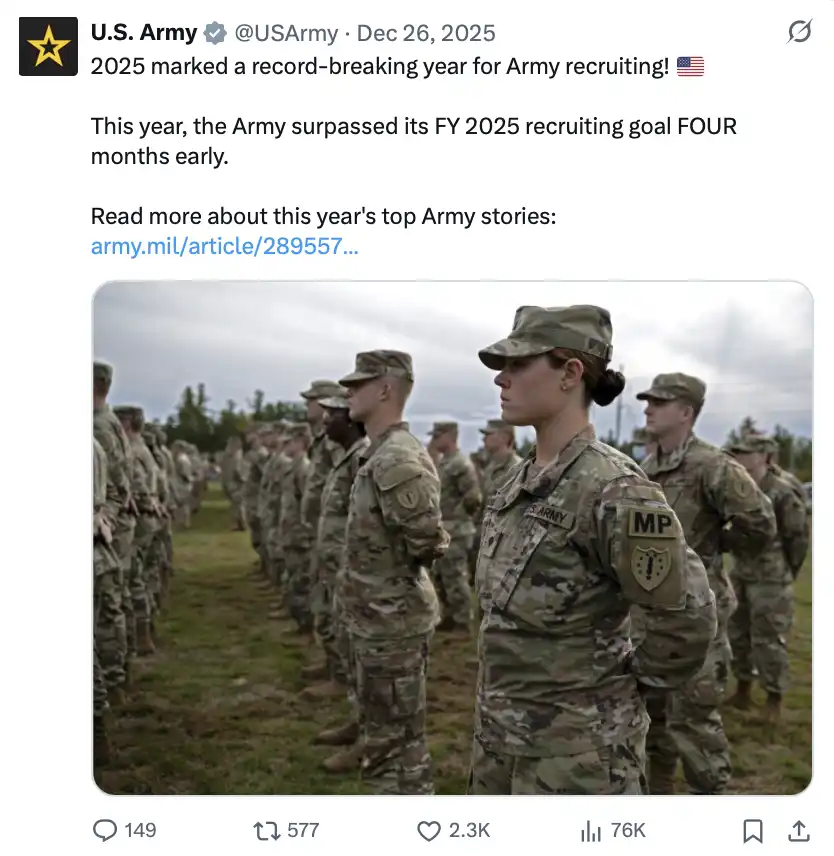
By 2025, U.S. Army recruitment numbers have set records and achieved the annual target four months early. In a macro context, this is often interpreted as: when economic opportunities decrease and the job environment tightens, more people will choose to join the military as a stable path.
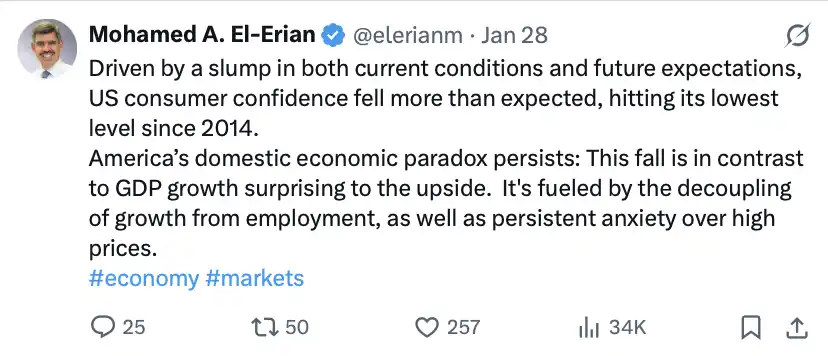
The core of this content is: the U.S. economy is experiencing a "data and perception disparity." On one hand, consumer confidence has plummeted, now at its lowest level since 2014; on the other hand, GDP growth has exceeded expectations. Behind this "economic paradox" is the decoupling of growth and employment, as well as the persistent anxiety brought by high prices—meaning that while macro data looks good, the actual experience of ordinary people is worsening.
Well, there is already enough evidence, so what should we do? Sit there and complain about the unfairness of fate and sigh? Certainly not.
What we need to do is first recognize the existence of this situation, then prepare for it to survive.
How to Cope (Action Guide)
The following content can be seen as an actionable checklist.
We need to face it with a "half glass of water" mindset. Act with a pragmatic and hardworking attitude, while also believing that things will eventually improve. This is not the end of the world. Precisely because we are clear about this, we can be bold when we need to take risks.
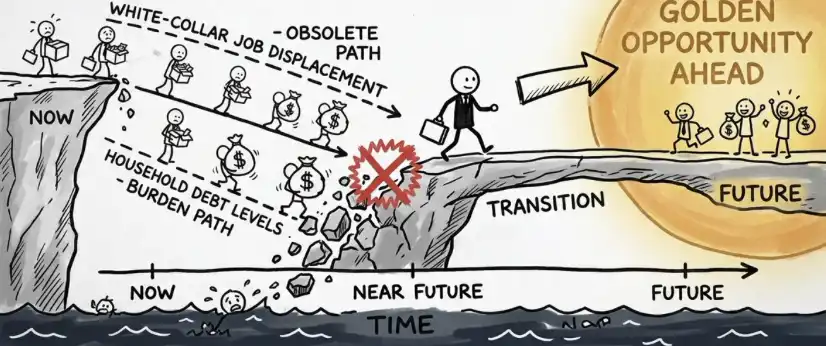
Immediate Financial Defense
Establish an emergency fund that can cover 3 to 6 months of "minimum living expenses." This priority is above all else aside from minimum repayments. If you currently have no savings, start by saving your first $1,000 immediately.
This is not optional. Do not borrow money to consume. If a large necessary expense must be made, try to lock in a fixed rate now. In a recession cycle, variable rates can drag you down.
Clear credit card debt as soon as possible. During economic downturns, variable rates usually rise. Be proactive in repayment; if necessary, call the bank to negotiate lower rates—there is no cost to asking, and data shows that about 70% of people can negotiate successfully. Alternatively, you can consider transferring to a 0% interest balance transfer credit card, but make sure to calculate whether you can pay it off before rates go up.
Do not guarantee loans for anyone. Almost 40% of guarantors end up repaying for borrowers. If you want to help others, give cash directly or offer private loans. In any case, protect your credit record. These may seem basic, but they are crucial.
Career and Income Protection
Do you hate your boss? Understandable. But if you have no alternatives, recklessly quitting just because "you don't like your boss" in a tightening job environment with fewer recruitment opportunities and replaced positions—consider yourself fortunate.
Continuously enhance your skills, especially learning to utilize AI. It could also be in other directions. YouTube, Udemy, Khan Academy, coding bootcamps—most are free or very low-cost. Learn programming, learn SEO, stack skills that make you harder to replace or enable you to start a side business.
Start a side job. Freelancing, online services, handmade products can all work. On average, a side job can bring in about $500 a month, and this money will build a safety net while you sleep.
Investment and Wealth Strategy
Ignore the panic created by media. Economists predict recessions almost every year, and "panic messaging" will only lead you to make emotional decisions that ruin your portfolio.
In the long term, the S&P 500 index is trending upwards—after all, it represents the 500 top companies in the U.S. If you are prepared, this phase might actually be a good time to increase your risk assets. I would do this, while also allocating as much Bitcoin as possible at the right time, continuously dollar-cost averaging and building up positions beforehand.
Markets will eventually recover. If you miss the ten best days of market performance, you almost miss out on most of the gains. Therefore, when the market has already dropped by 25%–35% (using the S&P as an example), and someone tells you it will get worse, that may actually be the time you should take on more risk.
Believe in the power of time. A Schroders study covering 148 years of data shows: investing for one month has a loss probability of about 40%; for one year, it drops to 30%; and investing for 20 years results in nearly zero probability of loss.
Take a longer view. You may not need to wait 20 years, but at least think in terms of a cycle. Or, you can be like a "cockroach that won't die."
Do you know who this person is?

Well, this guy is one of the wealthiest people in human history. He died in 1525, having controlled nearly 2% of GDP across Europe... and the reason he was able to do this was simply that he "survived like a cockroach."
Today, "being like an indestructible cockroach" probably means: cash + commodities + stocks, balanced allocation.
This combination can allow your assets to continue to compound growth across different cycles. However, this is more suitable for people with larger amounts of capital; it may not make you rich but will help you maintain stability.
If you have cash, I personally would still consider making some allocations further down the risk curve, such as buying more when Bitcoin drops to around 70%. Of course, this is just my view and does not constitute advice.
Remember: when everyone is panicking and selling off, those willing to take on risk have the opportunity to gain enormous wealth returns.
Next, there is an often-overlooked but extremely important investment direction—
Personal Preparation
1) Invest in Your Health
Make yourself "harder to knock down." Start investing time and energy into improving your physical condition, aiming to reach your best physical shape.
A disease, a surgery, or a short period of being unable to work can directly destroy your financial situation. Thus, this is the "highest return" investment you can make.
2) Asset and Tax Planning
Do proper tax planning to maximize the use of tax-exempt accounts and pension limits. Complete your estate and inheritance arrangements before the tax year ends, especially in cases where policies may change (like removing the 7-year tax exemption rule or imposing capital gains taxes on inheritance). If necessary, seek assistance from professionals.
3) Invest in Your Cognition and Knowledge
Do not be mocked for focusing on "non-field" subjects. Algorithms may not reward you immediately, but those who maintain genuine curiosity and continue learning will ultimately benefit. Continuous output and learning will gradually accumulate your abilities and influence; the algorithm will eventually "see you."
The 2008 financial crisis destroyed millions of jobs, but it also birthed a whole generation of developers, digital marketers, and internet entrepreneurs. They learned skills at low costs during the downturn and made wealth leaps in the subsequent bull market.
So, where should you invest your time?
First layer: Directly income-generating skills
Copywriting, sales, programming, SEO. These skills can be monetized immediately, whether freelancing or creating value within a company. A copywriter who understands conversion can earn money in any environment; a developer who can deliver products is the one business can least afford to lose.
Second layer: Skills to protect and amplify income
Financial knowledge, tax planning, negotiation skills, basic legal knowledge. Many people hand their money over to advisors for issues they could learn in a weekend; this "cost of ignorance" can compound continuously.
Third layer: Ability to establish long-term advantages
Macroeconomic analysis, understanding technical cycles, anticipating capital flows. These abilities allow you to see trends before the masses react.
But ultimately, the most important thing is to invest your time in things you are genuinely interested in and willing to explore deeply in the long term. Everything you do is not just for yourself, but for your family—so they can experience less uncertainty and more reassurance in the future.
Because of this, we choose to prepare in advance. We are not children, nor are we blindly optimistic. We are awake, rational, yet still believe things will get better.
This article is quite thrilling. Regardless of what happens in the world next, we are already prepared to face it.
P.S. This information is not scarce; it is just selectively ignored by most people. What truly creates a gap is not "whether you know" but "whether you act."
免责声明:本文章仅代表作者个人观点,不代表本平台的立场和观点。本文章仅供信息分享,不构成对任何人的任何投资建议。用户与作者之间的任何争议,与本平台无关。如网页中刊载的文章或图片涉及侵权,请提供相关的权利证明和身份证明发送邮件到support@aicoin.com,本平台相关工作人员将会进行核查。


