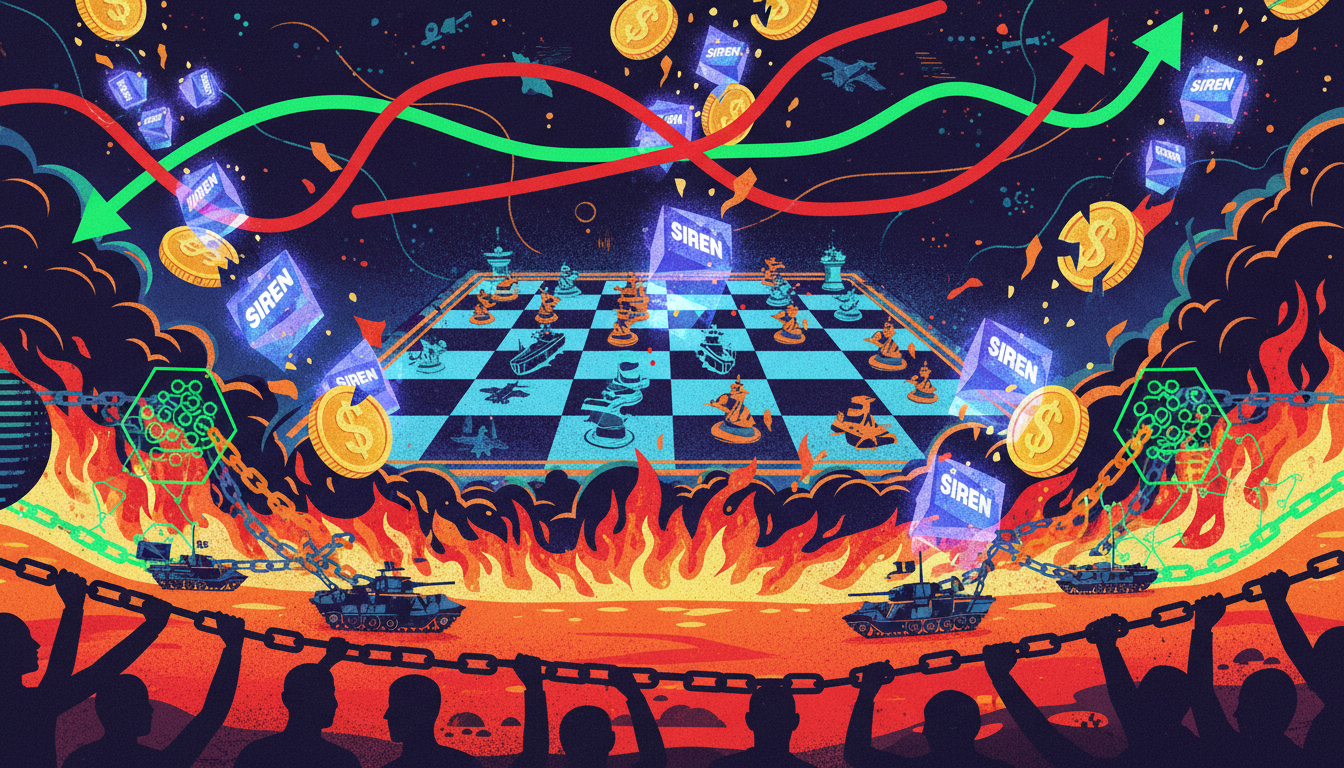
On March 25, 2026, at East 8 Zone time, Binance officially released the "Risk Warning and User Guide for Crypto Market Makers," launching a significant rule update after a series of market shocks in Q1. In the new document, Binance unveiled three "knives": clearly prohibiting profit sharing and capital protection models, requiring 100% disclosure of market maker information, and establishing a blacklist mechanism for violating market makers. This means that long-existing gray area practices involving volume manipulation market making, bottom guarantee betting, and implicit rebates are being reclassified as "risk assets" by exchanges. On one side, exchanges emphasize the "integrity of the market," while on the other, market makers rely on implicit incentives and asymmetric information for their traditional profit models, bringing the conflict to the forefront. The following sections will outline the shift in regulation following the Q1 market crash, paths for punishing volume manipulation market making, challenges in executing information disclosure, and the strategic implications behind the blacklist mechanism, detailing this power restructuring from the underworld to the hunting ground.
Binance Takes Action After Q1 Market Crash
Entering Q1 2026, multiple major and mid-sized exchanges were reported for abnormal concentrated selling by market makers: certain cryptocurrencies experienced a drastic market crash in a very short time, with order book liquidity collapsing instantly, only to be quickly replenished. Such extreme volatility triggered a new wave of questioning in the market regarding long-standing issues such as "internal and external markets," "proprietary betting," and "volume manipulation" — who exactly controls the trading volume and price curves, how much of the so-called "depth" is genuine trading, and how much is just a scripted setup. Although public details on individual cases are limited, they are enough to amplify market distrust regarding the liquidity authenticity and price manipulation opportunities of leading platforms.
Against this backdrop, on March 25, Binance threw out the "Risk Warning and User Guide," emphasizing "market integrity" while stating that "while market making can enhance liquidity, not all arrangements align with long-term market integrity," and that it would "take swift and decisive actions against violations." This indicates that the exchange has begun to shift from a past stance of "tacit permission and partial coexistence" concerning gray market making models to a model focused on "actively cutting risks and reshaping compliance boundaries": no longer simply using trading volume and coin listing pace to tell growth stories, but attempting to respond to regulatory and user concerns about manipulation risks with rules.
Interestingly, the timing is notable. On the same day, Coinbase launched PRL perpetual contracts, and BitGo announced support for the Canton Network token standard, with overseas institutions continuing to heavily invest in derivatives and custody infrastructure within compliance frameworks. In contrast, Binance's simultaneous introduction of new market making regulations serves to hedge external doubts about its own model with a narrative of "regulatory upgrade," while sending signals to regulators and institutional funds that, amid global scrutiny of liquidity manipulation, it aims to occupy the narrative high ground of "market integrity" first.
Profit Sharing and Capital Protection Commitments Cut Off
The most straightforward point in this guide is that Binance explicitly prohibits profit sharing and capital protection models. According to sources A and C, the new rule categorically places risk-sharing cooperation between project parties and market makers, centered on profit betting, into the unacceptable risk zone. This blanket statement targets the long-standing cooperative structures rarely discussed openly in the industry: project parties guarantee market makers do not lose, even promising to share market making profits at an agreed ratio in exchange for attractive order book appearances and favorable trading volume.
Combined with common market making cooperation models, typical gray manipulation practices affected include:
● Volume Rebates: Project parties pay high "trading fee rebates" to market makers, encouraging them to inflate trading volume through self-buying and selling or wash trading, creating "heat," but with limited real participants. Once the rebates decrease, liquidity often evaporates instantly.
● Implicit Guarantees: Off-market agreements or complex contractual structures promise "loss compensation," placing market makers in a "profit without loss" position in price difference betting, shifting motivations from "providing liquidity" to "coordinating price theatrics."
● Project Party Risk Guarantees: Project parties use their own tokens or funding pools to provide a safety net for market makers in building positions and crashing prices, with both sides betting on profits within price ranges, treating the secondary market as a tool for managing chips.
Binance's all-encompassing cut directly targets the "invisible incentives" that allow these models to exist: market makers can no longer easily secure returns through capital protection clauses and profit sharing, while the costs and risks of "buying liquidity" for project parties have been brought to the forefront. For long-tail projects and new coin launches, this could be the most immediate impact — previously, a market making budget could create a "decent" order book on key platforms, but now they either have to spend real money to attract natural liquidity or accept the reality of trading being lackluster post-launch.
At the same time, the new regulations do not disclose more information about the specific penalties and enforcement details for violations. The current external parties can only deduce Binance's regulatory orientation from public statements like "swift and decisive measures will be taken against violations": on one hand, there is a heightened vigilance towards systemic risks from gray income structures; on the other, it reserves operational space for possible individual case handling in the future. Without confirmation of more details, any descriptions of precise penalty mechanisms or accountability timelines can only remain at the level of speculation and cannot be treated as facts.
Full Real-name Registration for Market Makers: Trading Counterparties are No Longer "Shadows"
Beyond the halt of profit sharing, another equally crucial pillar is Binance's call for 100% disclosure of market maker information. According to sources A and C, this requirement aims not only at KYC-level identity verification but also at enhancing transparency regarding the roles market makers play on the platform, their cooperative relationships with project parties, and potential related parties, with the goal of making it clear "who is making the market for this coin, and who is profiting from it," no longer a mystery behind the scenes.
Once market maker information transitions from a black box to traceability, the risk awareness for project parties and ordinary users will be reshaped as well. In the past, the "mysterious large accounts" on the order book and single-point deep orders were often interpreted as signals of "institutional involvement" or "main force defending the market"; however, if the entities behind this liquidity, as well as cooperative arrangements, have higher visibility, users will be better able to distinguish natural buy orders from incentivized liquidity supply, thus shrinking the myth of "market defense." Emotional fluctuations are expected to reduce the artificially magnified components.
For market makers themselves, full real-name registration is both a risk and a bargaining chip. On one hand, compliant and transparent identities may yield a reputation premium: market making institutions that can complete full disclosure on Binance and maintain ongoing operations may be seen as "whitelisted participants," making them more attractive to leading projects and compliant funds. On the other hand, excessive information transparency may provoke worries about strategy exposure and reverse tracing of holding paths, especially for small market making teams relying on complex multi-account structures and cross-platform liquidity scheduling, who might find their gray practices unsustainable under the new rules, forcing them to exit or pivot to over-the-counter and fringe platforms with looser regulations.
Currently, Binance has not explicitly defined the scope and degree of public openness for "100% disclosure" in public documents — whether the information will only be visible to exchanges and regulators or if some will be open to the market; whether cooperation with market making parties will be disclosed by cryptocurrency or only marked in internal risk control systems — these critical execution questions remain unresolved. The extent to which genuine transparency can be achieved for users or if it remains in a "internally visible, externally black box" semi-transparent state needs to be observed over time for actual implementation effects.
Blacklist Deterrence: The Life-and-Death Gamble for Violating Market Makers
Compared to the restrictions at the terms level, what carries more symbolic significance is the blacklist mechanism for violating market makers proposed by Binance. According to public information from sources A and C, the existence of this blacklist has only been confirmed; it is used to record and handle seriously violating market entities. However, specific operational processes, criteria for determination, update and appeal mechanisms, and other details have not been disclosed, and have been explicitly noted as a missing information area in research briefs, preventing detailed reconstruction.
Even so, once the blacklist is implemented, its deterrent effect on market-making institutions relying on the Binance ecosystem should not be underestimated. Once classified as "high-risk or even prohibited collaboration entities," these institutions will face systematic setbacks in terms of access, cooperation, and reputation within the Binance ecosystem: the resistance for new projects to cooperate with them will dramatically increase, credit costs for engaging traditional financial connections will rise, and it may even affect their risk profiles in other exchanges, custody, and risk control service providers. For market-making institutions deeply involved across multiple chains and platforms, the blacklist is not just a platform issue, but a matter of survival.
This high-pressure deterrence is one of the tools by which exchanges attempt to compel market makers and project parties to shift from past short-term collaborations focused on "seeking volume and price" to a "seeking compliance and long-term" cooperative model. When the cost of violations no longer translates to "being fined and requiring correction by a deadline," but instead carries the risk of being marked as an irremovable "black label," project parties must reevaluate whether it is worth planting long-term compliance mines for the sake of volume manipulation and short-term price performance in their incentive designs and arrangements.
It should be emphasized that, currently, the criteria and process details for the blacklist have not been made public. Research briefs have clearly stipulated that any descriptions of specific banning thresholds, retrospective time ranges, or internal review mechanisms are prohibited from being fabricated. In the absence of empirical materials, the blacklist can only be seen as a "heavy weapon" added to the exchanges' toolbox, and its true usage frequency, applicable scope, and transparency level remain to be determined by time.
Escalation of Exchange Games: Compliance Narrative and Flow Migration
March 25 was not just a day for Binance to unilaterally update its market making guidelines. Coinbase launched PRL perpetual contracts and BitGo supports the Canton Network token standard, outlining the competitive landscape of leading institutions in terms of compliance and product innovation: one side features U.S. platforms expanding their derivatives matrices with compliance licenses and transparency as selling points, while the other, providers of custodial and underlying infrastructure, strengthen their positions in the institutional funding chain by supporting new standards.
In this comparative context, Binance's efforts to strengthen market making regulation to seize the narrative of "market integrity" serve both to clear internal risks and respond to external regulatory concerns. Global regulators’ intensifying scrutiny of liquidity manipulation and insider trading raises the stakes for who can first establish a recognized set of rules and execution frameworks within their ecosystem. Whichever entity succeeds will hold more leverage in future compliance negotiations. For exchanges that have previously been questioned for relying on "high volatility, high leverage, and high opacity" activities to drive their businesses, this self-disciplined posture itself represents a strategic choice.
Under the new regulations, the tripartite game among market makers, project parties, and exchanges will be reshuffled:
● In the past, project parties that paid premiums to obtain favorable data on leading platforms must consider who pays for these "gray premiums" — whether to continue bearing compliance risks or, under stricter rules, reduce market making budgets and direct resources toward real user acquisition and long-term community management.
● Market makers need to choose between the old model of "high profits, low transparency" and the new model of "low leverage, sustainable", with some small to medium institutions likely forced to exit mainstream platforms and move their business to the looser, fringe market, creating a spillover effect of traffic and liquidity.
● Exchanges will deliberately set boundaries to segregate compliance responsibilities and historical risks, while also trying to define the standards for "qualified market makers" in the new order, thereby capturing greater regulatory dividends within their ecosystem.
This restructuring will also directly impact the market structure: counterfeit coins and small-cap tokens that rely heavily on market making "support" will face greater pressures for survival. Liquidity may concentrate on leading assets and projects with clear rules, while some funds pursuing extreme leverage and short-term profits may migrate to platforms with looser regulations or even off-chain dark pools. For users, what may appear on the surface as diminishing depths and amplified volatility for certain cryptocurrencies is essentially the industry paying the price for past gray prosperity.
A Turning Point from Volume Manipulation Underworld to Compliance Hunting Ground
In summary, Binance's new regulations essentially drag the previously hidden gray chains embedded in trading terms, off-market agreements, and market making contracts into the regulatory spotlight. The crackdown on the incentive chains of volume manipulation, profit sharing, and capital protection commitments diminishes the space for "buying data with money and buying prices with contracts," and introduces systematic constraints on the previously common secret cooperation between project parties and market makers for the first time.
Simultaneously, the introduction of information disclosure and the blacklist mechanism has the potential to reshape the market making ecosystem over the next few years: those who can maintain competitiveness under high transparency and high compliance costs have the opportunity to become the "market making blue chips" in the new order; conversely, old players relying on multi-account cloaking and cross-platform arbitrage for price manipulation will gradually lose their footing in the shadows. Of course, all of this remains at the "rules proposed" stage, and the real execution strength, case handling methods, and cross-platform interaction effects require time to test.
For investors and industry observers, upcoming key indicators to closely monitor over the next few quarters include: changes in liquidity distributions between different platforms, the concentration evolution of leading versus tail-end market makers, and shifts in project parties’ marketing and market making strategies before and after launch — whether to continue emphasizing short-term market trends and trading volume or to invest more in compliance building and long-term user relationships. If these paths show systematic deviations, it would indicate that this regulatory update has genuinely altered industry behavior.
A critical yet clear perspective must be maintained: this round of action from Binance is both a self-rescue against potential systemic risks and a redefinition of its power boundaries. Exchanges are no longer just intermediaries but judges determining who can speak on the order book and how loudly. For all participants, whether ordinary traders, project parties, or market making institutions, this is now a moment to reassess their risk exposures and opportunity structures — deciding whether to remain at the center of the hunting ground or seek new life at the fringes of the rules.
Join our community to discuss and grow stronger together!
Official Telegram community: https://t.me/aicoincn
AiCoin Chinese Twitter: https://x.com/AiCoinzh
OKX Welfare Group: https://aicoin.com/link/chat?cid=l61eM4owQ
Binance Welfare Group: https://aicoin.com/link/chat?cid=ynr7d1P6Z
免责声明:本文章仅代表作者个人观点,不代表本平台的立场和观点。本文章仅供信息分享,不构成对任何人的任何投资建议。用户与作者之间的任何争议,与本平台无关。如网页中刊载的文章或图片涉及侵权,请提供相关的权利证明和身份证明发送邮件到support@aicoin.com,本平台相关工作人员将会进行核查。