Some people say this is the worst oil crisis since the 1970s.
At gas stations in Thailand and Vietnam, fuel is no longer available, and the public is forced to work from home; South Korea's chip factories are beginning to worry about helium supply; Japan has started discussions on buying oil from Alaska; food aid organizations in Africa are concerned about where to find food if the war continues for another three months.
These events are all happening this week, and the impact of the war on the world is more chaotic than we can imagine.
Since the outbreak of the Middle East war, the Strait of Hormuz has effectively come to a standstill, with nearly 20% of global crude oil and LNG supplies hanging in the balance. Oil prices surged 40% directly from pre-war levels, reaching $110 per barrel, while Iran publicly claims their goal is to push this number to $200. Qatar's Ras Laffan LNG facilities were bombed, a supply node that accounts for 20% of global gas trade, and restoring production capacity may take years.
So, when will this war actually end, and how will it conclude? The editors of BlockBeats have compiled five of the most likely scenarios.
Around April, swift resolution
This is the most ideal scenario, and some analyses suggest it is what Trump wants the most: the war will come to a close in the short term.
After all, Trump's way of thinking has never resembled that of a general; he is more like a CEO who wants to move on to the next deal once this one is done. He has stated: throughout American history, almost every battle has been won, yet too many wars have been lost, not due to inability to win, but due to not knowing how to exit after winning. This was true for Vietnam, Iraq, and Afghanistan. He doesn't want to replay the same mistakes.
Thus, in the military operation code-named "Epic Fury," the U.S. military has prioritized "precision decapitation" against senior members of the Iranian regime, as well as "demilitarization" strikes targeting nuclear capabilities, missile facilities, and naval forces. Once these "tiger teeth" that threaten U.S. and allied security are completely pulled out, Trump plans to transition military operations to closure.
According to the pathway of this scenario, a ceasefire would be expected around April, with several corresponding timelines.
The first timeline is the visit to China. Trump's original plan for a visit to China was at the end of March or early April, but it is now postponed to late April or early May. Trump does not want to be distracted by an unresolved "Middle East chaos" during his visit to Beijing; he needs to appear as a victor to gain greater leverage in U.S.-China trade negotiations. Treasury Secretary Mnuchin has also confirmed that the delay is purely due to the need to command military operations, while trade negotiations are progressing smoothly on the Paris front. This means that diplomatic avenues are open, waiting only for military operations to clear the way.
The second timeline is the midterm elections. With the midterm elections approaching in November, Trump needs a stable economic environment, especially stable oil prices and expectations of interest rate cuts by the Federal Reserve. If inflationary shocks triggered by the war persist for more than six weeks, they will permeate the entire supply chain and reflect in corporate reports during summer, making it difficult for the Republican Party. Letting oil prices fall from their peak would help push the Federal Reserve to adopt interest rate cuts under the guise of an "employment emergency" around September, ensuring the party's ultimate success in the midterm elections.
Iran's Offers, Buying a Way Out with Oil Commissions
Currently, the negotiation situation between the U.S. and Iran presents a bizarre "Rashomon" effect: Trump claims progress is being made, but Iranian Speaker Ghalibaf and official media vehemently deny any contact.
Trump recently revealed that the current interlocutors are "a completely different group of people," who have sent a substantial proposal involving oil and gas, rumored to be 5% of Iran's oil sales as commission, to be paid directly to the U.S. If true, this figure would be a considerable amount based on Iran's export scale.
Who are these "completely different people"? They are likely the regular Iranian armed forces (Artesh), rather than the well-known Revolutionary Guards (IRGC) loyal to the Supreme Leader. There has been a deep-seated conflict between these two forces; the Artesh is the national army, while the IRGC is an ideological tool. When the pressure for survival becomes significant enough, moderate elements within the regular army may choose to bypass the Supreme Leader and quietly engage with the U.S., which is not without precedent and is quite possible.
However, from Iran's perspective, the insistence on "denying negotiations" also has its political stance.
Iran knows very well that Trump places great importance on stock market performance. Just after the U.S. announced a pause in strikes, global oil prices and U.S. stocks quickly stabilized. By denying negotiations, Iran aims to dilute Trump's economic "bonus," preventing the U.S. from gaining more leverage at the negotiating table. Additionally, there is the need to maintain domestic legitimacy; for the mullah regime reliant on a tough-guy image, openly negotiating with the "Great Satan" would be political suicide.
Some seasoned military analysts point out that while Trump threatens to bomb Iranian power stations, he has recently temporarily relaxed sanctions on oil exports from Russia and Iran. This is not a sign of weakness but rather reflects Trump's "America First" logic. He needs Iranian oil to continue flowing into the market to stabilize inflation, but he will not allow Tehran to control the Strait. This approach of "holding a big stick in one hand and turning on a green light with the other" essentially positions Iran's energy infrastructure as a dynamic lever, testing the other side's bottom line through a five-day grace period.
But this scenario has its hidden dangers. Strategist Hansen gives a rather calm evaluation: such compromise is at best just a "pause button" for the war; Iran's ideological foundation remains unshaken, and the next Revolutionary Guards or proxy armed group will eventually emerge. More realistic obstacles come from Saudi Arabia. Crown Prince MBS has a very direct stance: we cannot stop halfway. In Saudi Arabia's view, stopping in the middle of the fight, leaving an embittered Iran with room to breathe, is more dangerous than not fighting at all. Saudi Arabia is pressuring Trump to use this historic window to completely eradicate the hardline regime.
Moreover, some analysts point out that Prince Pahlavi, who has been exiled from the U.S. for nearly half a century, is gradually becoming the "greatest common divisor" of the opposition forces within Iran. For the U.S., blockading the Strait of Hormuz may just be a tactical game, but promoting Pahlavi (or a coalition government centered around him) to lead Iran may be the true "general's flag" that fundamentally alleviates the energy threat in the Middle East and reshapes the geopolitical landscape.
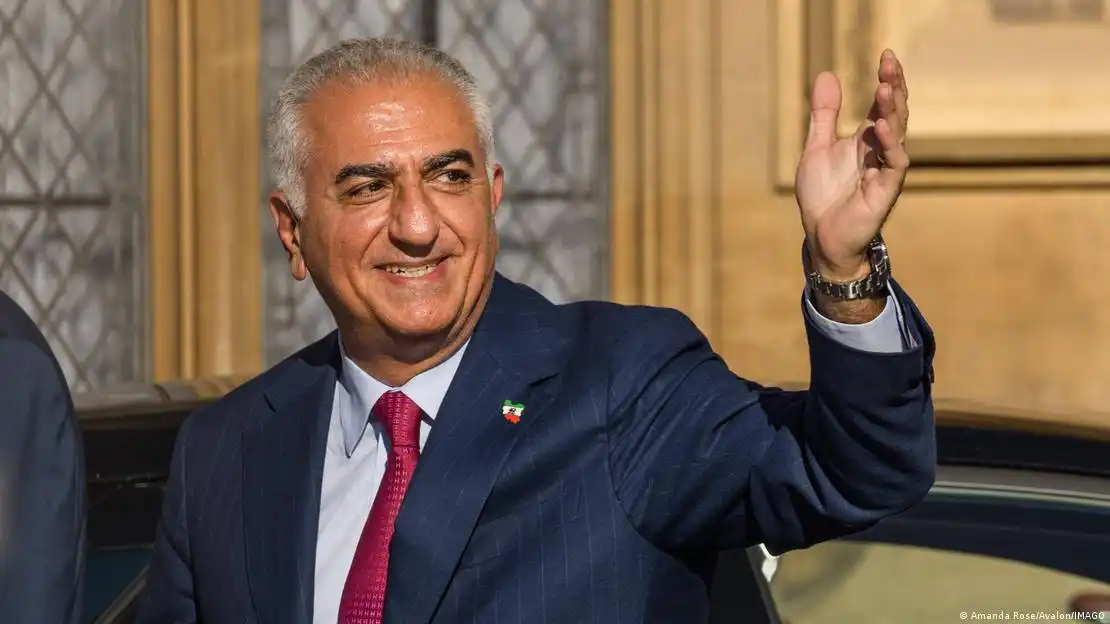
The son of the last king of Iran, the exiled Pahlavi (Reza Pahlavi)
Seizing Islands and Controlling the Strait, Continuous Strikes on Iran
If negotiations break down, or Trump decides to continue escalating military action alongside negotiations, the focus of the battlefield will shift to several small islands surrounding the Strait of Hormuz.
Qem Island, Greater and Lesser Tunb Islands, Abu Musa Island—these names are not often mentioned, but they control the passage of about one-fifth of the oil trade worldwide. Whoever takes these islands holds the "master switch" of the energy landscape in the Middle East.
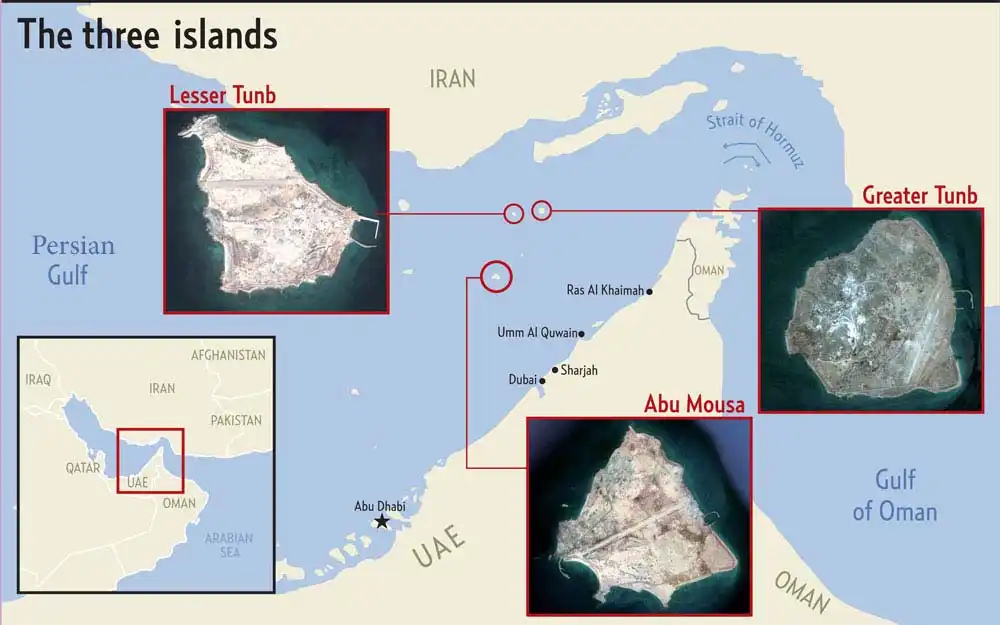
Map of Iranian Islands
The strategic intent of the U.S. military here is quite clear: bypass Iran's mainland quagmire and directly control the "valve" of the Strait. This is a typical "maritime centrism" approach, seeking not to occupy but to choke. The Greater and Lesser Tunb Islands and Abu Musa Island have an additional layer of value: they are originally contested territories between the UAE and Iran; if the U.S. captures them, they can directly hand them over to the UAE, thus establishing a long-term alliance defense perimeter and providing a significant political gift to Gulf nations.
Military analysts have noted that signs of further deployment of U.S. forces are now quite evident. Recently, 17 C-17 transport aircraft have been densely flying to the Middle East, including 6 from Fort Bragg, which is home to the 82nd Airborne Division and Delta Force. The core capability of the 82nd Airborne Division is speed, capable of global deployment within 18 hours, with advance forces already in place. The Marine Corps stationed in Okinawa and California is responsible for long-term control of larger islands, which will take three to four weeks to arrive.
The so-called "five-day window period" is actually to await the arrival of heavy expeditionary forces at their designated locations and to provide special operations units with a final terrain reconnaissance period.
The hottest variable among these is Khark Island. This island hosts 90% of Iran's oil exports and holds immense strategic value, but it is dotted with large oil storage tanks; if a great fire erupts, global oil prices will instantly spiral out of control, which is a result that the U.S. cannot afford either.
The analysis report from the Hudson Institute indicates that, ten days before the outbreak of hostilities, the U.S. military struck over 5,000 targets, and this high-intensity "demilitarization" pace is essentially conducting a 21st-century "industrial capability deprivation war."
Therefore, this viewpoint suggests that if a short-term resolution cannot be achieved and pressure continues, the more likely course of further military action would be precise control by special forces, rather than outright assaults. Because the war’s objective is not necessarily to overthrow the Iranian regime but to achieve "tactical weakening." Similar to the allied strikes on German industrial capabilities in the later stages of World War II. The goal is to dismantle the region's force projection capabilities that Iran has accumulated over decades, including nuclear facilities, ballistic missile production bases, and naval forces.
Ultimately, Iran may be weakened to a "large Hamas," meaning that while the regime exists, it will lose its substantial threat capabilities to the world in the next 10 to 20 years.
Jiang Xueqin's Prediction: The U.S. Will Lose
Recently, the name Jiang Xueqin has gained popularity because a video of his lecture on international affairs in a high school classroom in Beijing two years ago has been circulated repeatedly. The lecturer, Jiang Xueqin, based on historical and geopolitical logic, judged that Trump might be re-elected, and the U.S. might take military action against Iran. As some of his judgments have been confirmed by reality, his YouTube subscription rate has rapidly surged, and he is referred to by many netizens as "China's Nostradamus." Full interview translation: “Jiang Xueqin's Latest Interview Transcript: How to View Current Global Changes”)
His core assertion regarding this Middle Eastern war is: the U.S. may tactically win every battle but is strategically losing the war.
Why?
First, the U.S. military is too heavy, while Iran is too agile. Iran has been preparing for this day for over twenty years; it understands U.S. military logic perfectly and has designed countermeasures for every scenario. Two aircraft carriers, the Ford and the Lincoln, are indeed present, but because Iran possesses hypersonic weapons and a vast arsenal of suicide drones, the carriers do not dare approach Iran's coastline, and these massive steel fortresses become mere ornaments floating at a distance. U.S. internal war games have repeatedly shown that America would lose, not due to insufficient firepower, but because this system cannot handle such an opponent.
The second reason is that once boots are on the ground, it's a bottomless pit. Jiang Xueqin views the plan to capture Khark Island as a typical sunk cost trap. The island is captured, but it’s too close to Iran’s mainland to hold. To defend the island, one must control the coastline; to control the coastline, one must delve deep into the Zagros Mountains. The mission will expand endlessly like a snowball, which is the path of the Vietnam War. No one intends to take that route, but once embarked upon, it becomes very hard to turn back.
The third reason is that the Shia theological framework is the variable most easily underestimated by the West. In the Shia narrative, compromising with an unjust enemy is the real defeat; resisting, even to the point of certain death, is essential. The U.S. and Israel's choice to assassinate Khamenei and his family directly touches the deepest trauma of the Shia community, which has historically felt "betrayed." This will not make Iran submit but will only intensify the resistance across the entire Shia world, making them harder and more resolute.
Even more challenging is that the U.S. currently has no real exit strategy. If troops are withdrawn, Iran will present astronomical bills—approximately $1 trillion in reparations, along with demands for a permanent U.S. exit from the Middle East. In that case, Gulf nations would collectively turn toward Iran, the petrodollar system would shake, and Japan, South Korea, and Europe would lose faith in America’s protective capabilities. If the fighting continues, the U.S.’s $39 trillion debt and economy’s dependence on foreign purchase of dollars simply cannot sustain a protracted war of attrition.
Advance leads into a quagmire. Retreat leads to defeat.
The subsequent scenario depicted by Jiang Xueqin is grim: the war turns into a prolonged attrition similar to Ukraine, Saudi Arabia declares war on Iran and drags Pakistan into it as well, Iran pushes oil prices to $200 per barrel, and Qatar’s LNG facilities suffer serious damage leading to 20% of global gas trade being offline for an extended period, with energy crises sparking first in East Asia and Southeast Asia. In the longer term, three structural trends resurface simultaneously: the end of cheap energy leading to deindustrialization, the collapse of "peace under American hegemony" leading to remilitarization, and the fragmentation of globalization leading to mercantilism.
Meanwhile, back in the U.S., should Trump push for national conscription, the polarized political climate would send the National Guard into cities, and America could face a state of prolonged unrest reminiscent of Northern Ireland's "Troubles"—not a civil war, but not much better either.
This scenario has no winners, only varying degrees of losers.
The End Times Arrive, Waiting for the Messiah
This last scenario is one many rationalists hesitate to take seriously because it sounds too much like science fiction. But ignoring it is the truly unserious attitude.
Within Israel, there exists an apocalyptic fervor. Some rabbis and believers no longer view this war through the lens of security or geopolitics, but see it as a catalyst for the "Messiah's arrival." In this framework, the greater the pressure on Israel, the closer God's intervention becomes.
The most astonishing segment of this apocalyptic script involves actions against the Al-Aqsa Mosque complex in Jerusalem. The script predicts that Israel may exploit the extreme chaos brought by the war to implement a precise "controlled demolition," camouflaged by years of "archaeological excavations" conducted underground, thus completely destroying the mosque. This destruction aims to clear the path for building the "Third Temple" of Judaism.
According to religious ideation, the rebuilding of the temple signifies the complete revival of the Jewish nation and the dawn of the Messianic era. To divert international pressure and religious outrage, this action may be cleverly blamed on a misfired Iranian missile or stray fire from the war, triggering an unprecedented comprehensive religious battle between Persians, Arabs, and Israelis.
The "Greater Israel Project" surfaces, based on ancient religious narratives, aiming to expand territory from the Nile River in Egypt to the Euphrates River in Iraq, even touching parts of southern Turkey and Saudi territory.
By completely dismantling the existing geopolitical landscape, all scattered Jews would be compelled to return to the land, establishing a new world order characterized by theocracy.
Under this script's support are the approximately 7 million members of the "Christians United for Israel" organization in the U.S. and a large evangelical community, which serve as significant funding and moral pillars for such agendas. They genuinely believe that Israel is a key fulcrum for the return of Jesus. More secretive layers include the Freemasons, Knights Templar, Rosicrucians, and certain specific factions within Judaism, seen as participating behind the scenes in shaping policy directions.
Trump’s position in this narrative has two interpretations: he may simply be misled by advisors like Kushner and Rubio, who harbor apocalyptic inclinations, becoming an unaware actor; or after enduring impeachment, lawsuits, and assassination attempts, and miraculously returning to the White House, he himself may have developed a sense of "divine election" mission.
This mystical variable's intervention transforms this Middle Eastern war from a conflict that can be easily resolved through diplomatic negotiations into a self-reinforcing system, potentially dragging the entire world into an abyss that reshapes the foundations of civilization and faith.
Al Jazeera recently published an article titled "The U.S.-Israel Strategy Against Iran is Working," authored by a U.S. State Department advisor. He believes that America’s military action is systematically dismantling Iran's ability to project regional power. Critics are only fixated on the immediate casualties and economic costs, overlooking the threats accumulated over the past 40 years that are being systematically eliminated.
Interestingly, Al Jazeera has historically been seen as pro-Arab and pro-Islam; publishing this article indicates that a considerable portion of forces in the Middle East now believes that the U.S. will win this time.
What will the outcome be? Five scenarios, five conclusions, each may materialize independently or overlap with one another.
Trump wants to conclude swiftly, but war does not necessarily adhere to his schedule; Iran wants to buy its way out, but Saudi Arabia will not allow the war to simply end; the U.S. military wants to control the strait, but the costs of the island battles remain uncalculated; Jiang Xueqin claims the U.S. will lose, but losing itself can take a hundred different forms; and the followers of the end times await the Messiah, yet history never unfolds according to religious scripts.
This ship is sailing, the engine roaring, the deck packed with people, each pushing hard in the direction they believe is right.
But no one is at the helm.
免责声明:本文章仅代表作者个人观点,不代表本平台的立场和观点。本文章仅供信息分享,不构成对任何人的任何投资建议。用户与作者之间的任何争议,与本平台无关。如网页中刊载的文章或图片涉及侵权,请提供相关的权利证明和身份证明发送邮件到support@aicoin.com,本平台相关工作人员将会进行核查。


