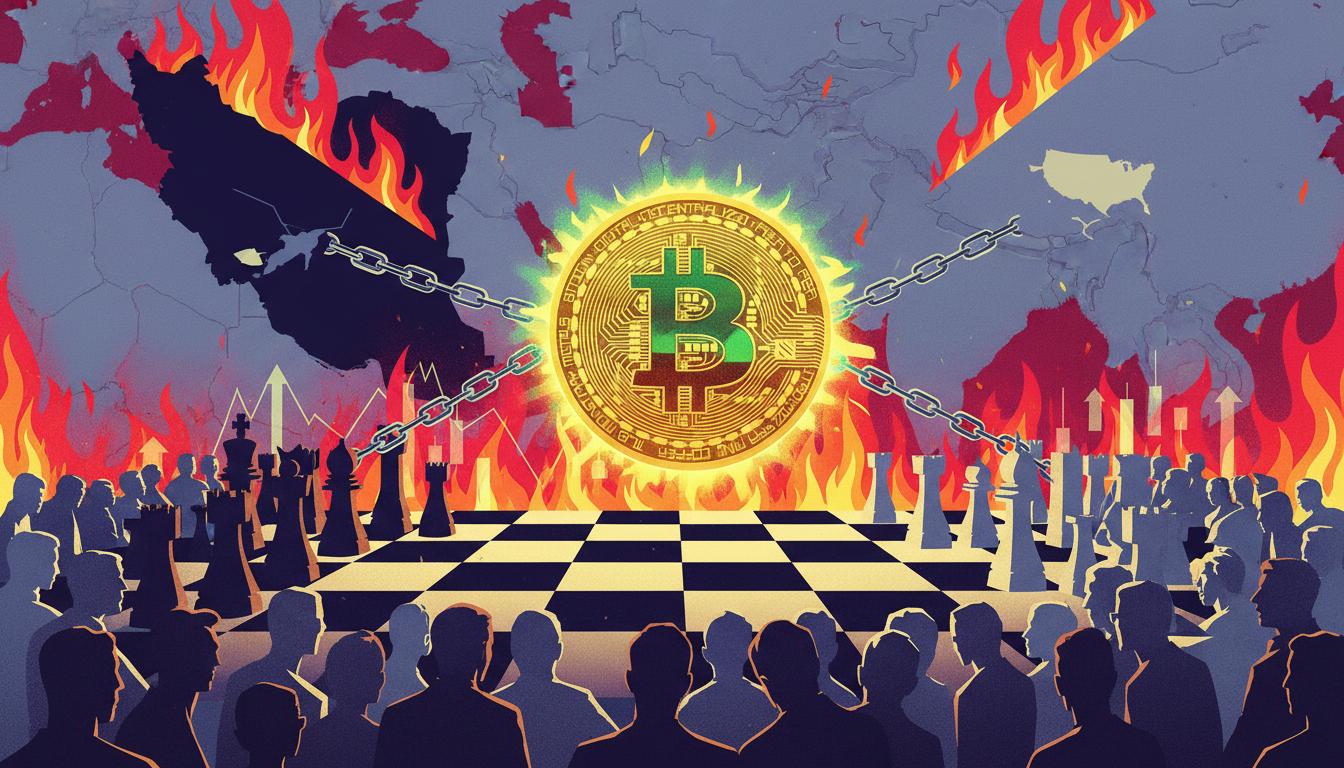
On March 25, 2026, in the East Eight Zone time, the explosion in the Middle East was not only fire and shockwaves. The intensity of Israel's strike against Iran has been calculated by several media outlets to be four times that of the previous round of 12 days of conflict, with approximately 15,000 bombs and ammunition already dropped, pushing geopolitical risk sentiments to a high level. On the same timeline, Aave V4 introduced a reinvestment module, planning to deploy approximately 6 billion USD, about 30% of its USD-denominated deposit size, into traditional low-risk assets such as US Treasury bonds, attempting to add a layer of buffer to the on-chain world with traditional coupon interest. The escalation of conflict and the conservative shift in DeFi are no longer just coinciding timelines, but rather a collective hedging experiment in the crypto market in the face of high-intensity macro risks.
Hedging After 15,000 Bombs
As of March 25, several media outlets cited battlefield statistics stating that Israel has dropped approximately 15,000 bombs and ammunition on Iranian targets, a scale about four times that of the last round of conflict lasting 12 days, setting an exceptionally high tone for the current round of geopolitical risks. The magnitude of ammunition consumption is in itself a direct quantification of intensity: when fire density transitions from "conventional conflict" to "surrounding strikes," market expectations of risk spillover will also be repriced accordingly.
The Israeli Defense Minister publicly acknowledged that the intensity of the current operation significantly exceeds historical levels, interpreted by financial markets as a signal that the situation is unlikely to cool down quickly in the short term. Rather than describing military technology, this conveys a political expectation of "high intensity will last for a while," which will be transmitted through channels such as oil prices, shipping costs, and safety premiums into asset pricing models.
The traditional financial inertia in similar conflict cycles is to see funds accelerate towards the dollar, US Treasuries, and gold, forming a classic "war asset triangle" characterized by high liquidity, high credit backing, and hedging attributes. The current issue is whether crypto assets, especially leading assets, are viewed as hedging tools or merely as high-volatility risk assets. Each round of geopolitical escalation serves as a stress test for narratives like "Is Bitcoin digital gold?" and "Is DeFi a reliable liquidity intermediary?" This round of conflict is no exception.
Under the Shadow of War: Aave Chooses Coupons and Risk Reduction
During the window where the intensity of conflict was being continuously raised by official rhetoric and ammunition statistics, Aave V4 proposed a reinvestment module, planning to invest approximately 6 billion USD, about 30% of its dollar-denominated liquidity, into US Treasuries and other traditionally low-risk assets. For a protocol that considers itself a "chain-based lending robot," this step is equivalent to opening a new revenue curve on its balance sheet: no longer merely matching borrowing interest differentials, but actively engaging in the coupon payments of the US Treasury money market.
A key commitment was repeatedly emphasized in the proposal—these idled funds earmarked for reinvestment will still remain "redeemable at any time." This means that Aave is attempting to find a balance between two seemingly conflicting constraints: on one hand, allowing the dormant funds in the pool to earn traditional asset yields; on the other hand, maintaining liquidity safety for users during extreme market conditions when large withdrawals occur. How to cushion between term mismatch, counterparty risks, and on-chain expectations is crucial for the successful implementation of this design.
More importantly, this conservative reinvestment module was not quietly proposed during a peaceful market period but rather at the height of rising geopolitical tensions. Turning to US Treasuries amid a rain of bombs essentially resembles a preemptive defense against long-term macro uncertainties rather than a short-term bet on a single price event. It conveys the message that leading DeFi protocols have begun viewing their asset pools through the lens of "war asset allocation," attempting to use the stability of traditional low-risk assets to reserve buffer space for larger future black swans.
The Role Shift from Non-Interest Reserves to Coupon Assets
For a long time, the default model of DeFi protocols has been to let a large amount of dollar-denominated assets sit in the pool acting as "non-interest reserves." The primary function of these idle funds is not profitability but ensuring someone can withdraw at any time and smooth out liquidation, even at the cost of sacrificing yield. The risk culture of the protocol is closer to "excess reserves + high redundant liquidity" to hedge against smart contract flaws and unexpected runs.
Aave's choice to allocate a portion of its reserves to US Treasuries and other traditional low-risk assets is equivalent to voluntarily introducing a new set of variables of "off-chain earnings + custodial counterparty risks" atop the originally singular "on-chain contract risks." The yield curve is extended, but the difficulty of managing asset duration and liquidity is also amplified simultaneously, transforming from pure "pool management" to work akin to that of a small asset manager, needing to weigh regulatory, liquidation channel, and market depth factors.
This "traditional bonds + on-chain liquidity" compromise route marks a change in self-positioning for leading DeFi: they are increasingly resembling a hybrid of banks and money market funds rather than merely cold lending robots. Banks deal with reserve ratios and interbank lending, money market funds have short-duration high liquidity bond portfolios, while Aave simulates a similar structure on-chain through smart contracts. The distinction lies in the fact that it faces a global, non-KYC, redeemable user base at any time, where any mispricing of risk will be real-time amplified within the market.
Geopolitical Risks Overlay Protocol Risks: Who is Covering Whom
When approximately 15,000 bombs and ammunition are concentrated on a single counterparty in a short timeframe, the dense deployment of munitions conveys not only tactical signals but also indicates the realistic possibility of further escalation and spillover of the conflict. Any evolution towards broader sanctions, shipping blockades, or capital controls will transmit through financial channels to on-chain liquidity: fiat inflow and outflow will be tightened, compliance agencies will reduce positions, and OTC quotes will shrink, all of which could alter users' subjective judgments on the safety of on-chain funds.
In this macro backdrop, once the scale of Aave's reinvestment module increases, it will form another kind of structural fragility: when the liquidity of external assets encounters a shock, the promise of "redeemable at any time" will be ruthlessly tested by extreme market conditions. If the US Treasury market experiences significant fluctuations due to liquidity tightening and market panic, the protocol will need to make difficult trade-offs between protecting coupon assets and fulfilling on-chain redemptions; this will no longer just be a simple matter of smart contract execution, but a life-and-death moment in asset-liability management.
For the average user, what appears on the surface is yield enhancement: funds that originally lay in the pool serving as a safety cushion are taken out to earn traditional market interest returns. However, from the perspective of risk distribution, this means the protocol is transforming part of the "system safety cushion" into a "coupon source," redrawing the risk balance between macro conflict and micro runs. Each additional cent of earnings received by users essentially indicates that when the next macro black swan erupts, they are standing with the protocol on the same narrower liquidity tightrope.
Iran and the US's Low-Key Communication Leaves a Gap for DeFi
While firepower continues to escalate on the battlefield, diplomatic avenues have not completely ceased. According to Reuters reports, Iran and the US are conducting indirect communication through Pakistan, and this low-key diplomatic "hidden line" shows that major powers are still striving to set bottom lines for the conflict, reducing the probability of the situation spiraling out of control. For the financial market, this structure of "frontline escalation, rear temperature drop" means that risks will be repriced, but it is still not at the level of systemic collapse.
This diplomatic gap allows the market to swing back and forth between panic and rationality: on one hand, the reality of 15,000 munitions makes it impossible to take the conflict lightly; on the other hand, the existence of indirect communication makes investors continually question—will this evolve into a true systemic crisis shaking the global financial system, or can it be contained within manageable geopolitical risk ranges? The result of asset allocation often gets stuck in this gray area where the situation is "not out of control globally but extremely intense locally."
Protocols like Aave are promoting conservative investments under the framework of "high intensity but controllable." On one hand, the conflicts have heightened long-term uncertainties, providing narrative and logical support for transitioning to low-risk assets like US Treasuries; on the other hand, diplomatic buffers allow the market to believe that at least within the visible cycle, traditional bonds and the dollar system will not be immediately undermined. This grants DeFi a short window for earning: in the tug-of-war between war and negotiation, trying to stitch on-chain structures to off-chain coupons, attempting to leave a safety cushion for themselves amid the reconstruction of global risk assets.
When Missiles Meet US Treasuries: The Next Shock is the Real Test
The abrupt enlargement of the scale of Israeli airstrikes coinciding with the announcement of Aave's reinvestment plan indeed reveals an unavoidable reality: the crypto industry can no longer pretend to live in a parallel universe unrelated to missile trajectories. When 15,000 bombs and 6 billion USD of on-chain idle funds appear in the same news headlines, the DeFi asset pool is inevitably swept into the same risk net of global geopolitics and monetary systems.
The leading protocols' shift towards low-risk assets such as US Treasuries represents a strategic defense against long-term high uncertainty and also a reshaping of their self-identity—from "sovereign-less lending black boxes" to more akin to "store-less global banks/money market funds." They are seeking new legitimacy: not entirely detached from traditional finance but using on-chain transparency and composability to adhere to the depth and safety cushions of the dollar system.
The real test, however, lies not today, but at the next genuine liquidity shock. When the fires of conflict further spill over, sanctions escalate, or other black swan events trigger on-chain runs, Aave's commitment to "redeemable at any time" will be put to the severest pressure test. In that moment, the governance credibility accumulated by the protocol over the past few years, its risk parameters, counterparty choices, and the details of this reinvestment module will all be distilled into a simple question: can users still access their assets seamlessly through a few transactions on-chain? How the answer unfolds will determine whether DeFi is viewed as a genuine hedging infrastructure or once again labeled as a "high-volatility speculative tool" in the next macro cycle.
Join our community, let's discuss and become stronger together!
Official Telegram community: https://t.me/aicoincn
AiCoin Chinese Twitter: https://x.com/AiCoinzh
OKX benefit group: https://aicoin.com/link/chat?cid=l61eM4owQ
Binance benefit group: https://aicoin.com/link/chat?cid=ynr7d1P6Z
免责声明:本文章仅代表作者个人观点,不代表本平台的立场和观点。本文章仅供信息分享,不构成对任何人的任何投资建议。用户与作者之间的任何争议,与本平台无关。如网页中刊载的文章或图片涉及侵权,请提供相关的权利证明和身份证明发送邮件到support@aicoin.com,本平台相关工作人员将会进行核查。