On March 25, 2026, the Iranian military reported to the outside world that it had launched missile strikes against the US aircraft carrier "Abraham Lincoln," once again bringing security in the Middle East and global focus back to the Strait of Hormuz. The Iranian military emphasized that they maintained "constant monitoring" of this carrier strike group and implemented the attack once it entered a predefined range, while the US quickly denied that the carrier had been hit or seriously damaged. Currently, publicly available information comes only from a single source, and key details regarding combat losses have yet to be independently verified. In this narrative conflict, the limited battlefield and the infinite information warfare overlap, making the control over the Strait of Hormuz the central framework for understanding the current turmoil. Compared to the tense geopolitical atmosphere, the cryptocurrency market performed relatively steadily that day, with limited fluctuations in mainstream coin prices; in contrast, concept stocks related to geopolitical risks saw a general increase of about 2.5%-3.2%, signaling some risk premium, but overall had not evolved into systemic panic.
Missiles Launched and Rapid Denials: Collision of Two Realities
From the Iranian military's narrative, this operation is packaged as a "necessary strike" after long-term surveillance. The naval commander claimed that Iran maintained continuous tracking of the "Abraham Lincoln" and its strike group, considering it a "legitimate target" once it entered the range of the Iranian missile system. Within this narrative framework, the missile launch is not just a tactical move but is also framed as an execution of predetermined red lines, a proactive response to external military presence, and a firm statement to domestic public opinion.
In stark contrast, the US quickly countered on the informational front. Based on currently available public information, the US military denied that the carrier was hit by a missile or suffered severe damage, with relevant statements mainly being one-sided outputs from Iran and pro-Iranian media, lacking multi-source cross-verification. Briefings also clearly pointed out that current public reports on the combat results are largely based on a single source, which means that whether the missile hit, the effectiveness of the strike, or whether there were collateral damages, the outside world cannot provide definitive answers at this moment.
More critically, many sensitive details surrounding this operation remain in an information blackout. The specific models of the missiles, range performance, number of hits, and the actual level of damage to the "Abraham Lincoln" have not been confirmed by authoritative channels; regarding whether cruise missiles from the coast were involved, specific coordinates of the strikes, and deployment of formations, both officials and reliable media have remained silent. In this case, any analysis regarding the extent of combat losses or technical details would constitute overstepping speculation, and can only be maintained under the principle of "unverified combat losses," keeping caution towards the incompleteness of information.
Behind the collision of these two realities lie clear narrative demands from both sides. For Iran, demonstrating long-range strike capabilities and the will to "pull the trigger" helps to deter regional adversaries and the US while conveying a signal of "not weak, with clear bottom lines" to the domestic audience; for the US and its allies, suppressing the momentum of the "carrier being hit" narrative helps maintain the authoritative image of the carrier group being "able to freely enter and exit sensitive waters," soothe public and allied concerns, and avoid falling into passive escalation due to exaggerated combat losses. This information asymmetry and respective audience orientation allow the same event to rapidly split into two realities in two different discursive systems.
Power Struggle under the Shadow of the Strait of Hormuz
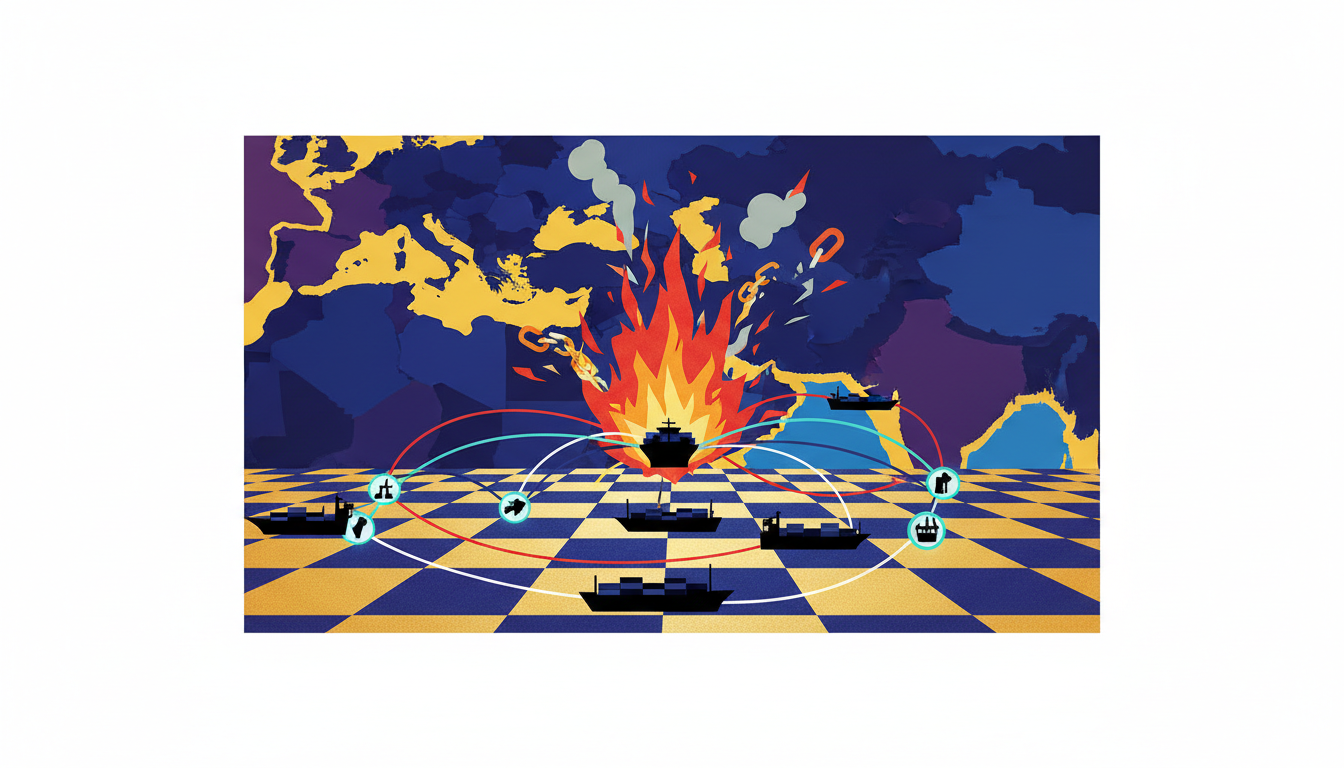
To understand the sensitivity of this missile incident, the geopolitical significance of the Strait of Hormuz is an unavoidable starting point. As a key maritime passage connecting the Persian Gulf and the Gulf of Oman, the Strait of Hormuz has long been viewed as one of the world's energy lifelines, with large amounts of crude oil and refined oil transportation requiring passage through this narrow waterway. Any military friction surrounding this strait is quickly interpreted by markets as a potential threat to oil transport safety, navigational fluidity, and regional situations, placing it naturally in a high-sensitivity zone for global public opinion and capital markets.
From a longer historical perspective, the power struggle between Iran and the US over control of the Strait of Hormuz has accumulated a heavy "prehistory": from intercepting oil tankers, "inspecting" merchant vessels, to periodic missile test launches and military exercises, both sides continuously denote the rules and actual control of the strait through military presence and posture adjustments. The recent claims of strikes against the "Abraham Lincoln" can be seen as another high-profile play in this long-running tug-of-war, pushing the confrontation from "demonstration of presence" further toward a "declaration of specific targets."
Recently, Iranian senior officials have made public statements that further outline their red lines and deterrence logic in this power struggle. Iranian Navy Commander Irani emphasized that "once entering the range of Iranian missile systems, it becomes a legitimate target," effectively equating the physical radius of range with a political boundary of safety, placing external military assets represented by aircraft carriers on the strike list. Meanwhile, the statement by Parliamentary Speaker Ghalibaf that "do not challenge Iran's determination to defend its territory" politically endorses this logic on a broader scale, directly linking missile actions to national sovereignty and the right to defense.
Through public military announcements and tough rhetoric, Iran actively shapes a narrative of a "buffer zone not to be easily approached" around the Strait of Hormuz. On one hand, this narrative warns potential adversaries of the risks—getting too close means not only being monitored but also risks being included in the category of "legitimate strikes" at any time; on the other hand, domestically it reinforces the national image of "we are capable of guarding our doorstep," providing an external focus for consolidating consensus and alleviating anxieties over complicated domestic economic and political pressures. Therefore, the struggle for control is not merely a confrontation between vessels and missiles but a continuous shaping of the "psychological boundary" surrounding the strait.
Aspirations of Discourse Warfare: Parallel Realities in Pro-Iranian Media and Western Reports
Beyond missiles and aircraft carriers, this contest quickly moves into verbal exchanges in the realm of discourse. Pro-Iranian media rapidly amplify the military and parliamentary leaders' tough statements, repeatedly circulating keywords such as "constant monitoring," "legitimate strike targets," and "don't test our determination" in domestic and international discourse, creating an image of clear victories and resolute will. By tying missile actions to symbols of national dignity and regional justice, related reports attempt to frame this military action as Iran's "legitimate response" to external pressures, rather than an isolated tactical action.
The presentation paths of Western and some regional media, however, differ markedly. On sensitive nodes like "whether the carrier was hit" and "what the strike effectiveness is," reports often emphasize phrases like "not yet verified" and "the US denies combat losses," highlighting the single source of information and absence of evidence, while adopting a stronger caution or even skepticism towards Iranian reports. The result is that the same event is received by readers in different media systems as two parallel narratives: one emphasizing "successful strikes and deterrence" and the other stressing "no evidence and doubts," with almost no adequately filled information gap in between.
It is worth noting that all details surrounding the attack videos, missile types, and specific strike images remain in a "pending verification" state. Briefings indicate that the authenticity of the so-called attack videos has not been confirmed by authoritative sources, while technical details about the missiles and the strike process are also gaps in information. Nevertheless, within the context of information warfare, images and narratives will continue to be used as psychological warfare tools: blurred visuals, exploding fireballs, and the name of the aircraft carrier in subtitles can all sketch a certain "already occurred" impression in the audience's mind, which may significantly differ from the factual truth.
For Iran, proactively releasing this content in the discourse arena serves multiple overlapping political and social functions. On one hand, it demonstrates its ability to counter external pressures, sending a signal to regional adversaries and the US that "we not only talk but also fight"; on the other hand, through high-density tough reports, it consolidates political consensus, strengthens the narrative framework of "external threats—internal unity," and to some extent, diverts public attention from domestic economic pressures and other issues. Thus, information warfare is not merely an adjunct of the battlefield, but rather a consciously employed tool itself.
Market on the Edge of Conflict: Calm Cryptocurrency Prices and Risk Premium in Concept Stocks
Compared to the intense hedging in the information arena, asset price reactions are much calmer. According to briefings, overall fluctuations in cryptocurrency were limited that day, with mainstream coins experiencing no waterfall sell-offs or extreme surges, and market sentiment did not evolve into systemic panic. Some short-term capital engaged in minor speculative play around geopolitical conflict concepts, but based on intraday volatility and trade volume, this seemed more like a "attention-capturing event" rather than a "liquidity crisis event." This price performance reflects traders' perception of a "normalized high-frequency friction" in the Middle Eastern situation.
In contrast, concept stocks related to geopolitical risks provided a more direct reaction in terms of risk premium. The brief mentioned that, stimulated by the event, related sectors generally increased by approximately 2.5%-3.2%, reflecting a short-term reevaluation by investors of military, defense, and energy security chains in the context of an overall market that was not experiencing extreme fluctuations. However, this reevaluation still remains in the "preliminary response" category and has not resulted in sustained large-scale diffusion, indicating that capital does not view this event as a "critical point" that would immediately reshape the regional security landscape.
The relative calmness of the cryptocurrency market can be attributed to several intertwined reasons: first, geopolitical frictions in the Middle East have occurred frequently in recent years; traders have some experience with the "rhetorical escalation but controllable substance" model and tend to wait for more evidence rather than immediately react emotionally; second, the core loss information from this missile incident is missing, and the US's denial of damage to the carrier temporarily lacks hard evidence to support a scene of "extreme escalation"; third, geopolitical risks have already been partly factored into the pricing expectations of various assets, especially in energy and defense-related targets, with relatively limited marginal impact.
From a broader asset allocation perspective, the role differentiation of traditional risk assets and cryptocurrency assets in geopolitical conflicts is also quietly adjusting. Traditionally, gold and certain sovereign bonds are seen as the preferred safe-haven tools during periods of geopolitical tension, while stocks and high-beta assets tend to be under pressure; cryptocurrency assets were once marketed by some enthusiasts as "digital gold," but in real conflict scenarios, their price performance is more influenced by liquidity cycles and risk preferences than by a singular safety attribute. In this incident, cryptocurrency assets neither bore the brunt of "panic selling" nor were massively regarded as the immediate safe-haven choice, this subtle neutral position may be closer to their true role within the global asset spectrum.
From Missiles to Price Models: How Geopolitical Conflicts Enter Traders' Minds
When comparing this missile incident to past rounds of tension in the Middle East, a recurring pricing pattern is observed— as long as the situation remains within the range of "verbal and limited strikes," and there are no clear, severe, and verifiable combat losses, markets tend to view it as "rhetorical escalation but substance is controllable." Under this path dependency, prices react in the short term to conflict news but rarely immediately enter a "systemic risk reassessment" state unless hard trigger factors like large-scale war outbreak or disruptions to key infrastructure occur.
For traders, the way geopolitical events are integrated into pricing models generally follows a few clear transmission chains. First is the energy chain: once the Strait of Hormuz is potentially obstructed, the uncertainty around crude oil and natural gas supply will be amplified, leading to a repricing of oil prices and related corporate profit expectations; second is the shipping chain: increased security risks near the strait imply higher insurance costs and rerouting costs, which in turn transmit to global transportation costs and some commodity prices; next is the military and security chain: deterioration of the regional security environment often leads to elevated expectations for defense spending, providing support for related stocks; finally is the risk preference assets: in the context of overall rising risk premiums, the stock market, high-yield bonds, and cryptocurrency assets will face valuation compression pressures simultaneously, but the pace and magnitude are highly dependent on the degree and duration of the situation's escalation.
The uncertainty of "true and false combat results" under information warfare represents another variable that is difficult to quantify but equally important. Unverified attack videos, combat loss reports from single sources, and various details intentionally amplified or weakened by each party will all influence traders' subjective expectations of future volatility, which in turn is reflected in implied volatility for options and pricing for derivatives. When the market perceives "the event has the tail possibility of escalating into a black swan," even if spot price reactions are limited, localized anomalies of "insurance rate increases" may appear in options and hedging positions.
In this context, observing subsequent market reactions requires monitoring several structurally significant signals: first, whether substantial military escalation signs arise, such as rounds of mutual strikes or increased mobilization scales, rather than isolated incidents; second, whether shipping through the Strait of Hormuz and its surrounding areas is actually obstructed, whether tanker passage costs and insurance rates continue to rise; third, whether a sustained rather than one-time linkage strength emerges between crude oil prices and volatility indexes. Only when these signals continue to resonate can it be said that geopolitical conflict is evolving from the narrative and local tactical stages to truly structuring risks that could rewrite medium-term asset pricing.
The Shadow of War Lingers: The Real Test After Market Stabilization
Returning to the missile incident itself, its core contradiction can be summarized as: the battlefield remains relatively limited thus far, while the information warfare aspect has already highly diffused. In this state of incomplete information, the market's price response can be summarized as "temporarily calm, wait and see." Iran's claims of strikes and the US's denial statements form a binary narrative, but in the absence of verifiable combat losses and missing technical details, risk assets are more willing to respond to this asymmetric game with modest risk premiums, rather than drastic panic selling.
It needs to be emphasized that key questions regarding whether the missiles hit the carrier, the effectiveness of the strikes, and whether significant combat losses were incurred have yet to receive authoritative verification. Briefings clearly list that missile types, number of hits, and status of carrier damages fall under sensitive areas of information absence and prohibition from fabrication. In the coming days and weeks, if new reliable information is disclosed—whether confirming or further denying combat losses—it could reshape market sentiment and pricing paths, particularly impacting assets related to crude oil, military, and volatility.
For investors, a more constructive risk framework is to closely monitor the true upgrade thresholds of geopolitical situations rather than being led by a single "sensational headline." Variables such as "whether shipping is obstructed," "whether there are consecutive and escalating military actions," and "whether major countries adjust their military deployments and diplomatic rhetoric in the region" are more decisive for the medium to long-term trends of risk premiums than singular missile news. Only when these thresholds are continuously touched or even crossed does it indicate that we have entered a new phase requiring systematic adjustments of positions and duration preferences.
From a longer-term perspective, the power struggle in the Strait of Hormuz and the overall situation in the Middle East will persist as background noise for global risk assets and the cryptocurrency market, fluctuating in strength yet hard to disappear. For traditional assets, this means that periodic fluctuations in energy costs and defense expenditures will occasionally magnify global inflation and growth uncertainties; for the cryptocurrency market, it suggests that its role oscillating between "safe-haven assets" and "high-beta assets" will be reexamined with every round of geopolitical conflict. How to construct a decision-making system that is neither overly panicked nor blindly optimistic during these peaks and valleys of conflict may be the real test left for all market participants behind this missile targeting the aircraft carrier.
Join our community to discuss and become stronger together!
Official Telegram community: https://t.me/aicoincn
AiCoin Chinese Twitter: https://x.com/AiCoinzh
OKX benefit group: https://aicoin.com/link/chat?cid=l61eM4owQ
Binance benefit group: https://aicoin.com/link/chat?cid=ynr7d1P6Z
免责声明:本文章仅代表作者个人观点,不代表本平台的立场和观点。本文章仅供信息分享,不构成对任何人的任何投资建议。用户与作者之间的任何争议,与本平台无关。如网页中刊载的文章或图片涉及侵权,请提供相关的权利证明和身份证明发送邮件到support@aicoin.com,本平台相关工作人员将会进行核查。