Written by: Glendon, Techub News
As the wave of tokenization sweeps across the globe, yet another asset management giant officially enters the tokenized government bond market.
As a global asset management giant managing over $2.2 trillion in assets, Invesco will take over the approximately $800 million tokenized U.S. Treasury bond fund USTB under the digital asset platform Superstate, officially stepping into the tokenized fund market. This fund holds short-term U.S. Treasuries and will be renamed to "Invesco Short Duration US Government Securities Fund" while maintaining the USTB code and token structure, with the transition expected to be completed by the second quarter of 2026.
This transaction reflects Invesco's deep recognition of tokenized assets and marks the giant's entry into the rapidly expanding U.S. Treasury tokenization market, competing head-to-head with global asset management giants such as BlackRock, Franklin Templeton, and Fidelity Investments.
Invesco's Cryptocurrency Layout Starting Point
Invesco's layout in the crypto space began much earlier than commonly recognized in the market. In September 2021, while the global crypto market was still in an "institutional probing period," Invesco collaborated with digital asset company Galaxy Digital to apply to the U.S. Securities and Exchange Commission (SEC) for a Bitcoin spot ETF, becoming one of the first traditional asset management giants to enter the crypto-native asset space. This move was not a sudden inspiration for Invesco, but rather based on a profound judgment that blockchain technology could reconstruct financial infrastructure. In its strategic blueprint, crypto assets are not just speculative tools but also represent a core direction for future portfolio allocation. Although this application was not approved at the time, it laid the foundation for the compliance framework, custodial mechanisms, and approvals for subsequent products.
In the following two years, Invesco's layout in the crypto sector showed a "dual parallel" characteristic: on one hand, it continuously advanced the ETF approval process by enhancing product competitiveness through reduced management fees and optimized custody solutions, while also preparing to meet market demands post-potential regulatory approval; on the other hand, while waiting for ETF approval, Invesco did not limit itself to a single product dimension but instead actively engaged in the construction of the Web3 ecosystem by investing in metaverse funds and participating in crypto venture capital.
By January 2024, when the U.S. SEC officially approved the first batch of spot Bitcoin ETFs, Invesco and giants like BlackRock and Fidelity were also approved, becoming a compliant channel for mainstream investors to enter the Bitcoin market. The Invesco Galaxy Bitcoin ETF (stock code: BTCO) showed strong capital absorption capabilities at the initial public offering, achieving net inflows for seven consecutive trading days. In July of the same year, Invesco launched and began trading the Invesco Galaxy Ethereum ETF (stock code QETH) in the U.S. market; in December, Invesco extended its layout into the public chain space by launching the Invesco Galaxy Solana ETF (stock code QSOL), thereby creating an ETF product line that covers mainstream crypto assets.
SoSoValue data shows that as of March 23 Eastern Time, the Invesco Galaxy ETF BTCO had a total net inflow of approximately $245 million, the Invesco ETF QETH had a total net inflow of approximately $22.95 million, and the Invesco Solana ETF QSOL had a total net inflow of approximately $4.22 million.
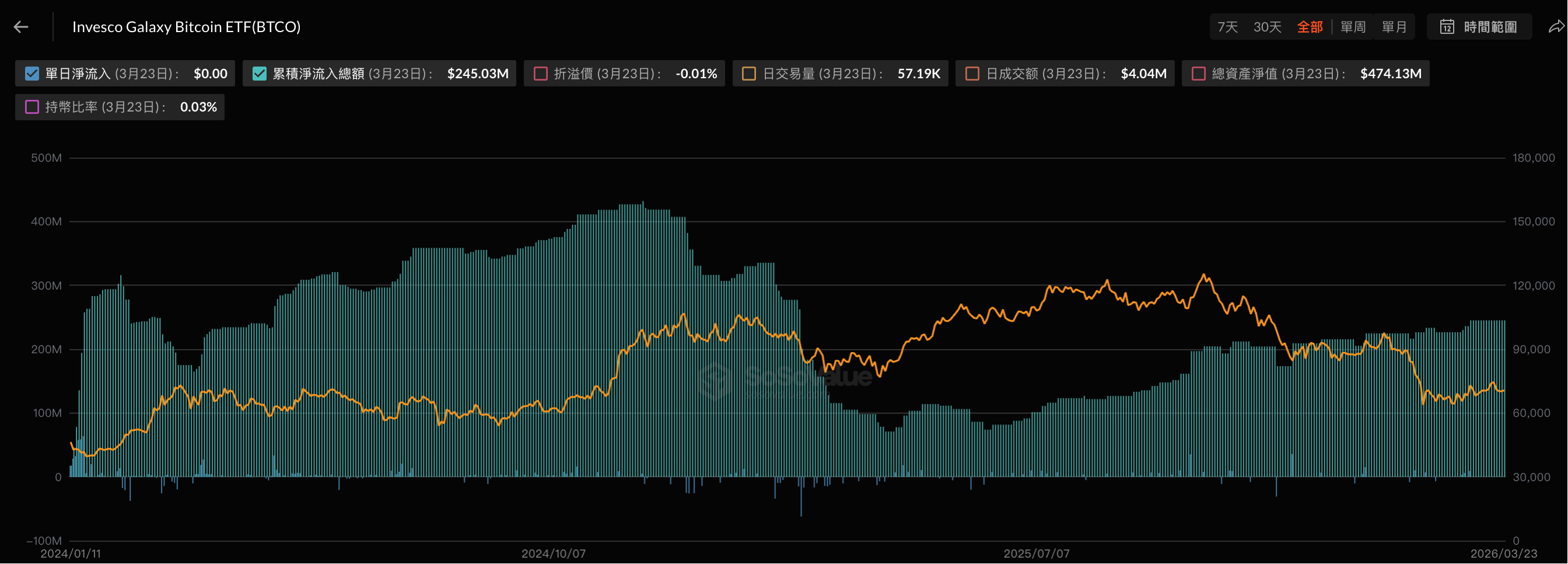
Outside of the U.S. market, Invesco is also making strides in the European market, launching the Invesco Physical Bitcoin ETN (trading code: BTIC) on the European market in November of the same year, which is listed on the Deutsche Börse (Xetra) and is provided with physical Bitcoin custody services by Zodia Custody, a subsidiary of Standard Chartered Bank, offering a regulated and compliant Bitcoin investment tool for European investors. Since then, Invesco's crypto strategy has officially transitioned from the "layout period" to the "implementation period."
Regulatory Historic Turning Point and Tokenization Layout
Invesco's acquisition of the on-chain fund under Superstate is not its first foray into the tokenization sector. As early as February 2025, Invesco partnered with Singapore's fintech platform DigiFT to launch a tokenized product for a private credit fund with a scale of $6.3 billion, allowing institutional investors to subscribe for shares in U.S. dollars or stablecoins USDC and USDT. As one of the first compliant real-world asset (RWA) tokenized funds issued by mainstream asset management institutions globally, this product has become a key "move" for Invesco in the RWA field.
It is essential to clarify that Invesco's pace in its crypto layout has always resonated with the evolution of U.S. regulatory policy. Before 2024, the regulatory framework for crypto assets in the U.S. remained ambiguous, with jurisdictional disputes between the SEC and CFTC and stringent definitions of "security tokens" presenting significant barriers to institutional entry.
However, after the 2024 elections, the regulatory winds underwent a fundamental shift: the Trump administration clearly proposed "crypto-friendly" policies, including plans to establish a national Bitcoin reserve and appoint regulatory officials who support crypto. That same year, the "GENIUS Act" was passed, providing a clear legal framework for regulated stablecoins and creating a favorable regulatory environment for real asset tokenization to some extent. Subsequently, the U.S. government and regulatory agencies have released multiple positive signals, proposing suggestions and guidelines related to asset tokenization and gradually improving the tokenization regulatory system.
For instance, in August 2025, the White House released the report of the Presidential Working Group on Digital Assets, recommending that tokenized stocks, bonds, private credit, etc., be incorporated into the existing regulatory framework for securities and banking, reflecting a "substance over form" approach, meaning that tokenized assets should be regulated based on the underlying asset properties rather than their technological forms. In January this year, the SEC published tokenized securities guidelines based on this foundation, systematically delineating the legal boundaries of "tokenized securities," further clearing compliance obstacles.
During this period, Invesco appointed former JPMorgan blockchain executive Kathleen Wrynn as the company's newly established "Global Head of Digital Assets" in June last year, responsible for managing its $1.6 billion crypto ETF and tokenized asset portfolio, and leading the tokenization transformation of Invesco's funds and the integration of crypto asset investment strategies. This new position marks a comprehensive upgrade in its organizational structure concerning digital asset strategy, and Wrynn's appointment is seen as a critical step towards deepening its crypto and tokenization layouts.
It is worth mentioning that as the regulatory framework gradually clarifies, the integration of traditional capital markets with tokenization technology is entering a substantial phase. In mid-month, the U.S. SEC approved the Nasdaq tokenized stock trading pilot project, laying the foundation for the large-scale trading of tokenized assets. Prior to this, with a series of policy relaxations, leading asset management institutions such as BlackRock, Fidelity, and Franklin Templeton have accelerated their layouts. RWA.xyz data shows that on March 17, the total scale of global tokenized real-world assets briefly exceeded $27 billion, reaching approximately $27.345 billion, having grown over 284% compared to the same period in 2025, setting a historical new high.
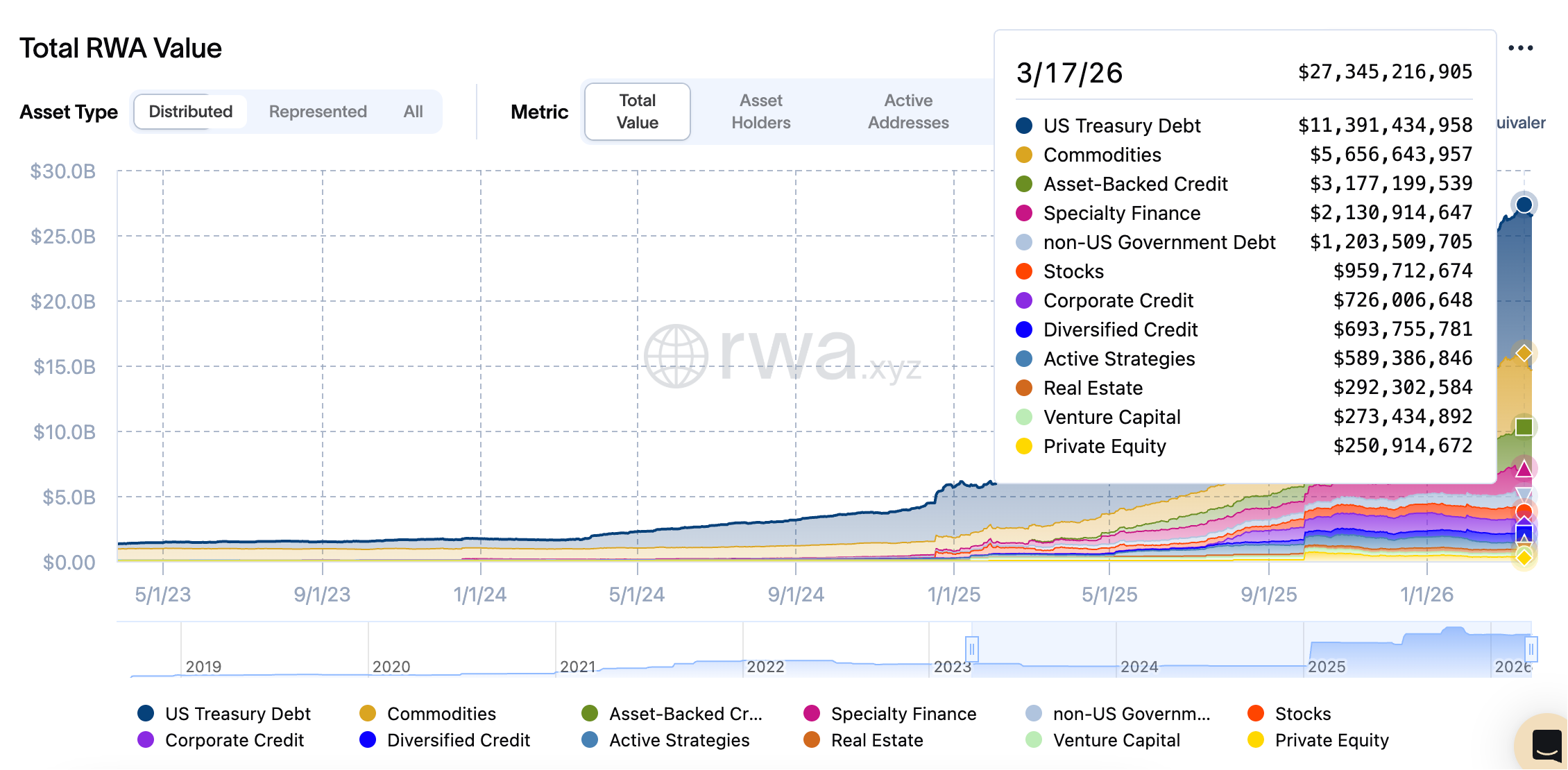
Among them, the scale of tokenized U.S. Treasuries has reached approximately $12.09 billion, becoming the core pillar of the RWA market. These products, backed by the credit of the U.S. government, feature low risk and high liquidity, perfectly aligning with the allocation needs of institutional investors. Meanwhile, the investor structure for tokenized government bonds is gradually shifting from early crypto-native institutions to traditional asset management companies, family offices, and even central banks, indicating a growing market maturity.
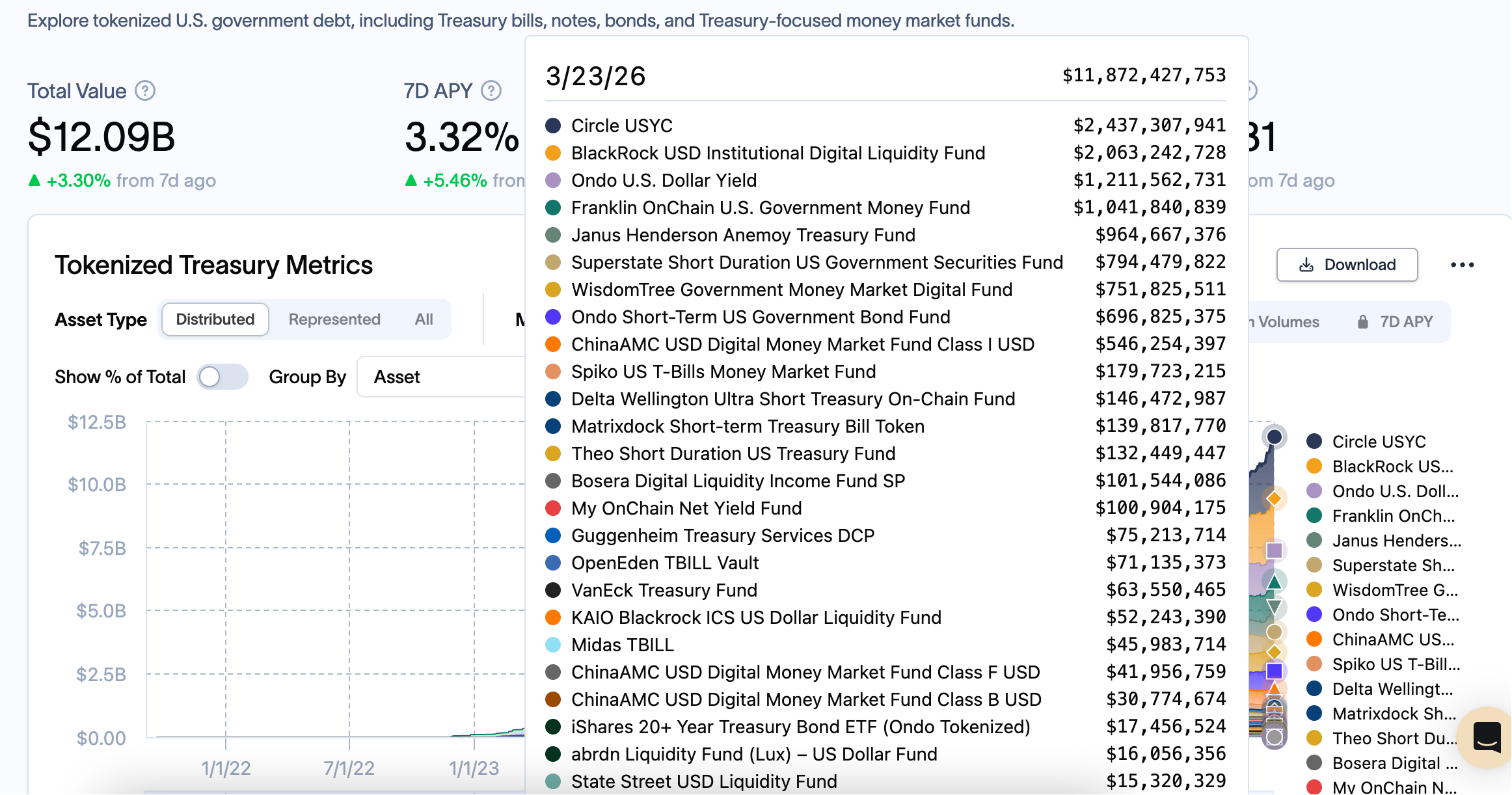
In terms of market share, in the tokenized U.S. Treasury bond market, the top three are Circle's USYC (approximately $2.437 billion), BlackRock's BUIDL (approximately $2.063 billion), and Ondo's USDY (approximately $1.212 billion). Currently, Superstate's tokenized U.S. Treasury bond fund USTB ranks sixth with $794 million, but as one of the first on-chain government bond funds registered and operating compliantly with the SEC since its official launch in February 2024, USTB has established deep collaborations with multiple mainstream DeFi protocols, asset management institutions, and blockchain ecosystems. Its tokenization system has undergone two years of operation, having passed market scrutiny in terms of compliance and stability.
Invesco's choice to acquire the USTB fund is a practical and precise entry into the tokenized government bond market, fully reflecting its pragmatic nature as a traditional asset management giant. Compared to building on-chain infrastructure from scratch, acquiring a mature fund allows for rapid market share and user base acquisition. From the transaction structure perspective, Invesco's arrangement is also quite astute as it retains USTB's token structure and on-chain infrastructure, with Superstate continuing to provide technical support, while Invesco focuses on investment management and brand operations. This "division of labor" model not only avoids the traditional institutions' shortfalls in blockchain technology but also firmly maintains core competitiveness—day-to-day investment decisions for the fund will be managed by Invesco's global liquidity team. This move also marks Invesco's strategic extension from "focusing on crypto-native assets" to "digitalizing traditional assets."
Currently, Invesco's crypto business has established three core pillars, forming a complete layout from retail investment products to institutional-grade on-chain asset management:
- Spot ETF product line: represented by BTCO, covering Bitcoin, Ethereum, and SOL spot ETFs, providing low-barrier and high-liquidity crypto exposure for retail and institutional investors.
- EU ETN Layout: relying on the mature UCITS regulatory framework in Europe, launching physically backed Bitcoin ETNs on the Deutsche Börse (Xetra), providing European investors with tax-efficient and regulated crypto investment tools.
- Tokenized Asset Management: starting with the tokenized U.S. Treasury bond fund USTB, exploring the on-chainification of traditional assets such as government bonds, bonds, and private equity to drive efficiency upgrades in financial infrastructure.
Every step of Invesco's layout reflects its stability and foresight as a traditional asset management giant. This entry into the tokenized fund market not only extends its own strategy but also indicates that the asset management industry is undergoing a profound transformation. From the perspective of industry trends, leading institutions such as BlackRock and Fidelity have accelerated their expansion from single asset tokenization to diversified varieties; as an active participant, Invesco is clearly not stopping at government bonds, and its subsequent actions may become a crucial force in promoting the comprehensive on-chain transformation of traditional assets.
Conclusion
Today, tokenization technology is fundamentally reshaping the underlying logic of asset management, improving efficiency, lowering thresholds, and integrating ecosystems in numerous aspects. Despite the promising prospects of this market, the path ahead still faces multiple challenges. First, there is regulatory uncertainty; although the U.S. has released several guiding documents, no relevant legislation has been enacted. Simultaneously, global coordination in regulation remains a long way off, with different countries having varying classifications and tax policies for tokenized assets, which may become invisible barriers to cross-border circulation; secondly, there are technological risks, such as the security of blockchain networks, vulnerabilities in smart contracts, and interoperability across chains, which still need to be collectively addressed by the industry; finally, there is the issue of investor perception; traditional investors need to enhance their understanding of tokenized assets, and balancing innovation with risk is a long-term challenge that asset management institutions must face.
However, these challenges may not halt the progress of asset tokenization. In the future, tokenized assets will deeply integrate with the traditional financial system, forming a new pattern of "on-chain and off-chain collaborative development." Currently, giants like Invesco have begun their layout attempts: starting with the most compliant government bonds, building the smallest viable ecosystem with mature technology, and continuously expanding into diversified products. This transformation will not happen overnight, but each technological iteration and regulatory refinement is paving the way for the eventual realization of tokenization.
免责声明:本文章仅代表作者个人观点,不代表本平台的立场和观点。本文章仅供信息分享,不构成对任何人的任何投资建议。用户与作者之间的任何争议,与本平台无关。如网页中刊载的文章或图片涉及侵权,请提供相关的权利证明和身份证明发送邮件到support@aicoin.com,本平台相关工作人员将会进行核查。


