Author: Will
This is the fifth article analyzing the YC W26 series. The last article dismantled AI programming tools and "Claude Code for X" (12 companies), while this article looks at the other half of the development chain—everything after code is written: operations, testing, workflow automation, and agent development infrastructure, totaling 22 companies.
Code is Just the Beginning
In the last article, we discussed how AI changes "writing code." But writing code is just part of software development—after the code is completed, there are deployment, operations, on-call duties, testing, bug fixing, and workflow automation, each step requires people.
The 22 companies in YC W26 are doing this: handing over every aspect of "after the code is written" to AI agents.
An alert at 3 AM in the production environment? IncidentFox automatically checks logs, locates the root cause, and prepares a fix script while you sleep; you just need to review and approve upon waking. Users find a bug? Lucent 24/7 automatically watches session replays, spotting issues before users do. Need to automate an approval process in Excel? Bubble Lab can do it in one sentence.
These 22 companies can be divided into 4 groups: AI Operations/SRE (5 companies), AI Testing/QA (2 companies), AI Workflow Automation (7 companies), and Agent Development Infrastructure (8 companies).
First, the Conclusion: 4 Takeaway Judgments
1. IncidentFox is the most complete product among these 22 companies. Two former Roblox engineers (who supported an infrastructure with over 100 million daily active users), open source, over 300 pre-configured integrations, deployed in less than one day. The core differentiation is not "using AI to analyze logs" (which anyone can do), but rather "automatically discovering your tech stack and generating integrations"—eliminating the most painful integration work.
2. The work done by AI Operations (5 companies) and AI Testing (2 companies) together is: transforming "code quality assurance" from being labor-intensive to agent-intensive. Traditional operations on-call, bug investigation, and regression testing require significant time from engineers. These 7 companies bet that agents can find problems faster than people, locate root causes faster, and operate 24/7.
3. Workflow automation (7 companies) is the most diverse group but with the broadest user base. Their common point is "enabling non-coders to use AI for automation"—RamAIn uses computer vision to operate any software, Bubble Lab can create automation processes in one sentence, and Jinba automates enterprise workflows through chat. This group targets not just developers but all knowledge workers.
4. Agent development infrastructure (8 companies) is the most "meta" group—creating tools for those who build agents. Emdash offers an open-source agent development environment, Overshoot provides an AI vision application platform, and Glue creates design canvases for agent interfaces. The logic of this group is similar to what is discussed in the Fintech article about "agent economic infrastructure": when the number of agents explodes, the tools for creating agents become a necessity.
Sub-track One: AI Operations/SRE—IncidentFox, Mendral, Corelayer, Sonarly, Lucent
Five companies are tackling the same issue from different angles: replacing operations engineers with AI.
IncidentFox
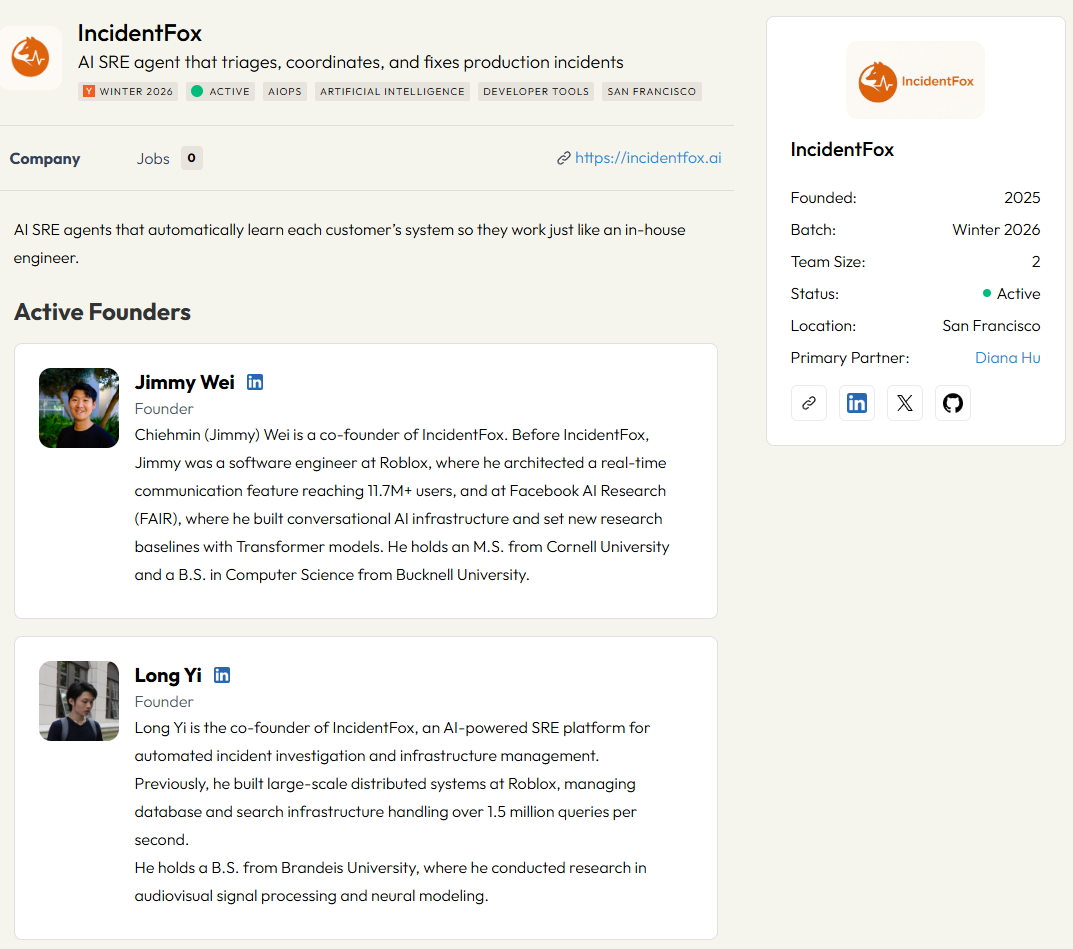
Official link: https://incidentfox.ai/
AI SRE agent—automatically triaging, investigating, and resolving production incidents, residing in Slack.
Core data: open source (Apache 2.0), over 420 stars on GitHub, 300+ pre-configured integrations, supports Kubernetes/AWS/Grafana/Prometheus/Datadog/PagerDuty/GitHub
Business model: open-source core + enterprise version (secure sandbox, credential proxy, multi-team management). Deployment time: 1 day
Team highlights: Jimmy Wei—former Roblox (built social communication features for over 100 million daily active users), previously at Meta FAIR researching multi-party conversational AI, Cornell CS. Long Yi—former member of Roblox's state infrastructure team (database infrastructure supporting over 100 million daily active users). The two complement each other perfectly with one building AI and the other in operations.
Competitors/risks: PagerDuty, Incident.io (raised over $50M), Datadog, ServiceNow are all expanding towards AI operations. However, IncidentFox's differentiation lies in "automatically generating integrations"—other tools require you to spend weeks manually integrating internal systems, while IncidentFox analyzes your codebase and historical incidents to automatically generate.
Additional highlights: SOC 2 compliant. Each investigation runs in an isolated container, and the agent cannot see the original keys. Also released a Claude Code plugin for individual developers.
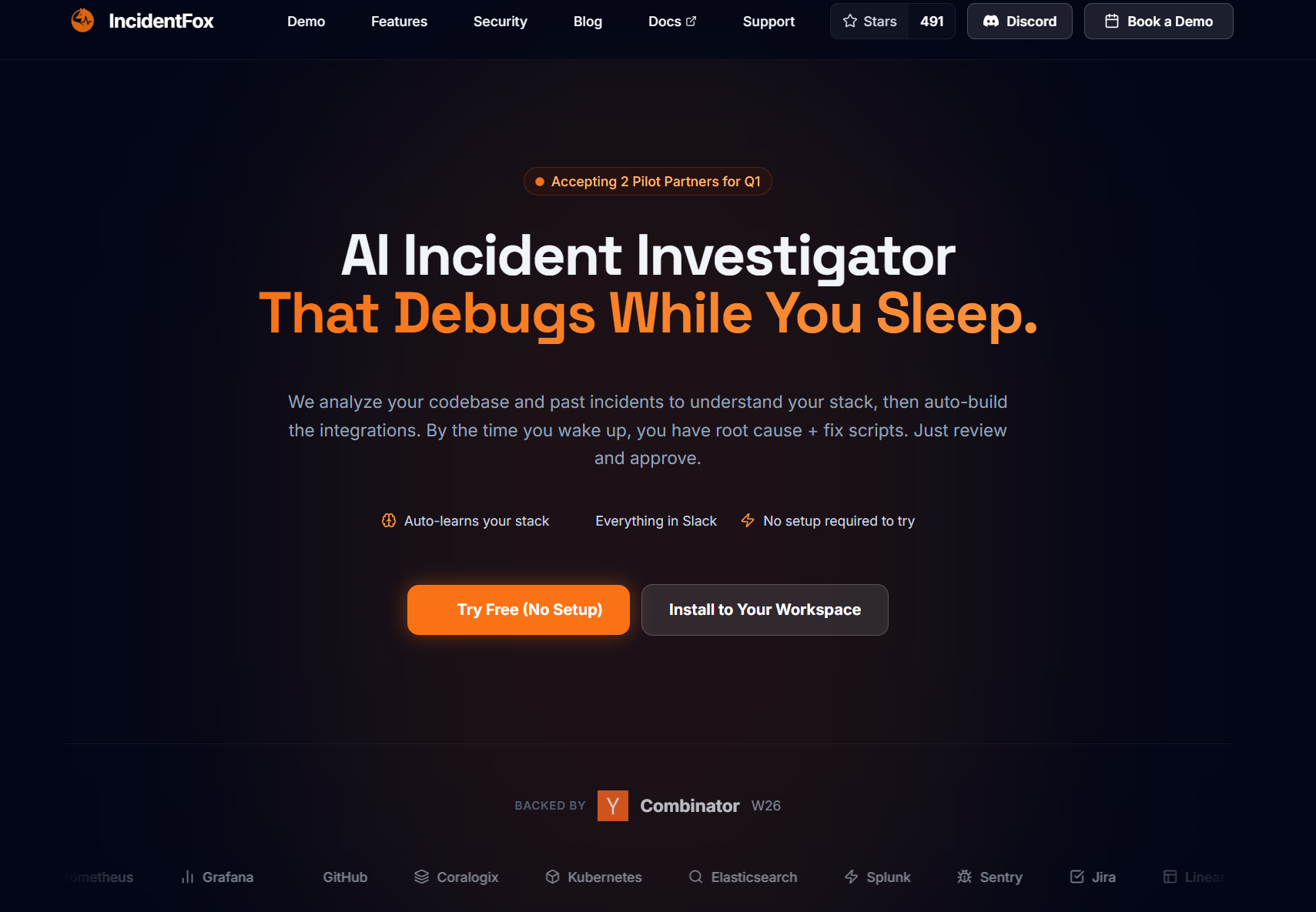
IncidentFox's core insight is that the reason AI operations tools fail is not due to the model's inadequacy but the depth of integration. Your payment team uses a self-developed Kafka pipeline, your infrastructure team uses a self-developed deployment system, and your ML team uses a self-developed model service—general AI tools simply cannot integrate. IncidentFox's approach is: analyzing your codebase and incident history, automatically discovering what integrations are missing, and automatically generating them. Humans only need to approve.
Chris Lu mentioned in a tweet that IncidentFox's description is "AI SRE engineers independently fixing production incidents." This positioning is both a blessing and a threat to operations engineers.
Mendral (0.9K monthly visits) is creating AI DevOps engineers. Different from IncidentFox's "after-the-fact fixes," Mendral is more focused on "daily operations"—continuous integration, deployment management, and environment configuration necessary on a daily basis.
Corelayer (0.4K monthly visits) is about "using data to debug AI on-call engineers." It emphasizes data-driven debugging—not guessing where the problem is, but automatically correlating with metrics and logs.
Sonarly (0.2K monthly visits) focuses on production alert AI engineers. It emphasizes alert handling—classifying, deduplicating, and associating a large number of alerts, identifying those few that truly need human attention.
Lucent (1.6K monthly visits) is an AI that automatically checks session replay to detect bugs—not searching for bugs at the code level but from the user experience perspective. AI watches user session recordings 24/7, automatically discovering freezes, errors, and abnormal processes, then creating bug tickets in Slack and Linear with complete reproduction context.
The founder Alisa Rae's story is worth telling: she is Australian, previously bootstrapped and sold an education technology company, was the second employee at MagicBrief (later acquired by Canva), and worked on rich text editors at Atlassian. She was rejected on her first YC application and was advised to "find a co-founder." She insisted on the solo route, raised $2M in seed funding, and got selected on the second application. Used by over 30 YC companies, founders report: "discovered 7 bugs never seen before in the first week," "broke even in the first week." 94% of users who encounter bugs do not report them, they simply churn—this is Lucent's reason for existence.
The common logic among the 5 companies is: most operations engineers' time isn't spent on "fixing problems," but on "finding problems." Correlating signals from dozens of monitoring systems, sifting through logs, checking recent deployment changes—this investigation process occupies an average of 80% of repair time. AI agents can simultaneously query all data sources, make connections within seconds, compressing "finding problems" time from hours to minutes.
Sub-track Two: AI Testing/QA—Canary, Ashr
Two companies are working on AI testing.
Canary claims to be "the first AI QA engineer that understands your codebase." The key is "understanding the codebase"—not a general testing tool, but first comprehending your code logic, then generating targeted test cases. Traditional AI testing tools often produce test cases that are disconnected from the actual code.
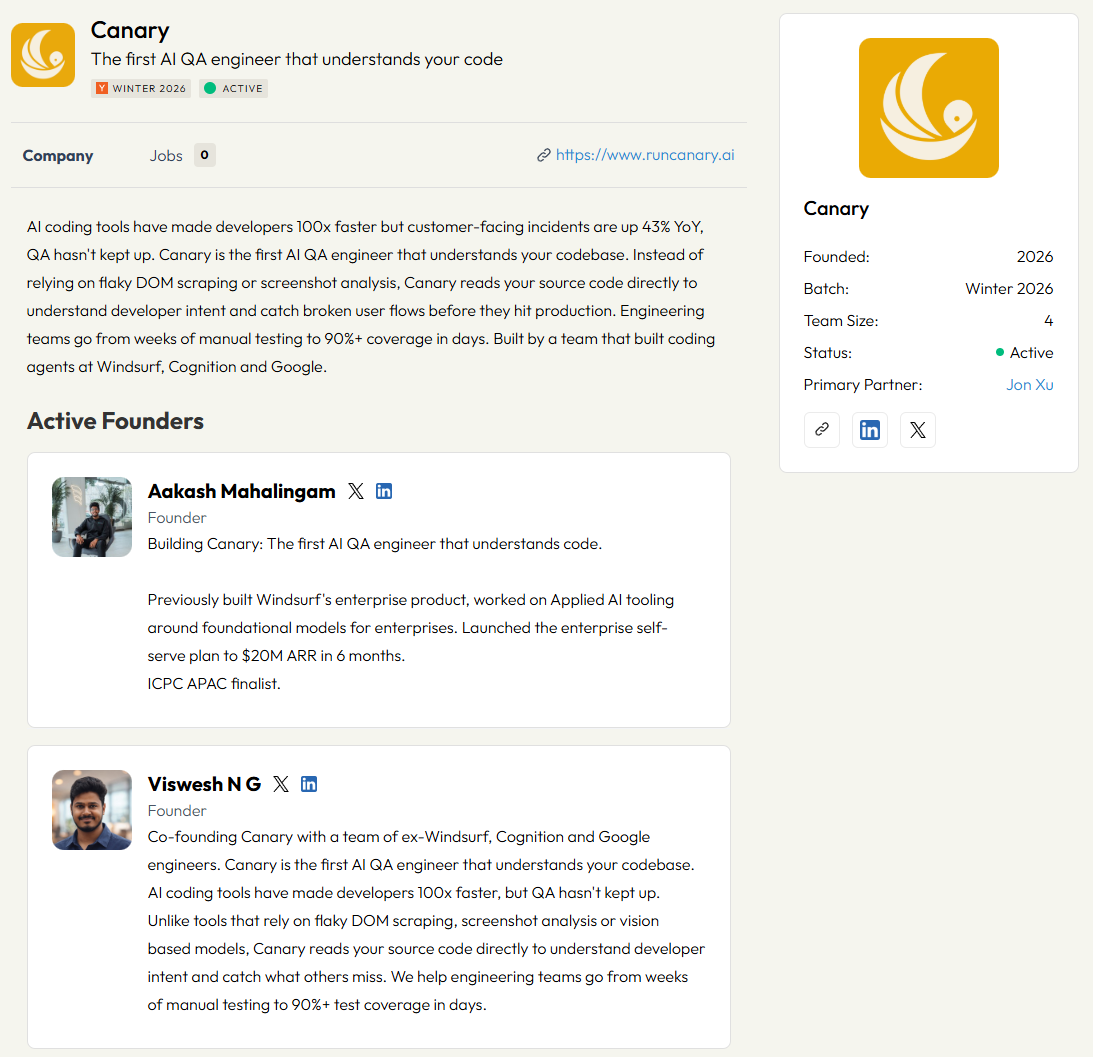
Official link: https://www.runcanary.ai/
Ashr focuses on agent-automated multimodal testing. "Multimodal" means not just testing text interfaces, but also images, videos, voice, and other interactions. As AI applications increasingly use multimodal inputs and outputs, testing tools need to keep pace.
Sub-track Three: AI Workflow Automation—RamAIn, Bubble Lab, Jinba, Ressl AI, EigenPal, Carson, Crow
This is the broadest group—users are not developers but anyone needing workflow automation.
RamAIn
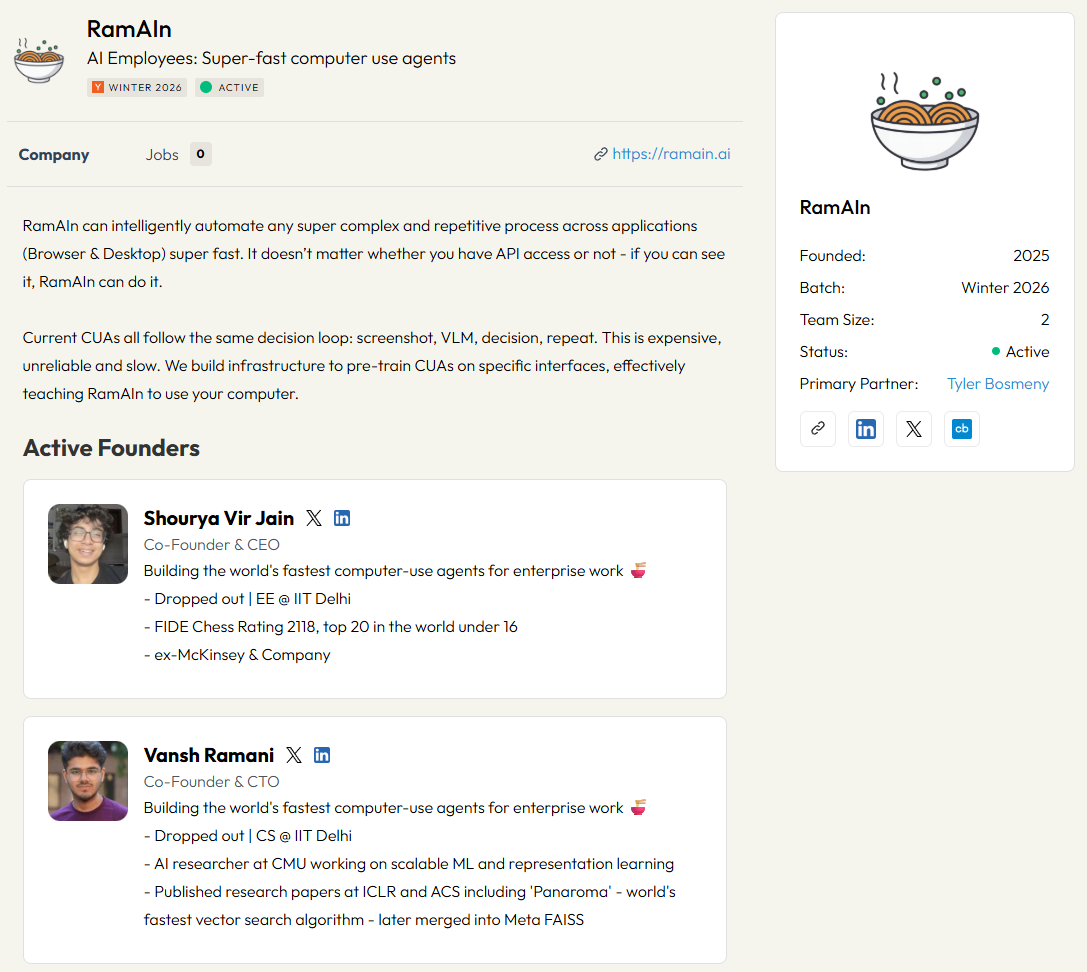
Official link: https://ramain.ai/
"The fastest computer in the world using agents"—teaching AI to operate your computer like a human, transferring data between browsers and desktop applications.
Core data: 35K monthly visits, with teams in procurement, insurance, healthcare, and finance already using it. Deployment completed in a few days
Team highlights: Two IIT Delhi students—CEO Shourya previously worked on enterprise AI projects at McKinsey, founded Genoshi (an AI studio, bootstrapped to six-figure revenue), and is also a FIDE chess player with a rating of 2118, representing India in competitions against 17 countries.
Business model: enterprise-level—automatically transferring data between legacy systems, desktop applications, and web portals. Target clients include procurement teams (ERP + vendor portals), insurance brokers (underwriter portals), healthcare providers (electronic medical records + lab portals), and finance teams (revenue cycle management).
Competitors/risks: Anthropics' Computer Use and OpenAI's Operator are major threats. RamAIn’s differentiation lies in "pre-training on specific interfaces"—general CUA (screenshot → visual model → decision → repeat) is expensive, slow, and unstable, while RamAIn first learns your interface and then automates it. Additionally, it has a "self-healing" capacity—if the UI changes, it doesn’t break, which is a fatal flaw of traditional RPA.
Bubble Lab (19K monthly visits) allows "one prompt, permanent automation." It turns repetitive workflows into automated processes with one sentence. Its positioning is simpler than Zapier—while Zapier requires you to configure trigger conditions and steps, Bubble Lab only requires you to describe what you wish to automate.
Jinba (17K monthly visits) offers "chat automation of any enterprise workflow." Targeting enterprises, it triggers approvals, data transfers, system integrations, etc., within chat interfaces.
Ressl AI (17K monthly visits) provides ERP/CRM configuration agents. After enterprises implement Salesforce or SAP, configuration and customization become a massive project. Ressl AI uses AI agents to conduct these configuration tasks.
EigenPal (9K monthly visits) works on enterprise AI document workflows. Carson develops desktop AI workspaces (which we've detailed in the OpenClaw article, so we won't repeat here). Crow (25K monthly visits) enables "users to control your applications through chat"—adding an AI chat layer to any SaaS product, allowing users to complete tasks directly via chat without needing to learn the interface.
The common logic among these 7 companies is: AI programming lowers the threshold of "writing code," but most work doesn't actually require coding—what's needed is stringing together existing tools and automating repetitive processes. This group of companies provides "automation without writing code."
Sub-track Four: Agent Development Infrastructure—Emdash, Overshoot, Cardboard, Glue, Sila, Valgo, SideKit, Wideframe
Creating tools for those who build agents.
Emdash (23K monthly visits) provides an open-source agent development environment—over 60K downloads, 2430 GitHub stars. It supports running multiple coding agents in parallel and any model provider. While closely aligning with the positioning of 1code discussed in the previous article, it places more emphasis on open-source and model independence.
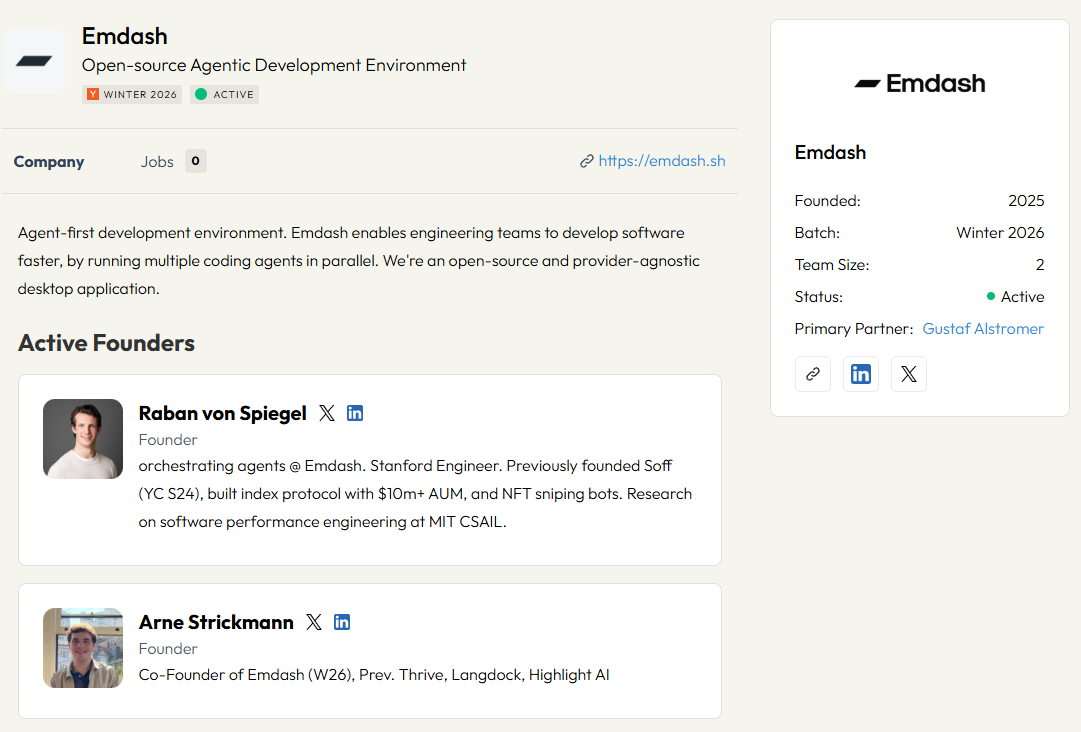
Official link: https://emdash.sh/
Overshoot (16K monthly visits) develops an AI visual application platform—helping developers build and run AI visual applications. With the proliferation of multimodal models, "AI applications that can see images" is a rapidly growing category.
Cardboard (7K monthly visits) offers an agent video editor. AI agents can automatically edit, splice, add subtitles, and apply effects. Video production traditionally requires specialized skills and expensive software; Cardboard aims to lower the threshold to "tell the agent what effects you want."
Glue designs canvases for agent interfaces—when your AI agent requires a front-end interface, Glue assists in the design. With more agents needing visual control panels, this demand will increase.
Sila provides messaging for agent workspaces—enabling communication infrastructures between agents. When multiple agents need to collaborate, how do they share information? Sila addresses this challenge.
Valgo (3K monthly visits) works on autonomous system algorithm safety verification. SideKit (2K monthly visits) provides a one-stop solution for mobile application deployment (one of the few non-AI companies in this batch). Wideframe collaborates on video editing AI.
Looking at the 22 Companies Together
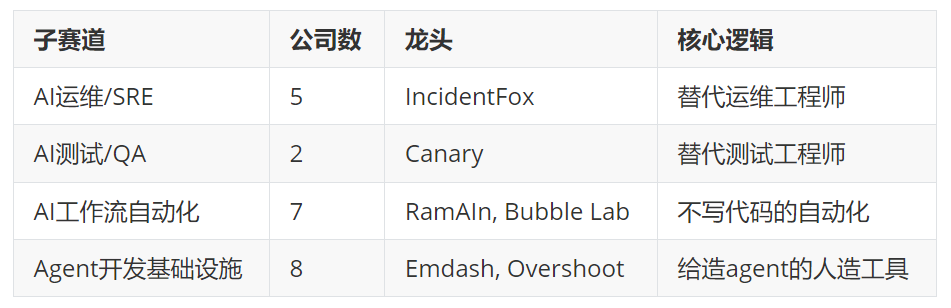
A few observations:
First, AI operations (5 companies) represent the most mature group among these 22. IncidentFox is open-sourced, has over 300 integrations, and is SOC 2 compliant. This is not coincidental—operations is one of the scenarios where AI can most easily demonstrate value: reducing repair time from hours to minutes is directly measurable.
Second, workflow automation (7 companies) faces its biggest competition not from each other, but from existing automation tools—Zapier, Make, n8n. The addition of AI makes these tools "smarter," but existing tools are also rapidly integrating AI functionalities. These 7 smaller companies need to find a sufficiently narrow niche to survive against Zapier (valued over $5 billion).
Third, agent development infrastructure (8 companies) is the longest-term bet. Currently, the number of agents isn't high enough, and the value of the infrastructure isn't yet obvious. However, if the agent economy truly takes off (as we have seen with Sponge providing bank accounts for agents in the Fintech piece), the toolchain for building agents could become the next level of opportunity equal to cloud infrastructure.
Fourth, all these 22 companies are B2B. Like all articles in this series—YC W26 is a thoroughly B2B batch. AI tools are sold to enterprises and developers, not to consumers.
Insights for Chinese Teams
First, the demand for AI operations in China is immense. Chinese internet companies (ByteDance, Alibaba, Tencent, Meituan) have operation scales comparable to those in the US, but the level of AI integration in operations tools is still low. Domestic monitoring systems (Alibaba's ARMS, ByteDance's APMPlus) have not yet aggressively pushed for AI functionalities like Datadog. If there are teams building a "Chinese version of IncidentFox"—integrating domestic mainstream monitoring systems, supporting Chinese log analysis, and understanding the domestic tech stack, there's a market to tap.
Second, workflow automation in China has a unique scenario—DingTalk and Feishu. These two platforms are the core working entry points for Chinese enterprises, but their automation capabilities are still relatively basic. If there are teams doing "AI workflow automation in DingTalk/Feishu" (similar to what Jinba does for Slack), it would be easier to scale than building a new platform from scratch.
Third, agent development tools are still lacking in China. The US already has Emdash, Glue, and Sila addressing various stages of the agent development chain, but China lacks comparable tools. As the number of agent developers in China increases, this market will open up.
Key Takeaways
1. The core bottleneck of AI operations is not the capability of the models but the depth of integration. IncidentFox's idea of "automatically generating integrations" is worth learning for all teams developing enterprise AI tools—no matter how smart your AI is, if it cannot integrate into the clients' systems, it can't do anything.
2. "Automation without writing code" is becoming an independent category. The traffic for RamAIn (35K monthly visits), Bubble Lab (19K), and Crow (25K) indicates the demand is real. These tools target not just developers but all knowledge workers—this market is ten times larger than that for developer tools.
3. Agent development infrastructure is a "long-term right but short-term not profitable" direction. Similar to cloud infrastructure back in 2010—at that time, there weren't many applications in the cloud, and infrastructure appeared to be excessive. But as applications exploded, infrastructure became the most profitable level. Agent infrastructure may repeat this story.
4. The total of these 22 companies plus the previous 12 makes 34 companies in the DevTools space—this is the largest track in the entire W26. This reflects a fact: AI first changes "how software is built," then other industries. Developer tools are AI's "home base."
免责声明:本文章仅代表作者个人观点,不代表本平台的立场和观点。本文章仅供信息分享,不构成对任何人的任何投资建议。用户与作者之间的任何争议,与本平台无关。如网页中刊载的文章或图片涉及侵权,请提供相关的权利证明和身份证明发送邮件到support@aicoin.com,本平台相关工作人员将会进行核查。


