Author: Charlie Little Sun
Last week, OpenClaw and Tempo have almost become the code words in the crypto circle.
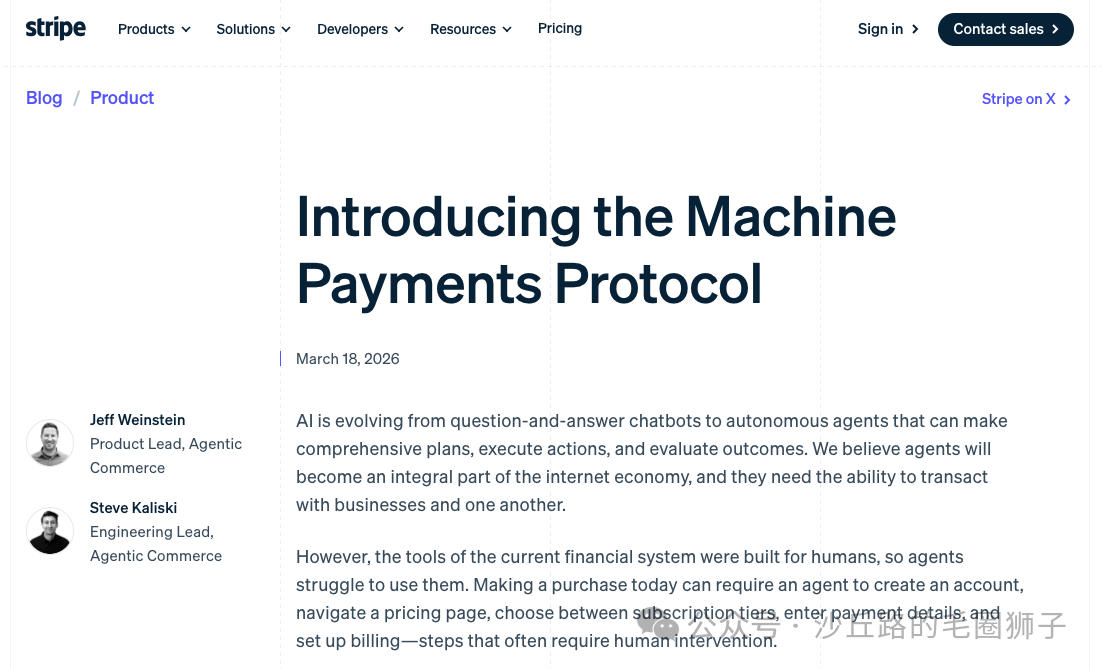
Many people have noticed the heat and know that Stripe has entered the game, and Visa and Lightspark have also taken a stand.
What has not been fully understood yet is not the news itself but that payment control points are shifting.
In recent months, the market has been filled with imagination about Agent Payments.
Coinbase is launching x402 in May 2025, redefining HTTP 402 as a payment language; Cloudflare quickly wrote it into the agentic payments documentation, creating a very internet-native programming payment experience with "no account, no session, no API keys" as a starting point.
Circle then moved forward along this line, tying USDC, Wallets, autonomous payments, and x402 together, and later launched Nanopayments, continuing to push towards higher frequency, lower amounts, and closer to machine payments.
So in recent months, many people's minds have defaulted to a map: Agents need to spend money, the protocol is x402, the currency is USDC, settlement is on-chain, and the developer entry point is in the Coinbase Developer Platform and related ecosystem.
This map is still correct today, but the problem is that it only describes the first phase.
Last week, Stripe and Tempo released MPP, and what truly changed is not "there's another protocol supporting AI agent payments," but rephrasing the problem from "how does the Agent make a stablecoin payment" to "how machines can have a payment-method-agnostic checkout interface."
Stripe's official positioning is: MPP is an open standard, internet-native way for agents to pay; while Cloudflare's technical documentation goes further, breaking it down into a unified protocol that can support Tempo stablecoins, cards and wallets supported by Stripe, Lightning, and even custom payment methods.
The battlefield has suddenly changed.
x402 won the first round
If I don't give credit to x402 first, all subsequent judgments about MPP will seem hollow.
I mentioned in x402, we might have misunderstood its original intention that the internet has long had an original sin: content, computing power, data, and APIs have become increasingly fine-grained, but payments remain stuck in the old world of accounts, subscriptions, prepayments, and manual checkouts.
The brilliance of x402 lies in the fact that it does not attempt to solve all problems at once but chooses a very sharp entry point: enabling HTTP requests themselves to carry payment capabilities.
The server returns 402 Payment Required, the client programmatically completes the payment, and then retries the request with the payment proof.
No account system, no session state, no API key management console. For Agents, this design is naturally convenient.
This is also why Circle will be the first to reap this wave of benefits.
What it aims to do is to allow AI agents to make payments autonomously through Circle Wallets, USDC, and x402 APIs; and in the recently released Nanopayments, Circle directly termed x402 as the standardized protocol direction for agents to pay on the web.
Adding on to Circle's recent financial report showing that USDC circulation increased by 72% to $75.3 billion, the capital market will naturally view both "stablecoin infrastructure" and "agent payments infrastructure" narratives as intertwined, leading to Circle's stock price surge.
In short, x402's victory is not about "technical finality," but about "making things happen first."
This is extremely important in new markets.
In the first phase, the most valuable solution is often not the most complete one but the one that allows developers to use it first.
What MPP truly rewrites is not rail, but checkout
The most commonly misunderstood aspect of MPP is that many people view it as "x402 Pro that supports more payment methods," which is a comprehensive solution above x402.
But what it actually aims to change is the checkout layer.
In this week's Tokenized podcast interview, Visa's Head of Crypto Cuy Sheffield made a key statement: if we really want to expand agentic commerce, we cannot throw agents back into "human land" to search for web pages, click buttons, and go through checkouts; what is truly needed is a headless checkout that allows agents to negotiate directly with merchants about what to buy, at what price, and how to pay, and completes the transaction cleanly.
More importantly, he, along with Tempo's Head of GTM Simon Taylor, repeatedly emphasized in that conversation that it is not about "supporting one more chain," but about being payment-method agnostic, payment-network agnostic, PSP agnostic, and vault-provider agnostic.
This is no longer the mindset of crypto protocol engineers; it is the payment platform redefining the interface.
Stripe's official blog is actually saying the same thing, but in a more restrained tone.
MPP is not merely issuing a spec, but is directly integrated into Stripe's existing Payment Intents and backend system.
Merchants can accept MPP payments sent by agents with just a few lines of code; these payments will flow into Stripe's balance, payout, tax, fraud, reporting, and refund processes just like normal transactions.
For developers, this means I do not have to learn a new on-chain payment protocol but can immediately start integrating machine users in a familiar payment stack.
This step is very Stripe: it has never been about inventing something entirely new at its most dangerous times, but about compressing something that only a few specialized players could understand into the default interface for developers worldwide.
This is why I believe MPP is really vying for the headless checkout of the machine commerce era rather than the payment rail. The former decides how money moves, while the latter determines through whom the transaction occurs. Historically, what is truly valuable is usually the latter.
Session is the real upgrade this time
The deepest difference between x402 and MPP lies in the session.
MPP defines two types of payment intents: charge is for one-time immediate settlement, suitable for per-request billing; session is based on payment channels for streaming payments, suitable for pay-as-you-go and per-token billing, aiming for sub-cent costs and sub-millisecond latency.
More importantly, the Cloudflare documentation clearly states that MPP is backward compatible with x402, and the original exact flow of x402 can essentially be mapped to MPP'scharge.
In other words, MPP does not negate x402, but rather builds on top of the established ground of x402 to create a protocol primitive for continuous consumption.
Tempo's official explanation of this primitive is more straightforward: session is like OAuth for money, authorizing once, and then programmatically paying within defined limits and rules, aggregating thousands of small interactions into a final settlement.
In the Tokenized podcast, Tempo's Head of Product Liam Horne mentioned that this concept in the old blockchain terminology is payment channels. However, today the most natural application is not the ideal payment network that BTC maxis discuss, but LLM charging per token, API charging per call, and agents continuously consuming according to workflow.
Deposit $5, and every time the model generates a token, a bit is deducted, closing the session afterward. Once this image emerges, you realize that MPP is targeting business models, not demos.
My previous experience at the Lightning Network company Strike makes me particularly sensitive to this aspect.
The concepts of MPP's session and payment channel resonate similarly with Lightning Network, which is why MPP supports Lightning Network from the start.
Tempo's choice of Lightspark as a partner for Lightning Network is even more meaningful, but let's set that aside for now.
Once you see "first lock in value, then continuously deduct in sessions, and finally aggregate settlement," you'll immediately realize that Tempo is not just vying for another chain, but is moving a payment intuition that has been genuinely understood only by a few payment infrastructure players into a broader machine commerce context.
The truly frightening aspect of Tempo is not just the protocol, but its ambition to take the entire payment operation system alongside it
Many people are currently comparing x402 and MPP, and by halfway through the comparison, distortion has already occurred because they do not entirely exist on the same layer.
x402 is essentially a payment language. It is elegant and sharply hits the pain point.
However, Tempo's offering is not just a language; it also includes a complete operational system customized for real-world payments.
Several specific points Tempo emphasized when launching its mainnet include: instant settlement, predictable low fees, high throughput, and global availability, while also incorporating payment lanes, stablecoin gas, and subsequent workload support for enterprise payments into its mainnet launch narrative.
TIP-20 is even more typical: it is not a general token standard but directly embeds practical needs from the real-world payment system, such as transfer memos, compliance controls, and reward distribution, into its primitives.
Tempo went from the first line of code to mainnet in just seven months, but Liam himself admitted that the real foundation is not seven months, but rather years of accumulated battle-tested infrastructure.
What makes Tempo worthy of serious consideration is not its speed but that it has not used startup narratives to obscure its engineering base, but rather clarified that "this is not a castle in the air built from scratch."
Therefore, compared to the initiator of x402, the Coinbase Developer Platform is better suited to getting standards up and running first, pulling developers in, and igniting the ecosystem; while Tempo's team is more suitable for the next phase, which is the stage where protocol abstraction, payment runtime, developer tools, and enterprise-level payment primitives gradually converge.
It is not about who is smarter, but who is more suitable for each development stage.
What Circle really needs to guard against is not the current circulation of USDB
Does this mean USDB is going to challenge USDC next?
USDC is indeed very strong right now: Circle is not just an asset issuer, it is also tightly bound to early agent payment narratives like x402, autonomous payments, and nanopayments, and the capital market has indeed given it considerable imaginative space.
The problem is that Circle's current advantage essentially lies in the money layer: the dollar that AI agents more readily spend is most likely USDC.
But what Stripe and Bridge are doing is not focused on that layer.
Stripe's Stablecoin Financial Accounts support both USDC and USDB, and its positioning for USDB is very clear: it is an infrastructure/closed-loop stablecoin, not a "second USDC" aimed at fighting for the open circulation market right from the start.
But this is actually why I think it is dangerous. Because a closed loop has never been a weakness; it is often the starting point for platform-based payments.
If Tempo, with MPP, pushes Stripe further towards the interface layer of machine commerce, the strategic significance of Bridge/USDB will completely change.
Today it is merely the stablecoin for backend processing; tomorrow it may become the default settler, default reward layer, or default treasury layer in a larger payment network.
When Bridge wrote USDB, it emphasized that it differs from traditional stablecoins in that reserve economics can be more flexibly allocated among the issuer, developer, and end user.
For Stripe, which is naturally adept at platform economic distribution, this is not just a product feature; it is a structural advantage.
Lightspark is not a supporting role; it adds a layer of historical significance to this matter
The presence of Lightspark should not be understood merely as "adding another Bitcoin rail."
Although MPP runs on Tempo today, the protocol itself is rail-agnostic.
Visa has expanded it to card-based payments, Stripe has extended it to its own cards, wallets, and other payment methods, and Lightspark has expanded it to the Lightning Network.
This combination is interesting as it expands MPP from a "stablecoin protocol" to a "payment coordination layer."
As mentioned earlier, the similarity between session and Lightning channels is aptly captured in Lightspark's words: a Lightning's basic component is payment channels, transactions do not have to be broadcast to the chain each time, and both parties continuously update balances in the channel, ultimately committing the results back to the main chain.
Tempo's session is of course not a simple copy of a Lightning channel; their technical levels and applicable scenarios differ, but they resonate highly in commercial intuition: truly high-frequency, low-value, continuous payments should not be settled one transaction at a time.
Looking further ahead, this line becomes more intriguing. Lightspark's head David Marcus was in charge of the Libra project at Facebook, where the core goal of Libra was to rewrite inefficient payment systems, not merely to issue a new coin.
Later, he left Facebook to work on Lightspark, and in 2025, he personally wrote that "Restarting Libra" is not the right path. Connecting these people and events creates a powerful historical echo: where Libra once sought to directly rewrite currency, this group seems to be changing payment interfaces in a different way today.
Speaking of Libra, it naturally leads to Meta, and the recent speculation around Meta's strategy to return to stablecoins. I explained the ins and outs of how how Stripe should acquire PayPal to capture Meta's windfall of stablecoins, detailing its relationship with Stripe.
Now, the MPP system has once again linked David Marcus's Lightspark with Stripe, as if a large platform alliance's puzzle has finally been completed: Stripe takes the interface, Bridge the closed-loop stablecoin, Tempo the underlying public chain, and Meta the distribution. Mark Zuckerberg, David Marcus, and Patrick Collison uphold the facade.
The capital market is about to reprice.
免责声明:本文章仅代表作者个人观点,不代表本平台的立场和观点。本文章仅供信息分享,不构成对任何人的任何投资建议。用户与作者之间的任何争议,与本平台无关。如网页中刊载的文章或图片涉及侵权,请提供相关的权利证明和身份证明发送邮件到support@aicoin.com,本平台相关工作人员将会进行核查。


