The Hong Kong stock version of MicroStrategy, or is it another more aggressive tokenized capital operation?
A Hong Kong listed company investing in cryptocurrency public chain projects with a valuation of 1 billion dollars, each word in this sentence is familiar, but when put together, it feels very strange. It sounds a bit surreal for a listed company to directly invest in cryptocurrency projects. Although it is not uncommon for listed companies to buy $BTC and $ETH, directly investing in projects, especially at such a high valuation, feels a bit unreal.
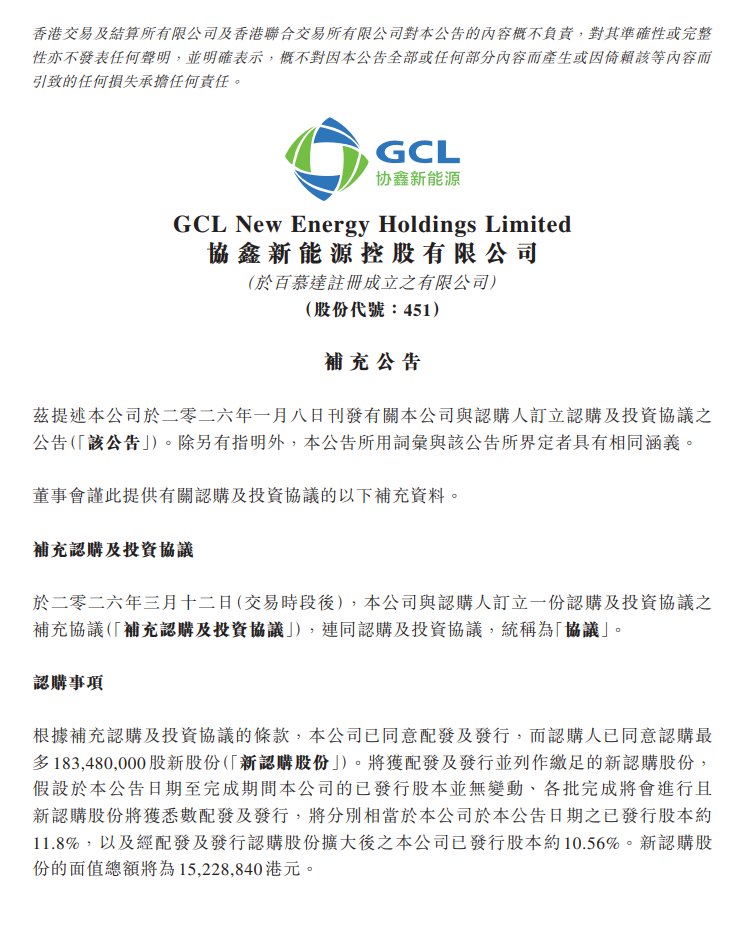
At first glance, it seems like the $MSTR model, where a listed company buys cryptocurrency through ATM (additional issuance). The same financing method is used by Xiexin New Energy (not ATM, but targeted additional issuance), issuing up to 183.48 million new shares at 1.05 Hong Kong dollars per share, corresponding to a total financing amount of about 193 million Hong Kong dollars, equivalent to approximately 24.7 million dollars.
However, Xiexin New Energy is not buying tokens but exchanging for future equity and token subscription rights of Pharos.
This is significantly different from MSTR. The model represented by MSTR is financing to buy ready-made tokens that already have global liquidity and pricing, while Xiexin New Energy is doing discounted share issuance to exchange for the future rights to equity and tokens of an unlisted project.
This transaction is not a one-time settlement but is divided into five batches. The first batch is 50%, followed by four batches of 12.5% each. One prerequisite for the first batch is that Pharos must first list on an exchange (the agreement does not specify which exchange), and the opening price cannot be lower than the investment price. The subsequent batches depend on whether the average FDV during a three-month observation period after the token's listing is not less than 760 million dollars.
Therefore, the essence of this matter is not that the listed company is allocating crypto assets, but that the listed company is using its own equity to wager on the TGE, liquidity, and valuation sustainability of a public chain project.
The announcement clearly states that the company receives two rights:
First, SAFE-like future equity rights
Second, Token warrant (subscription rights)
Xiexin New Energy approximately has the right to acquire 26 million Pharos tokens, accounting for about 2.6% of the total, with the threshold being that Pharos's listing opening price cannot be lower than 0.95 dollars. The 760 million dollars correspond to 80% of the estimated 950 million dollars FDV, so the lower limit for each token is 0.95 × 80% = 0.76 dollars.
This means that the token warrant obtained by Xiexin New Energy is not the Pharos tokens already in hand, but a discretionary right. The company can choose to exercise the option to acquire Pharos tokens at the nominal price in the agreement, but there is no obligation to exercise.
In simple terms, Xiexin New Energy first gets the “qualification to buy tokens,” and later decides whether to actually buy tokens. If Pharos goes public in the future and meets expectations in terms of price performance and liquidity, the company can exercise its rights. If the subsequent situation is poor, the company can choose not to exercise.
Now let’s look at the other party in this transaction, does Pharos itself have this value?
Pharos is technically positioned to solve the performance bottleneck of public chains in institutional applications, with the core highlight being that the co-founders and core technology team come from Alibaba's Ant Chain and focus on RWA. In those early years, many attempts at consortium chains were made in China, and Ant Chain is indeed among the leading groups. Although the technical approaches of consortium chains and open public chains differ significantly, the performance of Pharos's test network seems to be quite decent.
Moreover, there are specific RWA assets and an expected TVL that Xiexin is likely basing on the future tokenization through RWA forms of its photovoltaic and power station assets on Pharos, combined with some other undisclosed assets. For example, Pharos reached an agreement in February with Centrifuge to promote on-chain distribution of institutional assets, estimating a total of 250 million dollars.
Therefore, from a comprehensive perspective, this method is quite innovative; it is not that the listed company is pulling off a swindle, but rather that it is exchanging the risk that should be borne by cash for the dilution of equity.
It also signifies that Hong Kong listed companies are beginning to use their own equity to engage in a PRE-TGE risk investment with thresholds for token listing, valuation, and staggered delivery terms.
First, they need to see if tokens can be listed and whether the opening price can uphold the investment price, then they will check whether the FDV during several consecutive observation periods can hold steady. This is fundamentally not merely a simple DAT for buying tokens but integrates the future liquidity, market support, and valuation performance of an unlisted project into the capital operation structure of a publicly listed company.
This is not the Hong Kong stock version of MicroStrategy, but rather a different, more aggressive tokenized capital operation. The Hong Kong Stock Exchange took two months for full disclosure, likely undergoing repeated consideration. If it doesn’t succeed, what is left is discounted additional issuance, equity dilution, and a long chain of paper equity that is hard to cash out, but if successful, it may become a new model for Hong Kong stocks to embrace Web3 and could also represent a potential capital choice for future Web2 companies investing in Web3.
免责声明:本文章仅代表作者个人观点,不代表本平台的立场和观点。本文章仅供信息分享,不构成对任何人的任何投资建议。用户与作者之间的任何争议,与本平台无关。如网页中刊载的文章或图片涉及侵权,请提供相关的权利证明和身份证明发送邮件到support@aicoin.com,本平台相关工作人员将会进行核查。


