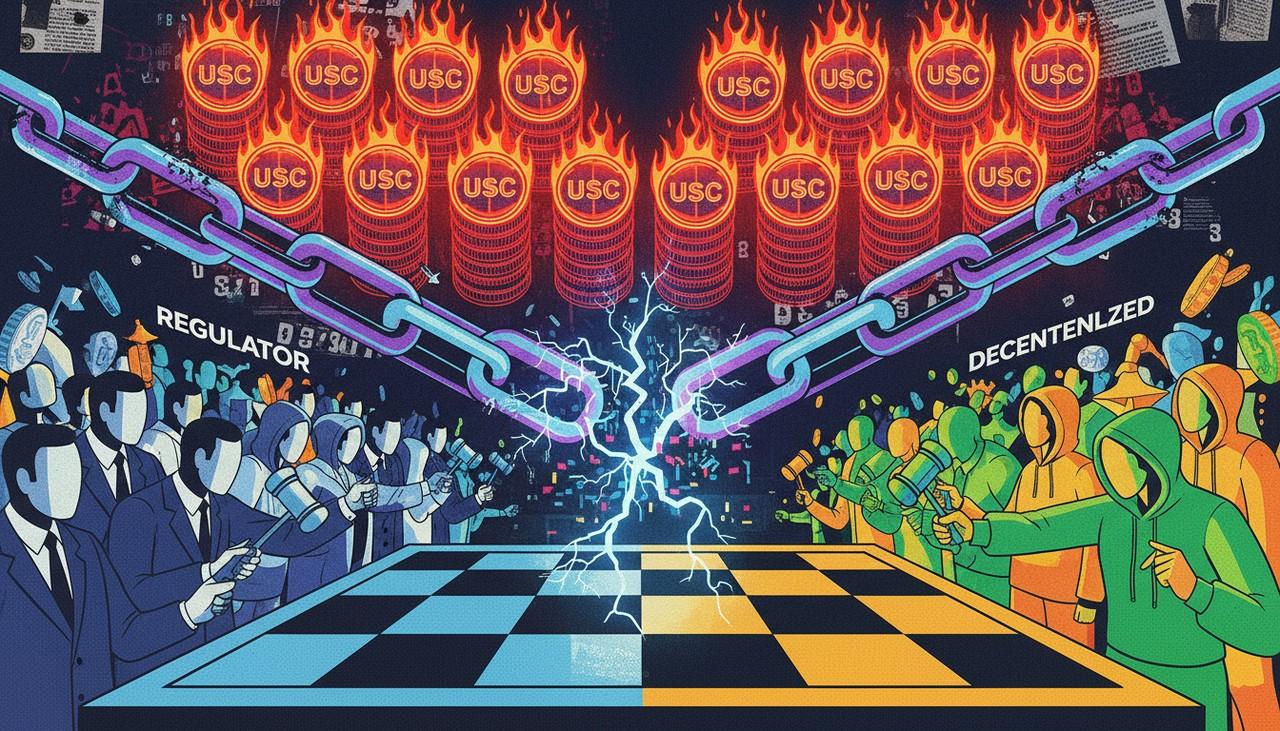
On the eve of the second half of 2026 in the East Eight Zone time, Bank of Montreal (BMO) collaborated with the Chicago Mercantile Exchange Group (CME Group) to announce plans to offer 24/7 tokenized cash services to institutional clients based on the CME network. This means that the flow of funds, which was previously "cut off" by banks' "business hours," will, for the first time, approach the uninterrupted operation rhythm of the crypto market within a compliance framework. On one side is the traditional financial clearing system, which assumes business days and hours as its basis, and on the other side is the crypto and global derivatives market, which has long been accustomed to year-round price and margin fluctuations; this structural misalignment is being directly brought to the operating table. The service still requires regulatory approval, with plans directed towards after the second half of 2026. The timeline itself reminds the market that reforms will not happen overnight, and there are still significant uncertainties regarding policies and technical details. However, traditional banks and mainstream market infrastructures have begun to provide their versions of the "next generation settlement method."
Funds Can Keep Running Even After Banks Close
In the current system, institutions face an old issue when trading across time zones and during extreme fluctuations: the market can fluctuate 24 hours, but banks will not operate for 24 hours. When the European and American markets close, the Asian market opens, or macro data suddenly emerges at night, derivative prices and margin requirements can change instantly, but fund transfers are often stuck at "next business day," forcing clearing members and trading institutions to leave redundant cash buffers in advance or bear the risk of insufficient margins. Especially in a combination of institutions across multiple markets, currencies, and time zones, "waiting for the bank to open" itself becomes a source of cost and risk.
BMO’s North America Treasury Head Derek Vernon candidly pointed out the demands of the frontline funding department—customers want to "continuously transfer funds when the market needs it, breaking the traditional business hour limitations." Behind this statement is the pursuit of precision in liquidity allocation by the treasury department: they do not want to be forced to accumulate idle funds across multiple accounts and clearing banks just to safeguard against a black swan overnight margin call due to the bank system's schedule. The demand arises not from conceptual packaging but from friction in daily fund operations.
Under the design of BMO and CME, the so-called "tokenized cash" can be understood as mapping bank deposits into a licensed network on a one-to-one basis, becoming an accounting unit that circulates 24/7 within that network. For institutions, fund transfers, margin replenishment, and collateral allocation that could only be completed during bank clearing hours will be extended to all day long: trading counterparts confirm tokenized balances on the CME-related network, clearing members receive and account in real time, while the bank maintains synchronization between tokens and deposits in the background. The experiential change is from "waiting for bank approval, waiting for system settlement" to "instant accounting within a compliant network," while from the regulatory perspective, it remains an extension of regulated deposits rather than freely circulating crypto tokens.
A Watershed from Retail Coins to Institutional Chips
Compared to products like USDT on public chains aimed at global retail investors, BMO's tokenized cash first draws a clear line regarding its target customers—it is aimed only at institutional clients, not retail users. The former serves the fund allocation and margin management of clearing members, market makers, and large asset management institutions, while the latter is closer to payment tools and trading instruments. This also means that BMO's design has always been embedded within the existing financial regulatory and KYC systems, not intended to become "freely tradable tokens" on the open market.
Within a compliance framework, publicly issued products like USDT are often seen by regulators as on-chain assets, requiring continuous explanations around reserve proof, cross-jurisdictional risks, and anti-money laundering rules; while BMO's tokenized cash is positioned as "tokenized deposits" that correspond exactly to bank deposits and circulate within a licensed network. Network participants must go through strict access, relying on CME's licensed infrastructure at the underlying level, where all funds correspond to specific account entities and regulatory domains. This design has a clear tendency toward risk and trust:
● On one hand, it is restricted to institutions, based on licensing, corresponding on a per-transaction basis with regulated deposits, helping regulators categorize it within the more familiar realms of "deposits" and "settlement accounts." Compared to open tokens, capital usage and risk control rules can be more easily applied within existing frameworks, and regulatory visibility is higher.
● On the other hand, for institutional treasury departments, the basis of trust is clearer—the tokens are backed by specific bank liabilities rather than an on-chain issuer with disputed transparency moving between multiple jurisdictions, which aligns better with the risk preferences of large institutions' compliance committees.
This explains why large banks, including BMO, prefer to test the waters with "closed tokenized deposits" in restricted scenarios rather than directly issuing crypto dollar substitutes aimed at retail. Retail products would immediately touch the regulatory red lines regarding payments, currency functions, and cross-border capital flows, while closed tokenized deposits are viewed more as an upgrade in settlement technology and "format innovation" within the existing deposit and clearing system, thus advancing experimentation in a politically less sensitive environment with clearer capital rules.
CME Takes the Stage: Derivatives Giants Turn to Settlement Infrastructure
CME Group has long been one of the largest derivatives exchanges in the world, controlling margin, collateral, and clearing infrastructure for various products such as interest rates, stock indices, and commodities. In this role, it naturally occupies a "central position" in the flow of funds and risk control, having the most intuitive sense of pain points in settlement efficiency and margin calls. In recent years, CME has continued to expand into crypto-related derivatives, and now further extends into a "tokenized settlement network," essentially upgrading itself from a single exchange to a cross-party settlement and collateral routing platform.
In the traditional model, CME is responsible for central clearing, and clearing members interact with their respective banks. However, when faced with cross-time zone margin calls and collateral reallocation, a misalignment forms between CME's margin requirements and banks' business hours. By building a licensed tokenized network, CME attempts to minimize the time difference between "margin requests" and "funds and collateral coming in," bringing the entire chain close to real-time closure from a technical standpoint. Its advantage lies in mastering clearing rules and risk control models while possessing the relational networks of most mainstream clearing members, allowing it to push for standardization from a central position.
BMO became the first bank to adopt CME tokenization solutions in the cloud, publicly named as such, which means this network is, from the start, aimed at clearing members and large financial institutions rather than long-tail participants. Once a major bank in CME's licensed network successfully navigates the process, other clearing members, custodians, and large brokers will have the motivation to follow suit in order to avoid lagging behind competitors in margin efficiency and collateral reallocation speed. As more clearing members join, the network effects will manifest in:
● The same tokenized cash can be reused across more clearing routes, increasing collateral turnover rates;
● Multiple banks connecting to CME infrastructure on the same network, shortening the flow path of funds between clearing members;
● Exchanges and clearing houses gaining higher "liquidity visibility," allowing them to identify and buffer risk exposures more quickly during extreme market conditions.
This enables CME to evolve from a mere matchmaking and clearing institution to a "cross-institutional funding and collateral operating system," with BMO becoming the first banking node on this evolutionary path.
Regulatory Red Lines Not Clearly Drawn, Roadmap Laid Out First
Despite the grand narrative, this tokenized cash service is still firmly "tied" to the progress of regulation. According to publicly available information, this plan still requires approval from the relevant regulatory authorities, with the timeline vaguely set for after the second half of 2026, and no more precise timeframes have been confirmed by officials. This time frame indicates that the project is in a serious preparation stage, while also revealing the uncertainties of regulatory bargaining and technical reviews—any detail deemed "close to crypto assets" will affect the pace of final approval and applicable rules.
One of the key points of regulatory disagreement is how to delineate "tokenized deposits" from "crypto assets." If entirely considered an extension of traditional deposits, the existing deposit guarantee and capital adequacy frameworks can be applied, with banks facing operational and technical risk management; whereas if certain features are classified under the category of crypto assets, this may trigger higher capital requirements, stricter investor protections, and information disclosure obligations, or even necessitate additional licenses and segregation arrangements. For BMO and CME, ensuring that these tokens are always anchored to bank liabilities in the legal text rather than being seen as independent assets is the core of the design debate.
Meanwhile, current publicly available information on the technical architecture and currency scope remains limited. The terms referred to by outsiders as "based on CME's licensed network and cloud ledger" lack multi-source official confirmation, and which currencies will be supported and whether it will initially only support the dollar among other specifics have not been explicitly disclosed. For market participants, this information gap means a high dependence on official disclosures, leaving room for redundancy when assessing their system transformation plans and risk exposure arrangements, and reminding them not to pre-price the story of a "new era of multi-currency global settlement" based on speculation.
24-Hour Margin Era: Who Will Benefit First
If we push forward to the moment when tokenized cash officially goes live, the first to feel the changes will be core institutional users revolving around trade settlement, margin calls, and collateral allocation. For market makers and high-frequency trading institutions, the shift from "waiting for bank batch clearing" to "instant accounting within a licensed network" means they can flexibly allocate available funds between different clearing members and accounts, shortening the time from transaction to available margin. For clearing members with massive futures and options trading volumes, margin calls can be supplemented in real-time during nighttime and extreme situations, reducing the passive liquidation caused by delays in funds arriving.
Cross-product arbitrage and risk transmission paths during extreme market conditions will also be reshaped. In the past, when different markets opened at different times, cross-market arbitrage was often constrained by the pace of funds transferring between various clearing banks, requiring arbitrageurs to maintain a significant amount of "static margin" to prevent any chain from breaking when banks closed. Under the tokenized cash network, funds can quickly move between multiple clearing members within the same licensed network, improving the efficiency of margin calls during extreme conditions, which may reduce "technical liquidations" and accelerate the pace at which losing positions are closed, thereby compressing the risk exposure window in terms of time.
For custodial banks, clearing members, and market makers, the new settlement rhythm brings not only benefits but also significantly increases system transformation and operational pressure. They need to:
● Modify backend systems to adapt to the accounting and reconciliation logic of tokenized cash, ensuring a seamless connection with existing core accounting systems while keeping regulatory reporting standards unchanged;
● Reshape risk control parameters and liquidity management strategies, redefining the concepts of "intra-day risk buffers" and "overnight risk buffers" under the premise of 24-hour transferability;
● Adjust operational shifts and compliance monitoring processes to address the reality of large-scale fund flows during non-traditional business hours, ensuring that abnormal trading and anti-money laundering monitoring do not have blind spots overnight.
The rising costs and complexities may mean that only leading clearing institutions and market makers are willing to invest first, thereby seizing the first-mover advantage in the "24-hour margin era," while smaller institutions may be forced to stand by in the short term due to transformation costs.
Is Tokenized Cash the End Point or a Transition Product?
Structurally, BMO and CME are performing a "fine-tuning redraw" of the boundary between traditional banks and crypto finance. They are not directly moving banking operations onto public chains but extending the deposit and settlement system that originally operated only during daytime business hours into nearly all-day operations within a regulated licensed network. The long-emphasized concepts of "real-time settlement" and "assets freely moving on-chain" in the crypto world are filtered here into a version usable by institutions: faster rhythm, less friction, but still within the regulatory view.
If more large banks and exchanges follow this model, the trend of global fund settlement moving from "T+1" and "T+0" to approaching "real-time" is almost certain. The shortening of settlement cycles not only means technical upgrades but will also force synchronization of risk management, capital allocation, and regulatory reporting rhythms. Banks will be compelled to reassess their liquidity reserve methods, clearing houses will need to re-evaluate the time dimension assumptions in margin formulas, while institutional investors will have to adapt to a new normal where "funds are deployable around the clock."
A more open question remains: Will institutional-level tokenized cash reverse force the accelerated integration of sovereign digital currencies with public chain ecosystems? On one end, sovereign digital currencies seek efficient settlement and programmability on central bank ledgers, while on the other end, public chain ecosystems pursue transparency, openness, and permissionlessness. Projects like BMO and CME stand precisely in the middle ground—neither fully moving toward public chains nor remaining in the traditional batch processing clearing model. If institutional-level tokenization proves to safely and efficiently support large-scale fund flows in the coming years, regulators and central banks may have greater motivation to introduce similar mechanisms in sovereign digital currency designs, while public chains could potentially absorb this portion of "institutional tokenized cash" into broader financial portfolios through compliance bridging and custodial solutions. The answer is currently uncertain, but it is clear that tokenized cash is not the end of the story; it is more like an experimental field at the intersection of traditional finance and crypto finance.
Join our community to discuss and become stronger together!
Official Telegram group: https://t.me/aicoincn
AiCoin Chinese Twitter: https://x.com/AiCoinzh
OKX benefits group: https://aicoin.com/link/chat?cid=l61eM4owQ
Binance benefits group: https://aicoin.com/link/chat?cid=ynr7d1P6Z
免责声明:本文章仅代表作者个人观点,不代表本平台的立场和观点。本文章仅供信息分享,不构成对任何人的任何投资建议。用户与作者之间的任何争议,与本平台无关。如网页中刊载的文章或图片涉及侵权,请提供相关的权利证明和身份证明发送邮件到support@aicoin.com,本平台相关工作人员将会进行核查。