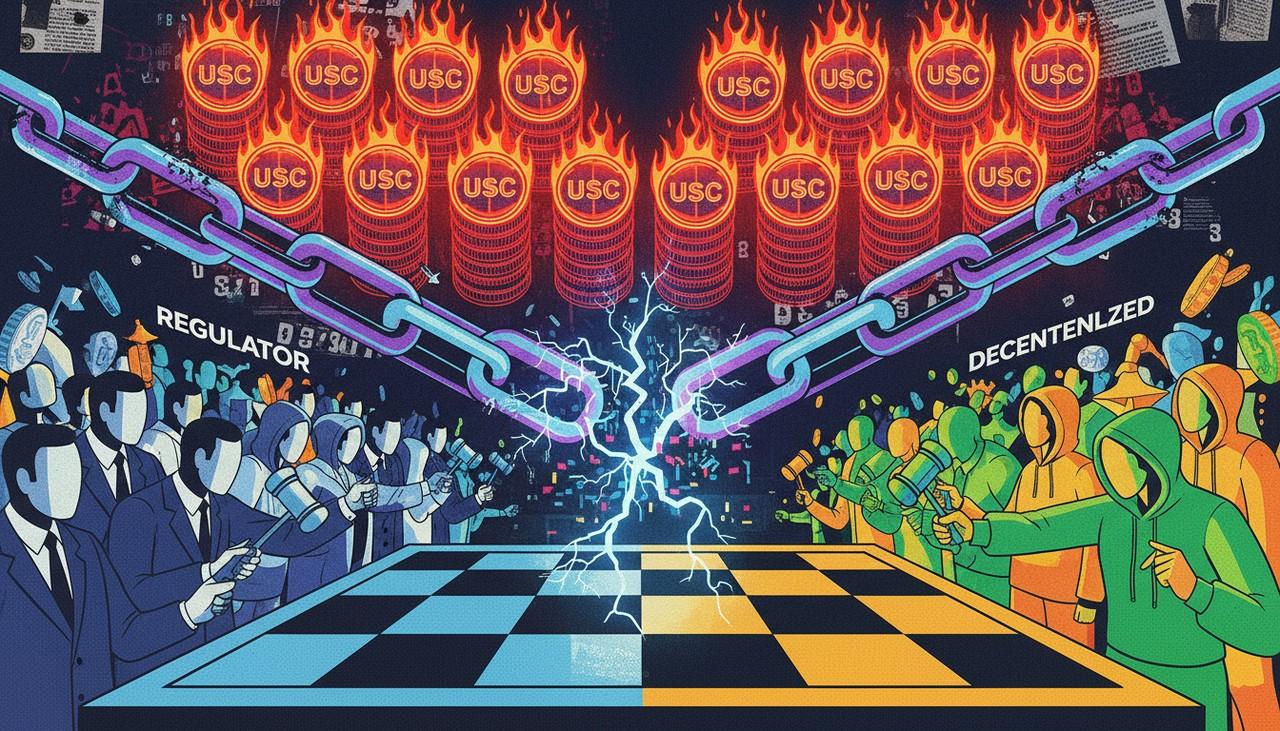
On March 24, 2026, Saudi, US-Iran relations and American regulatory actions were simultaneously brought to the forefront: on one side, reports about the Saudi Crown Prince urging Trump to maintain pressure on Iran clashed with official denials, while on the other side, news emerged that Iran may be collecting a toll of up to $2 million per trip for passage through the Strait of Hormuz, stirring the nerves of the energy market. At this timeline, the risk expectations around the Strait of Hormuz, a global energy choke point, synchronized with signals of tightened regulatory boundaries pressing down on the crypto market. For capital, the question is no longer "should we hedge," but rather: under the dual constraints of hedging properties and regulatory red lines, where exactly will liquidity flow?
The Underlying Currents Amid Saudi Denials and Pressuring Rumors
On March 24, a report from The New York Times drew attention: it was claimed that Saudi Crown Prince Mohammed bin Salman had urged the Trump administration to continue military pressure on Iran against the backdrop of escalating US-Iran tensions, even encouraging a "harsher" approach. The report placed this claim against the long-standing backdrop of US-Iran antagonism intertwined with oil interests, amplifying external perceptions of Saudi Arabia's behind-the-scenes role and the regional security structure.
Almost simultaneously, Saudi official sources denied the report, emphasizing that the claims were inaccurate. It is worth noting that whether it's about the Crown Prince's specific wording or his communication methods and frequency with Trump, current public information primarily comes from a single media outlet, lacking verification from multiple sources. This means statements circulating, such as "keep hitting the Iranians hard," remain unverified information, treating them as established facts only drives public opinion towards an emotional direction.
At this point, maintaining restraint becomes particularly crucial: the market can and must pay attention to Saudi Arabia's position in regional negotiations, but regarding the so-called "regular communications" between the Crown Prince and Trump, there are neither public records nor authoritative disclosures of frequency and details; excessive dramatization only skews the narrative towards sensationalism and personalization, diverting analysis from the main lines of energy, the dollar system, and asset pricing. However, it is this repeated tug-of-war of "report-denial-reinterpretation" that continuously amplifies participants' imaginations of escalating situations in the Middle East, with battle scenarios not yet confirmed, yet sufficiently creating new anxieties and fluctuations between risk and safe assets.
Strait of Hormuz Tolls: The Link Between Energy Chains and Asset Pricing
On the same day, another piece of news from Iran heightened this uncertainty: according to a single source, Iran reportedly began collecting passage fees from commercial vessels traversing the Strait of Hormuz, with amounts reaching up to $2 million per trip. Currently, this claim also lacks multi-source confirmation, nor are there publicly available legal details for cross-verification, but once released, it was immediately interpreted by the market as a signal that Iran seeks to leverage this critical waterway for funding and pressure.
The Strait of Hormuz is a critical chokepoint for global crude oil and liquefied natural gas (LNG) transportation, with a significant percentage of Middle Eastern oil and gas passing through this narrow waterway daily. Any news regarding "additional costs" or "restricted passage" will directly factor into expectations for future oil prices, shipping rates, and even global inflation trajectories. Therefore, even unverified toll rumors are sufficient for energy traders and macro funds to adjust their positions in anticipation of potential structural disruptions on the supply side.
This sensitivity is immediately reflected in the market: after the news broke, US stock index futures experienced a decline of about 0.5%-0.6% before the market opened on March 24, reflecting a rapid repricing of risk assets in light of geopolitical uncertainty in the Middle East. Investors do not need to wait for tankers to actually be intercepted; just the expectation of an added layer of cost or risk in the chain prompts early repricing of stocks, bonds, and even credit markets. From there, energy risk naturally spills over into broader asset allocation decisions—when expectations for crude oil and shipping rates rise, traditional hedging strategies are reassessed, and concurrently, some funds begin to reevaluate the role of crypto assets as "digital hedges" under extreme scenarios.
Funds Seek Safe Havens: From US Stock Futures Correction to Mainstream Coin Liquidity
The approximately 0.5%-0.6% slight correction in US stock index futures on March 24 is not an "apocalyptic" signal, but it does reveal a more subtle contraction in risk appetite: the market is not in a panic, but is willing to slightly pull back from high valuation, high beta assets when Middle Eastern news turns negative, leaving more room for observation. This "small pullback" action is seen by many cross-market funds as a low-cost insurance.
In the macro background, Wolfe Research analyst Stephanie Roth indicates that the Federal Reserve is unlikely to raise rates this summer, providing the market with a relatively moderate interest rate environment. In other words, the dominant variable for asset prices in the short term is more likely to come from geopolitical and regulatory factors rather than new tightening shocks. This combination prompts certain funds to reassess crypto assets: in an environment where interest rate pressures are limited, but geopolitical uncertainties are rising, the characteristics of the crypto market as "unrelated to sovereigns" and "24-hour liquidity" are once again packaged into the hedging narrative.
This does not mean that all risk appetites will flock to on-chain assets in a rush, but rather a more nuanced structural migration: short-term funds may withdraw part of their positions from high beta tech and cyclical stocks, transitioning to high liquidity mainstream coins and their derivatives, utilizing their depth and global pricing continuity to hedge against tail risks. For institutions using multi-asset portfolios, crypto assets can be viewed as a "complementary hedging tool"—not replacing gold and government bonds, but offering additional operational space during localized impacts, weekend events, or unexpected geopolitical windows. The more intense the Middle Eastern tensions, the harder it becomes to ignore the attractiveness of this "backup channel."
The Other Hand of Regulation: CFTC's Innovation Working Group and Crypto Derivatives
Almost simultaneously with geopolitical risks, new signals from US regulation emerged. On March 24, the Commodity Futures Trading Commission (CFTC) announced the establishment of an innovation working group, clearly indicating that it will explore regulatory pathways under the frameworks of emerging technologies and products, with crypto derivatives naturally being one of the focal points. Choosing to announce this move during a time of macro and geopolitical disturbances also objectively provides the market with guidance that "regulation will continue to advance."
Currently, the specific focal areas of this innovation working group have not been disclosed, making it impossible for external parties to gauge whether it leans more towards DeFi, options structures, or extensions of existing exchange models; thus, speculations regarding its regulatory scope and intensity at the technical level lack a basis. The research brief also clearly identifies these details as information voids, needing to deliberately avoid excessive conjecturing to prevent the still-undefined regulatory contours from being portrayed as established rules.
Against the backdrop of ongoing global regulatory scrutiny over ransomware laundering, the CFTC's balancing dilemma is increasingly pronounced: on one hand, it needs to combat behaviors that utilize crypto derivatives and over-the-counter structures to bypass existing rules and obscure illegal fund flows; on the other hand, it must avoid excessive tightening that would push innovation into unregulated gray areas or directly be siphoned off to overseas markets. For the CFTC, the key lies in finding effective middle ground between "not tolerating abuse" and "encouraging compliant innovation."
From traditional financial derivatives regulatory experiences, clearer rules, multi-tiered licensing systems, and transparent compliance pathways often reduce the friction costs for institutional participation. For institution funds already familiar with futures, options, swaps, and other instruments, if the CFTC's innovative framework can clearly define compliance boundaries, risk management requirements, and reporting standards for crypto derivatives in the coming years, then what currently appears to be "pressure from another regulatory hand" may in the medium to long term transform into preconditions for incremental capital entry.
Magnifying Glass on the Gray Area: OTC Laundering and Regulatory Arguments
Beyond the abstract notion of "regulatory innovation," some specific cases provide regulatory agencies with more persuasive tools. The research brief mentions that a Russian OTC broker is alleged to have participated in a laundering activity involving approximately $4.7 million, suspected to be related to the transfer of ransomware-related funds. The amount itself is not large, but it is typical: trades occur at the intersection of on-chain records and off-market matchmaking, precisely in the area that's hardest for regulation to fully penetrate.
Such cases reveal a longstanding issue: ransomware attacks often demand payments in crypto assets, and once the ransom enters the network of OTC brokers, off-market makers, and cross-chain services, it swiftly navigates between on-chain addresses, exchange accounts, and fiat bank accounts, making it difficult for a single regulatory entity to fully reconstruct the flow of funds. While on-chain transparency seems to enhance traceability, as long as there are enough off-market elements and cross-border jump points, the difficulty of law enforcement will sharply increase.
In regulatory games, such cases often become important arguments for institutions to advocate for more tools and authorities—whether demanding stricter KYC/AML standards, broader data sharing, or promoting cross-border collaboration mechanisms, all can accelerate with the publicly acceptable reasoning of "combating ransomware laundering." The result is that compliance cost curves are pushed upward, forcing exchanges, OTC platforms, market makers, and even some wallet service providers to invest more resources to meet compliance requirements.
Meanwhile, global institutional funds still have a strong interest in the cross-border liquidity and settlement efficiency offered by crypto assets, unwilling to easily abandon this tool. From a funding perspective, this presents a typical "internal tug-of-war": one side sees rising compliance costs and risks, while the other side struggles with irreplaceable global liquidity and diversified sources of returns. As the CFTC and other regulatory bodies promote innovation working groups, they are also utilizing these typical cases for "case education," creating public opinion and political space for future more systematic regulatory reforms.
The Shadow of War and Crypto Bets Under Regulatory Net
When placing the above clues on the same timeline, the tensions in the Middle East, the uncertainties surrounding the energy lifeline of the Strait of Hormuz, and the regulatory innovations driven by the CFTC are jointly reshaping the risk—return—compliance triangle of the crypto market. The game between the US, Iran, and Saudi Arabia has reintegrated the geopolitical risk premium into asset prices; rumors about Iran's alleged tolls of up to $2 million per trip have turned every instance of "passing through" the energy supply chain into a variable of market concern; while the CFTC's innovation working group and regulatory arguments aimed at combating ransomware laundering weave a denser web of rules on the other side.
For investors, the core implication can be summarized as: increased short-term volatility, with hedging demand and compliance costs rising simultaneously. On one hand, funds will seek more hedging assets with continuous trading time due to the shadow of war; on the other hand, they must reassess the cost-effectiveness of crypto allocations under increasingly high compliance thresholds. For some highly sensitive funds, the role of the crypto market is shifting from a simple investment venue to a more complex "liquidity buffer + policy testing ground."
Looking ahead, if the geopolitical situation in the Middle East stabilizes and the passage expectations for the Strait of Hormuz revert to manageable ranges, while the CFTC and other agencies gradually introduce clearer regulatory frameworks for crypto derivatives, then the current tremors and uncertainties might instead lay the foundation for the next phase of compliance-driven incremental capital and derivative innovations. Clear rules will not only help institutions expand their positions but also facilitate the iteration of new products within regulated frameworks, avoiding a forced navigation on the gray edges.
In this process, it is essential to continue reminding that both reports about the Saudi Crown Prince "urging military action" and assertions of Iran collecting exorbitant tolls carry the characteristics of single sources and are yet to be verified. The market can and must make decisions based on imperfect information, but in trade executions and risk management, one must always be vigilant against the amplification of unverified news driven by emotions, leading to excessive impacts on positions and directions. In an era intertwined with the shadows of war and the regulatory net, what is truly scarce is often not the opportunity but the calm judgment of information quality and risk boundaries.
Join our community to discuss and grow stronger together!
Official Telegram group: https://t.me/aicoincn
AiCoin Chinese Twitter: https://x.com/AiCoinzh
OKX benefits group: https://aicoin.com/link/chat?cid=l61eM4owQ
Binance benefits group: https://aicoin.com/link/chat?cid=ynr7d1P6Z
免责声明:本文章仅代表作者个人观点,不代表本平台的立场和观点。本文章仅供信息分享,不构成对任何人的任何投资建议。用户与作者之间的任何争议,与本平台无关。如网页中刊载的文章或图片涉及侵权,请提供相关的权利证明和身份证明发送邮件到support@aicoin.com,本平台相关工作人员将会进行核查。