On March 24, 2026, Eastern 8 Time, news regarding Saudi Arabia's plan to grant 30-day permit exemptions for vessels in the Persian Gulf spread on Chinese information platforms. Meanwhile, Binance AI Pro trading agent confirmed it would launch on March 25, and OKX's free AI trading course is also set to be released in the same quarter. On one hand, there are unverified geopolitical rumors that have not yet received formal confirmation from Saudi officials, packaged by intelligence accounts as positive signals "supporting energy supply"; on the other hand, leading exchanges are clustering to launch AI tools and educational content in Q1 2026, attempting to seize minds in a new round of product competition. This temporal overlap creates a tremendous tension field: unverified shipping exemptions and AI automated trading simultaneously rewrite market imaginations regarding risks, tools, and modes of participation within the same window. The real question is not just whether tankers can smoother navigate critical energy corridors but rather—how will crypto market emotions and trading structures be pushed toward new forms as geopolitical policies and the AI trading wave overlap.
30-Day Shipping Exemption Rumors: The Inertia Amplification of Energy Narratives
Since March 24, several Chinese crypto and finance media outlets have cited intelligence accounts claiming Saudi Arabia will grant a 30-day permit exemption for vessels passing through the Persian Gulf. Different sources present slight variations, with some emphasizing "to support energy supply," and others highlighting "to ease transit restrictions," but thus far, no original statement from Saudi Arabia bearing formal document numbers or endorsements from official spokespersons has appeared. This means the event remains at the level of "reported" or "allegedly," rather than being a regulatory text that can directly serve as a basis for institutional changes.
Nonetheless, the market habitually binds this type of shipping policy development to the historical memories of global energy and derivatives sentiment. The Persian Gulf, as a critical energy corridor, means that every tightening or loosening of transit expectations can act as an emotional amplifier for oil prices, shipping stocks, and related derivatives. In the past, whether due to military tensions or marginal adjustments in transit rules, it often did not require precise figures to spread narratives of "hedging" or "easing." The so-called 30-day exemption has also quickly been incorporated into this existing narrative trajectory. In the absence of specifics regarding applicability and execution mechanisms, the simple market restatement of "supporting energy supply" is sufficient to become an emotional anchor point on social media and trading chatrooms.
In a state of incomplete information, the associative pathways for traders and media are often strikingly similar: smoother shipping implies eased supply-side pressures, further interpreted as marginal improvements in global risk appetite, possibly even linking to commodity prices, inflation expectations, and risk asset valuations. Even if researchers are aware that this reasoning contains many missing links and unquantifiable variables, once a geopolitical narrative is labeled "energy" and "easing," it inherently possesses the ability to diffuse across markets. The highly volatile ecology where crypto assets reside especially tends to treat such macro cues as catalysts for short-term emotions rather than waiting for more complete policy details.
Unverified Official Statements: Geopolitical Rumors and Information Asymmetry
In specific phrasing, statements like "exemptions allow vessels to transit the Persian Gulf without permits" are currently still marked as pending verification information. There are no publicly released implementation details from Saudi regulators, nor is there cross-validation from international shipping and energy agencies, which fundamentally exposes a long-term structural risk in the crypto market: a high reliance on early, semi-formed geopolitical intelligence and the resulting information asymmetry. For most retail investors and small to medium institutions, what they can access are merely fragments that have been rephrased second or third-hand, often edited for tone and emphasis by different repeaters due to considerations of traffic and stance.
In this transmission chain, media, intelligence accounts, and social platforms play crucial roles in amplifying narratives. Intelligence accounts emphasize "exclusive" and "frontline"; media, eager to capture time windows, tend to rapidly publish under the packaging of "allegedly" or "insiders say"; KOLs on social platforms then use more emotionally charged language for reinterpretation. Each link can amplify or distort the intrinsically incomplete policy expectations, turning "potential transit conveniences" into "already established structural benefits" or "major risks resolved."
For crypto traders, the difficulty lies in: the absence of regulatory details and the challenges of quantifying impacts, yet the market needs to respond with pricing immediately. Consequently, emotions often manifest first in the derivatives market—such as through the subtle changes in implied volatility of futures and options and changes in basis structures—to hedge or bet on the direction of this event; simultaneously observing the performance of safe-haven assets linked to energy and global risk appetite as an indirect emotional barometer. In the absence of hard data and official confirmation, this method of "sidelining" geopolitical sentiment through price systems itself exposes the dual attributes of the crypto market being highly financialized and highly driven by narratives.
Binance AI Pro to Launch: Strategy Outsourcing and Macro Uncertainty
Nearly simultaneously with the geopolitical rumors, Binance officially announced the AI Pro trading agent will launch on March 25, a smart trading tool aimed at traders, emphasizing key features such as multi-model integration and isolated API in the official description: the former aims to enhance the robustness of strategy generation by combining different model styles (such as trend recognition, volatility capture, pattern matching, etc.), while the latter establishes isolation boundaries between user accounts and AI agents at the interface level, controlling strategy execution permissions and reducing structural risks of "tool malfunction."
For different user types, the significance of the AI trading agent varies. For quant teams with self-built infrastructure, it appears more like an optional module: capable of integrating some model capabilities, assisting in strategy generation or factor mining, interfacing with their own risk control and execution frameworks. For small to medium traders lacking engineering capabilities, it resembles "strategy as a service"—from generating trading ideas and managing positions to fully or semi-automatically executing orders, it may be completely outsourced to a black-box-like intelligent system. In this model, it is more accurate to say that traders are not "making decisions" but choosing "which types of models to delegate decision-making to."
This current round of launch timing coincides with a rapidly escalating window of geopolitical uncertainty. Macro narratives continually overlapping, while individual traders find it difficult to process real-time multi-dimensional signals from energy, interest rates, regulation, and on-chain, thus intelligent tools are naturally packaged as a form of "risk management outsourcing": where AI takes on the initial phases of information filtering, scenario simulation, and strategy selection, allowing users to focus their energy on parameter settings and risk thresholds. The issue is that this outsourcing does not eliminate uncertainty; it simply transforms anxiety over "not understanding geopolitics" into a belief in "trusting models," and models' adaptability to extreme events and black swans often only becomes apparent in genuine stress testing.
OKX Free AI Course: Retail Education and Robot Belief
Unlike Binance, which directly launched trading agent products, OKX has chosen to launch a free AI trading course in the same quarter, more clearly positioning AI in the dimensions of "knowledge dissemination" and "capability building." This course is evidently aimed at retail investors and junior practitioners who have a vague understanding of coding and models but are full of expectations for "enhancing win rates with AI." Research briefs mention in Q1 2026, mainstream exchanges are intensively gearing up AI products and educational content, forming a trend, and OKX's move can be seen as an "educational angle" within this trend.
In contrast to Binance AI Pro's "first provide tools, then discuss understanding," the difference in OKX's approach is: first shape users' basic understanding of AI trading, then gradually guide them to use related tools. From a regulatory sensitivity perspective, this approach also lowers the risk of being directly labeled as "black-box agency trading," making it easier to explain to regulators as "financial education" and "technological popularization." Simultaneously, it also makes an implicit judgment about user maturity—believing that many users are currently at the stage of "willing to trust AI but not truly understanding AI" and need courses to fill the gap between concepts and practice.
However, the dissemination of AI trading knowledge itself may reshape retail behaviors. As more users grasp basic model concepts, backtesting logic, and parameter tuning methods, the so-called "robot belief" may shift from a phenomenon of a few to a widespread collective behavior: everyone is learning similar tutorials, relying on similar model structures, responding with highly homogenized reactions under similar signals. What ensues may not necessarily be a more rational market but rather amplify herd effects—when consensus in a particular type of model points in the same direction, price fluctuations may be pushed to extremes by waves of robot orders, and if the market enters scenarios not previously seen by the models, collective stampedes may also become more severe.
Geopolitical Turbulence Coupled with AI Racing: A New Layering in the Crypto Market
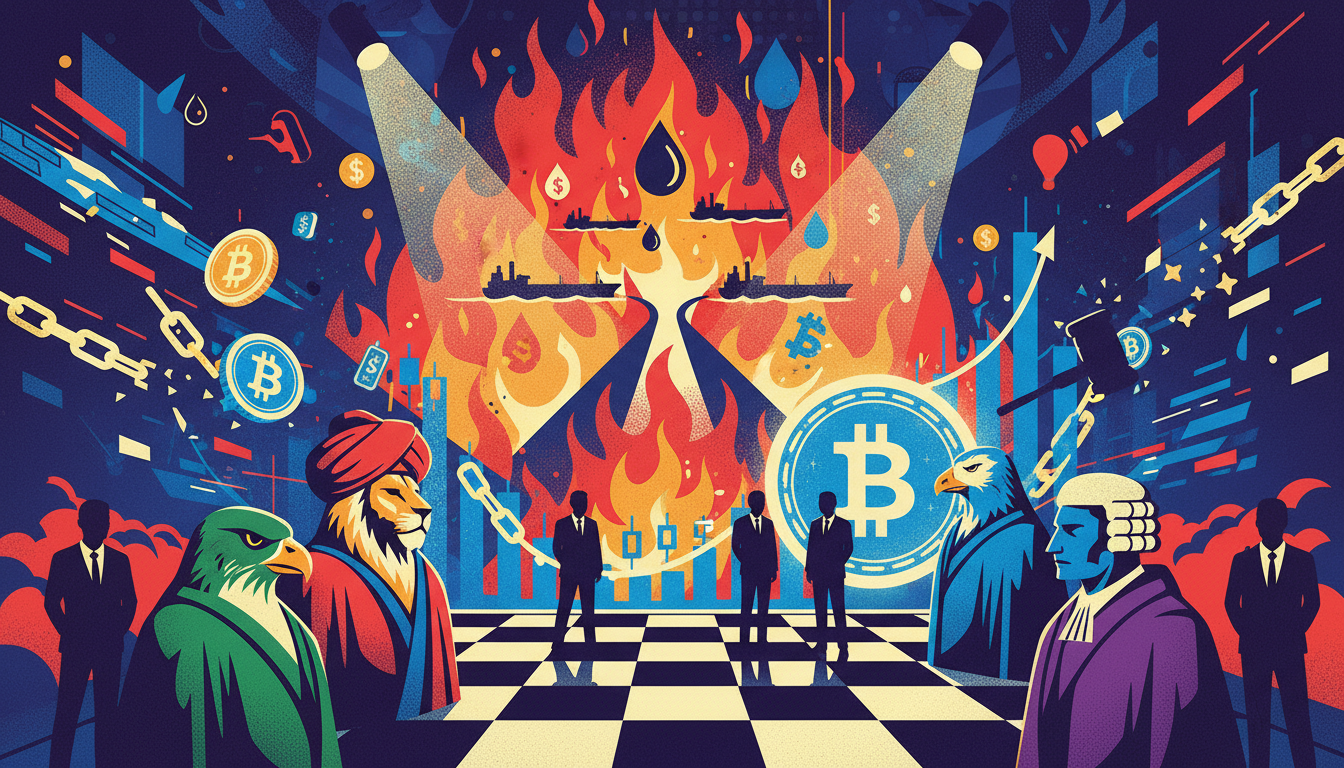
If we extend the timeline to late March 2026, a rather dramatic picture emerges: on one side, rumors of Saudi Arabia's 30-day shipping exemption are spreading at the energy and macro narrative level, while on the other, Binance AI Pro and OKX AI courses and other intelligent trading tools and educational products are launching in concentrated fashion. On a macro level, expectations for passage through critical energy corridors influence global risk appetites; on a micro level, AI infrastructures from interfaces to courses are quietly rewriting the decision chains behind every trading button. The interplay of macro narratives and micro tools within the same time window presents the crypto market with a new state of "geopolitics above, algorithms below."
In this market backdrop, as geopolitical noise amplifies, the rapid rollout of AI products is not hard to understand. First, to retain existing users: during periods of heightened volatility and uncertainty, providing users with tools and knowledge that appear more "professional" and "secure" can alleviate loss and observation sentiments. Second, to compete for incremental funds: packaging AI trading as next-generation infrastructure helps attract new funds and teams sensitive to tech narratives. Third, to shape a "technological moat": whether through multi-model integration or educational systems, they fundamentally construct ecological stickiness that is challenging to replicate in the short term—once users have completed the learning-to-practice loop on a platform, the cost of migration significantly increases.
The positions of different participants in this overlapping game are also being redefined. Institutions and leading quant teams with the ability to build their own research and infrastructure can treat the AI tools provided by exchanges as supplementary modules or liquidity gateways rather than core dependencies; they are more concerned with marginal advantages in data acquisition and execution speed. Retail investors and small accounts may be further stratified in the dual acceleration of information and tools: some are genuinely able to understand course content and learn to set boundaries between AI suggestions and their judgment; others may leap directly over the understanding stage, treating "a certain AI strategy" as the next generation of signal clusters, continuing to replicate old following and luck-based models under a new guise. Geopolitical noise amplifies macro uncertainties, while AI racing accelerates the completion of this stratification on a micro level.
From the Persian Gulf to Trading Interfaces: Observation Coordinates for the Next Stage
In summary, the unverified news of Saudi shipping exemptions and the wave of exchange AI trading tools are both influencing crypto market sentiments in the short term as "narrative amplifiers": the former provides a macro story framework regarding energy and geopolitics, while the latter offers a technical vision regarding efficiency and intelligence. However, conflating the two is dangerous—short-term informational noise and long-term structural changes should be clearly distinguished. Details of the shipping exemptions remain unclear, and formal statements from Saudi and related agencies have not materialized; whereas the proliferation of AI tools seems more like a slow variable spanning multiple years, gradually transforming participation modes across cycles.
For ordinary participants, it is essential to remain vigilant against two excesses: one is the over-interpretation of geopolitical policy and oil price impacts, replacing reasoning with emotions in the absence of official documents and quantifiable data; the other is the mythologizing of AI trading capabilities, treating models in a rapid experimentation phase as "all-powerful" black boxes. Between uncertain narratives and technological optimism, what truly needs to be sought is a boundary of operation: to understand which variables cannot currently be reliably priced, which decisions have been overly outsourced to models, and which risks must still be borne by oneself.
Key signals worth closely tracking in the future include at least three main lines: first, whether Saudi Arabia and related energy and shipping regulatory bodies issue formal, retrievable policy texts and how international agencies interpret this, thus elevating the current "rumor level" to "rules level"; second, the actual usage data and behavioral trajectories of mainstream exchange AI tools—including user penetration rates, strategy concentration, and performance in extreme conditions, as these will tell us whether AI has genuinely transformed trading structures; third, the attitudes and regulatory explorations of various countries towards AI trading, whether they incorporate it into existing automated trading frameworks or classify it as a technology requiring special caution. Only after these clues gradually clarify can we more confidently answer: from the Persian Gulf to trading interfaces, where will this intertwined narrative ultimately lead the crypto market in the next stage.
Join our community to discuss and become stronger together!
Official Telegram community: https://t.me/aicoincn
AiCoin Chinese Twitter: https://x.com/AiCoinzh
OKX benefits group: https://aicoin.com/link/chat?cid=l61eM4owQ
Binance benefits group: https://aicoin.com/link/chat?cid=ynr7d1P6Z
免责声明:本文章仅代表作者个人观点,不代表本平台的立场和观点。本文章仅供信息分享,不构成对任何人的任何投资建议。用户与作者之间的任何争议,与本平台无关。如网页中刊载的文章或图片涉及侵权,请提供相关的权利证明和身份证明发送邮件到support@aicoin.com,本平台相关工作人员将会进行核查。