Original author: KarenZ, Foresight News
On November 3, 2025, a security incident that caused losses exceeding $120 million largely shattered the growth illusion of the established DeFi protocol Balancer.
This is the largest security incident in Balancer's history. However, the deeper wounds are not contained within that astronomical figure.
Looking at the financial data attached to Balancer's latest proposal, its fundamentals are already far from optimistic: the protocol's annual fees are approximately $1.65 million, while the DAO estimates annual revenue of only $290,000, accounting for 17.5%.
The remaining funds are funneled to veBAL holders, core pools, Balancer Alliance programs, and other parties. The entire system appears to be a continuously operating "printing press," but in reality, it has leaks on both sides: on one hand, transaction fees are progressively diluted; on the other hand, about 3.78 million BAL tokens are released each year due to inflation, resulting in a persistent sell pressure of about $580,000 at current prices—considering that the current fully diluted valuation (FDV) of BAL is only $11 million.
The annual operating budget is as high as $2.87 million, while annual revenue is only $290,000, leading to a gap of $2.58 million.
The DAO treasury (excluding BAL) has only $10.3 million left. At this rate, the treasury has less than 4 years of life left.
After the security incident, Balancer's TVL was further exacerbated. Balancer's TVL fell from $800 million to about $300 million, and has continued to decrease since then, with the current TVL being less than $160 million. To put it in perspective, at its peak in 2021, Balancer's TVL exceeded $3 billion.
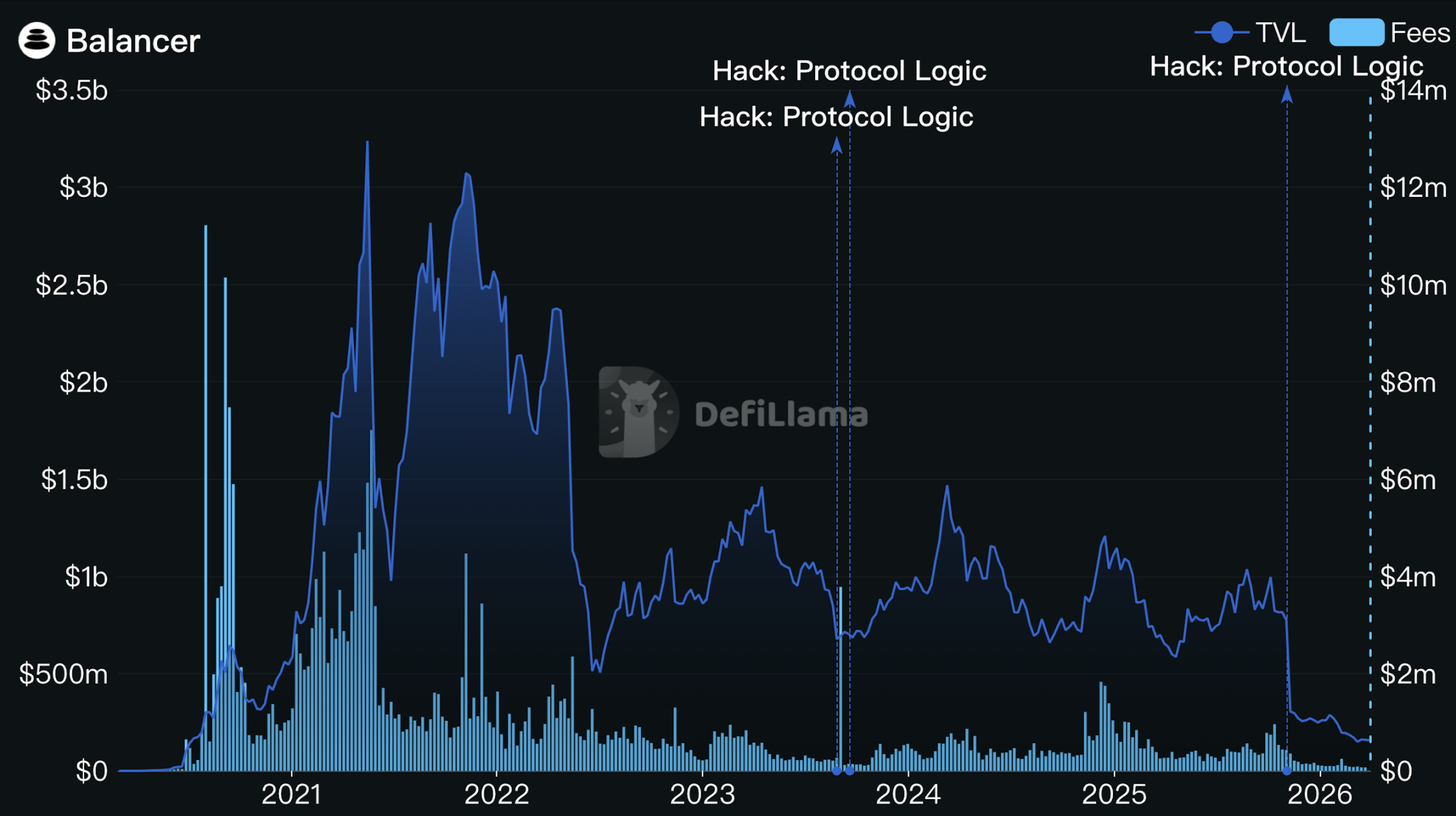
Source: DefiLlama
Balancer has officially reached a crossroads of fate. On March 23, 2026, the core Balancer team simultaneously released two important governance proposals: a comprehensive reform of the BAL token economics and a restructuring of the operational framework.
The core logic of the two documents can be summarized in one sentence: abandon the growth model driven by token releases and transition to a revenue-driven sustainable operation.
Operational Restructuring: Team "Downsizing," Annual Budget Reduced by 34%
The proposal suggests officially dissolving Balancer Labs, while its core technical staff will join Balancer OpCo Limited as contractors, which will continue to operate as the legal representative of the DAO.
The team size will be reduced from about 25 people to 12.5 full-time equivalents (including exclusive service providers such as Beets and MAXYZ), and the annual operational budget will be cut from $2.87 million to $1.9 million, a reduction of 34%.
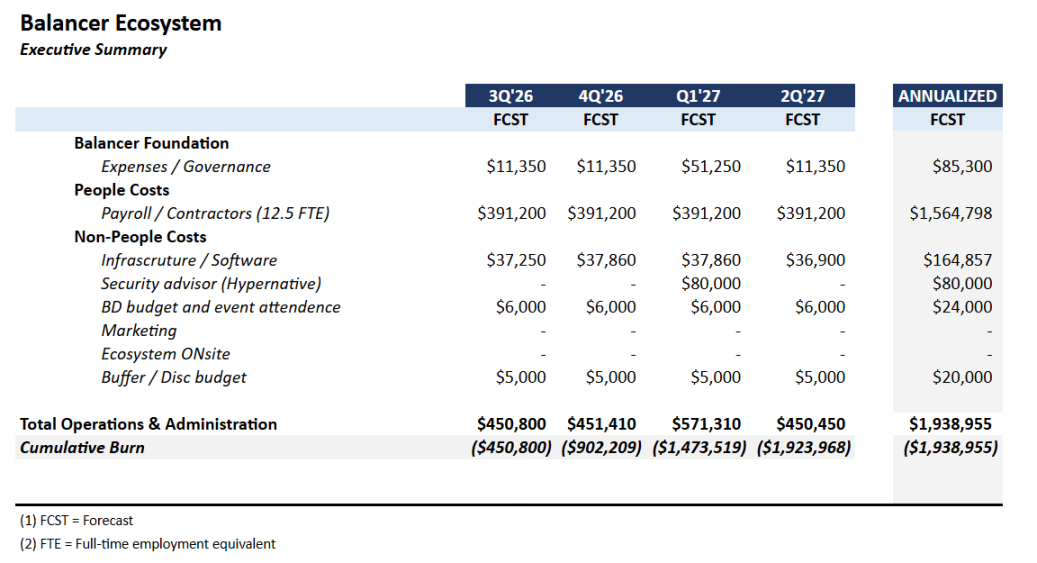
The product line will also be drastically narrowed. The team will concentrate resources on three commercially viable products: Boosted Pools (flagship product), reCLAMM (to be relaunched after fixing vulnerabilities and possibly renaming), and LBP (Token Launch Pool, opportunity-based operations).
Other exploratory directions, such as ETF structured products, yield optimizers, and AI-driven liquidity tools, can only be advanced if they meet "core KPI targets."
The on-chain deployments are also shrinking. Maintaining models across more than 9 chains for V2 and V3 has become unsustainable; the team will clearly retain Ethereum, Gnosis, Arbitrum, and Base as the four core chains, while other deployments will be reviewed individually based on cost revenue and operational expenses, with non-compliant ones being terminated directly.
Token Economics Reform: Demolish and Rebuild, Not Patchwork
Stop BAL Releases, Abolish veBAL
After the proposal is approved, Balancer will terminate the BAL token incentive releases, with no transition period.
At the same time, the veBAL governance mechanism will also be officially abolished. Holders will cease to receive any economic benefits after the last bi-weekly fee distribution, and their locked veBAL will become purely governance tokens, awaiting natural expiration after the locking period ends.
This is a painful decision, but the underlying logic is clear: the veBAL mechanism has had structural risks of oligopolistic monopolization since its design inception. Currently, Aura Finance (the veBAL meta-governance protocol) and large whales have amassed significant voting power, rendering the genuine community voice increasingly weak in governance. This mechanism has not only failed to promote the healthy development of the protocol but has also become a vehicle for a circular economy game—the protocol's funds flow to intermediaries through incentives, and intermediaries then allocate more incentives to themselves.
If veBAL was once an experiment borrowing from Curve's design, the team now admits: the experiment is over, and the results did not meet expectations.
In response to the termination of veBAL economic rights, Balancer will provide a compensation initiative of $500,000, directly distributed to veBAL holders, which is pure cash compensation.
All Fees to DAO Treasury, Reduce V3 Protocol Commission
All protocol fees, V2 exchange fees, V3 exchange fees, Yield fees, and LBP fees will henceforth flow 100% into the DAO treasury, abandoning the old multi-party split mechanism.
At the same time, the commission rate on V3 protocol fees will be reduced from 50% to 25%. In other words, for the same transaction fee that was previously 50% for liquidity providers, they will now receive 75%.
These two actions may seem to contradict each other, but their underlying logic is consistent: the former eliminates the circular economy, allowing the treasury to obtain real usable funds; the latter enhances LP attraction by exchanging lower platform commissions for more organic liquidity and real transaction volume.
The proposal anticipates that after the reforms, the DAO's annual revenue could reach about $1.22 million, which is more than four times the current $290,000.
Those Who Want to Leave Can Destroy BAL for Stablecoins at $0.16 Each
The treasury will also allocate 35% of its assets (approximately $3.6 million) as a dedicated pool, not to actively buy BAL from the secondary market, but to open a "burn for stablecoin" channel: BAL holders can voluntarily send tokens into smart contracts for destruction, receiving an equivalent stablecoin at NAV price (net asset value, approximately $0.16 each).
The window will open 12 months after the proposal is passed, lasting for 12 weeks, where any unused stablecoins will revert back to the treasury after the window closes. The 12-month waiting period is designed to allow veBAL holders, who gradually unlock, to participate.
As of the time of writing, the price of BAL is $0.1548, below the NAV price. Providing an exit at NAV price gives those wanting to leave a more dignified option than a secondary market sell-off.
If this channel is fully utilized, approximately 22.7 million BAL will be destroyed, accounting for about 35% of the circulating supply, which is six times the current annual inflation release.
9-Year "Runway": Is It Enough?
If both proposals pass, the financial model calculated by the team is as follows:
DAO annual revenue of about $1.22 million (assuming the V3 fee reduction leads to an increase in organic TVL), annual operational expenditure of $1.9 million, buyback expenditure of about $3.6 million, plus $500,000 for veBAL compensation.
After completing the buyback and compensation, the treasury will still have about $6.2 million left, and the annual funding gap will shrink from about $2.6 million to $700,000, theoretically extending the survival cycle to nearly 9 years.
For a DeFi protocol, 9 years is sufficient to traverse a full industry cycle.
However, this model is based on optimistic assumptions: the reduction of V3 protocol commission does indeed stimulate more organic TVL; the downsized team can effectively support the protocol's daily operations, security maintenance, and other business; core products (especially reCLAMM) can successfully attract the market again after repairs.
If any one link falls below expectations, the 9-year survival cycle will rapidly shorten. The team has made it clear that if the DAO's monthly income falls below $60,000 for three consecutive months, they must submit a revised plan to the community.
For Balancer, this is an almost all-or-nothing reform. Abandoning the once-proud veBAL mechanism and the complex multi-party revenue-sharing structure, they are returning to a fundamentally streamlined approach: allowing real trading fees to drive the protocol's survival, rather than relying on newly minted tokens to maintain a false prosperity.
Whether this drastic reform will be effective ultimately rests with the market and time; we await to observe the long-term results.
免责声明:本文章仅代表作者个人观点,不代表本平台的立场和观点。本文章仅供信息分享,不构成对任何人的任何投资建议。用户与作者之间的任何争议,与本平台无关。如网页中刊载的文章或图片涉及侵权,请提供相关的权利证明和身份证明发送邮件到support@aicoin.com,本平台相关工作人员将会进行核查。


