Original author: Ye Zhen
Original source: Wall Street Observations
U.S. President Trump once again triggered a huge shock in global markets with a social media post. Although his comments regarding a ceasefire in the Middle East were immediately denied by the parties involved, Wall Street still chose to "buy in."
This indicates that, in the eyes of the market, the president's fear of a plunge is more important than the truth of his statements, and "capriciousness" itself has become a potent drug to curb short-sellers.
According to CCTV News, Trump posted on social media on Monday, announcing that the deadline for bombing Iranian energy facilities would be extended by five days and that both sides are engaging in "very good and productive dialogue" toward a "comprehensive and thorough resolution." This statement instantly reversed market pessimism, leading Wall Street to experience its most severe trading day since the outbreak of the U.S.-Iran conflict.
After the market opened, the S&P 500 Index surged by as much as 2.2%, marking the largest increase since May, while the Dow Jones Industrial Average jumped by over 1,000 points during the session. Meanwhile, oil prices plummeted more than 13%, with Brent crude falling below the $100 mark, and the yield on two-year U.S. Treasury bonds dropped significantly from a high point to 3.79%.
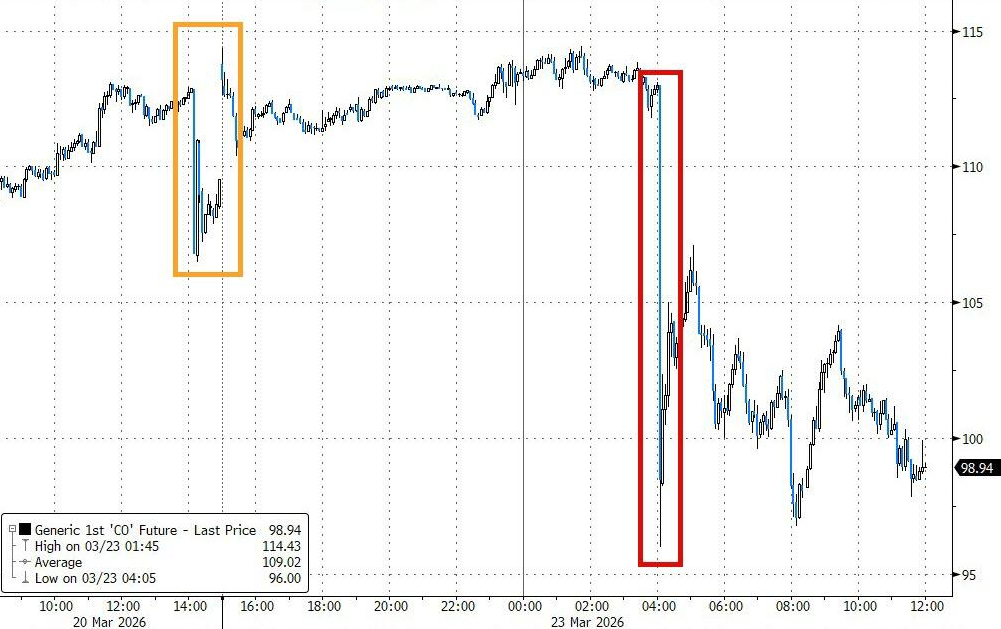
(Brent crude falls below $100)
However, less than an hour after the tweet, the Iranian government denied claims of negotiations taking place. This scene mirrored events from two weeks ago when Trump declared that "the war is completely over," which similarly led to a brief stock market rally and a drop in oil prices.
This repetition forces Wall Street to confront a deeper question: What exactly is the market trading?
The answer is not peace, but Trump's market bottom line. Investors interpret this statement as a signal: the president's aversion to market declines will ultimately prevent him from fulfilling his most extreme threats. Furthermore, Trump's unpredictability has become a stabilizer for the market: it keeps bulls from chasing prices too aggressively and prevents bears from freely shorting the market.
TACO trade returns to the market
On Monday at 7:05 AM Eastern Time, Trump posted on social media, announcing that the 48-hour deadline for attacking Iranian electric facilities would be extended by five days due to "very productive dialogue" between the two sides, which is expected to lead to a "comprehensive resolution."
Upon the news, the market quickly reversed, with Brent crude falling below $100 per barrel and at one point down over 13%; U.S. stock futures jumped sharply; the yield on two-year U.S. Treasuries dropped 0.22 percentage points from a high point to a low of 3.79%; European stock and bond markets also rapidly rebounded from previous declines.
After the U.S. stocks opened, the S&P 500 Index rose by as much as 2.2%, achieving the largest single-day increase since May; the Dow Jones rose by over 1,000 points at one point. However, as Iran clearly denied that negotiations were ongoing, market gains began to retract. By the close, the S&P 500's increase narrowed to about 1.2%, and the Dow closed up about 630 points (1.4%), with the gains in the U.S. bond market also dissipating.
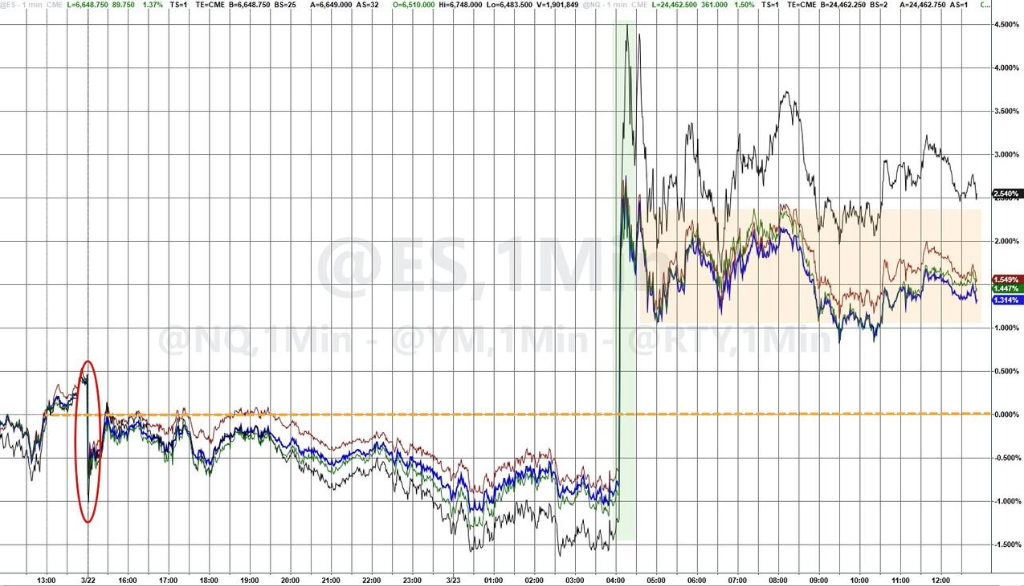
(U.S. stock index movements on the day)
This scenario is not unfamiliar to Wall Street. Two weeks ago, when Trump claimed in a media interview that "the war is completely over," the stock market experienced a nearly identical spike, and oil prices also saw a similar pullback. At that time, the gains did not last either.
According to media analysis, part of the purpose of Trump's statement this time is to reassure investors shaken by the impact of war, to avoid further painful sell-offs at the start of the new week. Last Friday, the S&P 500 had already set a record for the longest consecutive weekly decline in a year.
Why does Wall Street still surge despite knowing the statements are dubious?
For Wall Street, whether Trump's statement is true may not be important. The significant market rebound is not due to investors blindly believing the president's ceasefire claims, but rather because they view it as a guarantee: the president's extreme aversion to poor market data will eventually prevent him from taking more drastic military action.
The war, which erupted over three weeks ago, has already put pressure on the global economy. The blockade of the Strait of Hormuz has cut off key energy supplies, and surging energy prices have brought new inflationary shocks. The global bond market has seen over $2.5 trillion evaporate, facing the largest single-month decline in more than three years. Meanwhile, the yield on two-year U.S. Treasury bonds has cumulatively risen by over half a percentage point since the outbreak of the war, further constraining the Fed’s space for rate cuts.
Tom Garretson of RBC Wealth Management stated: "Trump has clearly been trying to suppress oil prices, but perhaps the bond market has once again forced him to change his mind."
Marko Papic, chief strategist at BCA Research, said: “If this cannot be resolved in the next 7 to 10 days, we will face a global economic standstill. Today's statement indicates that Trump realizes the real economy may be on the brink of collapse.”
There are also analyses suggesting that the current trading logic resembles a Keynesian "beauty contest."
Daniel Alpert, managing partner at Westwood Capital, pointed out that the market is not trading based on facts, but rather on the expectations of others. Even if investors suspect this is a lie, as long as they believe others will see it as positive and buy in, they will follow suit.
Moreover, fear of missing out (FOMO) is also a significant factor driving the stock market up.
Steve Sosnick, chief market strategist at Interactive Brokers, emphasized that no one wants to miss out on a rebound; even a little bit of good news can provoke a strong market reaction. At the same time, stock market traders are closely following the footsteps of oil traders, as the sharp drop in oil prices provides a substantial baseline for the stock market's rebound.
What does Trump's capriciousness mean for short-sellers?
Trump's unpredictability itself has become a twisted stabilizer for the market: it keeps bulls from chasing prices too aggressively and prevents bears from freely shorting the market.
Michael Kantrowitz, chief investment strategist at Piper Sandler, may have the most accurate assessment: "The truth depends on people's perceptions, and Trump's capriciousness will only exacerbate uncertainty, helping to prevent originally confident bears from further pushing the market down. All this unpredictability buys time for the market and prevents overconfidence—good or bad."
During the first year of Trump's presidency, the "TACO trade" took hold, and buying on dips became a market consensus. However, this war with Iran is shaking that belief—hostilities continue to escalate, Iran’s leadership remains in control, and the Strait of Hormuz is still under blockade.
Brad Conger, chief investment officer at Hirtle Callaghan, said: "What worries me is that this is no longer entirely within Trump's control, unlike tariffs that can be called off at any time. Those who feel encouraged by Trump's response to the market are misplacing their confidence."
Jordan Rochester, a strategist at Mizuho Bank, pointed out that the chaotic communication from the White House is causing market positioning difficulties.
"The hardest part is not predicting the course of the war, but predicting how the White House will communicate and how the market will react to it," he wrote in a client report, "We are facing a confused market—unsure whether this is a credible signal that the end is near or just another 'almost done' performance."
免责声明:本文章仅代表作者个人观点,不代表本平台的立场和观点。本文章仅供信息分享,不构成对任何人的任何投资建议。用户与作者之间的任何争议,与本平台无关。如网页中刊载的文章或图片涉及侵权,请提供相关的权利证明和身份证明发送邮件到support@aicoin.com,本平台相关工作人员将会进行核查。