Author: Yokiiiya
AI is a walled city, and Crypto is also a walled city. Those inside the city want to escape, while those outside want to rush in. Whether it's AI or Crypto, the desires of life are mostly the same.
Today I suddenly feel a bit dazed.
A Web3 friend I met last year has recently been crazy about vibe coding; another Web3 friend has recently become a "lobster expert," discussing agents, workflows, and how AI is starting to truly take over workflows in various shares. Watching their changes, a sentence suddenly popped into my mind: AI is a walled city, and Crypto is also a walled city.
In the past two years, a growing notable change is that people in the Web3 space feel FOMO when they see AI, and those in AI feel FOMO when they see Crypto. Both sides are glancing at each other and projecting onto each other, appearing to switch industries, while actually judging: from which end will the future system first grow out?
AI is a walled city, and Crypto is also a walled city. People move back and forth between the two sides, not switching tracks, but seeking the entrance to the future system.
II. AI and Crypto, Two Entrances to the Future System
If we look at AI and Crypto together, many people will actually have a subtle feeling: they don't seem to be the same thing, yet they seem to be slowly getting closer. One is focused on models, agents, search, programming, and content generation, while the other talks about wallets, stablecoins, on-chain settlements, rights confirmation, and collaborative networks. On the surface, they appear very different; however, more and more people are starting to pay attention to both AI and Crypto at the same time, indicating that there is some yet-to-be-fully articulated connection between these two systems.
Looking deeper, you will find that the reason they are slowly getting closer is not just due to narrative trends, but because they are stuck at two ends of the future system.
AI changes "how things are accomplished." It enables machines to begin understanding information, processing tasks, generating judgments, and even gradually taking over workflows that previously could only be driven by humans. Past software resembled tools; you clicked it, and it moved; today's AI is increasingly resembling a system that can continuously execute tasks. You give it a goal, it begins to break down tasks, adjust tools, and produce results. The remarkable aspect of AI is not just that it can answer questions, but that it is beginning to participate in actions.
Crypto, on the other hand, addresses another issue: after things are accomplished, how is value confirmed, transferred, and distributed? The original discussion in the Bitcoin white paper was not about today's most familiar prices and markets, but a more fundamental question: without financial institutions acting as intermediaries, can two people complete payments directly? Can transactions be recorded, verified, and transferred without relying on third-party trust, but rather through the system itself? It is clearly stated in the abstract that the goal is to achieve peer-to-peer electronic cash, allowing online payments to be sent directly from one party to another without going through financial institutions.
The BTC white paper rewrites "how value flows," while AI is rewriting "how information acts."
From this perspective, although AI and Crypto start from different points, they both touch on the most fundamental aspects of the future system. AI answers "who does the work," while Crypto answers "how to settle accounts after completion." One pushes action forward while the other handles settlement backward; one makes machines increasingly resemble participants, while the other allows value to become programmable, transferrable, and collaborative.
AI is transforming information flow, while Crypto is rewriting value flow. They are not two hot topics, but two entrances to the future system.
This is why today more and more people naturally discuss AI and Crypto within the same framework. It's not because both terms are popular, but because an increasing number of people have started to realize: if the future system is truly going to change, it will likely not only alter "how to do things," nor will it only change "how to settle." It will inevitably touch both ends. The real unresolved question has never been which side is more attractive, but rather which end will the future first open from.
III. The Stories Begin to Converge, but the Value Has Not Yet Closed the Loop
If AI and Crypto structurally occupy the two ends of the future system, a more apparent recent change is that the connection between the two sides has begun to transition from abstract judgment to increasingly specific system assembly.
The rise of agent payments is a typical signal. It is frequently mentioned not because everyone suddenly loves a new concept, but because when agents do not just answer questions but begin to continuously execute tasks, invoke tools, and initiate actions, questions of payment, authorization, and settlement naturally arise. A system that "acts" will inevitably encounter the issues of "how to pay," "how to account," and "how to collaborate." In this sense, the relationship between AI and Crypto is becoming less vague and is starting to show increasingly specific interfaces.
At the same time, an interesting term has begun to appear in both AI and Crypto contexts: token.
In AI, a token is a unit that models process text, consumes computing power, and measures reasoning costs. How models are charged, how reasoning is measured, and how efficiency is compared often revolves around tokens. In Crypto, however, a token points to a different set of things: it is a carrier for value transfer, rights distribution, incentive collaboration, and settlement organization. A measurement language closer to intelligent production, and an organizational language closer to value networks. They are not the same type of token, but they each play the role of a "basic unit" in their respective worlds.
In AI, a token is a unit of production; in Crypto, a token is a unit of value.
The same word has become a basic unit in both worlds. This is not a coincidence. It indicates that AI and Crypto are indeed trying to define the underlying grammar of the future system, with one defining "how machines do work" and the other defining "how systems settle."
On the AI side, it defines how machines process information, consume computing power, and produce results; on the Crypto side, it defines how value is recorded, distributed, settled, and flowed. The former is more like a production language, while the latter resembles a financial language. Although they share a name, they are not the same thing; they originate differently, yet are gradually connecting.
This "connection" is no longer just a conceptual discussion. Whether on the Stripe side or the Coinbase side, no one is merely selling a single tool, but is attempting to build a complete agentic payments stack: at the top is the layer of agent invocation and tasks, in the middle are payment protocols, identity, wallets, and settlement interfaces, and at the bottom are the underlying networks and value circulation systems. In other words, this is no longer merely a slogan of "AI + Crypto" but is seriously addressing the question: if machines can initiate transactions, which system should they use to complete payments?
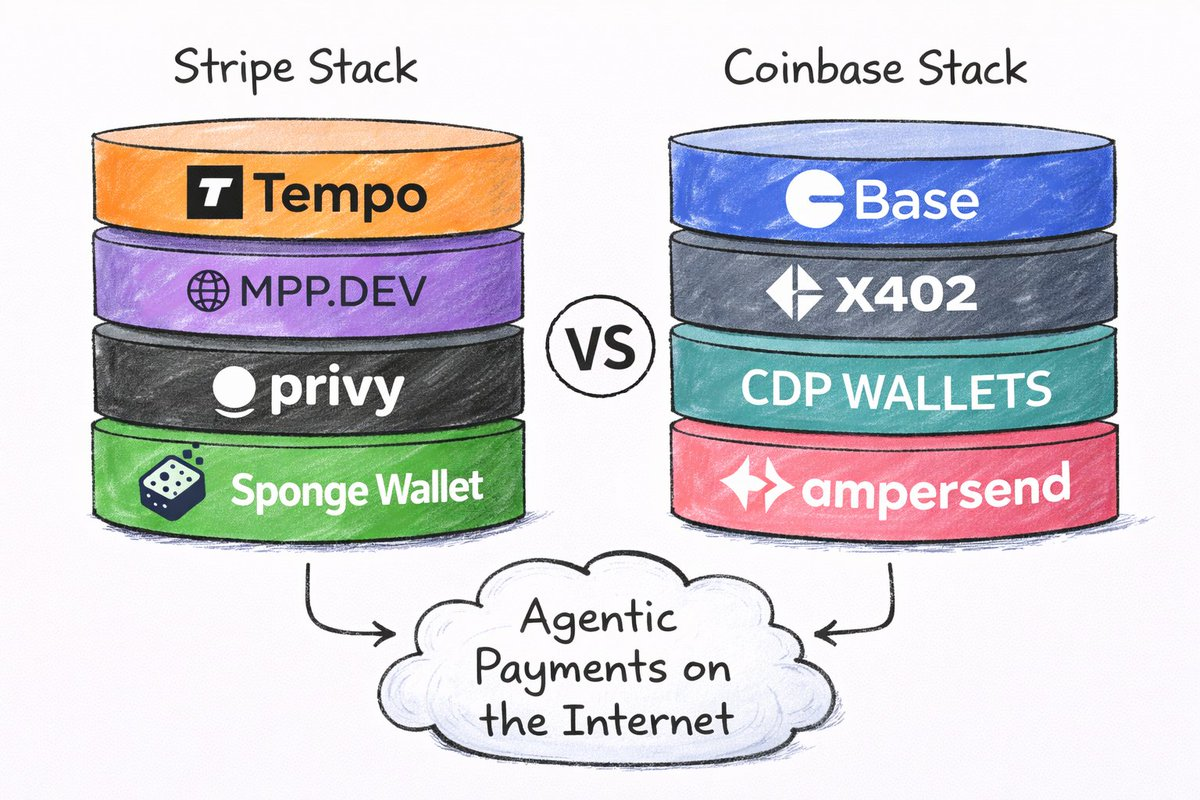
The most interesting aspect of this image is not who will win, but that it indicates something: the narrative has begun to grow infrastructure.
However, having infrastructure does not mean there is demand; having interfaces does not mean there is a closed loop; having stories does not mean there is business.
Many discussions about AI and Crypto today still mostly stay at the narrative level rather than the value level. Stories are always easy to tell: agents need payments, so they need wallets; machines need collaboration, so they need on-chain identities; once the automated economy emerges, a new settlement network will certainly be needed. This logic is not absurd and is even very alluring. But business has never been established solely on self-consistent logic but rather on addressing real problems.
What problem are you really solving? Whom are you helping to reduce costs? What efficiencies are you improving? What new value are you creating? Have you formed a closed loop that makes users willing to continuously use, pay, and stay? If these questions cannot be answered, even the grandest narrative will still remain merely a narrative.
The direction may not be wrong, but being correct in direction does not mean that the right business is available today.
IV. A More Important Question Than Choosing a Path
As I write this, I increasingly feel that perhaps what really matters is not "should I go for AI or stay in Crypto."
Because many people are moving back and forth between the two sides today, it appears they are switching industries, but in reality, they are determining where the real entrance to the future system is. Everyone wants to avoid missing the door that opens first, and everyone hopes to stand where the change truly happens.
But more important than "where is the entrance" is the question: what problem do I really want to solve?
If this question is unclear, AI will turn into a new illusion, and Crypto will also become a new illusion. Today you feel AI is more mainstream, more in demand; tomorrow you feel Crypto is more fundamental, closer to value reconstruction; the day after tomorrow, you are reignited by words like agent payments, machine economy, and on-chain agents. But if the awareness of the problem is unclear, people will only be blown between two cities by the wind.
However, once the problem is clarified, many things will actually become simpler. You do not necessarily have to stand on the AI side, nor must you stand on the Crypto side. What truly matters is which end your problem is closer to, where your capabilities are more suitable to cut in, and whether you can create real, sustainable, and verifiable value in that position.
In the end, business will not pay for imagination, but will pay for value.
Be it AI, Crypto, agentic payments, or machine economy, all these concepts can be grand, and the stories can be moving. But what can truly last will not be the best storytellers but those who genuinely solved problems, improved efficiencies for others, reconstructed certain cost structures, and made value loops run.
Perhaps many years later, looking back, AI and Crypto will indeed converge somewhere. However, from today's perspective, the bridge is not yet fully constructed, and many people have already started glancing back and forth at the bridgehead. I am also one of them.
It is not that I have already figured everything out, but rather I am beginning to slowly accept: in such an era, clarity is not necessarily the norm; it is repeated calibration that matters.
If the problems are unclear, both AI and Crypto will become new illusions. The real determinant of which city you should stand in is not the hype but the problem.
Clarifying what problem you want to solve is more important than which city you stand in.
免责声明:本文章仅代表作者个人观点,不代表本平台的立场和观点。本文章仅供信息分享,不构成对任何人的任何投资建议。用户与作者之间的任何争议,与本平台无关。如网页中刊载的文章或图片涉及侵权,请提供相关的权利证明和身份证明发送邮件到support@aicoin.com,本平台相关工作人员将会进行核查。


