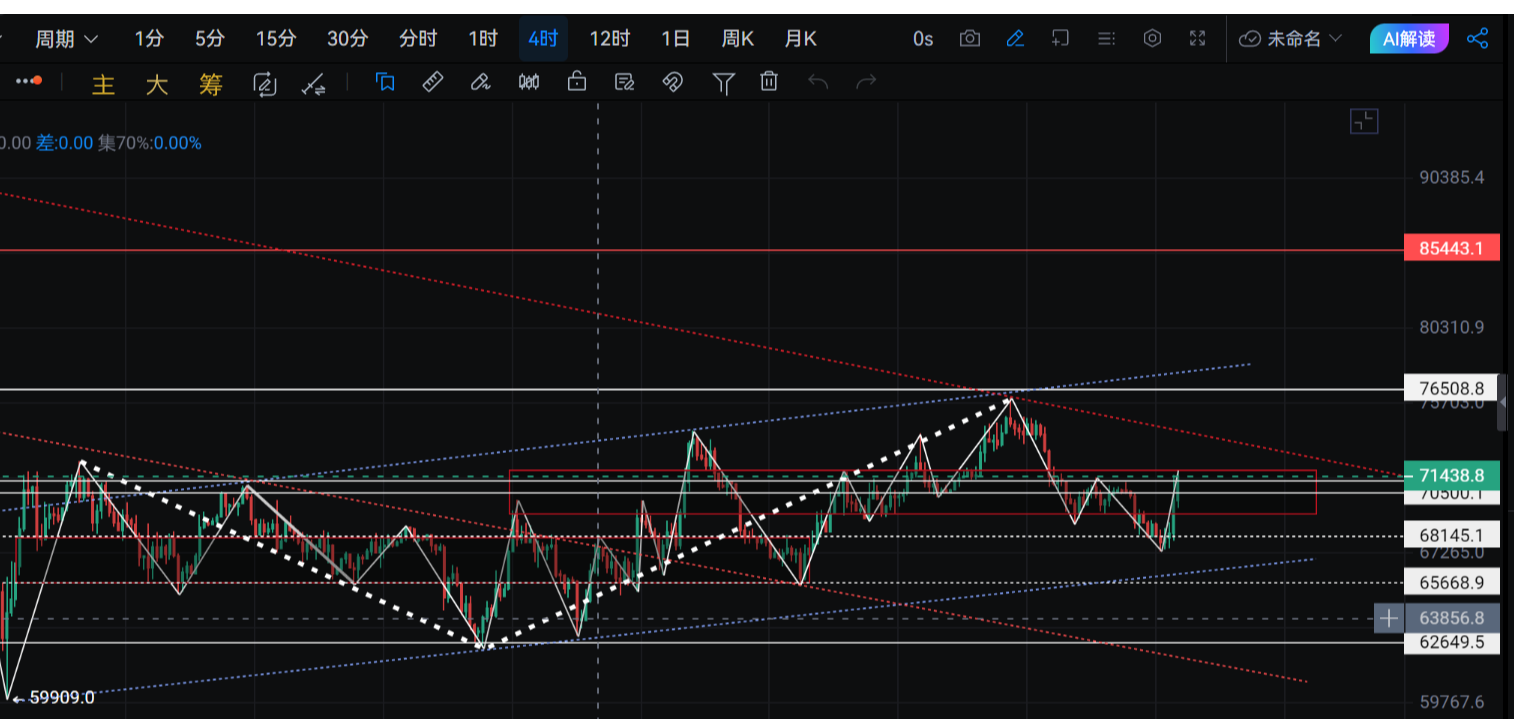
As of 23 March 2026, 8:00 AM UTC, on-chain data shows that High Stakes Capital concentrated its sale of 300,000 HYPE tokens within about two hours, with an average transaction price of approximately $38.17, corresponding to a cash-out amount of about $11.45 million. This reduction in holdings is nearly half of its original position, drawing significant market attention. With this sell-off materializing, the market quickly intensified its focus on the game between "top institutions locking in profits at high prices" and "sell pressure and liquidity absorption capability after HYPE's three-month surge of 580%," raising the question of whether such a large sell order might act as a critical turning point breaking the upward trend or be merely a digestible stress test and how prices and depth can withstand this impact in the short term.
300,000 Tokens Sold in Two Hours: On-Chain Data Reveals Reduction Scale
According to confirmed on-chain data, the High Stakes Capital address sold a total of 300,000 HYPE tokens within a two-hour window, at an average transaction price of approximately $38.17 (according to Onchain Lens), translating to a cash-out of about $11.45 million. Whether in absolute terms or relative to the market, this constituted a substantial impact on short-term prices and the order book. After the sale, the address still holds 302,421 HYPE, valued at approximately $11.54 million, indicating that its original holdings approached 600,000 tokens, with the recent sale representing about 49.8% of its original position, classifying it as a "near cut in half" adjustment in a single institutional account.
Market voices note that this sale of 300,000 tokens is roughly equivalent to 37% of HYPE's average daily trading volume, which explains why fund-stressed investors are particularly concerned about the selling pressure's effect on short-term transactions. In the face of sell pressure equivalent to one-third of the daily average, even if there is a counterparty taking on the orders, price slippage and the depth of the order book are almost impossible to avoid. It is important to emphasize that no specific information about the buying party has been disclosed on-chain, and the specific flow of funds remains in the tracking phase, introducing uncertainty regarding the critical question of "who is buying and how much can they absorb," becoming one of the core variables for future observation.
Early Institutions Floating Profit of $33.2 Million: Periodic Profit-Taking or Bearish Signal
High Stakes Capital is widely regarded as one of the early institutional holders of HYPE, participating early in configurations and holding long-term, allowing it to accumulate considerable floating profits during the previous rally. According to TechFlow statistics, this address has a cumulative floating profit exceeding $33.2 million on HYPE, coupled with approximately 300,000 tokens remaining, valued at about $11.54 million, indicating that its overall investment return is at an extremely favorable range, granting it the "initiative" to actively manage positions and risk adjustments at any stage.
Placing this reduction in the context of HYPE's price increase of 580% over the past three months suggests it is closer to a periodic profit-taking behavior rather than a simple reading as a "direct bearish signal": following multiple price surges, some top institutions choose to lock in some profits and reduce their exposure, which is a common operational logic in both traditional and crypto markets. Of course, at this stage, the external parties cannot know its internal risk assessment models and profit target range. It should be made clear that according to briefing constraints, no speculation is allowed regarding High Stakes Capital's specific motives for this reduction and subsequent operational paths. We can only cautiously infer based on disclosed profit data and reduction percentages that its overall risk preference has slightly contracted while still retaining a considerable number of tokens exposed to HYPE assets.
High Concentration of Tokens: Systemic Pressure Triggered by One Sale
Based on the original holding of nearly 600,000 tokens at this address, it can be seen that the concentration of HYPE tokens among top addresses is high, meaning that a single largeholder's adjustment of positions will significantly impact secondary market prices and liquidity. This sale's scale is nearly half of the address's holdings, equivalent to 37% of HYPE's average daily trading volume; under such a token structure, the marginal effect of a single sell order will be significantly amplified—not only reflected in short-term price volatility but also in the cascading impacts on depth and market sentiment.
In assets with relatively limited liquidity, institutional-level sell orders often spread externally through amplified slippage and volatility: if market making and order book depth cannot be timely expanded, prices will become more sensitive to selling pressure, and equal-sized sell-offs will trigger much steeper declines in thin markets. Simultaneously, to avoid further adverse price impacts, potential subsequent buyers may lean towards "buying lower," thus weakening upward support in the short term and forming unidirectional pressure on lower depth prices. The key quantitative indicators to track next include:
● Frequency of Large Address Sales: Whether more top holding addresses follow suit in reducing their holdings or if High Stakes Capital is an "outlier," directly impacting whether concentration risk expands.
● Order Book Depth and Spread Changes: Observing the amounts of buy and sell orders at the first two levels on major trading platforms, whether bid-ask spreads and slippage curves recover, aiding in assessing the speed of sell pressure digestion and market depth restoration.
Token Flow and Retail Investor Sentiment: Who Is Buying These 300,000 Tokens
With "the buying party undisclosed," we can currently only make indirect inferences via on-chain data: observing whether the transfer flow between large addresses has significantly increased, if there is a single new large holder concentrating on absorption, or if multiple smaller addresses are diversely absorbing, while not inventing any specific identities of institutions or individuals. This process can be correlated with several quantifiable analytical dimensions: first, the changes in the distribution of large addresses' holdings, second, the structure of on-chain transaction counts (proportion of large versus small transactions), and third, if there have been short-term anomalies in recharge and withdrawal data on major trading platforms, to determine whether tokens continue to concentrate or gradually disperse to fragmented addresses.
Regarding retail investor sentiment, news of this reduction, once spread on social networks and news platforms, often triggers a "cognitive to behavioral" chain—first noticing the announcement of large reductions by top institutions, followed by magnified panic or cautious sentiments amidst noticeable price fluctuations, ultimately reflected through behaviors like hesitant short-term chasing, passive stop-losses, or even active position reductions. In the absence of clear backing by the buying party, retail investors may be more inclined to equate this sale with a signal of "smart money retreating," thereby suppressing their willingness to chase prices upward and increasing sensitivity to high-level pullbacks. To determine whether it evolves into a typical case of "institutions offloading and retail absorbing," it is essential to combine the continuous monitoring of whether transaction volumes sustain their increase and whether the holding structure shifts from large addresses to fragmented ones. Only when "volume increases while tokens sink" occurs simultaneously will this narrative be more compelling.
What’s Next for Prices and Liquidity
From a data perspective, the impact of this event on HYPE needs to be split into two layers: short-term impact and mid-term trends: the short-term dimension is primarily dominated by concentrated selling pressure and emotional feedback, with prices having high elasticity towards sell orders and panic sentiments; whereas mid-term movements still depend on whether HYPE's fundamentals can continue to sustain the narrative, and if there is new capital and new participants willing to step in around current prices. If we can observe new capital entering the market and the depth of the order book recovering, then this reduction would resemble a “high-level stress test” in the market; if liquidity remains tight and volumes drop sharply without stabilization, the space and time for high-level pullbacks may be further extended.
Investors should focus on tracking several quantifiable indicators: first, changes in transaction volume relative to daily averages, to observe whether “volume absorbs” or “volume drives down” is dominant; second, whether main platforms’ order book depths and spreads have returned to pre-event ranges; third, the frequency and intervals of large sell orders to assess the continuity of selling pressure. If another reduction close to the scale of this one occurs subsequently, the market may technically form a clearer “cap effect”: the upper sell pressure zone will be repeatedly verified, and the area of large holders’ offloading will gradually solidify into strong resistance and a liquidation zone, suppressing new upward trend momentum.
Overall, this concentrated reduction by High Stakes Capital seems more like a stress test of HYPE's liquidity absorption capability in the secondary market rather than a definitive bearish signal in itself. For participants, the key lies in adjusting position leverage and holding periods based on the aforementioned data and indicators, allowing for a buffer against potential high volatility rather than making extreme emotional reactions after a single event.
The HYPE Quiz After Institutions Cash Out
In summary, High Stakes Capital's sale of 300,000 HYPE tokens within two hours, at an average price of $38.17, cashing out approximately $11.45 million while corresponding to nearly 49.8% of its original holdings, signifies that leading institutions are choosing to "cash out" at high levels but are yet to select a complete exit from the field. Meanwhile, against the backdrop of HYPE’s 580% growth over the past three months, a reduction of similar size has further amplified market recognition of concentration risk and liquidity risk, compelling investors to face the reality: when top addresses possess "discursive power" over price rhythms, the secondary market may face significant shocks in extreme scenarios.
Looking ahead, investors may build a data-centric tracking framework: continuously observing large address behaviors (whether there are more reductions or replenishments), the evolution of token distribution (whether concentration is increasing or decreasing), and transaction volumes versus order book depth (whether liquidity is recovering or even enhancing), thus dynamically assessing HYPE's health post this round of stress testing. Ultimately, this serves both as a major test of HYPE's absorption capacity and liquidity resilience in the secondary market and as a concentrated inspection of retail sentiment and risk preferences: whether to view institutional profit-taking as a "top signal" for collective exit or to establish a new stable state after restructuring the token structure will be answered by the upcoming data on volume-price dynamics and on-chain metrics.
Join our community, let's discuss, and grow stronger together!
Official Telegram community: https://t.me/aicoincn
AiCoin's Chinese Twitter: https://x.com/AiCoinzh
OKX benefits group: https://aicoin.com/link/chat?cid=l61eM4owQ
Binance benefits group: https://aicoin.com/link/chat?cid=ynr7d1P6Z
免责声明:本文章仅代表作者个人观点,不代表本平台的立场和观点。本文章仅供信息分享,不构成对任何人的任何投资建议。用户与作者之间的任何争议,与本平台无关。如网页中刊载的文章或图片涉及侵权,请提供相关的权利证明和身份证明发送邮件到support@aicoin.com,本平台相关工作人员将会进行核查。