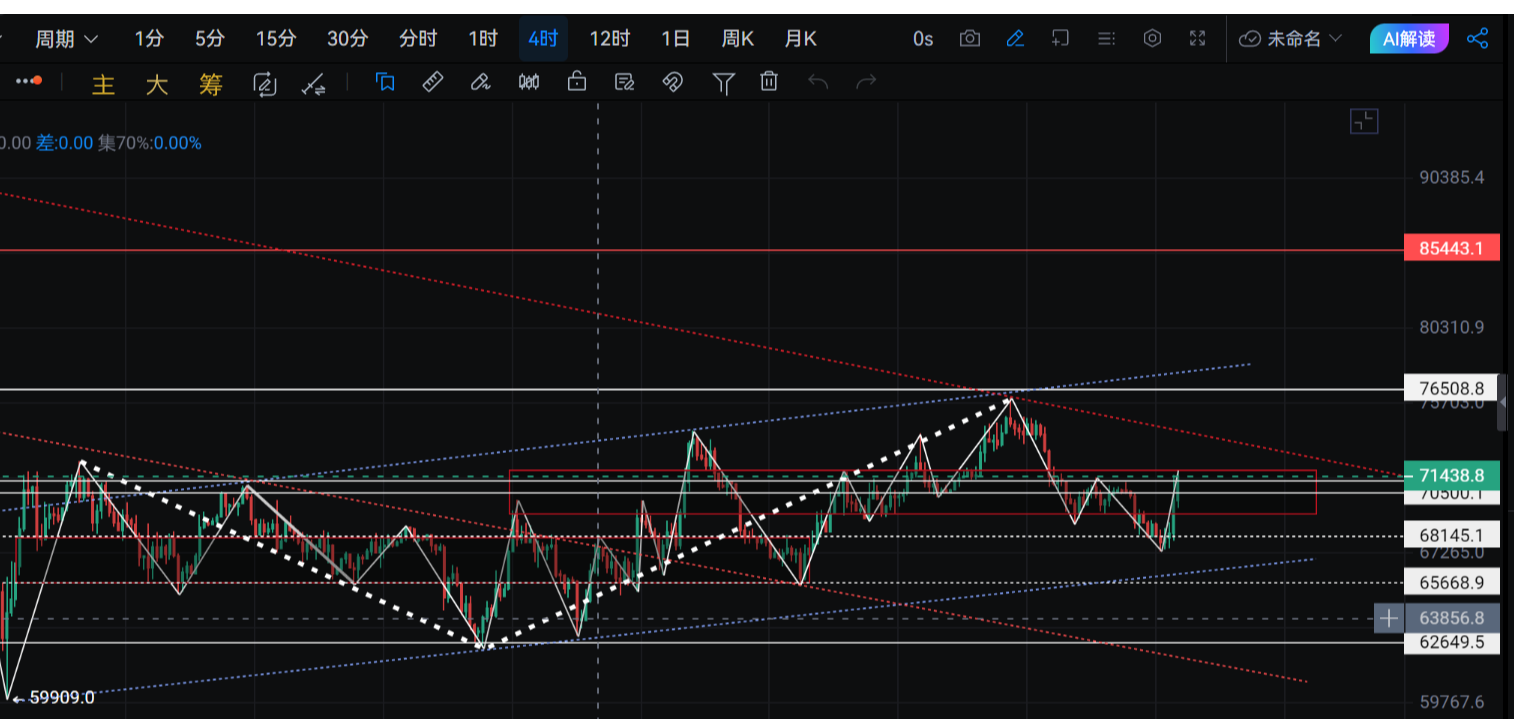
On March 23, the narrative at the intersection of crypto and AI was re-ignited: on one side, Origins Network secured $8 million in strategic financing, backed by well-known institutions including Animoca Brands (according to a single source); on the other side, traditional markets saw a dramatic drop of approximately 10.10% in WTI crude oil futures in a single day, materializing macro risks into a striking candlestick chart. On the same day, Chengdu released a draft opinion soliciting feedback on AI subsidies of up to 25 million yuan, Bitunix announced the completion of upgrades to its trading page order book component, while CZ, under regulatory scrutiny, attempted to reshape discourse with his new book "Freedom of Money." Policy support, infrastructure development, and funding sentiment formed a complete link that day: as capital avoids geopolitical conflicts and inflation uncertainty, is it accelerating bets on the high-risk, high-growth combination of "crypto × AI"?
$8 Million Bet on Modular Networks: The Narrative Moves from Concept to Fundamental Puzzle Pieces
On March 23, Origins Network announced the completion of $8 million in strategic financing, with renowned institutions like Animoca Brands in the investment lineup (according to a single source). In a macro environment filled with noise, this seemingly modest amount of financing carries stronger symbolic significance: capital has not distanced itself from the intersection of AI and crypto, but is instead preemptively positioning itself in a more structured race. For modular networks, their value no longer rests solely on the abstract imagination of "a new generation of public chains," but is situated within the collaborative framework of the AI era.
Amidst an exponentially expanding demand for computing power and model scale, the collaboration among computing power, data, and models is becoming increasingly complex. Modular networks are expected to take on a more flexible role as a "collaboration and settlement layer": on the computing side, it can provide unified rules for resource scheduling and settlement among different providers; on the data side, it is expected to offer programmable infrastructure for data circulation, access authorization, and usage billing; on the model side, it can create a verifiable execution environment for inference tasks, service calls, and profit distribution. Even though specific technical details have not been fully disclosed, the direction of capital investment is clear—it's not about recreating a "universal public chain," but about structurally disassembling the real bottlenecks of the AI industry.
Viewing from a capital perspective, under the backdrop of the 10.10% single-day drop in WTI crude oil futures and ongoing geopolitical tensions, institutional willingness to re-invest in this niche track signifies a preference for assets. Rather than betting on short-term valuation elasticity, they are positioning themselves for a future where AI resources become factorized and tradeable. In contrast to past rounds of financing for AI public chains and computing projects, which leaned more toward "telling an AI story first, then shoving demand onto the chain"; this round differs in that the application boundaries of AI infrastructure in the real world are clearer, and the commercialization paths for computing power, data, and models are more defined, with institutions showing greater tolerance for "landing expectations." In this context, the $8 million feels more like an amplified signpost, alerting the market that modular networks are being re-evaluated within the strategic coordinate system of the AI industry chain.
Local Governments Splash Up to 25 Million: Policies Paving the Way for Computing Power and Data
Simultaneously with the targeted capital injections in the primary market, the policy layer is also paving the way for AI. Chengdu released an opinion draft for AI support policies, with the most notable figure being single projects can receive subsidies of up to 25 million yuan (according to a single source). In a context where local fiscal space is generally under pressure, this figure itself is a stance: local governments do not want to miss the window of industrial upgrade brought by AI and are determined not to fall behind other cities in the new digital economy race.
The strong intervention at the local level is driven by uncomplicated motives. On one hand, AI is seen as a lever for driving structural upgrades in the industry and enhancing urban competitiveness; on the other hand, computing centers, data resources, and key application scenarios are being redefined as "new factor strongholds." Whoever can first complete the layout of computing infrastructure, build high-quality data pools, and cultivate AI applications with demonstrative effects will have the opportunity to gain discourse power in the next round of industrial cycles. For regional hub cities like Chengdu, launching high-amount subsidies sends a clear signal to start-ups, traditional enterprises, and upstream infrastructure providers: they are willing to invest real money in AI.
This round of AI support policies superficially revolves around algorithms and applications, but in reality, it indirectly leaves room for the interface of the crypto world regarding computing power, data circulation, and on-the-ground scenarios. On the computing side, if localities promote participatory computing power supply and scheduling, how to achieve transparent measurement and settlement naturally leads to a demand for on-chain settlement and programmable billing mechanisms; on the data side, as enterprises and institutions enjoy subsidies to promote data assetization, how to establish rights, authorize, and track usage will push for more mature on-chain data rights and access control solutions; on the application side, as a large number of AI services start to collaborate across entities and regions, tokenized incentives and on-chain reputation systems may also move from the periphery towards becoming necessary modules.
Following the path of subsidy flow, the logic becomes clearer: the starting point is traditional enterprises and AI start-ups receiving local subsidies, directly driving them to expand computing power, collect and process more data, and explore more complex models and applications; subsequently, the demand for infrastructure that is cost-controlled, collaboratively verifiable, and commercially sustainable begins to rise. In this process, on-chain settlements, token incentives, and data rights solutions could soon transition from being mere "self-indulgence of Web3 entrepreneurs" to tools that are passively incorporated into policies and industrial practices.
Oil Prices Drop Over 10%: The Turmoil of the Old World and the Appeal of New Narratives
On the same day, WTI crude oil futures fell approximately 10.10%, providing a highly impactful visual sample of macro risks against the backdrop of geopolitical tension. For traditional funds that consider commodities as key allocation objects, such extreme volatility signifies a rapid exhaustion of risk budgets, with assets that were once seen as hedges against inflation and anchors for energy supply showing dual characteristics of high volatility and high uncertainty within a short period.
The dramatic fluctuations in commodities are reinforcing a structural differentiation in asset preferences: the "old energy," represented by crude oil, is increasingly tied to geopolitical conflicts, supply chain disruptions, and policy games; while the "new technology," represented by AI, semiconductors, and crypto infrastructure, is more associated with technological advancement, industrial upgrades, and long-term growth expectations. As traditional hedge assets themselves become unstable, capital starts to make new trade-offs between "geopolitical and inflation risks" and "technological and valuation risks." The former is uncontrollable and lacks a clear timetable; the latter, although volatile, can be managed through diversified layouts and phased retreats.
Contrasting the instability in the oil market with Origins Network's $8 million financing and Chengdu's maximum 25 million yuan AI subsidies creates a stark contrast: in one coordinate system, there is a commodity curve driven by geopolitical and macroeconomic environments; in another coordinate system, there are long-term capital and policy layouts unfolding around AI and crypto infrastructure. This leads to a reasonable hypothesis: as capital actively avoids unpriced geopolitical risks, it is more willing to assume "technological risks" that can be managed through research and structural design. At this stage, crypto and AI assets seem more like "growth stories" that are packaged more completely and vividly than traditional safe havens. This positioning also sets the stage for the upcoming shifts in sentiment and narrative.
From Trading Pages to Narrative Upgrades: Self-Rescue for Platforms and Individuals
Apart from macro and policy narratives, the "micro participants" in the crypto industry are also making adjustments. On March 23, Bitunix announced it had completed upgrades to its trading page order book component, emphasizing that this upgrade optimized the user trading process and interface experience. For a trading platform, such seemingly "engineered" changes directly address the most practical question—how to retain old users, attract new funds, and reduce user loss caused by trading frictions in an environment of concentrated liquidity and intensified competition among leading platforms.
This "micro" experience upgrade forms a noticeable rhythmic dislocation with the upstream "macro" infrastructural narratives like AI and modular networks: the former involves meticulous polishing at the daily operations level, while the latter involves structural bets aimed at the years ahead. Yet, they collectively form two ends of the same link: without front-end products and liquidity support, even the grandest infrastructure narratives can hardly achieve price discovery; without upgrades in backend technologies, computing power, and data layers, front-end products risk losing competitive leverage in the next cycle.
Echoing the product upgrading on the platform side is the reshaping of personal brands and discourse power. Binance founder CZ announced that his new book "Freedom of Money" (Chinese title "Binance Life") is now complete. This book appears at a time when regulatory pressure significantly rises and both personal and platform images experience severe swings, making it hard not to interpret it as an attempt at "narrative reconstruction"—attempting to find a new position amid regulations, public opinion, and the industry by retelling his story. The terms "Money" and "Life" in the title reflect the intricate relationship between personal fate and the development of the crypto industry.
If we place Bitunix's upgrade and CZ's book release on the same plane, one end involves competition among platforms over product strength and user experience, while the other end involves core figures competing over discourse power and values. Together, they reflect that within the tightening squeeze of rising new AI narratives and regulatory scrutiny, the crypto industry is seeking self-rescue and redirection through various paths—either by providing better products to absorb new liquidity, or by establishing stronger narratives to reposition within the new order.
Risks, Speculation, and Faith: Role Differentiation Under the New Narrative
The shadow of macro uncertainty has not faded. Former U.S. President Trump remarked regarding the U.S.-Iran agreement that, "We are hopeful of achieving certain substantive results", which serves more as an anticipation of potential moderation rather than a confirmation of concrete progress. It reminds the market: geopolitical tensions and negotiation games are still operating at high levels, and macro-level unease will not dissipate with just one or two optimistic statements. In this context, the understanding and pursuit of "safe-haven assets" by capital are also constantly adjusting.
Alongside this is the institutional strengthening of speculation under the new narrative. Odaily Star Daily specifically cautioned about the "Freedom of Money coin", highlighting its price volatility and the need for risk awareness, indirectly providing a note for "traffic assets" in the current environment: as long as a concept is linked with celebrities, popular narratives, or emotional symbols, it can be pushed into the spotlight in a short period, accompanied by extreme volatility and opaque risks. The combination of AI and "freedom currency" is more easily packaged into speculative stories with a moral halo by some participants.
Placing these phenomena within the same risk spectrum reveals a coexistence pattern from serious infrastructure financing and local AI subsidies to high-volatility meme coin speculation: on one end, infrastructure projects like Origins Network receiving $8 million in strategic financing, expected to provide foundational support for future computing power and data collaboration; in the middle, local governments guiding AI industry layouts with subsidies up to 25 million yuan, hoping to leverage fiscal incentives for long-term outputs; on the other end, high-volatility tokens represented by Freedom of Money coins attract short-term funds under the influence of new narratives and celebrity effects. These three share the same set of keywords: AI, freedom, future; but they carry vastly different timelines and risk natures.
In the dual fervor of AI and crypto, participants need to first clarify their roles:
● "Storytellers," adept at constructing grand narratives that intertwine technology, ideals, and wealth freedom, guiding the flow of attention and traffic;
● "Builders of infrastructure," attempting to address real computing power, data, and collaboration challenges within the layers of financing and policy support, with longer return cycles and substantial failure rates;
● "Followers of traffic," frequently entering and exiting high-volatility assets, basing their decisions mainly on emotions and speculation, with both returns and risks highly amplified.
Recognizing these roles and clarifying one's position among them may be a more essential topic at this stage than simply identifying which track to bet on.
The Next Act of Crypto × AI: Extending the Timeline Amid Volatility
Returning to the clues mentioned at the outset: $8 million financing for Origins Network, Chengdu's draft opinion on AI subsidies up to 25 million yuan, WTI crude oil futures' single-day drop of approximately 10.10%, along with Bitunix's order book component upgrades and CZ completing "Freedom of Money," these seemingly scattered events sketch an invisible route together—in the current environment where macro volatility and geopolitical risks are continuously rising, funding and policy are consciously shifting from an "unsolvable macro question" to a "designable technology question."
The fusion of AI and crypto is still in its early stages, currently more a capital and policy layout phase: local governments are paving the way with real money for computing and data centers, institutional capital is betting on modular networks and AI infrastructure, and trading platforms along with key figures are seeking new positioning at the product and narrative levels. Applications and business models that can sustainably generate cash flow and gain recognition from traditional markets have yet to surface on a large scale, indicating there remains significant tension between valuations and expectations.
For individual investors, two things need to be done simultaneously: on one hand, remain cautious of short-term speculation disguised under the banner of AI and "freedom currency", particularly tokens strongly tied to celebrities and emotional hotspots but lacking clear mechanisms and risk disclosure; on the other hand, maintain ongoing attention on infrastructure directions bolstered by technological accumulation, team capabilities, and policy dividends—whether revolving around computing power scheduling, data rights, or the collaboration and settlement layers of modular networks, as they are more likely to carry genuinely verifiable value creation in the coming years.
Looking ahead over the next few quarters, as local AI policies transition from soliciting opinions to implementation and more projects like Origins Network secure financing, modular networks and projects related to computing power and data are likely to experience a revaluation. This will be a dual test of capital patience and project execution: no matter how compelling the story, if it cannot deliver verifiable results in terms of computing costs, data quality, and application effectiveness, it will eventually be repriced by the market; while those teams that focus on building infrastructure amid the noise may require longer timeframes to see their marks on the price curves.
Join our community to discuss and become stronger together!
Official Telegram community: https://t.me/aicoincn
AiCoin Chinese Twitter: https://x.com/AiCoinzh
OKX benefit group: https://aicoin.com/link/chat?cid=l61eM4owQ
Binance benefit group: https://aicoin.com/link/chat?cid=ynr7d1P6Z
免责声明:本文章仅代表作者个人观点,不代表本平台的立场和观点。本文章仅供信息分享,不构成对任何人的任何投资建议。用户与作者之间的任何争议,与本平台无关。如网页中刊载的文章或图片涉及侵权,请提供相关的权利证明和身份证明发送邮件到support@aicoin.com,本平台相关工作人员将会进行核查。