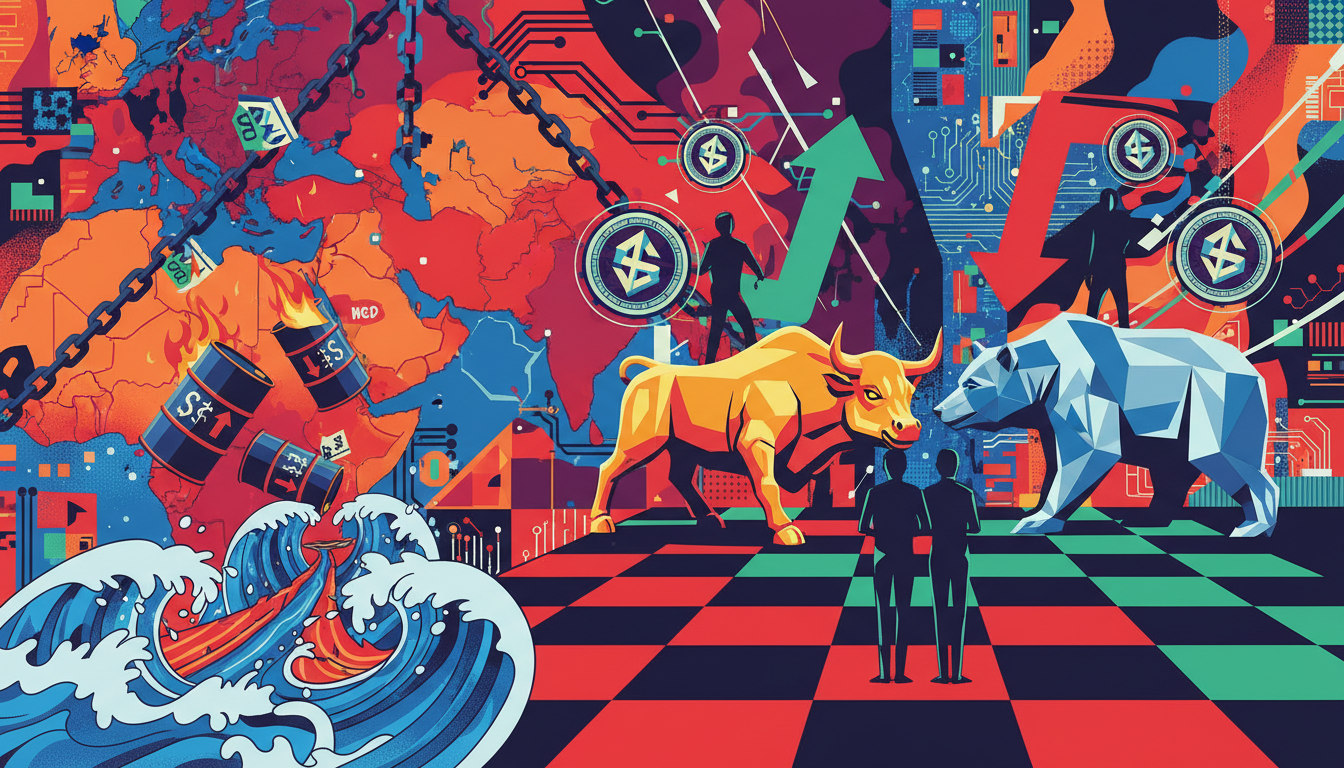
The gunpowder smell in the Strait of Hormuz has been rising this week in the East 8 timezone, with the US and Iran quickly taking positions in the public opinion arena: on one side, former US President Trump suddenly sends signals of de-escalation, while on the other side, Iran loudly denies any form of negotiation contact and directly labels this set of "de-escalation rhetoric" as psychological warfare. Iran publicly reiterates that there is no direct or indirect contact with the US, accusing Washington of trying to change battlefield and market expectations with rhetoric. Meanwhile, market sentiment appears to have been put on a roller coaster — the probability of a "US-Iran ceasefire" contract on Polymarket once soared to 44%, only to plummet back to 16%; although the data from a single platform is limited, it sufficiently reflects the extreme uncertainty of the situation's direction among outside observers. The real question hanging over all participants is: how will this enduring tension around the Strait of Hormuz reshape the long-term pattern of global energy pricing and risk premiums?
Trump's Sudden Shift and Iran's Strong Rebuttal
In chronological order, this round of narrative pulling began with Trump's sudden shift — after a series of hardline statements, he suddenly released signals about de-escalation and negotiating space, offering the market a "potential cooling" scenario. Iran chose not to take the bait but instead publicly denied any direct or indirect contact with the US, completely shutting down the so-called possibility of negotiations outside official rhetoric. Such denial not only negates the facts but also sends a signal both internally and externally: Iran will not trade secret communication for short-term security in the current state.
The Iranian Foreign Ministry further "dissects" Trump's motivations, pointing out that his remarks do not truly seek a ceasefire but are based on two considerations: first, to lower energy prices by releasing expectations of de-escalation; second, to buy time for US military equipment and tactical deployments. Defining the opponent’s de-escalation rhetoric as psychological warfare means that Iran not only does not acknowledge the goodwill narrative from the US but even regards it as another extension of the battlefield. This open naming of the other side's "buying time and suppressing oil prices" interpretation strengthens the confrontation between the two sides on the level of discourse, adding more suspicion to the external understanding of the US-Iran game.
In this narrative structure, it is difficult for outsiders to discern which level of discourse approaches the true intentions: are Trump's de-escalation remarks tactical withdrawal, strategic deception, or a response to domestic and international pressures? Is Iran's strong rebuttal born from genuine security anxieties, or is it to maintain a tough image domestically and raise the negotiating threshold externally? When both sides begin to frame each other's statements as psychological warfare, any single statement becomes easier to interpret as a strategic maneuver, thereby exacerbating market and observer speculation about the real bottom line and red lines.
The Psychological Warfare Cannot Douse the Gunpowder Smell in the Strait
After Trump's sudden shift, Iran did not give any "emotional cooling" space. Through Tasnim News Agency, Iran released a weighty statement — "The Strait of Hormuz will not return to pre-war status through psychological warfare." The key of this statement lies not in denying the existence of psychological warfare, but in directly declaring: mere rhetoric and expectation management are insufficient to reverse the current security reality. This effectively categorizes all attempts to "cool down through words" as ineffective operations.
Iran insists on a "self-defense position," emphasizing that it is responding to external pressures and threats; conversely, the US is accused by Iran of attempting to influence energy price trends through public opinion guidance and soothing statements. This constitutes a set of deeply rooted structural contradictions: one side believes it is under threat and needs to anchor military and security deployments; the other side is portrayed as a manipulator calculating global energy prices and strategic pace using narrative tools. When safety and pricing dimensions are forcibly overlapped on the same battlefield, any verbal "de-escalation" is hard to be seen as a real risk reduction.
In the absence of any substantial negotiation or contact signs, psychological warfare is more about "tuning" the existing level of tension, rather than being a true lever to push the conflict back to a pre-war state. Words can create temporary fluctuations and illusions, but cannot replace hard constraints such as navigation security arrangements, military presence scale, and rules of engagement. Once the market realizes that "there is no negotiation table, only a war of words," trust in so-called de-escalation statements will quickly diminish, and the marginal effectiveness of psychological warfare in calming the situation will swiftly decrease.
Moreover, it is worth noting that Iranian officials have publicly framed tension and instability as a medium-to-long-term norm: the unstable state of the energy market has been publicly confirmed as "ongoing." This means that, from Hormuz to broader Middle Eastern waters, risk is no longer seen as a one-time shock but is embedded in the basic scenario for the coming years or even longer. For the market, this is not just a description of current fluctuations; it also suggests a new "common sense": becoming accustomed to pricing amid high-risk noise.
The Roller Coaster of Ceasefire Expectations and the Dilemma of Risk Pricing
Outside the discourse game, the market itself is also staging a drama of sudden emotional turns. According to data from a single source, the probability of a "US-Iran ceasefire" contract on Polymarket once surged to 44%, only to quickly drop back to 16%. In a relatively short time frame, such volatility can be described as a "flash crash" in the realm of expectations. The probability dropped from nearly fifty-fifty back down to a low point, indicating that participants shifted their view on the ceasefire prospects from "there might be hope" to "essentially hopeless."
More interestingly, in the absence of any substantial negotiation or contact information, why did the predictive market briefly bet on a ceasefire probability nearing half? Behind this are both a phase interpretation of Trump's soothing words and a projection of some funds' inertia towards "unexpected diplomatic breakthroughs." In other words, most participants did not possess more inside information; they were constructing what seemed to be a reasonable scenario based on public statements and then placing bets. Once Iran's strong rebuttal broke this imagination, the wind direction swiftly reversed.
The dramatic fluctuation in ceasefire probabilities essentially reflects a larger embarrassment: geopolitical risks are difficult to quantify precisely and maintain pricing over time. Unlike traditional economic data, wars and ceasefires are often discrete events, and their occurrence depends on opaque political decisions and security assessments. The predictive market attempts to describe this "jumpy reality" with continuous probability curves but only ends up exaggeratedly fluctuating whenever there is a change in news. Frequent ups and downs are more about amplifying information noise than stable depiction of real risk levels.
At the same time, it must be emphasized that Polymarket is just one of many samples of emotions and betting channels, and its participant structure, liquidity scale, and pricing mechanism determine that it can only represent part of the market's sentiment, not a global consensus. Viewing its direction as "the only truth of the market" is evidently biased, but ignoring such emotional shocks would miss key clues in understanding how capital chases or recedes amid uncertain narratives.
The Energy Chain Shock Under Long-term Tension in Hormuz
If we zoom out from the narrative battlefield, the Strait of Hormuz itself determines that each escalation of tension is not just regional news but a core variable in a global supply chain. As a major maritime route for global oil and gas, it carries key shipments from major oil-producing countries in the Middle East to various parts of the world. Once this channel is considered a "high-risk area," the benchmark assumptions of global energy markets will shift: from "default flow" to "may be obstructed at any time."
The direct consequence of sustained tension is the amplification of capacity bottlenecks and insurance costs. Even without substantial blockades, shipowners and carriers will increase redundancy in route selections and scheduling; some vessels may be forced to divert or change routes, resulting in reduced effective capacity. At the same time, the costs of war risk add-ons, crew crisis allowances, and other hidden costs will be shared in the transportation costs of every barrel of oil and every ton of liquefied natural gas. These supply chain pressures will eventually transmit along the industry chain to upstream producers and downstream consumers, pushing up the overall price system's uncertainty.
With Iranian officials openly stating that the unstable state of the energy market will persist, the market's pricing logic for medium-to-long term oil prices is also forced to adjust: on one hand, central levels face upward pressure — long-term risk premiums are embedded in the futures curve; on the other hand, the elevation of volatility itself becomes the norm, with prices becoming more sensitive to sporadic events and rhetorical shocks. For downstream sectors such as refining and shipping, passively bearing pressure is not the only option in such a high-uncertainty environment.
More realistic defensive strategies include: extending the raw material procurement cycle, increasing diversified supply sources to mitigate Hormuz's single-point risk; using tools like futures and swaps to hedge parts of price volatility while embedding more flexibility regarding delivery locations and times in contract terms; increasing the weighting of cash flow management and inventory management in asset allocation, writing "acceptable volatility" into the basic premise of corporate operations. These strategies will not eliminate risks but can buy more buffer time for key links in the industry chain against the backdrop of long-term tension in Hormuz.
From Battlefield to Market: The Chain Reaction of Energy and Asset Narratives
From a macro perspective, each escalation of tension in the Strait of Hormuz ultimately feeds through expectations of oil and gas prices into inflation and interest rate expectations. Energy prices are fundamental variables in the global inflation basket; once the market believes "geopolitical instability will persist," even if short-term spot supply can be maintained, longer-term inflation expectations will also be elevated. Central banks, when formulating monetary policy, must reassess between "bearing the costs of geopolitical shocks" and "maintaining economic growth," causing shifts in the pricing of the yield curve.
In this chain, the roles of traditional assets and commodities are also quietly changing. Oil, gold, and other commodities still carry safe-haven narratives amid geopolitical shocks, but as financialization deepens, they increasingly also function as speculative tools — safe-haven buying and leveraged funds often coexist, making prices during tense events both a "safe anchor" and an "amplifier." The stock and bond markets must digest more complex signals: cost pressures stemming from high oil prices, elevated inflation expectations, and potential re-pricing of monetary policy.
In an environment where uncertainty in energy and inflation is rising, cryptocurrency assets may oscillate between two narratives: on one hand, some investors see it as an alternative asset to hedge against fiat currency devaluation and geopolitical chaos; on the other hand, its high volatility, leverage, and liquidity-driven characteristics make it act as a "risk amplifier" during extreme risk sentiment. At certain times, it may rise alongside gold, becoming part of the "safe-haven basket"; at other times, it may retreat alongside high-beta tech stocks, reflecting its fundamental color as a "risk asset."
For market participants, the key is to distinguish between two time scales: short-term emotional trading and medium-to-long-term geopolitical repricing. The former is more focused on specific news drop and statement release time windows, chasing expected differences and liquidity peaks; the latter is gradually writing “long-term tension in Hormuz” and “normalization of energy risk premiums” into asset pricing models. Confusing the two can easily lead to buying high during emotional peaks or exiting too early before structural risk premiums have completely released.
The High-Risk Long Cycle in the Absence of Negotiation
Taking into account the current public information, the lack of any signs of substantive contact and negotiation channels between the US and Iran makes the tension in Hormuz more like a protracted war without a clear timetable, rather than a short-term conflict that can be quickly concluded with a ceasefire agreement. As a result, navigation security and energy supply are locked into a high-uncertainty time axis, with the market forced to oscillate between "will not immediately spiral out of control" and "no real de-escalation in sight."
In this pattern, the boundaries of psychological warfare and discourse games also become increasingly clear: they can temporarily influence expectations and prices, but cannot replace true security arrangements and diplomatic breakthroughs. Without substantive military de-escalation and diplomatic frameworks, any "de-escalation rhetoric" is hard to earn long-term trust from the market and only regarded as tactical noise. This also indicates that even if similar "soft rhetoric" from Trump appears again in the future, the market's responsiveness may continue to weaken.
For the energy chain and broader asset markets, a more realistic preparation is to normalize risk premiums as a baseline scenario for the coming years: accepting the upward shift and increased volatility of oil and gas prices, and accepting central banks navigating more complex inflation-growth trade-offs. If future verbal escalations or localized military frictions intensify, asset price paths may show: energy-related assets and traditional safe havens may spike in the short term while high-risk assets come under pressure; and once a ceasefire framework or security mechanism with substantive content emerges, energy risk premiums are expected to gradually decline, while high-beta assets and certain emerging markets may welcome a clearer correction trend.
In this high-risk long cycle without negotiations, what truly needs to be adjusted may not be sensitivity to the next headline but the cognitive framework that encompasses the entire geo-energy-asset chain: viewing the tension in Hormuz as a "new normal," and then re-examining behind every price shock whether it is emotional noise or a part of structural repricing.
Join our community, let’s discuss together and become stronger!
Official Telegram group: https://t.me/aicoincn
AiCoin Chinese Twitter: https://x.com/AiCoinzh
OKX Benefits group: https://aicoin.com/link/chat?cid=l61eM4owQ
Binance Benefits group: https://aicoin.com/link/chat?cid=ynr7d1P6Z
免责声明:本文章仅代表作者个人观点,不代表本平台的立场和观点。本文章仅供信息分享,不构成对任何人的任何投资建议。用户与作者之间的任何争议,与本平台无关。如网页中刊载的文章或图片涉及侵权,请提供相关的权利证明和身份证明发送邮件到support@aicoin.com,本平台相关工作人员将会进行核查。