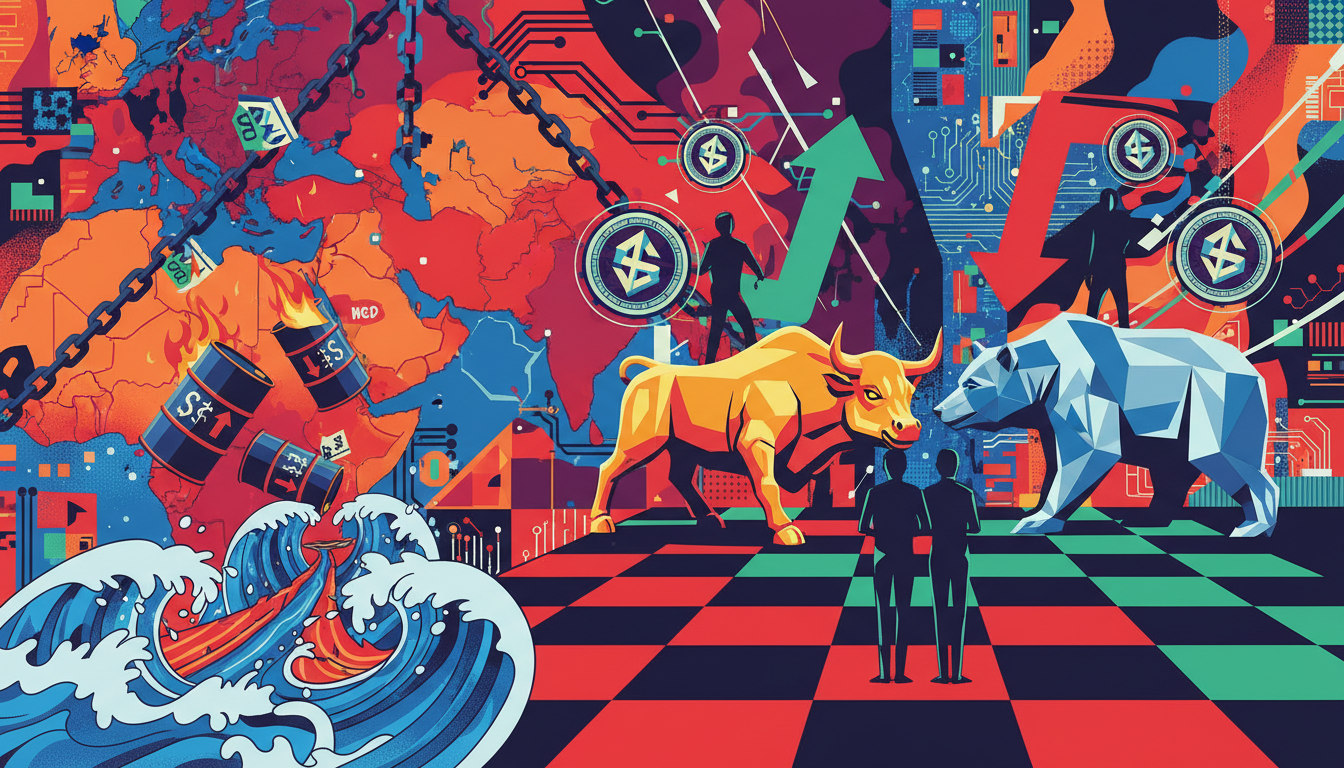
This week, amidst information tug-of-war between the U.S. and Iran regarding "dialogue" and "military strikes," the narrative suddenly intensified: on one side is the U.S. President's claim of "pausing strikes for 5 days, and having good and productive talks over the past two days," while on the other side, Iranian officials repeatedly deny any form of negotiation, instead boasting of a narrative depicting “U.S. retreat under Iranian threats” as a victory. At the same time those conflicting signals emerged, Brent crude oil futures experienced a rare crash, with a single-day drop exceeding 14%, and the geopolitical premium being violently erased from the market. Who is leading the narrative, who is responding passively, and why the market switched from “conflict escalation premium” to “risk cooling discount” in mere hours became the key issues to interpret this abrupt halt in oil prices and understand how the information war penetrates the energy market.
Trump's Negotiation Claims and Iran's Deterrence Narrative
In this war of words, Trump initially presented a seemingly de-escalating framework: military strikes could be paused for 5 days, but only if negotiations progressed. He emphasized on social media that “good and productive talks” occurred over the past two days, implying the U.S. still controlled the pace, pushing a controllable diplomatic game against the backdrop of military threats. This statement aimed to show domestic voters the image of being “tough yet rational” while signaling allies and markets that “the conflict is manageable,” leaving room for subsequent choices.
In stark contrast, Iranian state media quickly denied the existence of any form of dialogue or cooperation, directly undermining the basis of “good and productive talks.” Iranian state television framed the current situation as a case of successful deterrence, stating that “the U.S. President retreated under Iran's decisive threats”: it was not about negotiating compromises but forcing the opponent back. Iranian foreign offices followed up by amplifying the narrative of “U.S. retreat,” rewriting a reality initially centered around sanctions and Strait control as a unilateral strategic victory.
Both sides adopted completely opposite narrative paths regarding the same event: the U.S. emphasized “pausing due to rational choices,” while Iran emphasized “retreat under threatening pressure.” For the U.S., maintaining the image of “I set the terms” aids in continuing to control the topic in domestic politics and among allies; for Iran, packaging this confrontation as a template of “forcing a superpower to retreat” is an important political asset for consolidating support internally and demonstrating resilience externally. Both sides are competing for a core conclusion before international audiences—who is in control of the situation, and who is being forced to concede.
Tension Between Ultimatum and Self-Proclaimed Retreat
To understand the narrative hedging in this round, it’s necessary to extend the timeline. Previously, Trump was quoted by multiple media outlets as having issued a hard-line statement similar to “48 hours to open the Strait of Hormuz,” akin to an “ultimatum”: restore navigation through the Strait within a limited timeframe, or military options remain on the table. The deterrence intent of such statements is very direct—declaring the U.S. intends to use military power to guarantee shipping security in a crucial global energy chokepoint and apply pressure on Iran.
However, when the situation developed to the point of “pausing strikes for 5 days,” Iran seized the change in narrative rhythm, quickly rewriting the causal chain. The Iranian embassy in Afghanistan publicly claimed that the U.S. had “retreated under Iranian threats,” creating a stark contrast to Trump’s earlier “48-hour ultimatum” stance. Where the U.S. originally showcased “setting limits + deterrence,” in the Iranian narrative, it was translated to “forced to retract orders,” and continuously reinforced through regional media channels.
If we thread together the entire timeline: first there was “the ultimatum to open the Strait,” followed by “short-term pause in strikes against the backdrop of negotiations,” culminating in “Iran denying dialogue and claiming U.S. retreat,” a clear narrative seesaw emerges. The starting point is the U.S. controlling the loudspeaker while setting the framework with military threats, the mid-point is a tactical brake under realistic constraints, and the endpoint stands where Iran “flips the script” on the narrative level. Behind the ebb and flow of narrative power, both sides are utilizing limited publicly available information to compete for the highly symbolic title of “who is retreating.”
Price Crash of 14% and a Single Statement that Changed the Pricing Story
This war of words did not remain in the realm of public opinion but was engraved in an extremely intuitive manner on the candlestick chart of Brent crude oil. Various sources indicate that on the day when conflicting signals were concentrated, Brent crude futures experienced a maximum daily drop exceeding 14%, with long positions being aggressively liquidated, resulting in a rapid decline resembling a “flash crash.” From the market structure, the previously established geopolitical premium based on “conflict escalation, Strait restrictions” was quickly subject to reflexive selling, as prices sought a new equilibrium amidst panic-driven selling.
Almost overnight, the market pricing framework underwent a dramatic shift: in the prior phase, the prevailing assumption on trading desks was “increased probability of military conflict, rising risk of supply disruptions,” consequently adding a thick layer of risk premium to oil prices; however, after repeated amplification of terms like “pausing strikes for 5 days” and “good dialogue,” macro quantitative and subjective trading capital swiftly interpreted this new information as “short-term escalation risk under control,” leading to the active dismantling of the previously added premium protection. The result was not a smooth price correction, but rather a drastic single-day retracement of over 14% under the resonance of leverage and sentiment.
This round of price drop clearly exposes international oil prices' high sensitivity to political statements: snippets of conflict escalation can drive oil prices up continuously within days, while "pausing strikes" and "good dialogue" can similarly break through multiple technical supports in mere hours, enabling rapid risk repricing in the market. What truly drives the market's movement is not any substantiated change in supply and demand but the instantaneous reconsideration of potential future scenarios—often hinged on a few highly ambiguous statements that can be rewritten by both sides.
The Intersection of Gun Barrels and Microphones in the Strait of Hormuz
The reason each statement can be amplified by the market is closely tied to the unique strategic position of the Strait of Hormuz. As the energy lifeline connecting the Middle Eastern oil production areas to global consumption markets, this narrow waterway has historically been vital for the transportation of crude oil and refined products. Whenever keywords like “blockade,” “attack,” or “military exercises escalation” surface, the market readily translates them into “increased supply disruption risk,” “soaring insurance costs,” and “amplified shipping uncertainty,” which can rapidly lead to premiums in futures markets.
In this round of events, a single source indicated that at a certain time frame, there were “6 vessels transiting the Strait of Hormuz in real-time,” but lacked a complete time series and multilateral verification. For shipping companies, insurance institutions, and commodity traders, in the absence of more physical and military deployment data, they can only stitch together these scattered indicators and leaders' verbal statements into a rough risk picture. Whether it’s “normal navigation” or “preparation for detours,” to a large extent, judgment is forced based on public discourse rather than clearly verifiable real-time situations.
When transparent military deployment information is absent, the Strait of Hormuz becomes a lever caught between gun barrels and microphones: the actual direction of the gun is unclear to the outside world, and can only be inferred through the volume and tone of the microphone. This information structure directly feeds into futures and shipping pricing—one leader's “ultimatum” may be interpreted as an escalation of risk transmission, while a statement like “pausing strikes” could be understood as a signal of risk retreat, forcing the market to oscillate between the two.
How the Absence of Truth Amplifies Price Echoes
In this U.S.-Iran information war, a key variable that has been overlooked is the “absence of truth.” Briefings indicate that critical details about actual military deployments by both sides, third-party intelligence verifications, and other key information have not been made available to the market. Investors can only access publicly stated speeches from both sides and selectively filtered media reports. The true progression of the brinkmanship on the edge of war is obscured by layers of rhetoric, leaving a noisy narrative space.
In such a highly uncertain environment, financial behaviors often follow the survival logic of “run first and look later.” When a certain narrative—such as “conflict escalation will blockade the Strait”—gains the upper hand in social media and television footage, risk-averse buying will drive oil prices up first; conversely, once opposing signals like “pausing strikes for 5 days” and “good dialogue” emerge, previously extreme-positioned trades will crowd out toward exits, resulting in an excessive reaction to a singular narrative, which then rapidly rebounds if the reality fails to materialize.
This cycle manifests as nonlinear volatility in oil price curves: emotions push prices away from fundamentals during the rise, while similarly, during the fall, they excessively correct downward at the same speed. With truth obscured, information noise and emotions dominate, turning price into an echoing chamber—whether it is an “ultimatum” or a “retreat declaration,” both can evolve into violent long-short conflicts within a short time frame, resulting in extreme market situations like the recent single-day decline of over 14%.
How Much Can the Market Endure Before the Next Round of Warnings?
Looking back at the entire event, the war of words between the U.S. and Iran around “dialogue,” “deterrence,” “pausing strikes,” and “ultimatums” reshaped global perceptions of “who is retreating” within a short span, also directly inscribed on the long shadow of Brent crude oil’s over 14% drop. From “superpower issuing an ultimatum” to “regional power declaring the opponent forced to retreat,” the focus of the narrative shifted hands multiple times within days, each swing bringing a reevaluation of risk premiums and passive adjustments of funding positions.
For market participants, treating snippets from leaders' social media as the “only truth” equates to entirely surrendering the anchor point of asset pricing to emotional fluctuations. In an information-asymmetric geopolitical game, a more realistic approach is to deliberately widen the observational perspective, combining multi-source news, historical behavior patterns, and personal risk control boundaries, utilizing options, cross-product hedging, and other tools to manage extreme scenarios rather than simply following each “hardline statement” or “victory declaration” to chase price movements.
Looking ahead, should extreme phrases like “breakthrough in negotiations,” “countdown of ultimatums,” or “retreat under threats” re-emerge, the emotions will likely follow a similar pathway: the first stage involves amplification by social media and headlines, driving oil prices to dramatically skew in a short time; the second stage sees trading funds rethinking in the absence of new solid information, with some premiums being retracted; the third stage involves re-pricing based on subsequent actual actions (whether there is indeed a blockade, whether there is actual troop withdrawal). The range of oil price fluctuations may continue to widen under this cycle of “narrative-pricing-correction.”
Before the next round of high-decibel warnings arrives, the real question to ask oneself might not be “who is retreating,” but rather: in a market dominated by a war of words, how much of my position is based on the truth, and how much is merely betting on a title yet to be rewritten.
Join our community to discuss and grow stronger together!
Official Telegram community: https://t.me/aicoincn
AiCoin Chinese Twitter: https://x.com/AiCoinzh
OKX Benefit Group: https://aicoin.com/link/chat?cid=l61eM4owQ
Binance Benefit Group: https://aicoin.com/link/chat?cid=ynr7d1P6Z
免责声明:本文章仅代表作者个人观点,不代表本平台的立场和观点。本文章仅供信息分享,不构成对任何人的任何投资建议。用户与作者之间的任何争议,与本平台无关。如网页中刊载的文章或图片涉及侵权,请提供相关的权利证明和身份证明发送邮件到support@aicoin.com,本平台相关工作人员将会进行核查。