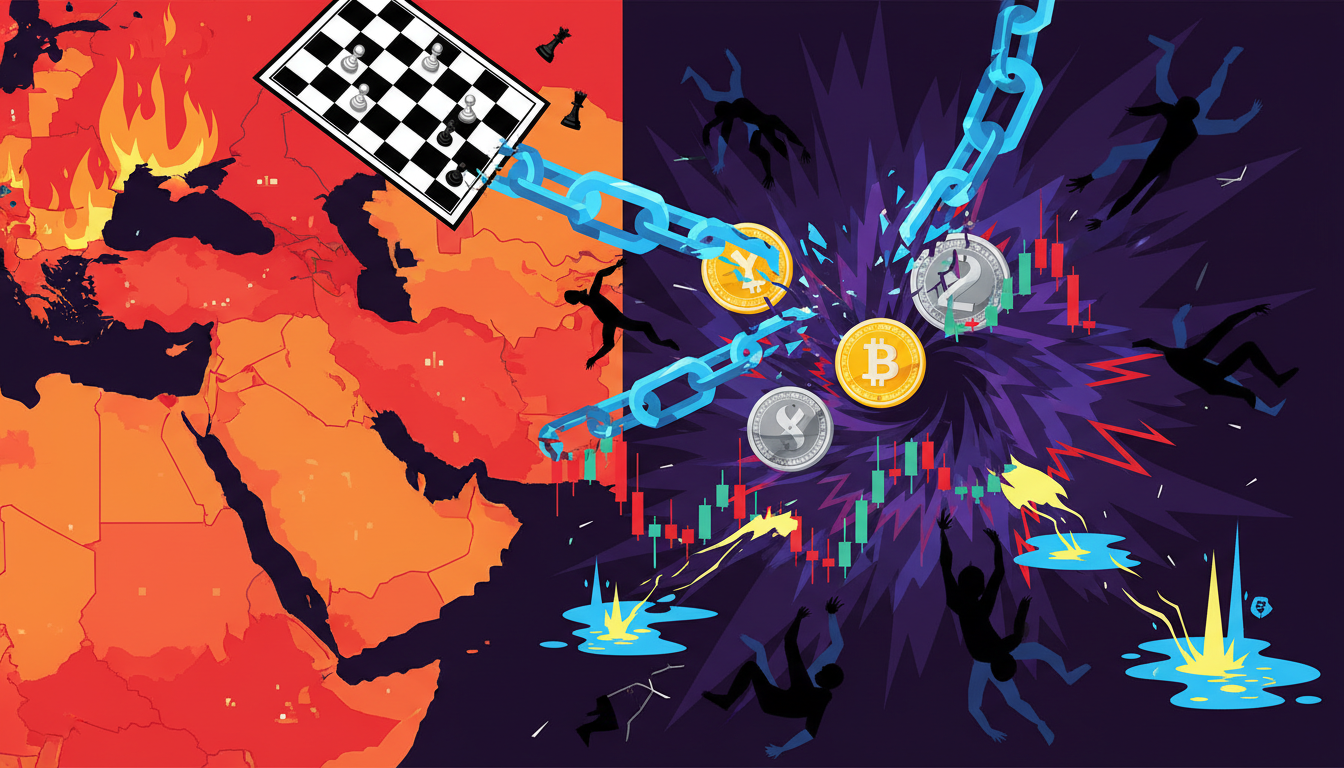
On March 23, 2026, Eastern Eight Zone Time, global assets experienced a rare resonance within the same trading day: on one hand, spot gold, New York futures gold, and spot silver sharply declined during the session, wiping out the entire annual gain of precious metals; on the other hand, in the crypto market, a giant whale dumped 5,000 ETH at an average price of $2,063, while South Korea's leading exchange Upbit listed RESOLV as a trading alert target in accordance with the country’s Virtual Asset User Protection Act. The price crash of traditional safe-haven assets starkly contrasted with the large holders in the digital asset market choosing to “take profits,” casting a shadow of tightened regulation over the Asian markets. A series of events on that day pointed to the same core question: when traditional “safe-haven anchors” like gold and highly volatile assets like Ethereum are both revalued on the same turbulent day, will funds choose to continue diversifying their bets or will they seek out new safe havens and value homes?
The Halt of the Safe-Haven Myth with Gold and Silver Plummeting
On March 23, precious metals became the focus of global attention. According to brief data, that day spot gold fell below $4,300/ounce, with an intraday decline of about 4.5%, New York futures gold also broke below $4,300/ounce, with an intraday decline of 6.03%, resulting in a synchronous shock across both spot and futures dimensions, leading to concentrated impacts on longs in a short time. Meanwhile, the price of spot silver dropped to $63.09/ounce, with an intraday decline of about 7%, with silver's decline even being sharper than gold's, and the precious metal sector overall showed a unilateral downward trend.
More symbolically, this sharp drop directly erased all of gold’s gains prior to 2026, making “annual gains zeroed out” the key phrase of the day. For many long-term holders, the narrative of gold being a long-term “inflation-resistant and risk-averse” asset was tested against reality in such a rapid price pullback: is its safe-haven attribute still reliable, or can it also succumb to being sold off during rapidly contracting liquidity and swiftly changing market sentiment? The impact on long-term narratives reaches far beyond the turbulence in intraday profits and losses.
On the market sentiment level, data from Bitget was frequently shared: “Gold experienced its largest single-day drop in 2026”. Such expressions reinforced the perception of “historic” volatility and amplified panic and passive liquidation pressures during the session. For funds that are accustomed to viewing gold as the “last line of defense,” the day’s price curve not only broke technical formations but also shook psychological defenses, making the question of “is the safe-haven myth being rewritten?” one of the main topics of discussion after hours.
From Gold and Silver to Ethereum: Funds Wandering in the Storm
Under the premise of not touching the red line of speculative reasons, it can be determined that: the violent fluctuations in precious metal prices on March 23 coincided with significant ETH sell-offs in the crypto market on the same day, creating an apparent resonance in timing. On one side, gold and silver saw significant retracements of 4.5% to 7% within the day, while on the other side, on-chain data detected concentrated selling operations from whales, two asset clues intermingled on the same day, leaving room for speculation on capital flow and risk preference changes.
When traditional safe-haven assets are struck hard, funds do not necessarily migrate simply from “safe assets” to “risky assets,” but investors will often be forced to re-evaluate their asset allocation strategies. Theoretically, some funds might shuffle between stocks and high-volatility crypto assets, trying to find compensation and opportunities within a wider risk range; or they may choose to further reduce positions and increase cash ratios. Without more granular capital flow data, we can only acknowledge the existence of this possibility, without making hasty attributions.
If we juxtapose the single-day massive tremors in precious metals with Ethereum’s price hovering above $2,000 on that day, we discover a tension worth pondering: an asset viewed as a “safe-haven anchor” experienced a 4% - 7% deep retracement within a single day; meanwhile, another asset widely acknowledged as a “high-volatility gambling arena,” became the stage for big holders finely adjusting their positions and taking profits in batches. The boundaries between “safe-haven” and “gambling” were redrawn on that day—at least from the price performance and capital actions, it was no longer that simple binary opposition of the past.
It should be emphasized that there is currently no authoritative data to prove a direct causal chain between the crash in precious metals and the giant ETH sell-off. Neither the macro-level liquidity environment nor the micro-level behavior of a single address is sufficient to support “causal locking.” Therefore, a more prudent approach is to treat both types of events as parallel samples within the same trading day, observing how the market rebalances “safe-haven,” “risk,” and “opportunity” under severe disturbances, rather than hastily providing a singular explanation.
Giant Whales Dumping 5,000 ETH...
On the crypto market side, on-chain monitoring shows that a giant ETH whale sold 5,000 ETH on March 23 at an average price of about $2,063. According to Lookonchain’s interpretation, this transaction is seen as a standard “profit-taking” operation—not a panic liquidation, but an active move to lock in floating profits. Calculating this out, this single sale scale approaches ten million dollars, enough to create noticeable selling pressure on short-term liquidity.
More crucial data lies in this whale's overall holding structure: briefings show that it still holds about 126,000 ETH, worth about $260 million at current prices. This implies that even after dumping 5,000 ETH, the address's position in Ethereum remains substantially large, having neither fully liquidated its position nor completely turned extremely bearish. In other words, this was a tactical reduction of positions on a large bull base rather than a strategic retreat.
The concentrated sell-off of 5,000 ETH should not be underestimated in terms of its amplification effects on short-term market sentiment and on-chain behavior. On one hand, having to absorb such a large volume of sell orders in a short time often amplifies price fluctuations locally, triggering quick downturns and even liquidity slippage; on the other hand, “copy trading” behavior on-chain often accelerates after seeing the movements of whales, and some small and medium investors treat it as a directional indicator, choosing to sell or reduce their positions along the way, thus self-reinforcing the sell-off curve on a sentiment level.
This also brings a paradoxical signal: while the big holders choose to “cash out” above $2,000, they still maintain large open positions exceeding 100,000. For market participants, it is hard to simply interpret this as “bearish” or “bullish.” It seems more like a risk management action while not giving up on medium and long-term exposures—amid heightened volatility and increased external uncertainty, they temporarily reduce their positions to recover liquidity, allowing for maneuvering space in case of future market fluctuations. This complex posture reflects that current main funds in the crypto market still have the willingness to participate in medium to long-term narratives, but have developed a stronger sensitivity to short-term risks.
South Korea Targets RESOLV...
On the same day, another signal related to risk appetite emerged from the Asian market. South Korea's leading exchange Upbit listed RESOLV as a trading alert target, signifying that this cryptocurrency would be labeled as high risk on the platform. For liquidity and retail confidence, “trading alerts” often bring direct impacts: some users may choose to quickly reduce positions and exit, and market depth may decline due to increasing risk premiums, further amplifying price volatility.
It is noteworthy that Upbit’s action is based on South Korea’s Virtual Asset User Protection Act. This not only addresses the risks of a single cryptocurrency but also serves as a concrete example of the tightening compliance landscape in major Asian markets. Unlike past practices that mainly relied on self-regulation by exchanges, the implementation of regulatory frameworks has provided clearer legal grounds and execution boundaries for measures like “listing alerts” and “restricting trading,” and market participants need to adapt to this new compliance constraint environment.
As global precious metal prices plummet and the crypto space faces overlapping regulations and individual crypto risks, Asian investors are confronted with dual uncertainties: on one hand, traditional safe-haven assets have lost their symbolic meaning of stable anchoring in the short term; on the other hand, some crypto assets are being actively cooled off due to regulatory and compliance issues, raising the difficulty of regional capital allocation. For retail investors with limited risk tolerance, this dual pressure can easily translate into a stronger defensive mentality.
Within the framework of proactive warnings from exchanges and regulatory legislation, two structural changes may arise in the short term: firstly, mainstream coins and top assets with comparatively controllable compliance risks, larger scales, and more mature narratives may benefit relatively in an environment of rising safe-haven sentiment; secondly, trading structures may concentrate from high-risk small coins towards top assets, and the use of leverage in the market may become more cautious. This does not imply that the crypto market as a whole will become a “new safe haven,” but rather indicates that the pricing of risk premiums is being rewritten under regulatory scrutiny.
Where Will Funds Flow After the Safe-Haven Label Loosens?
Returning to the panoramic view of that trading day: gold and silver experienced dramatic declines erasing annual gains, ETH whales chose to rhythmically “take profits” above $2,000, and South Korea's Upbit added RESOLV to its trading alert list based on regulatory frameworks. The interplay of these three events produced a notable tone of unease—traditional safe-haven narratives are being severely tested, the internal dynamics of digital assets and compliance pressures are both becoming more visible, and the familiar “safety coordinate system” for investors is showing cracks.
In the absence of speculation about the specific triggers of gold's drop, what we can do is regard this day as a sample of “safe-haven consensus being tested,” rather than a definitive judgment on future dynamics. Whether it be the violent tremors in precious metals, the positioning adjustments of crypto whales, or the substantial actions from Asian regulations, they currently resemble a set of “stress test data”: they reveal how various forms of capital instinctively shrink, defend, or reposition when extreme volatility and tightening compliance coincide.
From a medium-term perspective, key observation points will focus on three dimensions: first, whether precious metals can rebuild momentum in the coming weeks to months, thus restoring their core position in safe-haven narratives; second, whether this whale holding 126,000 ETH and other major on-chain players will continue to reduce positions or shift to other sectors, or whether they plan to re-increase after volatility settles; third, whether the Asian markets represented by South Korea will further enhance execution力度 under the Virtual Asset User Protection Act framework, thereby reshaping the foundational rules of compliance and risk pricing in the region.
When the safe-haven halo of both traditional and digital assets is questioned in the same period, the market may be forced to answer a difficult question: will the future value anchor still be the “absolute safety” of a single asset class, or will it be a basket of relatively safe combinations across assets, regions, and regulatory frameworks? The answer to this question requires time and data, but March 23 has undoubtedly been inscribed on the timeline of this long-term game.
Join our community, let's discuss and grow stronger together!
Official Telegram community: https://t.me/aicoincn
AiCoin Chinese Twitter: https://x.com/AiCoinzh
OKX Welfare Group: https://aicoin.com/link/chat?cid=l61eM4owQ
Binance Welfare Group: https://aicoin.com/link/chat?cid=ynr7d1P6Z
免责声明:本文章仅代表作者个人观点,不代表本平台的立场和观点。本文章仅供信息分享,不构成对任何人的任何投资建议。用户与作者之间的任何争议,与本平台无关。如网页中刊载的文章或图片涉及侵权,请提供相关的权利证明和身份证明发送邮件到support@aicoin.com,本平台相关工作人员将会进行核查。