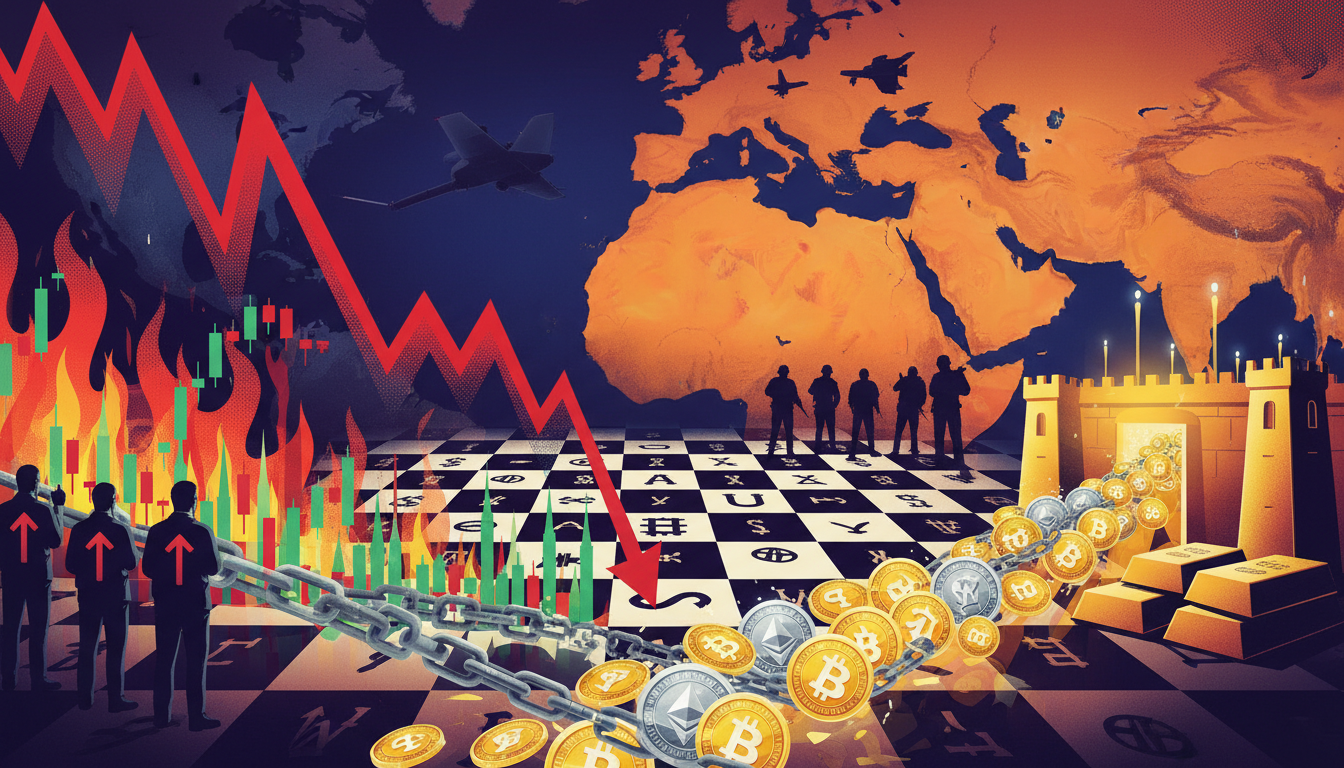
On March 23, 2026, Eastern Eight Time, the conflict in the Middle East had been raging for four weeks, from the Iranian frontlines to Israel's direct strikes on Tehran, pushing the Strait of Hormuz, a vital global energy artery, to the brink. Goldman Sachs warned that the oil flow through Hormuz could decrease by 5% and last for six weeks, prompting an immediate and severe market reaction in commodities and crypto assets: WTI crude oil soared to $101 per barrel at one point, while gold rarely fell for eight consecutive days, with spot prices being pressured around $4320.30 per ounce, London copper prices plummeted by 6.7% in a single week, marking the largest drop since April 2025, while BTC broke below $68,000, and ETH dropped by 1.78%, with traditional "safe-haven" and "risk" assets being pressured almost simultaneously. The resurgence of inflation and the expectation of global growth slowdown were at odds, causing capital to rapidly shift between commodities and cryptos: on one side chasing high oil prices and safety premiums, on the other side retreating from high volatility in the crypto circle. Safe-haven assets did not fully realize their protective function, and risk assets were no longer solely betting on liquidity. Is this merely a short-term panic ignited by war, or the starting point of a repricing across commodities, RWA, and crypto? The following articles will examine the redistribution of power and chips in this cross-asset storm through the contrasts of whales' misfortunes and retail investors' windfall.
How oil prices went out of control after the blockage at Hormuz
With the war in Iran dragged into its fourth week, Israel's strikes on Tehran crossed the threshold from a regional conflict, and the market truly began to price "channel risks." The Strait of Hormuz carries a critical proportion of global oil and gas transportation daily, with Goldman Sachs estimating: oil flow may decrease by 5% and possibly last six weeks. This is not abstract geopolitical noise, but a hard assumption directly incorporated into the futures curve, becoming the anchor point for the oil bull-bear game.
Amid this backdrop, WTI crude oil reached a maximum of $101 per barrel during trading, returning to the three-digit price range. Bulls were betting on transport disruptions combined with passive inventory consumption: even if physical demand did not surge in the short term, the "chokepoint" on the supply side was enough to elevate marginal barrel prices. Bears were focused on two critical factors - whether the war would really evolve into a sustained blockade, and whether high oil prices could be maintained in an environment of global growth slowdown. Around the question of "Is $101 just an emotional peak?" futures and options positions quickly reconfigured, with high volatility becoming the new norm.
Price shocks in oil did not stop at the energy sector but transmitted layer upon layer along the global supply chain. Rising energy costs first squeezed profit margins for chemical production and shipping companies, passing through to the manufacturing sector via higher shipping rates and raw material prices. For companies already facing cost pressures, high oil prices meant further margin compression, which also meant some firms might transfer pressures to consumers by raising prices, thereby pushing up inflation expectations. The market was simultaneously worried about imported inflation resurfacing and realized that the cost shocks were eroding corporate profits and employment, amplifying the sense of tension at the macro level.
Goldman's commodity team assessed in this round: high oil prices might persist for a long time. This sentence was interpreted internally in traditional financial institutions as a "risk reassessment in terms of time" - a part of the funds chose to strategically increase positions on crude oil futures and related RWA exposures to lock in potential long-term price central tendency shifts, while another portion hedged against further surges in extreme scenarios through protective structured products. Although specific position data was not disclosed, the direction was clear: energy surges, once viewed more as tactical tools, were being seen by some institutions as a long-term variable requiring "defensive embrace."
Gold's eight-day decline: Safe-haven assets are also hesitant
In stark contrast to the uncontrolled rise in oil prices, as geopolitical conflict escalated, gold unexpectedly fell for eight consecutive days, with spot prices being pressured around $4320.30 per ounce. According to traditional financial textbooks, escalations in warfare would imply skyrocketing demand for safe havens, and gold should lead the charge; however, the reality was that prices slipped continuously, and the market was collectively stunned by the odd combination of "war + gold price correction," beginning to question whether the logic of safe-haven assets itself was evolving.
Analysts at Capital.com offered an explanation leaning more toward a narrative interweaving of technical and geopolitical perspectives: gold had accumulated considerable gains in the previous period, and technically there was a possibility for short-term rebound, but the trend was highly dependent on the geopolitical situation - any signal of conflict escalation, channel blockage, or sanction diffusion could instantly change traders' bias. In this environment, technical patterns were no longer a purely self-consistent system but were continuously "redrawn" by every shift in the conflict in the Middle East. Sentiment was extremely fragile, and the market could quickly shift from profit-taking to chasing high safe havens.
The contradictory behavior of funds was particularly evident in gold. On one hand, short-term bulls had locked in their gains at the beginning of the conflict and chose to reduce positions or close out at high levels to avoid severe retracements; on the other hand, long-term funds remained concerned that high oil prices would compress future rate cut space, and inflation would stubbornly persist over a longer cycle, hence still needed to hold gold and other assets to hedge against purchasing power loss. Meanwhile, concerns about global growth slowdown were dragging down overall demand expectations for metals, with some funds worried that if the economy weakened, actual interest rates remained relatively high, the carrying costs for gold would continue to increase, diminishing its long-term appeal.
This oscillation also penetrated the on-chain RWA track. On-chain products linked to gold and government bonds anchor one end to "real-world interest rates and safe haven demand," while facing the other end's requirements for yield and liquidity from on-chain funds. The current hesitation in gold prices and the disturbances in the government bond yield curve indicate that the risk premiums and discount rates for such products have not yet completed a new round of reset - on-chain contracts have already provided digital prices, but the market still has not reached a consensus on what constitutes a reasonable safe haven premium under "conditions of war."
Price plunge in copper and the tug-of-war over inflation expectations
If gold's abnormal behavior puzzled the market, then the 6.7% drop in London copper prices in a single week (the largest decline since April 2025) was more like a sensitive "global growth thermometer," suddenly plummeting to freezing points against the backdrop of Middle Eastern conflicts. As a representative of industrial metals, copper prices are extremely sensitive to infrastructure investment, manufacturing activities, and the real estate cycle; such a drop was tantamount to writing four words on the market: demand pessimism.
On one side, high oil prices fueled production and transportation costs, igniting inflation expectations; on the other side, prices for industrial metals like copper fell sharply, reflecting widespread market concerns about future orders, investment, and consumption. This sense of tearing brought the term "stagflation" back to the surface: price pressures from costs coexisted with weak demand expectations, corporate profits were squeezed by costs, and actual incomes for residents were eroded, while traditional monetary policy tools found themselves stuck between inflation and growth. Although no one dared to easily conclude that "stagflation has arrived," the market's combinations were already pricing in such risks.
In the interconnected realm of RWA and commodities, this differentiation began to directly impact the design of on-chain products. RWA protocols linked to industrial metals and credit assets, if they want to continue attracting funds in an environment where risk premiums generally rise, must increase nominal yields or provide more aggressive discounts to mitigate investors' concerns over "uncertain growth prospects." In other words, the repricing of real-world credit and industrial metals is forcing on-chain RWA to provide a more substantial "safety net"; otherwise, funds will shift towards seeking short-term liquidity or clearer safe haven targets.
For the crypto market's narrative itself, the plummet in copper prices alongside rising inflation expectations constituted a heavy blow. Previously, the RWA sector had been viewed as "the infrastructure for on-chain commodities and credit finance," expected to play a bridging role amid macro volatility. But the reality was that when commodity prices and credit spreads swung violently in extreme environments, on-chain RWA products often exhibited pricing lags and insufficient liquidity, rapidly amplifying secondary market discounts and redemption pressures. This exposes an awkward truth: in genuine macro extremes, "putting real assets on-chain" is just the first step; the real challenge is to continuously and accurately reflect dynamic risk premiums in the real market.
Simultaneous downturn in crypto: The safe-haven myth shattered
As oil prices soared amidst war and channel risks, while industrial metals plummeted amidst growth concerns, the crypto market did not play the role of a "parallel world." Bitcoin's price dropped below $68,000, and ETH dropped by 1.78%, forming a rare resonance with the volatility of traditional assets. The "digital gold" narrative appeared particularly awkward in the face of actual price performance: in a world where inflation expectations are rising and geopolitical conflicts are escalating, gold hesitated, while Bitcoin chose to adjust downward, and the safe-haven story temporarily failed.
The process of capital shifting among global assets provided a clearer underlying explanation for this round of adjustments. When inflation and geopolitical risks rose simultaneously, some institutions began to reevaluate high volatility and high correlation asset exposures. Under conditions where liquidity was no longer unidirectionally loose and macro uncertainty surged, withdrawing some funds from crypto back to traditional commodities and short-duration cash-like assets to build a "safety net" became a choice that aligned better with risk control models. Crypto was not entirely abandoned in this round, but its priority in asset allocation did decline.
Worse still, amidst this macro backdrop, the incident of Resolv Labs facing an attack of about $9 million USR tokens further amplified market concerns regarding DeFi security. For many assets originally viewed as alternatives to "on-chain dollars," such an attack was not an isolated security incident but a symbol: even dollar-denominated, low-volatility on-chain assets could not completely escape technical and protocol risks. The overlay of macro conflicts and micro security incidents has also led to doubts about asset classes that could originally serve as "safe havens" within crypto.
Overall, this round of crypto adjustments resembles a unified event of "de-leveraging and risk aversion" across dimensions, rather than a simple reaction to singular bearish news or individual attacks. From reduced leverage and contraction in maturity mismatches to the concentrated sell-off of high-volatility assets, the market is redefining "what constitutes safety under the shadow of war and high inflation" through actions. The story temporarily rests on an open question: when leverage has been washed out and panic released, who will grab the higher quality chips in this cross-market reshuffle - institutions that withdraw early, waiting for a second entry, or crypto natives who continue to hold on-chain and participate in volatility with more flexible strategies?
Whales' huge losses and retail investors' 209-fold windfall
In this extreme market driven by macro events, on-chain data provides the most direct individual sample: the whale address 0x2607 has a floating loss of $26.77 million on ETH positions and is forced to relocate. This case breaks the stereotype that "whales are always winners," reminding the market: in an era of high leverage and cross-asset interconnections, even large players can falter in extreme volatility. Although specific leverage multiples and opening details have not been disclosed, the result shows that this whale had to adjust its risk exposure amid systemic volatility triggered by the conflict.
In stark contrast is the emergence of extreme cases of 209-fold returns among retail investor groups related to SIREN. In the same round of market events and the same time window, some were forced to relocate positions with tens of millions in floating losses, while others achieved hundred-fold magnifications through high-leverage derivatives in short-term directional fluctuations. This extreme contrast of "blood losses and windfalls coexisting" precisely illustrates the distribution of returns and risks in the current crypto market - the macro storm does not discriminate by wallet size; it merely amplifies the differences in chips and strategies taken on by different participants.
On a behavioral level, the strategy differentiation between whales and retail investors during extreme volatility is equally pronounced. The former often bear greater liquidity responsibilities and stricter risk control constraints—when prices hit internally preset risk thresholds, they must execute passive actions like reducing position sizes, relocating, and hedging, even if it means being "swept out" amid abnormal noise. Retail investors, on the other hand, often flexibly gamble on direction with margin and derivative positions, accepting a higher probability of liquidation in exchange for astonishing odds in a few successful instances, with SIREN's 209-fold story exemplifying this "extreme right tail return."
From a narrative height, this commodity and crypto storm ignited by conflicts in the Middle East is not merely a script of market events, but more like a compact of rapid transfers of risk pricing power from a few giants to a more decentralized group of participants. When oil prices, gold, copper, and BTC, ETH all experience violent fluctuations simultaneously, the correlation matrix in traditional institutional models is disrupted, and on-chain strategy players and retail investors find opportunities to reshape the price discovery process amid the gaps. Those who can more quickly understand "the real macro variables" amidst information chaos and panic will have the chance to quietly take over the chips before the next wave of volatility.
New cross-asset order: Pricing restart after the war
From the Strait of Hormuz being incorporated into war risks, to WTI soaring to $101, then to gold's eight-day decline around $4320.30 per ounce and the 6.7% plunge in London copper prices, culminating in BTC breaking below $68,000, and ETH dropping by 1.78%, this seemingly fragmented sequence of market events actually constitutes a cross-market interconnected impact. The war in the Middle East merely served as a trigger; the real core is how the global market re-prices risk and return under the multiple constraints of "high oil prices, growth concerns, and limited policy space."
Under the assault of high oil prices and growth anxieties, the central bank's policy space has been significantly compressed. On one hand, inflation expectations driven by energy make loosening become more sensitive; on the other hand, if growth data continues to weaken, tightening will exacerbate real pressures. In this tension, the pricing logic of risk assets is quietly shifting from a singular "liquidity-driven" model to a "geopolitical and safety premium-driven" model: wars, channels, sanctions, and supply chain disruptions begin to be incorporated into valuation models, and assets are no longer merely a function of discounted cash flows but must pay extra insurance premiums for "geopolitical uncertainties."
For RWA and the broader crypto market, the key to the next phase is not "who tells a louder narrative first," but rather "who can more precisely anchor real inflation, supply chain risks, and return compensation to the chain." Whether it is energy, precious metals, industrial metals, or credit assets, government bonds, and monetary market instruments, whoever can build structured products on-chain that possess both liquidity and risk transparency will have a better shot at becoming the preferred entry point for safe haven and speculative funds in the next wave of macro fluctuations, occupying a new narrative spotlight.
During this phase of resonance between war and emotions, information noise will be greatly magnified, filled with battle rumors, unverified sanction news, and so-called "internal position movements" on social media. For investors, a more practical path is to closely monitor verified macro data and publicly available institutional viewpoints—for example, Goldman's assessments on Hormuz flows and oil prices' longevity, or Capital.com's technical and geopolitical analyses of gold—rather than making excessive bets based on unverified war rumors or conjectured "whale movements." The new cross-asset order is restarting amid the flames of war, but those who can truly survive this round of reboot often aren't the ones who run the fastest, but those who can most effectively distinguish noise from signal.
Join our community to discuss and grow stronger together!
Official Telegram community: https://t.me/aicoincn
AiCoin Chinese Twitter: https://x.com/AiCoinzh
OKX benefits group: https://aicoin.com/link/chat?cid=l61eM4owQ
Binance benefits group: https://aicoin.com/link/chat?cid=ynr7d1P6Z
免责声明:本文章仅代表作者个人观点,不代表本平台的立场和观点。本文章仅供信息分享,不构成对任何人的任何投资建议。用户与作者之间的任何争议,与本平台无关。如网页中刊载的文章或图片涉及侵权,请提供相关的权利证明和身份证明发送邮件到support@aicoin.com,本平台相关工作人员将会进行核查。