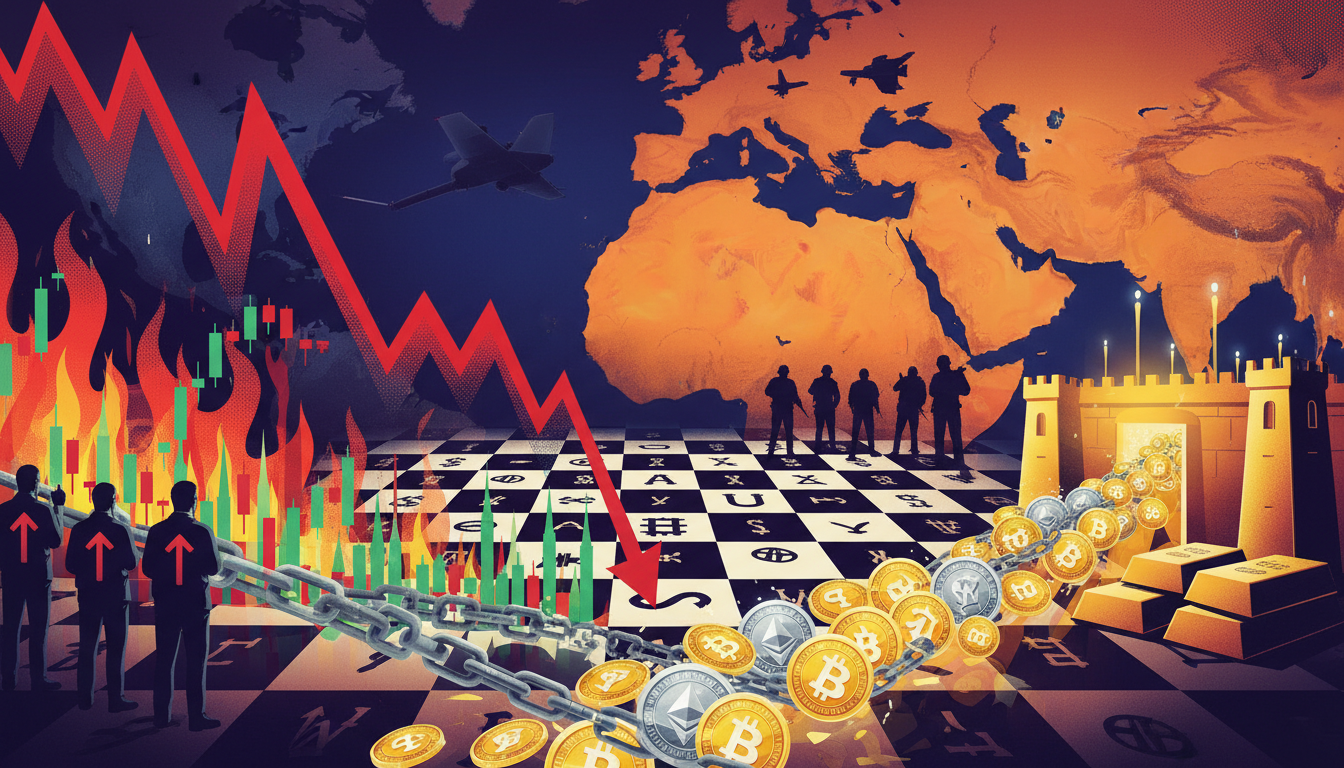
As of the week of March 23, 2026, Eastern Eight Time, the global asset market experienced a rare synchronous shock: spot gold recorded its largest single-week decline since 1983, while Bitcoin and Ethereum both retraced in the same week, and RWA-related tokens also weakened significantly. At the same time, the ongoing conflict in the Middle East has deepened concerns about limited oil supplies, raising mid-to-long-term price expectations for Brent crude oil and, through the chains of inflation and interest rate expectations, suppressing the global easing imagination space. Under this main line of "geopolitical → oil prices → inflation → interest rates," the price fluctuations of crypto assets increasingly resemble a part of traditional macro trading portfolios, rather than an independent world detached from it.
The core question thrown out this week is not just about the rise and fall of prices, but the splitting and restructuring of narratives: As gold experiences a rare significant drop amid high-intensity geopolitical risks, the label of “king of safe havens” is forced to accept scrutiny; while Bitcoin and the RWA sector, previously packaged as “digital gold” and “on-chain safe-haven assets,” also retraced along the same macro shock chain. Whether crypto is being integrated into a unified macro trading framework as a high Beta positioning tool or if the so-called “safe-haven narrative” is experiencing a collective collapse under real-world shocks is a pressing question that all participants in the upcoming cycle must confront.
Gold's Largest Weekly Drop in 40 Years: Technological Pricing of Safe-Haven Label
During the week of March 23, 2026, spot gold recorded a largest single-week decline since 1983, and this fact itself surpasses the experience boundaries of most market participants. Typically, declines not seen in decades would accompany financial crises or drastic changes in monetary policy, but this time's backdrop is tensions in the Middle East and escalating worries about oil supply — according to traditional textbooks, this should be a scenario where the demand for gold as a safe haven erupts. The misalignment between price and narrative directly raised the temperature of discussions on "whether gold has failed."
Market reports repeatedly mentioned expressions related to "Trump's threats to Iran." In the context where risk sentiment was continuously amplified, gold did not perform the traditional safe haven flight; instead, it experienced a flash crash pullback, sparking considerable post-market discussions among traders and institutions about the abnormal performance between geopolitical issues and safe-haven assets. More intriguingly, in the conclusions offered by analysis firms during their review, a phrase emerged — "The short-term technical rebound potential for gold depends on Trump’s execution of threats to Iran." This statement reflects not just a simple bullish or bearish viewpoint, but gold is increasingly being traded in a technical and event-driven manner: an asset originally viewed as a long-term safe haven across cycles and political situations is starting to be utilized by short-term funds to engage in event-driven speculation based on "whether threats are executed."
When the price of safe-haven assets fluctuates entirely around such news-level variables as "whether threats are executed," it indicates that its pricing logic is slipping from "long-term credit anchor" to "short-term trading chips." This role transformation sets the stage for the two subsequent questions: one is how the RWA sector, which is highly tied to the narrative of gold, will be repriced in the event of a gold plunge; the second is how much persuasive power remains for the narrative of "Bitcoin = digital gold" and "on-chain assets = new type of safe-haven assets" in the wake of real-world shocks.
Oil Price Surge and Interest Rate Rebound: Macroeconomic Chain Fully Tightens
Accompanying gold's flash crash was the synchronized rise in oil prices and interest rate expectations. A report from Goldman Sachs' commodities team pointed out that amidst four weeks of ongoing Middle East conflict and escalating regional tensions, oil flow through the Strait of Hormuz is expected to maintain around 5% low levels for the next six weeks, indicating that the supply bottleneck of this key channel is being priced by the market as "mid-term reality" rather than "short-term noise." Under this assumption, Goldman Sachs raised its long-term price expectation for Brent crude oil to $85 per barrel, elevating oil from a tactical risk point to a structural variable in inflation and interest rate pricing.
The direct result of rising oil prices is that global inflation expectations have been reignited, and the market begins to factor in the secondary transmission pressures on prices from rising energy costs. On top of this chain, the Fed's space for interest rate cuts has been further compressed, and the implied probabilities for related interest rate futures and interest rate swaps have seen a noticeable decline — although the specific timeline and frequency of interest rate cuts cannot be precisely predicted, the directional signal has become clear: the market is shifting from "easing in sight" to "higher rates for longer." Accompanying this is the rebound of U.S. Treasury yields, which creates stronger pressure on high-valuation assets and leveraged positions.
This pressure is not limited to the U.S. A research brief showed that Japan’s 10-year government bond yield rose to 2.32% this week, nearing the high range since 1999, becoming a typical coordinate for cross-market transmission. Against the backdrop of Japan's persistent ultra-low interest rates, a yield close to 2.32% itself represents a synchronous upward shift of the global interest rate central. This synchronous upward shift exerts systematic pressure on all assets that rely on the "low interest rates — high valuations" logic, and technology stocks, growth stocks, and crypto assets regarded as high Beta find it difficult to stand apart.
More importantly, this round that began with geopolitical risks in the Middle East, transmitted through oil prices and inflation expectations to the interest rate market, is gradually unifying different asset pricing frameworks: whether it is gold, crude oil, or Bitcoin and Ethereum, an increasing amount of funds are beginning to evaluate positions under the same “interest rate — inflation — risk premium” model. This also lays the crucial background for discussions on how “crypto’s sensitivity to macro indicators has been significantly amplified.”
BTC Falls Below $68,000: Crypto from Independent Cycle to High Beta Puzzle
In this context of macro tightening, the feedback from the crypto market has not been sluggish. Research briefs show that during the week, Bitcoin fell below the $68,000 mark, with a single-week decline of about 1.42%, while Ethereum dropped about 1.78% in unison; in terms of absolute declines, this is far less than the storm-like crashes seen in history, but when placed alongside gold's largest weekly drop in over 40 years and the significant correction in the RWA sector, it forms a clear “asset resonance picture.”
The timing of this correction coincides with notable pressure on rate cut expectations and an increase in global interest rate central, revealing subtle changes in the pricing logic of funds for crypto assets: Bitcoin and Ethereum are no longer being categorized separately into "crypto's independent cycle," but rather seen as high Beta factors in traditional risk asset portfolios by an increasing amount of capital — when macro liquidity tightens and risk-free rates rise, the first positions to be reduced are those with greater volatility and higher risk premiums; in this sense, crypto assets share a high degree of homogeneity with high-valuation tech stocks.
This role change is directly reflected in their sensitivity to macro indicators. Every adjustment in interest rate expectations, every unexpected inflation data release, and every oil price uptick manifests through futures and derivatives markets, quickly amplifying into short-term fluctuations for Bitcoin and Ethereum. The narrative once held that “the crypto world is self-contained” is gradually receding into the background in this round of chain reactions, being replaced by the reality that “crypto is part of the macro risk basket, passively accepting the pull and rebalancing of macro funds.”
However, it’s worth noting that the current 1.42% decline for Bitcoin and 1.78% for Ethereum is relatively moderate; compared to gold's decades-in-the-making weekly decline, crypto’s drop even seems “restrained.” This partly reflects market resilience after the increase in institutionalization: the presence of more long-term and allocation-based funds has reduced the risk of centralized leverage chain explosions, leading to a significant contraction in crypto’s volatility in the face of macro pressures compared to earlier bull and bear cycles. In other words, while crypto is being incorporated into the macro trading framework, it is also reshaping its volatility characteristics through institutionalization and derivatives hedging.
RWA Sector Plummets 4.85%: Synchronous Bleeding of the Digital Gold Narrative
If the synchronous corrections of gold and Bitcoin still represent a resonance between two worlds, then the 4.85% drop in the RWA sector within 24 hours amplifies this resonance further into a narrative-level “self-contradiction.” According to SoSoValue data, during the period when gold recorded its largest single-week decline since 1983, RWA concept tokens, which are highly tied to traditional “real world assets” and packaged as “digital gold” and “on-chain gold,” also experienced significant declines simultaneously. This price trajectory moving in sync with spot gold carries a strong dramatic quality.
Over the past year, RWA has been endowed with multiple imaginations: on one hand, it is seen as a “bridge” between traditional assets and the on-chain world, helping institutional funds strike a balance between compliance and efficiency; on the other hand, its designs surrounding anchor assets like gold, government bonds, and credit assets have provided the market with a new narrative of “on-chain safe haven” and “digital gold.” However, when physical gold plummeted sharply amid geopolitical shocks, RWA-related tokens did not demonstrate any characteristics of “inverse safe haven,” but were instead sold off as risk assets, and the simultaneous decline of “on-chain gold” and “off-chain gold” constitutes a concentrated stress test for this narrative.
Under price pressure, some investors began to reassess the true source of returns and risk exposures of RWA: whether the returns of the tokens themselves come from the cash flows of underlying physical assets, or from liquidity premiums in the secondary market? Is their linkage to underlying assets such as gold and government bonds a strong constrained asset-backed relationship, or is it closer to an emotionally driven “shadow anchoring”? When the primary gold exhibits a rare flash crash and interest rate centers rise, RWA token prices decline alongside risk assets; this round of corrections has provided preliminary answers in practice — at least at the current stage, RWA resembles crypto risk assets centered around the narrative of real-world assets rather than a truly effective on-chain safe haven tool.
The open question left in front of the market is a fundamental inquiry about the future: Will RWA ultimately evolve into a safe haven bridge between traditional assets and the crypto world, or will it, due to being leveraged more heavily and acquiring stronger speculative attributes, become an amplifier of risks similar to traditional assets like gold? This answer depends on institutional developments such as compliance and custodial mechanisms, as well as whether future funds will treat RWA as “hedging tools” or “amplification chips.”
Whale Unloading and Address with Huge Losses: On-Chain Reflection of Macroeconomic Panic
How macro pressures ultimately permeate onto the chain can be clearly observed from the behaviors of several specific addresses. A research brief shows that the on-chain address pension-usdt.eth chose to reduce its position by about 50% during this round of volatility, while another whale address 0x2607's ETH position suffered nearly 50% unrealized losses. These two scenes form a microcosm of the crypto world that week: on one side, large capital rhythmically unbundles, locking in profits or stopping losses; on the other side, heavily positioned and highly leveraged addresses endure substantial pressure during price dips.
For retail investors, significant unload actions by whale addresses often carry a sentiment amplification effect. Once on-chain data monitoring platforms capture information like “pension-usdt.eth reduced its position by 50%,” interpretations and amplifications on social media soon follow, from narratives such as "whales are fleeing the peak," "insider funds run first," to "a new round of declines has begun." In the context where macro interest rates and inflation expectations have turned bearish, such on-chain signals naturally get embedded within a broader pessimistic framework, exacerbating short-term panic and passive follow-up offloading, forming a self-reinforcing chain of “whales act first — retail amplifies — price further retraces.”
Deeper changes indicate that the behavioral logic of large holders is also significantly becoming “macroeconomic.” Whether it is the unloading of pension-usdt.eth or 0x2607's swings between profits and losses, the underlying logic often isn't purely technical indicators or sentiment-driven, but a repricing of changes in interest rate and inflation expectations: as the consensus of "higher rates for longer" gradually forms, the discount rate for long-term risk asset positions is adjusted upwards, and the intrinsic value of discounted assets is passively lowered. Large holders choosing to adjust their positions at critical interest rate and oil price nodes reflects an incorporation of crypto assets into the overall asset-liability management.
Meanwhile, security events such as Resolv Labs suffering attacks of around $80 million occurring frequently also piled onto market sentiment during that week. For a considerable amount of risk-averse funds already elevated due to macro uncertainties, the “protocol risk” and “smart contract risk” arising from technological security events, combined with “interest rate risks” and “liquidity risks,” further amplifies the overall markdown on crypto assets. In such an environment, the selling pressure in the crypto market originates not only from price volatility itself but from the resonance of both macro and technical risk lines.
Crypto Driven by Macro: Observation Coordinates for the Next Stage
Looking back at this week, from gold creating its largest single-week decline since 1983 to long-term Brent crude oil expectations rising to $85 per barrel, and then to Japan's 10-year government bond yield rising to 2.32%, U.S. Treasury yields recovering, and synchronous corrections in Bitcoin, Ethereum, and the RWA sector, a complete chain has emerged: geopolitical conflicts drive up oil prices, triggering inflation expectation increases, suppressing rate cut expectations, and raising the global interest rate center, thereby applying pressure on all assets premised on “low interest rates — high valuations.” In this chain, crypto assets are no longer an exception, but deeply embedded within the same macro framework as high sensitivity puzzles.
Throughout this process, the credibility of the narrative surrounding “digital gold” and “safe haven assets” has undergone practical testing. On one hand, Bitcoin and gold resonated in their decline during the same macro shock, making “digital gold” more like a component of the macro risk asset basket rather than an independent safe haven tool charging against the trend; on the other hand, the "on-chain gold" system represented by RWA also weakened in tandem with the sharp drop in spot gold, more resembles a chain extension and amplification of traditional safe haven narratives rather than truly independent hedging assets. This narrative is not inevitably bankrupt in the future, but it must be reconstructed with more solid custodial mechanisms, transparent asset support structures, and a richer array of hedging tools to reshape its credibility.
Looking forward to the next few stages, at least three key observation points deserve continuous tracking:
● The evolution path of the Middle East situation: Whether the conflict is a phase of easing or evolves into broader regional confrontations will directly affect oil flow through the Strait of Hormuz and the price center for crude oil. If the assumption of “5% low flow maintained for six weeks” is extended, inflation and interest rate expectations will further tighten.
● The policy signals from the Federal Reserve and major central banks: Even if the rhythm of interest rate cuts cannot be precisely predicted, the combination of dot plots, public speeches, and economic data will continue to adjust market expectations for “the duration of high rates,” thereby influencing the pricing of all assets, including U.S. Treasuries, Japanese bonds, and crypto assets.
● The interlinked changes between oil prices and the yield curve: Each turning point in the trajectory of Brent crude oil prices and the steepness of the U.S. Treasury yield curve will reflect market new judgments on "growth — inflation — policy," and the price elasticity of crypto assets to these variables will determine their weight and role in institutional portfolios.
In the new macro cycle, investors need to redefine their risk boundaries and emotional turning points when allocating crypto assets: on one hand, accept the reality that “crypto has been incorporated into macro trading systems,” bringing indicators such as interest rates, inflation, and oil into daily observation lists; on the other hand, also be wary of being swept by amplified emotions in a high-volatility environment, distinguishing between “healthy corrections driven by macro pricing” and “irrational stampedes amplified under safety events.” For truly long-term participants, understanding how crypto is repriced within the macro flood might be more critical than predicting the direction of the next candlestick.
Join our community to discuss and become stronger together!
Official Telegram community: https://t.me/aicoincn
AiCoin Chinese Twitter: https://x.com/AiCoinzh
OKX Benefits Group: https://aicoin.com/link/chat?cid=l61eM4owQ
Binance Benefits Group: https://aicoin.com/link/chat?cid=ynr7d1P6Z
免责声明:本文章仅代表作者个人观点,不代表本平台的立场和观点。本文章仅供信息分享,不构成对任何人的任何投资建议。用户与作者之间的任何争议,与本平台无关。如网页中刊载的文章或图片涉及侵权,请提供相关的权利证明和身份证明发送邮件到support@aicoin.com,本平台相关工作人员将会进行核查。