While traditional analysts are still debating whether Brent oil prices will hit 110 or 120 US dollars, the gamblers in the prediction markets have already provided the answer with real money: this conflict will not be resolved quickly, and the market is pricing in a "long-term standoff."
The fire of war in the Middle East has not extinguished as expected in March. As the situation in Iran enters its fourth week, the number of tankers passing through the Strait of Hormuz has plummeted to only 1 to 2 ships per day, and international oil prices have firmly stood above 110 US dollars. Meanwhile, a prediction market platform called Polymarket is quietly becoming the frontline for global traders to glimpse the geopolitical direction.
Recent data shows that Polymarket's daily active users exceeded 151,400, with trading volumes surpassing 1 billion US dollars in the past two weeks, both setting new historical highs. What has allowed this blockchain-based prediction platform to stand out in turbulent times?
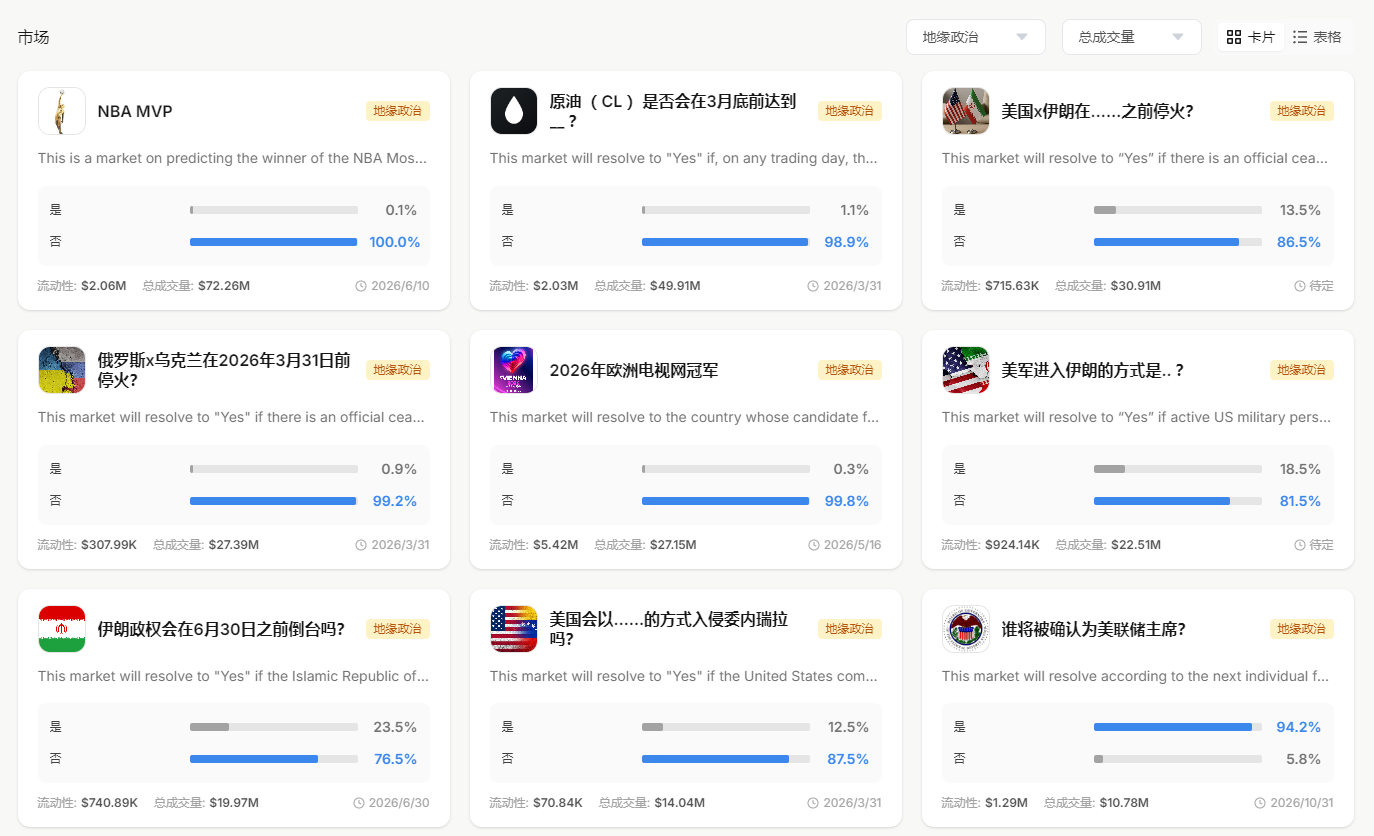
1. The Market is Completely Losing Hope for “Quick Resolution”
● When the situation in Iran erupted on February 28, traders on Polymarket held optimistic expectations—at that time, the market believed there was a 78% probability that the conflict would end in March. A month later, this number has plummeted to 4%.
● The latest research report from China International Capital Corporation cites Polymarket data, indicating that the market currently expects the highest probability for the conflict to end between April 1 and May 15, reaching 44%. This means that geopolitical tensions have not only failed to ease but are transforming from short-term emotional shocks into more prolonged systemic risks.
● Eric Freedman, Chief Investment Officer at Northern Trust, pointed out in a report on March 13 that the signals being conveyed by the prediction market are very consistent: “The conflict will last for more than just a few days or weeks.” This refined expectation is directly reflected in asset prices: gold dropped 15%, U.S. Treasury yields surged to 4.4%, and the volatility of U.S. stocks, A-shares, and Hong Kong stocks reached new highs since April 2025.
2. Oil Price Game: 100 US Dollars is the “Waterloo”
● The direction of oil prices has become the most intense battleground in the prediction market. China International Capital Corporation's analysis suggests that a price of 100 US dollars for oil is a critical watershed—if oil prices remain above 100 US dollars and continue into the third and fourth quarters, the overall CPI in the U.S. will remain above 3.5%, meaning the Federal Reserve will be unable to cut interest rates this year.
● However, there is a significant divergence in market pricing regarding the path of oil prices. The scenario translated from the bond market through interest rate expectations is as follows: the conflict will last until the third and fourth quarters, and oil prices will remain above 100 US dollars—this is regarded by China International as “the most pessimistic expectation.” In contrast, the equity market has not taken such extreme scenarios into account.
● A survey conducted by Bank of America Merrill Lynch among global investment managers reveals that the market's average expectation for oil prices at the end of the year is around 76 US dollars, with only 11% of investors expecting it to exceed 90 US dollars. This gap in expectations implies both risk and opportunity.
3. Trump's Statements Become a New Bet: De-escalation or Escalation?
● On March 21, Trump posted on Truth Social suggesting the “gradual end” of military actions in the Middle East. This statement triggered a strong market response: U.S. stock ETFs surged, and Brent oil prices fell from 112 US dollars to around 108 US dollars.
● However, contradictory signals quickly followed. Just hours after Trump's post, the Pentagon confirmed that the U.S. was sending thousands more Marines to the Middle East. The Israeli Defense Minister then emphasized that U.S.-Israel joint military actions would be “significantly strengthened.”
● Even more confusing, shortly after the “gradual de-escalation” remarks, Trump issued a “48-hour ultimatum,” demanding Iran to fully open the Strait of Hormuz, or else its power plants would be bombed. These contradictory statements have put the market in a dilemma.
● Richard N. Haass, a former member of the U.S. National Security Council, commented on this: “Trump's contradictory statements may reflect his new doctrine towards the Middle East—while the U.S. destroys stability, others must bear the consequences.”
● Traders on Polymarket clearly did not take Trump's de-escalation remarks at face value. Data shows that the market expects only about a 30% chance that shipping will return to normal in the Strait of Hormuz by the end of April, and this probability has been declining in recent trading days.
4. Analysts Warn: "Don't Take Trump's Words Too Seriously"
In response to the market volatility triggered by Trump's statements, several institutions have issued warnings.
● Caixin Media cites analysts' views, pointing out that although Trump publicly expresses a tendency to ease tensions, U.S. military power in the Middle East is increasing, meaning that the conflict is unlikely to really end in the short term. The term “gradual de-escalation” is more interpreted by military experts as a shift from full-scale escalation to limited intervention, maintaining operations primarily focused on airstrikes while lowering the likelihood of a ground invasion.
● From this perspective, Trump's de-escalation remarks do not guarantee a drop in oil prices. In the event of prolonged conflict, normal flow through the Strait of Hormuz is unlikely to resume. Analysts are quite cautious, advising investors “not to take it too seriously,” given Trump's frequent shifts in attitude over the past three weeks.
5. Polymarket vs. Kalshi: The Dual Structure of Prediction Markets
As geopolitical risks heat up, the value of prediction market platforms is becoming increasingly evident. Currently, the two most representative platforms in the United States are Polymarket and Kalshi, both operating under CFTC regulation, but with significant structural differences.
● Polymarket is a blockchain-based prediction market operating on the Polygon network, trading using the USDC stablecoin. Its advantages lie in transparent, fast, and extremely low-cost transactions, performing strongly in emerging markets such as global politics, cryptocurrencies, and geopolitical events.
● Kalshi is a fully regulated exchange approved by the CFTC that allows direct trading with fiat currency, leading in areas such as macroeconomic decisions (federal interest rate decisions, inflation data) and depth in the U.S. domestic market.
Both platforms are accelerating the mainstreaming process of prediction markets. Latest data shows that Polymarket has between 250,000 to 500,000 monthly active traders, with monthly website traffic exceeding 17 million, and transaction volumes expected to reach 18 billion US dollars by 2025.
6. Industry Trend: Nasdaq Has Also Entered the Game
The appeal of prediction markets is extending from the cryptocurrency circle to traditional finance. On March 2, 2026, Nasdaq officially submitted an application to the SEC, planning to launch binary options products linked to the Nasdaq-100 Index. These products, called “event-related options,” are priced between 0.01 and 1 US dollar, allowing investors to bet on whether specific events will occur.
This means that one of Wall Street's largest players is officially entering the field of prediction markets. Although Kalshi and Polymarket have previously offered similar products under CFTC regulation, Nasdaq's entry marks a recognition of prediction markets within the mainstream financial system. If the application is approved, it will be Nasdaq's first foray into prediction markets.
7. Market Outlook: Focus on Three Major Variables
In light of the ongoing developments in the Middle East, Northern Trust advises investors to focus on three major variables:
1. The Fed's Policy Signals
The March Federal Reserve meeting will issue a summary of economic projections. While the market does not expect rate adjustments at this meeting, how the Fed “generally describes the conflict and its expected duration” will provide important market signals.
2. The Passage Status of the Strait of Hormuz
Since March 9, the daily passage of tankers through the Strait has consistently remained at a low level of 1 to 2 ships. When normal passage resumes will be the most direct indicator of eased geopolitical risks.
3. The Consistency of Trump's Statements
From “gradual de-escalation” to “48-hour ultimatum,” Trump's fluctuating statements have become a direct driver of market volatility. Traders are pricing each of Trump's speeches on Polymarket—this political prediction topic is gradually becoming a new focus for users.
The conflict in the Middle East continues, and trading activity in prediction markets is still on the rise. While analysts in traditional financial markets are still debating how high oil prices will rise, traders on Polymarket have already priced in every possible future with real money. Regardless of how the conflict ultimately ends, the once-niche field of prediction markets is proving its value amid the geopolitical storm.
Join our community, let’s discuss and grow stronger together!
Official Telegram community: https://t.me/aicoincn
AiCoin Chinese Twitter: https://x.com/AiCoinzh
OKX welfare group: https://aicoin.com/link/chat?cid=l61eM4owQ
Binance welfare group: https://aicoin.com/link/chat?cid=ynr7d1P6Z
免责声明:本文章仅代表作者个人观点,不代表本平台的立场和观点。本文章仅供信息分享,不构成对任何人的任何投资建议。用户与作者之间的任何争议,与本平台无关。如网页中刊载的文章或图片涉及侵权,请提供相关的权利证明和身份证明发送邮件到support@aicoin.com,本平台相关工作人员将会进行核查。


