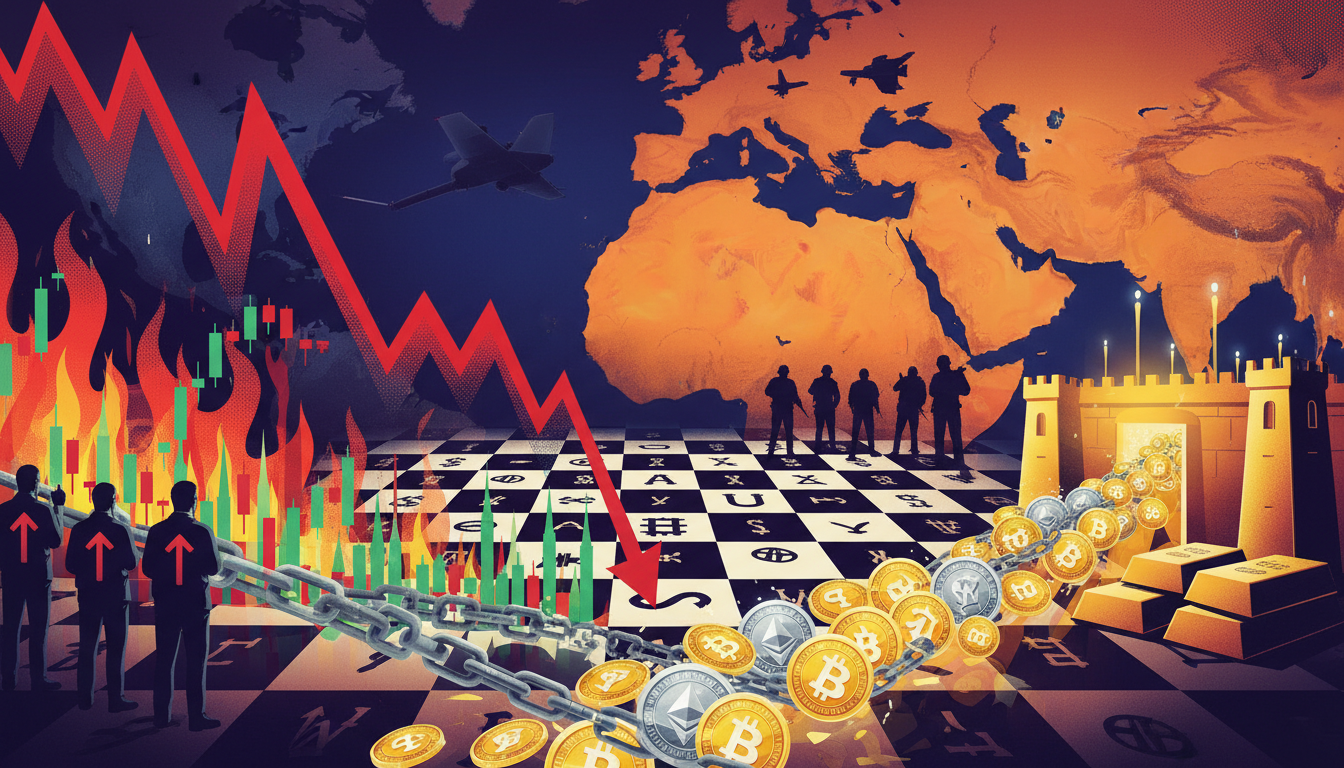
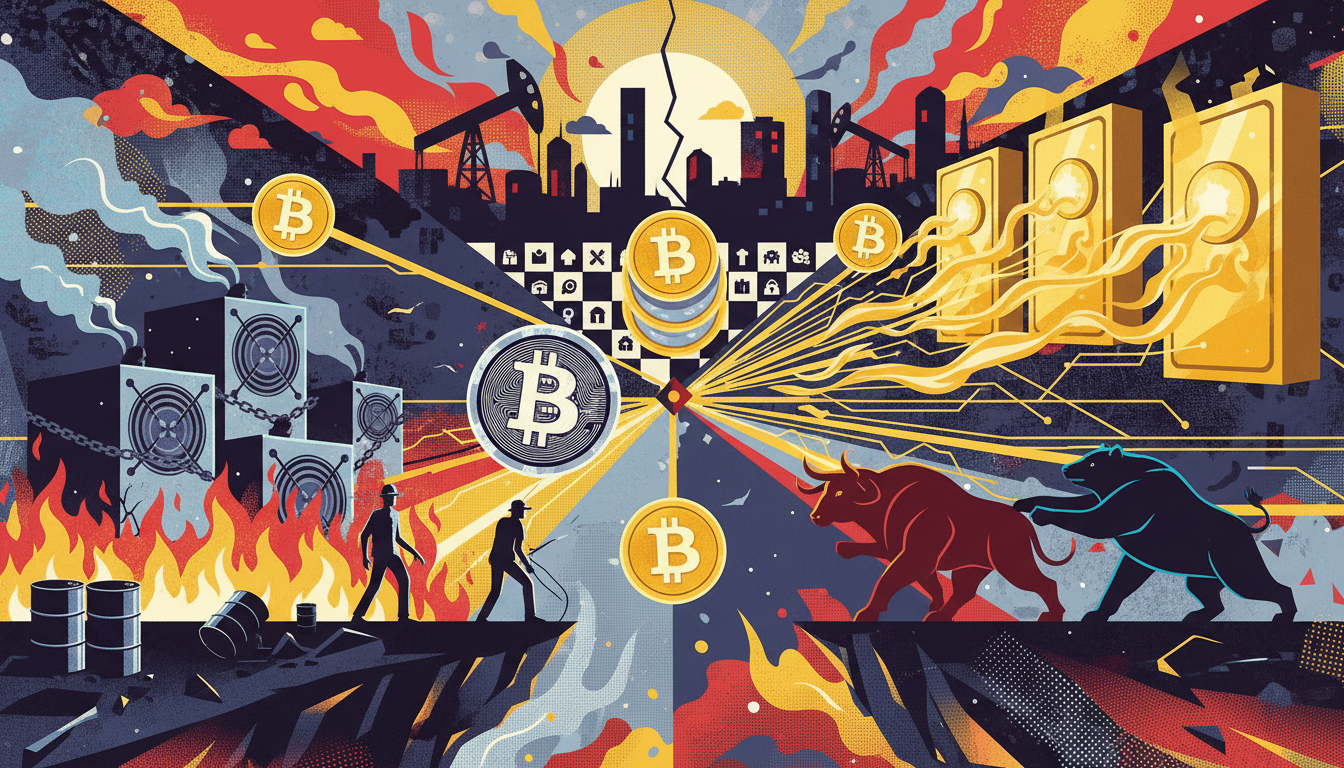
This week in East Eight Time Zone, a sudden flash crash in short-term gold trading broke the traditional safe-haven narrative: the spot gold price quickly fell by over 2% during the session, briefly dropping below the key 4350 USD/ounce level, piercing through both technical and emotional points. While most funds chose to reduce positions, defend, and wait, Sky co-founder Rune Christensen instead increased his bets amid panic—on-chain data showed he opened a new 20x leverage GOLD long position and gradually covered his previously established short positions in the S&P 500 index, shifting his macro risk exposure from stock index hedging to betting on a rebound in gold. The short-term "failure" of safe-haven assets intertwined with aggressive bets on highly leveraged crypto derivatives constitutes the core tension of this event: as gold and on-chain gold tokens weakened simultaneously and global safe-haven volatility rose, a "macro hedge fund's reflection in the crypto market" operation was testing the limits of this misalignment with real money.
Gold falls below 4350 USD: The safe-haven label stripped at the peak of volatility
In terms of timeline, this round of volatility was not a gentle decline, but a typical short-term "flash crash" trend. According to market data, the spot gold price fell over 2% in a single trading day, briefly dipping below the 4350 USD/ounce threshold, triggering a large number of programmatic sell-offs and passive position reductions. For an asset long viewed as "insurance against market panic," such a rate and magnitude of decline during a phase of rising macro uncertainty carries strong signaling implications.
More strikingly, on-chain gold tokens also simultaneously tore off the "stable" covering. Taking the PAXG token, which is pegged to physical gold, as an example, its 24-hour decline exceeded 3%, clearly larger than the intraday fall of spot gold, reflecting the amplification effect of thin on-chain liquidity combined with leveraged funds. Tokens originally seen as "on-chain gold substitutes" failed to provide additional buffering at a critical moment, instead amplifying volatility, causing "gold bulls" in the crypto market to experience a steeper downturn curve.
All of this happened in a macro background that seemed "bullish for gold": the Japanese 10-year government bond yield climbed to about 2.32%, a multi-decade high, while the global safe-haven asset volatility index was also in the historical 90th percentile range, indicating that global funds' anxiety over risk was nearing extremes. According to textbook logic, when panic intensifies, gold should receive more safe-haven buying, but the reality is that gold plummeted, and on-chain gold fell even more sharply—traditional safe-haven assets displayed a "misalignment" at the most critical moment, planting the seeds for subsequent capital reallocation.
20x GOLD leverage long: Seeking reflexivity at the bottom of panic
Rune's key action occurred during this flash crash, rather than after the market stabilized. When the spot gold price broke below 4350 USD and on-chain gold tokens fell over 3% within 24 hours, market sentiment was in a chaotic stage of "no safe haven assets being safe," and liquidity briefly flowed back to the dollar and short-duration high-yield assets. In such an environment, opening a new 20x leverage GOLD long position meant he was betting on "overblown panic" with a very high amplification factor.
High leverage itself amplifies the range: if the price rebounds, even a few percentage points of recovery could translate to tens of percentage points of paper profit under 20x leverage; conversely, if volatility continues to extend downward, a minuscule further pullback could reach the liquidation line, leading to forced position closures. While there is no public data to quantify his specific opening price point, it is clear that this operation is essentially betting on amplified rebound profits using an extremely narrow margin of error.
Importantly, techflow interpreted this series of operations as "a typical operation mapping of macro hedge funds in the crypto market". From this perspective, Rune was not simply making an emotional bottom-fishing decision, but was treating on-chain gold derivatives as a tool within the macro context: as traditional gold was being concentratedly sold off by institutional funds at both cash and futures levels, causing volatility to surge, taking a high-leverage long position on-chain was akin to wagering that the market would experience a technical rebound and capital inflow after extreme panic. In other words, this is not merely directional gambling; it's closer to a hedge-style gamble exploiting the "overpricing of panic" in the market.
Covering S&P shorts: From betting on systemic risk to embracing localized rebounds
Alongside increasing his GOLD long position, Rune gradually began to cover his S&P 500 index short positions. His prior short positions on stock indices were closer to traditional macro hedging logic: in a backdrop of economic cycle uncertainty, pressured profit expectations, and high interest rates lingering, shorting U.S. stock indices could hedge risks of asset declines. However, at the moment of gold's flash crash and the misalignment of safe-haven assets, he chose to simultaneously increase his gold long position while slowly exiting his stock index shorts, a stark directional contrast.
From a rhythm perspective, this was not a one-button liquidation, but rather a gradual reduction of S&P shorts. This methodical exit suggests he had not entirely abandoned his concerns about systemic risk but believed that the previous pessimistic pricing on U.S. stocks had already reflected a significant portion of the risk, thus decreasing the cost-performance ratio of maintaining heavy shorts. Meanwhile, reallocating the risk budget to gold longs essentially shifted the bet from "betting on the decline of overall risk assets" to "betting on a rebounding correction of a deeply oversold asset."
When viewed in the context of the macro misalignment, the clarity is heightened: on one hand, as Japanese government bond yields increased and global safe-haven volatility maxed out, it means the old logic of the bond-stock-gold traditional asset chain is being re-evaluated; on the other hand, in this re-evaluation process, the roles of who will absorb the panic among stocks, bonds, and gold have become ambiguous. Rune's withdrawal from stock index shorts and turning to high-leverage gold longs appears more like a proactive re-positioning of this misaligned structure—no longer betting on systemic declines of the entire risk asset system but rather looking to find reflexive opportunities in the "localized failures" of safe-haven assets.
Slow entry through TWAP: Whales don't bet on points, only ranges
Aside from direction and leverage multiples, the more noteworthy aspect is the trading method. On-chain data indicates that Rune employed a TWAP (Time Weighted Average Price) order to split buying and selling, adjusting his exposure rather than doing a one-time "all-in." This means he distributed transactions at a relatively uniform pace over a pre-defined time window, minimizing the impact of single orders on price, and in a way diminished the importance of "buying at a specific point," redirecting focus to "completing positioning or reducing exposure within a general range."
As analysis by panews suggests, TWAP strategies often reflect a cautious attitude of professional capital towards short-term volatility. In moments of heightened volatility and weak market depth, if whales were to sweep in directly with large orders, it could both expose their intentions on-chain and increase their average holding costs due to high impact costs. By using TWAP for "steady entry and exit", they can gradually enlarge or compress their risk exposure while remaining concealed within market noise, shifting the pressure of precise point judgments to managing time and ranges.
In the current environment of the crypto market, such programmatic entry and exit has become even more necessary. On one hand, the disconnect between leverage in the crypto derivatives market and spot prices is intensifying, with numerous high-leverage contracts magnifying severe price fluctuations in thin-depth environments; on the other, the frequent pull between price differences and basis between spot and derivatives makes "manual timing" exceptionally challenging. For larger participants on-chain, compared to betting on a single precise moment, using TWAP to gradually build positions within a volatile range aligns more with the professional logic of "surviving uncertainty" rather than "winning glory in a single bet."
Misalignment of safe-haven assets: A multi-layer disconnection from Japanese government bonds to on-chain gold
To understand the profound meaning behind this counter-trend speculative bet, one must zoom out to the misaligned picture of global assets. Firstly, from the interest rate perspective: the yield on Japanese 10-year government bonds has risen to about 2.32%, a multi-decade high, which is a notable squeeze effect on global capital allocation. When a market long regarded as a "zero-interest safe haven" suddenly offers a more attractive risk-free return, part of the traditionally defined safe-haven demand may shift from non-yielding assets like gold to sovereign debt that can provide stable cash flows.
Secondly, regarding volatility: the global safe-haven asset-related volatility indices are currently at historical 90th percentile high ranges, indicating that market pricing for extreme scenarios is nearing historical extremes. In this environment, some funds are opting for "cash is king" or increasing their holdings in high-rated short-duration bonds, rather than continuing to crowd around a single safe-haven asset like gold. Therefore, during the macro funds' re-ordering and re-shaping of the "safe haven basket", the short-term pressure on gold no longer seems completely abnormal.
The third layer is the misaligned reflection of the on-chain world: one end is the rebalancing of traditional gold and government bonds, while the other end is the self-circulation of on-chain gold tokens like PAXG and crypto derivatives. Tokens pegged to gold were meant to move gold exposure on-chain, yet due to the dual amplification of leverage and liquidity, their price fluctuations may exceed those of the underlying asset; the crypto derivatives market is already filled with high leverage, and once assets like gold became the subject of contracts, the prices of traditional safe-haven assets were dragged into more frequent and intense volatility cycles. What ultimately presents itself is a multi-layer misaligned link chain of "bond yields rising—gold being squeezed out—on-chain gold and GOLD contracts amplified fluctuations."
In this chain, Rune's operation is more like an "experimental bet" on the misaligned structure: as upstream macro funds drive concentrated sell-offs of gold and downstream on-chain derivatives amplify panic, he chooses to stand on the link with the most amplified volatility, betting with 20x leverage that the system will self-correct, and that gold's severe decline within this chain will lead to a reflexive recovery.
Signals from whale bets: The rhythm and direction of the next storm
Bringing all of this together, one can see that Rune completed a clear shift in mindset and structure in this event: from previously hedging systemic risk through S&P 500 index shorts, to covering stock index shorts during the gold flash crash and contrary to that making a long bet on gold, his focus has shifted from "pure hedging" to "the rebound game amidst high volatility." This change does not mean risk has disappeared; on the contrary, it acknowledges the continued existence of systemic risk while placing bets on the market's short-term "overpricing."
For a broader range of market participants, the behavior of on-chain whales during periods of severe fluctuations in safe-haven assets itself serves as an important emotional and directional indicator: on one hand, it transmits clues about "who was wrongly sold, who was overvalued" to the market through the flow of funds and position structure; on the other hand, the combination of TWAP and high leverage employed by whales also reminds retail investors—that in a stage where crypto leverage and spot are severely disconnected and traditional safe-haven assets are no longer stable, making decisions solely based on single-point market conditions or sentiments carries far greater risks than imagined.
Looking ahead to the upcoming rhythm, under the premise of sustained macro high volatility and the disconnect in crypto leverage, funds are more likely to switch back and forth among several tracks:
● Some will flow into high-yield, relatively safe traditional bonds and cash-like assets, continuing to reinforce the "interest rate is king" center;
● Some will engage in relative value games among gold, government bonds, and stock indices, using futures, options, and on-chain derivatives to amplify minor price differences;
● Additionally, some will use tokens and contracts like PAXG and GOLD to bring macro hedging logic on-chain, participating in the reshaping of this "new safe-haven order" with higher leverage and faster frequency.
For ordinary participants, what truly requires vigilance may not be the counter-trend speculative bets represented by Rune but being swept up by the short-term profit illusions of such operations, blindly following without understanding macro misalignments or lacking risk control tools. Macro and crypto are entangled in unprecedented ways, while whales are employing fund-level risk control and execution tools, and if retail investors merely hold transaction snapshots to mimic them, they will only drift further away from the true boundary of victory and defeat in this game.
Join our community to discuss together and become stronger!
Official Telegram community: https://t.me/aicoincn
AiCoin Chinese Twitter: https://x.com/AiCoinzh
OKX welfare group: https://aicoin.com/link/chat?cid=l61eM4owQ
Binance welfare group: https://aicoin.com/link/chat?cid=ynr7d1P6Z
免责声明:本文章仅代表作者个人观点,不代表本平台的立场和观点。本文章仅供信息分享,不构成对任何人的任何投资建议。用户与作者之间的任何争议,与本平台无关。如网页中刊载的文章或图片涉及侵权,请提供相关的权利证明和身份证明发送邮件到support@aicoin.com,本平台相关工作人员将会进行核查。