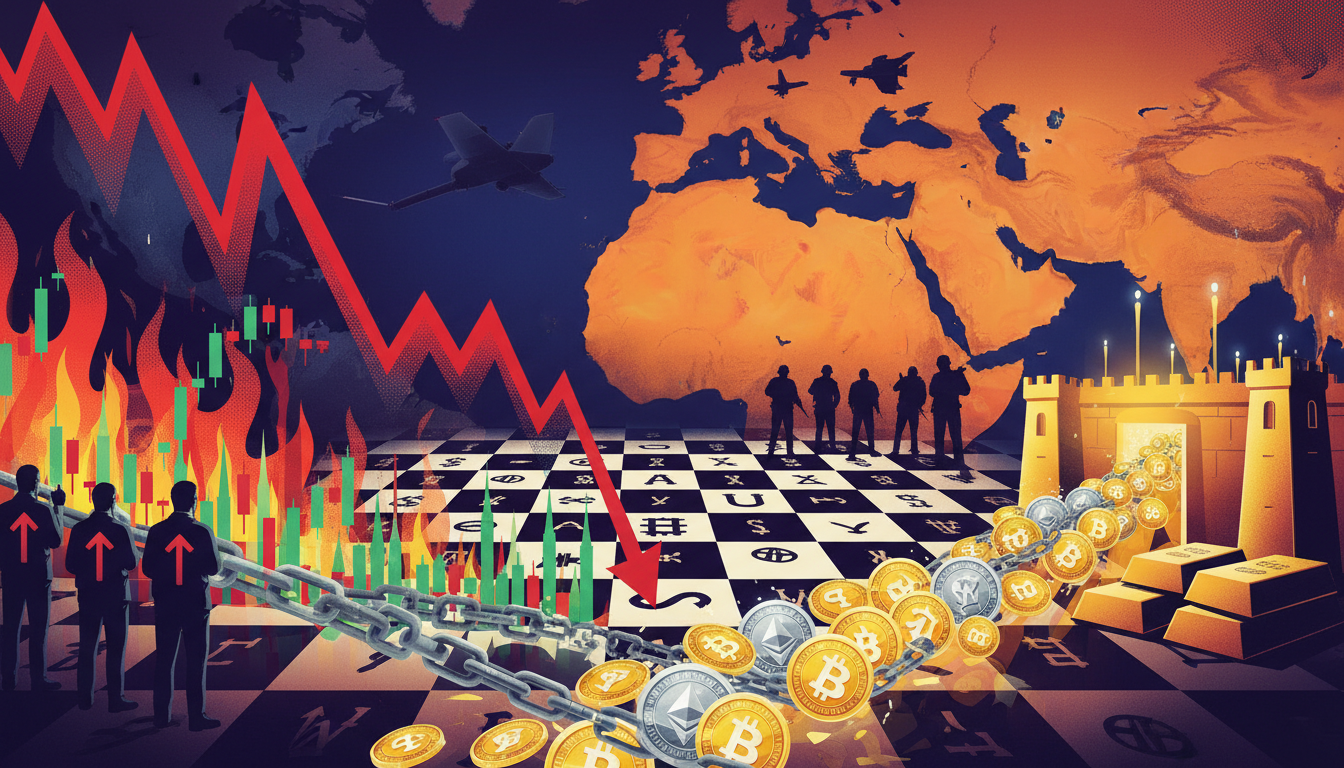
On March 23, 2026, at 8:00 AM Beijing time, global risk assets faced a severe adjustment almost simultaneously: the South Korean KOSPI index's intra-day decline expanded to 6%, triggering a circuit breaker mechanism, and the KOSPI 200 futures dropped 5% and were forced to suspend trading. Meanwhile, the Nikkei 225 and European stock index futures weakened, creating a clear risk chain. Even more shockingly, traditional safe-haven assets were not spared, with spot gold retreating about 2% that day, falling to $4407.89 per ounce, creating an abnormal scenario of simultaneous declines in "stocks, currencies, and precious metals." In an environment where risk appetite and safe-haven assets fell simultaneously, crypto assets are neither completely independent "parallel markets" nor easily categorized as a single risk asset; they are passively exposed to global liquidity fluctuations but have also become a significant part of risk redistribution due to their level of utilization and leverage. The real question is: in this round of intense volatility, is the crypto market under pressure, absorbing, or amplifying global risk?
Korean Stocks Plunge 6% and Circuit Breaker Activated: Safe-Haven Funds Have Nowhere to Anchor
On March 23, the South Korean KOSPI index fell continuously during the morning session, with the intra-day decline rapidly expanding to 6.00%, triggering a market circuit breaker, and trading sentiment shifted from panic to nearly "technical paralysis." The linked KOSPI 200 futures also suffered a heavy hit, dropping 5% and hitting the circuit breaker, forcing long positions and hedging strategies to be interrupted, and liquidity quickly migrated to higher-tier markets and off-exchange tools. This "multi-level risk shutdown" triggered by a single market caused investors to lose traditional hedging and reallocation channels in a very short time.
Typically, spot gold would act as a safe-haven anchor during sharp stock index declines, but the day's market provided a reverse example: according to market data, the price of spot gold fell about 2.00% to $4407.89 per ounce, not acting as a "safe harbor" for capital accumulation, but instead retreating alongside risk assets. Historically, a stock market crash combined with weak gold prices often signifies that risks in a single region or sector have escalated into broader liquidity events, where investors are no longer switching between assets but are compressing exposures and reducing leverage overall.
When stock indices and gold decline together, the traditional narrative of the "risk switch" shows cracks: the sell-off on the risk asset side did not receive support from the safe-haven side and manifested more as passive liquidation and margin pressure. In an atmosphere where funds have nowhere to go, assets that should absorb risk or hedge volatility—whether gold or other traditional derivatives—failed under tight liquidity conditions, putting crypto assets in a delicate position: on one hand, they might passively become a new outlet for risk; on the other hand, given that tools and liquidity are still available, some funds may attempt to rebalance through the crypto market.
Regulatory Shift: Dual Signals from the Central Bank and SEC
Just a day before the market volatility, the South Korean president nominated Shin Hung-song, with a background from the BIS (Bank for International Settlements), as the governor of the South Korean central bank. This candidate had previously expressed public doubts about the sustainability and risk management of so-called "stablecoins," leaning towards a cautious, even negative stance. If this attitude extends into policy tools during his term, it would mean stricter liquidity support for related crypto assets, accompanying services in the banking system, and even the integration into payment systems, thus affecting the depth of domestic crypto trading and the efficiency of fund circulation related to the Korean won.
For the South Korean crypto market, which highly depends on domestic deposit channels and compliant payment interfaces, a stricter prudent framework for "stablecoins" may raise the friction costs of fiat currency inflow and outflow and prompt some funds to seek more complex detour paths between on-chain and off-chain. The result is not a simple "crackdown on crypto," but rather a rebalancing of the domestic crypto ecosystem in terms of funding sources, transaction structures, and risk exposure distributions: highly compliant institutions are more inclined to compress exposures, while flexible funds turn to utilize cross-border and cross-chain tools for reallocation, and this structural differentiation itself will amplify price volatility.
Across the ocean, U.S. regulators responded to the volatility in another way. The U.S. SEC recently opted to waive the 30-day waiting period for changes to some crypto derivatives rules, accelerating the landing of relevant systems, reflecting a realistic judgment of the rising market scale and systemic risks: as crypto derivatives become highly coupled with traditional market risks, prolonged regulatory lags may actually exacerbate uncertainty. At the same time, Fidelity Investments explicitly stated in a letter to the SEC its support for the inclusion of "new crypto assets" within existing regulatory frameworks, indicating that mainstream institutions prefer to expand crypto products within traditional regulatory boundaries rather than constructing a separate "gray area" for them.
The overlay of these two signals presents a complex picture of "regulatory tightening but institutionalization": on one hand, scrutiny over crypto and related assets has become more stringent, especially for categories that can strongly substitute currency functions and payment scenarios; on the other hand, in terms of securitization, fund formation, and derivatives, crypto assets are being rapidly integrated into existing rules, becoming standardized components within the traditional financial system. For the market, this both compresses the gameplay space for some "high-freedom" strategies and opens up new channels for crypto assets to be widely used as compliant tools by institutions.
Wall Street Relaxes Crypto ETF Restrictions: A New Hub for Risk Transfer
On the tool front, the New York Stock Exchange (NYSE) recently announced the cancellation of position limits on 11 crypto ETF options, coinciding with increased volatility of global risk assets, drawing significant market attention. The so-called cancellation of position limits essentially relaxes the exposure constraints on such option contracts for a single participant, granting market makers and institutional investors greater positional flexibility in hedging, arbitrage, and strategy development, which also means these ETF options are expected to further enhance depth and activity.
For market makers, loosening position limits can improve the efficiency of continuous quoting and cross-asset hedging while reducing the risk of "passive naked running" in extreme markets; for large institutions, higher limits on unilateral positions are beneficial for structured product design and building complex hedging combinations. However, this "leverage wrench" also has an amplifier effect: in an environment where risk appetite contracts sharply, directional crowding in massive options positions can easily amplify short-term volatility in the underlying crypto ETFs and even the spot market through chain adjustments in dimensions like Gamma and Vega.
Compared to traditional stock index options, crypto ETF options started later, and the volatility of the underlying assets is already higher. Regulators initially used position limits to control the systemic impact of single institutions, but now this boundary is selectively loosened, marking that crypto ETFs have progressed from experimental items to routinely usable components in the Wall Street "toolbox." They are no longer just "alternative assets" ornaments but standardized channels capable of fulfilling real risk transfer demands.
Therefore, when the South Korean stock market triggers a circuit breaker and gold declines simultaneously, while traditional safe-haven tools narrow their risk absorption capacity, crypto derivatives—especially ETF options—will naturally be viewed by some global investors as a new outlet for risk transfer. Funds may not simply stem from a pure bet on the long-term value of crypto but may use it as a part of cross-market and cross-asset hedging combinations, utilized to hedge or speculate on macro fluctuations when other channels are constrained.
On-chain 20x Leverage Games: Rune's Scripts and Risks
In the on-chain world, risk narratives have a more direct and magnified example. According to Onchain Lens monitoring, Sky co-founder Rune made significant adjustments to his 20x leveraged position during this round of volatility, with on-chain trading records showing him flexibly adjusting leverage and actively rebalancing positions at extreme market points. This operational style continues his consistent high-risk preference: boosting capital efficiency with high leverage, pursuing extreme returns when the direction is right, while also compressing the liquidation threshold into a very narrow space.
The role of high leverage in extreme markets can be summarized as "double amplification": on one hand, leveraging smaller principal to gain larger nominal exposure can provide multiples or even tens of times returns when the market aligns with expectations; on the other hand, when volatility deviates from expectations, even a temporary price breach can trigger cascading liquidations and forced closings, compelling positions to be liquidated at the least favorable moments, turning localized volatility into a mini "flash crash" in on-chain funding. The public address movements of high-profile participants like Rune are more easily followed by other speculative funds, amplifying the magnitude and speed of collective actions on-chain.
Regarding on-chain contract design, a viewpoint has recently been frequently cited that warrants caution: "If the design of the prediction market contracts allows a single participant to directly determine the outcome, then the price is essentially 'executing a script'." This statement points to the situation where, if contract mechanisms permit a few players to change the outcome itself through positions or actions, market prices cease to aggregate diverse information and expectations but instead devolve into the outputs of some script. The combination of highly leveraged tools with such manipulable contract structures makes the "market" resemble a script rather than a battleground.
In the current context of high macro volatility, when institutional funds enter on-chain derivatives, they often do not feel content merely to bear directional risks but instead try to lock in more controllable yield paths at the structural and design levels: using high-leverage contracts for hedging or basis trading, transferring risks under predictable liquidation rules and insurance fund mechanisms; deeply participating in prediction markets, perpetual contracts, option pools, and other protocols to capture "structural Alpha" from fees, slippage, and liquidity mining. In this process, the crypto market acts as a cutting-edge experimental field for repackaging and transferring risk, while also exposing how a singular player wielding excessive leverage and influence can quickly distort market prices from the ideal of "fair game."
Ethereum Ecosystem Under Pressure: Triple Pull of Technology, Governance, and Compliance
As the core settlement layer among mainstream public chains, the Ethereum ecosystem bears structural pressures in this round of macro volatility. Over the past few years, focusing on the narrative of scaling, Ethereum has chosen to migrate many transactions and applications to L2 networks, taking on a more central role in settlement and security, which has raised multiple debates over transaction fees, value capture, and security assumptions: are L2's fee distributions sufficient to support the security budget of the mainnet? Will different rollup security models and data availability schemes reverse-transmit risks back to the mainnet? These questions have been re-amplified by the market amidst increasing volatility and declining risk appetite.
At the technical community level, Vitalik Buterin recently publicly criticized certain L2 rollups, expressing concerns over their design direction and security boundaries—though specific technical details have yet to be disclosed in briefs, this fact alone is enough to trigger the market to reassess the L2 expansion models. When the macro environment is already unstable, questions raised by core developers more readily amplify into "route uncertainty," accelerating the flow of funds between different L2s, cross-chain bridges, and applications, thereby raising the migration costs and systemic complexity across the entire ecosystem.
In high-volatility macro settings, the technological and governance uncertainties associated with Ethereum as the primary settlement layer are often directly translated into "risk premiums" by the market: users care more about asset security, contract audits, and governance transparency, while institutions focus more on the predictability of protocol changes and the timeline for regulatory compliance. Any challenges to security assumptions or controversies over governance structures will feedback through metrics like Gas fees, L2 valuations, and on-chain activity levels into prices and capital flows.
At the same time, tightening global regulation and the accelerated entry of institutions pose a difficult choice for the Ethereum ecosystem between compliance and decentralization. On one hand, to carry more regulated funds and traditional financial assets onto the chain, Ethereum and its L2s must make compromises in areas like identity verification, audit tracking, and asset whitelisting; on the other hand, excessively leaning towards compliance might erode the core of its decentralization narrative, weakening its ability to resist point and political pressures. Finding a new balance between protocol layers, client-side implementation, and application layer governance is a deep game that Ethereum must face in the coming period.
After the Risk Resonance: Is Crypto the Endpoint or a Transfer Station?
Returning to the timeline of March 23: the 6% plunge in South Korean KOSPI triggered a circuit breaker, KOSPI 200 futures fell 5% and suspended trading, while gold prices simultaneously retreated to $4407.89 per ounce; almost concurrently, U.S. regulators accelerated changes to crypto derivatives rules, the NYSE relaxed position limits on 11 crypto ETF options, on-chain whales like Rune frequently adjusted their 20x leveraged positions amid high volatility, and the Ethereum ecosystem faced pressures in L2 expansion and security disputes. The stock market, precious metals, traditional derivatives, and crypto tools collectively formed a complete chain from "risk exposure" to "risk repackaging."
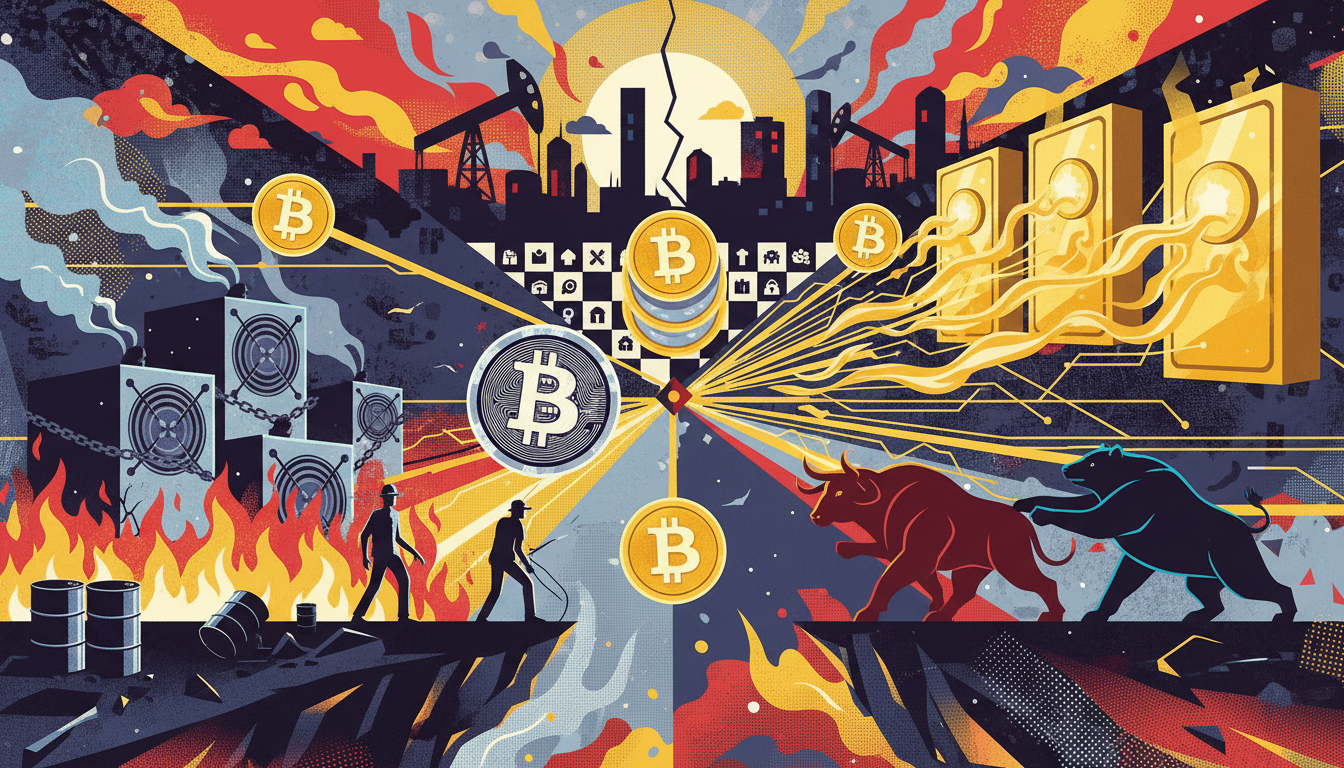
In this chain, crypto assets play a dual role: on one hand, as a liquidity carrier across regions and regulatory boundaries, they can absorb certain risk exposures when traditional channels are constrained, acting as a temporary "buffer layer" for global capital, assisting in the risk and position redistribution between different markets; on the other hand, the high leverage of the crypto market, its flexible tool design, and severe information asymmetry means it also possesses the potential to amplify localized volatility into systemic shocks, especially in the phase where on-chain derivatives and synthetic assets are widely used.
Looking forward to the coming months, several forces will jointly shape the next round of crypto narratives: on the regulatory front, signals from the South Korean central bank and the U.S. SEC indicate that crypto assets will be more deeply integrated into traditional regulatory networks, with a tightening of scrutiny but an acceleration of the institutionalization process; at the institutional level, Wall Street continues to expand its crypto toolbox through ETF options and compliant products, making it resemble a configurable asset class rather than a marginal experiment; at the technical and ecological level, the internal contradictions of Ethereum and other public chains regarding scaling, security, governance, and compliance will determine their relative positions in the next capital cycle.
In this context, investors need to be cautious of overinterpreting extreme market movements on a single day. The plunge and resonance on March 23 provide us with a window to observe how global risks migrate between different markets, but what is truly important is to continually track the mid- to long-term changes in the pace of regulatory implementation, institutional behavior patterns, and governance pathways within public chain ecosystems. Whether crypto is ultimately the endpoint of risk or a transfer station will not be decided by any single trading day but will gradually manifest during the next round of institutional and technological restructuring.
Join our community to discuss and become stronger together!
Official Telegram group: https://t.me/aicoincn
AiCoin Chinese Twitter: https://x.com/AiCoinzh
OKX Welfare Group: https://aicoin.com/link/chat?cid=l61eM4owQ
Binance Welfare Group: https://aicoin.com/link/chat?cid=ynr7d1P6Z
免责声明:本文章仅代表作者个人观点,不代表本平台的立场和观点。本文章仅供信息分享,不构成对任何人的任何投资建议。用户与作者之间的任何争议,与本平台无关。如网页中刊载的文章或图片涉及侵权,请提供相关的权利证明和身份证明发送邮件到support@aicoin.com,本平台相关工作人员将会进行核查。