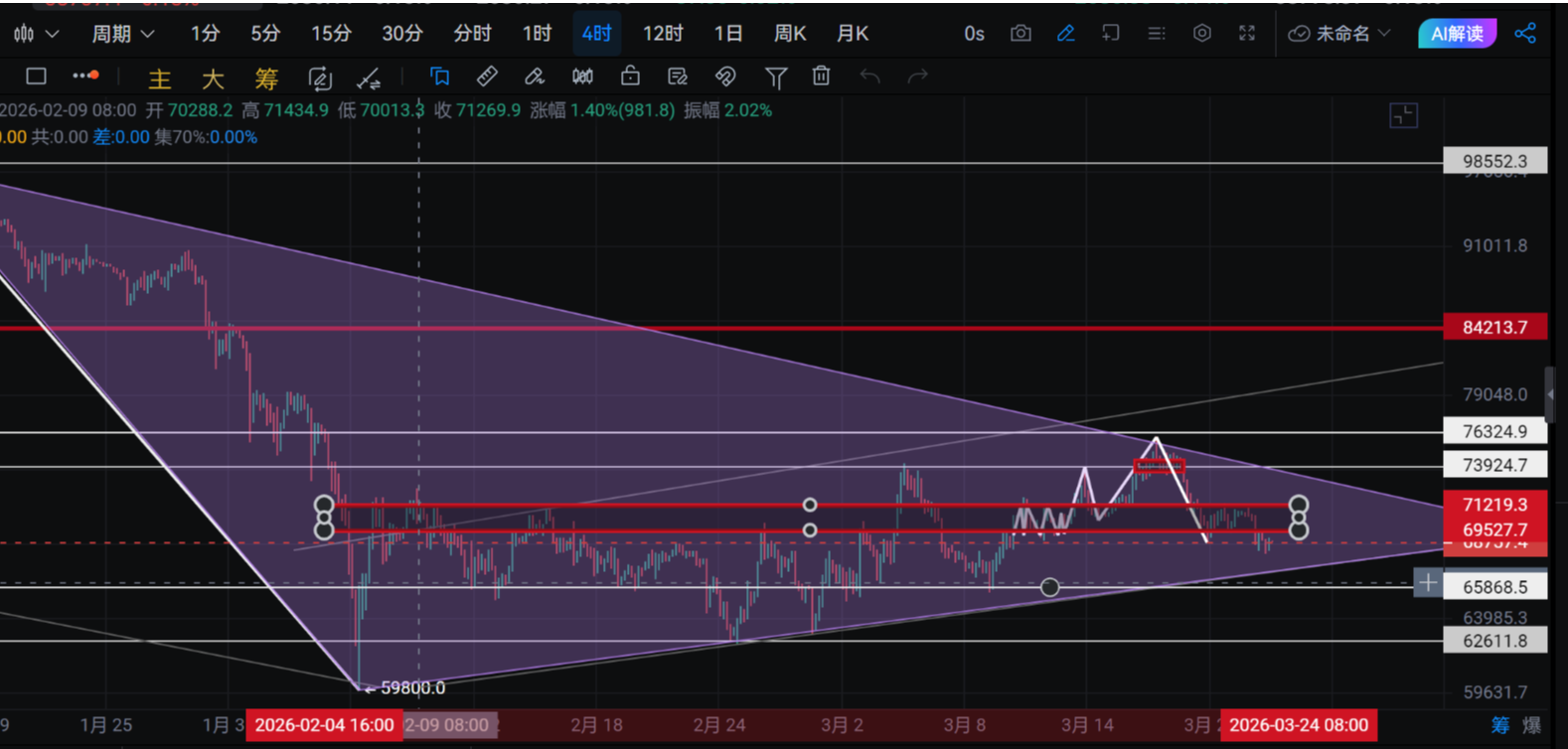
This week in East Eight Time Zone, U.S. Treasury Secretary Basent publicly defended the U.S. and Israel’s attacks on Iranian infrastructure and supported Trump’s “48-hour ultimatum to open the Strait of Hormuz”. As a result, the Strait of Hormuz, a global energy choke point, has once again been pushed to the forefront. On one side, Iran has thrown out high-intensity countermeasures threatening to “completely close the Strait of Hormuz and target regional energy and American corporate assets”, while on the other side, U.S. decision-makers have clearly placed Iran’s oil hub, Halk Island, and other critical energy points on the negotiation table, making the image of escalating geopolitical conflict increasingly clear. In this context, where risks related to crude oil and inflation are rapidly amplifying, the market is re-betting: during a period of pressure on fiat currency purchasing power, will cryptocurrencies like Bitcoin once again play a role as safe-haven and hedge assets? A more critical question is whether this round of tensions surrounding Hormuz will rewrite the narrative structure of the crypto market and become the real trigger for the next market trend.
U.S. Draws a Sword at Hormuz: Basent's Logic of Escalation
Basent's statement is not merely a “casual commentary” by a financial official on foreign issues, but a systematic defense for U.S. and Israeli attacks on Iranian infrastructure from the perspective of the U.S. economy and voters' interests. He openly supported Trump's “48-hour ultimatum to open the Strait of Hormuz”, characterizing this step as a necessary measure to protect global shipping and energy security. In his words, it’s to make Iran understand that if it does not cooperate, subsequent military and economic measures will not be geographically restricted, effectively seeking prior legitimacy for actions that could be expanded thereafter.
The more impactful point is Basent’s use of the word “escalate.” He flatly stated that “sometimes you have to escalate to de-escalate the situation” and claimed this is the “only language the Iranians understand”. These two statements amount to a public acknowledgment that the U.S. strategy has shifted from traditional deterrence and containment to a willingness to shape a new balance through substantive intensity escalation. In geopolitical discourse, this attitude often corresponds to a higher probability of misjudgment and loss of control, also indicating that every verbal signal surrounding Hormuz will be treated by the market as a “prologue” for potential actions.
When Basent specifically names Iran's oil hub, Halk Island, and emphasizes that “all options are on the table”, the signal becomes even more direct: energy infrastructure itself is being incorporated into the game piece, not just a mere symbolic threat of sanctions. As a critical node for Iran's oil exports, if Halk Island becomes the focus of military and economic pressure, what’s at stake is not only Iran’s finances but also the global oil transport network and the re-evaluation expectations of maritime insurance pricing. This posture of “entering energy key points” is interpreted by the market as a proactive test of the bottom line for supply chain security.
In the narrative directed toward domestic voters, Basent presented a more precise cost-benefit framework: “It is expected that the American people will have to endure 30 to 100 days of rising prices in exchange for 50 years of peace”. Even though this time frame and “50 years of peace” highly rely on a single source, it conveys a clear political signal – short-term inflation and rising living costs are packaged as “necessary pains to endure”, while the payoff is a cross-generational security dividend. This narrative is reshaping American voters’ logic of weighing short-term pain against long-term security, directly linking the issues of inflation and oil prices with the toughness of U.S. policy toward Iran.
Iran's Revenge List Revealed: From Blockades to “Striking the Heart of Energy”
Corresponding to the U.S. “planned escalation” is Iran's Islamic Revolutionary Guard Corps releasing a high-intensity countermeasure list: completely closing the Strait of Hormuz, striking Israeli energy facilities, destroying American-owned companies in the Middle East, and targeting power plants in nations hosting U.S. troops as potential targets. These four directions encompass multiple layers, from global shipping lanes to regional power networks, from national infrastructure to multinational capital arrangements; the threats are not solely military confrontations but challenges to the security of the whole global supply chain.
The reason the Strait of Hormuz is repeatedly referred to as a “throat” is due to its burden in global crude oil and natural gas transport weight. If there is substantial obstruction, not only will tanker routes be forced to change or slow down, but maritime insurance companies will significantly increase premiums in their risk models for that region, which will in turn raise the hidden costs of every barrel of oil and every cubic meter of natural gas before arrival. Simultaneously, military deployments around the Strait will be required to move forward, with fleets and air defense systems becoming denser, further exacerbating the possibility of accidental clashes.
The threat of “striking the heart of energy” escalates traditional Middle Eastern conflicts into a global supply chain crisis expectation test. Once the energy infrastructure of Israel and surrounding Gulf countries is seen as high-risk targets, local generation and refining stages will need increased protective investment, and downstream manufacturing and transport sectors far away in Europe, America, and Asia will also have no choice but to incorporate a higher “Middle Eastern premium” into their cost models. U.S.-owned assets of multinational corporations in the Middle East are named as direct targets, and this “capital structure-directed” option for retaliation means that capital faces a reordering in terms of regional layout and withdrawal sequences.
Even if these countermeasures remain primarily at the verbal level for now, for a financial market highly sensitive to risk pricing, the named threats alone are enough to be quantified as risk premiums. Whether it is the pre-emptive rise in oil prices and natural gas futures or the heightened volatility of gold, certain currencies, and crypto assets, these are all results of this “yet-to-happen extreme scenario” being continuously discounted. In this context, crypto assets and commodities are together pushed to the forefront of a new narrative of hedging.
Oil Prices and Inflation Shadow: The Invisible Battlefield of Monetary Purchasing Power
Starting from expectations that the Strait of Hormuz could be blocked or obstructed, the first layer of impact directly targets rising oil prices. Higher oil prices will not only stay within the energy sector; they will follow the classic path of transportation costs—chemical chains—agricultural products and food prices, translating into input inflation pressures globally. Rising logistics costs make every kilometer of transport more expensive, with chemical and plastic product prices following suit, ultimately transforming into a palpable sense of “everything is more expensive at checkout than last month” for consumers on supermarket shelves and online shopping carts.
Basent’s prediction of “30 to 100 days of rising prices” adds a time window to this pressure. Regardless of whether the actual interval lands closer to 30 days or 100 days, for consumers in the U.S. and globally, it means a short cycle clearly perceived in daily life: wages have yet to be adjusted, but the prices of fuel, food, and household goods are slowly rising week after week or even month after month. Compared to abstract inflation data, this experience of “real purchasing power shrinkage” is more easily converted into emotional feedback on policies through social media and ballots.
Traditionally, gold and commodities are viewed as hedging tools during inflation cycles, and their historical performance has been verified during phases of multiple geopolitical tensions and monetary easing. Digital currencies like Bitcoin have also shown instances of fluctuating alongside gold or even leading to temporary surges during similar phases of geopolitical shocks and rising inflation expectations. Although the effectiveness of this “digital gold” narrative varies across different cycles, every time macro uncertainty dramatically increases, the market's interest in this analogy is rekindled.
On one side is Basent's assertion that “without security, there can be no prosperity”, emphasizing the policy priority of “prosperity can only come with security”; on the other side is the market's instinctive search for a “value anchor amid currency devaluation” as purchasing power is diluted. The tension between these two logics provides new storytelling soil for crypto assets: the more security issues overshadow economic ones, the more likely it is to see a reality of “buying security with prices”; and the more price volatility erodes savings, the more individuals will seek digital asset allocation spaces that can carry long-term beliefs, beyond traditional assets.
Hedging or Speculation? Crypto Fund Behavior Under Geopolitical Conflict
In multiple recent geopolitical events, the market has frequently observed a pattern of short-term capital flowing into Bitcoin and mainstream coins: when news first breaks, prices often rise rapidly with amplified trading volumes, only to show a clear pullback within days or even hours. Behind this pattern, hedging and short-term speculation often coexist—some capital indeed tries to hedge the uncertainty of fiat currency and local assets through crypto asset allocation, but a larger share of crowded trading stems from price gap speculation driven by emotions.
In Iran and the broader Middle East region, there has been a longstanding real demand for on-chain assets due to sanctions and capital controls. As regional tensions escalate and expectations of restricted traditional financial channels intensify, some local and nearby funds attempt to bypass the banking system through on-chain assets like Bitcoin, aiming for cross-border transfers and wealth preservation. This demand is not merely a product of public discourse but will manifest at specific event nodes in indicators such as increased regional trading volumes and rising activity among related on-chain addresses.
Concurrently, the behavioral differences between institutional and retail funds in the face of geopolitical risks will also be amplified. Institutions are more likely to hedge through futures and options, using derivatives to protect against fluctuations in their spot positions and balance sheets, and may not significantly adjust their spot allocations in the short term; while retail investors are more susceptible to sudden news and social media sentiment, pursuing the quick rises and falls brought by “safe-haven trends.” In candlestick and position structures, this manifests as short-cycle surges in volume, frequent entry and exit of leveraged funds, and significant liquidations during extreme market conditions.
At the same time, the risks surrounding Hormuz may also lead to expectations of tighter regulation and compliance. Once cross-border funds circumventing on-chain assets become the focus of policy attention, certain countries may enhance scrutiny on the entry and exit of fiat currency and trading platforms, requiring stricter due diligence and compliance for accounts and tokens involving funds flowing from sensitive regions. While this trend has not been explicitly detailed in briefings, it already poses additional pressure that needs to be evaluated in advance for some tokens and centralized trading platforms: on one side is the new demand brought by “hedging”, while on the other is the rising compliance threshold and service capability test.
Chain Reaction of Energy and Computing Power: Oil and Electricity Cost Repricing
When the risk premium of energy facilities and power plants in the Middle East is continuously raised, its impact will not remain solely in the oil and gas market, but will also indirectly affect the global computing power layout through electricity prices. In high-energy public chain ecosystems, miners and node operators are highly sensitive to electricity prices. Once the cost of power generation in certain areas rises persistently due to energy risks, those mining operations that originally relied on cheap electricity for a cost advantage may face pressures of squeezed profit margins or even forced shutdowns.
If the energy infrastructure of countries hosting U.S. troops mentioned in Iran's threat list encounters disturbances, the stability of local data centers and cloud services will also come under scrutiny. Although no specific facilities or attack plans have been publicly detailed as of now, market concerns regarding “declining reliability of power and networks” are enough to prompt some exchanges, market makers, and infrastructure providers to reassess their data hosting and matching system layouts in certain regions. For high-frequency trading and derivative matching, increases in millisecond-level delays and occasional disconnections can translate into real costs and risks.
On the mining end, the upward correlation between oil prices and electricity prices means that mining returns and machine depreciation cycles will be repriced. As electricity costs rise, miners are forced to balance more frequently between cryptocurrency prices, output, and costs: some operators may choose to sell their inventory early to lock in cash flow before prices rise, while others may opt to relocate to regions with more stable electricity and more favorable policies. These actions not only affect on-chain block issuance rhythms and computing power distribution but also amplify market sentiment discussions about network security and decentralization levels.
Moreover, the risk repricing surrounding energy and logistics will also impact supply chain finance and tokenized assets for bulk trade. On one side, companies may be more inclined to view on-chain settlement and traceable tools as means for risk management and transparency enhancement, resulting in new demand for related tokenized assets and infrastructure; on the other side, in an environment of rising uncertainty and cost pressures, some companies may cut innovation budgets and prioritize resources for “maintenance” rather than “upgrades”. In the contest of these two forces, those who can frame cryptocurrencies and on-chain solutions as “risk tools for cost reduction and efficiency enhancement” will have opportunities to benefit from the current turmoil.
From the Hormuz Gamble to the Crossroads of a New Crypto Cycle
Regardless of where the final conflict leads, the U.S. decision-making class represented by Basent has publicly bet on a highly controversial transaction: accepting a short-term cost of rising prices for 30 to 100 days in exchange for a “peace lasting 50 years.” Meanwhile, the high-intensity retaliation list released by the Iranian Islamic Revolutionary Guard Corps has placed blockades of Hormuz, attacks on energy facilities, and U.S. enterprises clearly on the table. The combination of these two dynamics adds intensity to this already sensitive Strait, pushing it to the center of global politics and market attention.
For crypto assets, the gamble surrounding Hormuz brings not only heightened expectations of oil prices and inflation but also a systemic revaluation of energy infrastructure and global supply chain security. In this environment, on one hand, the narrative of “hedging and protection” is once again reinforced, granting cryptocurrencies like Bitcoin a new round of “value storage” envisioning space; on the other hand, structural changes in energy and computing costs, supply chain finance, and tokenized infrastructure provide the industry with a second narrative thread of “infrastructure revaluation”.
This presents higher strategic demands on crypto investors: under the macro geopolitical timeframe surrounding Hormuz, merely monitoring on-chain data and technical indicators is not sufficient. What truly matters is the ability to distinguish between short-term emotional trading and long-term allocation logic amid information bombardment and sharp fluctuations: the former may complete a rapid rise and fall within days, while the latter requires a longer cycle to consider energies, regulations, and macro liquidity along three main lines.
If the following conflicts gradually ease and the “powder keg” of Hormuz is stabilized, the main line of the crypto market may likely return to technological innovation and regulatory evolution: from scaling and performance to privacy and compliance, then to the pace of institutional fund inflow; while the preceding hedging story might compress into a high-volatility interlude on the price curve. Conversely, if the situation escalates further, and the rights of passage in the Strait of Hormuz and the security of Middle Eastern energy facilities remain threatened, the crypto market may likely undergo a new round of fund and discourse authority restructuring amid heightened volatility—those who can provide real and usable hedging and infrastructure value in the cracks of risk and regulation will have the opportunity to grasp the new leading narrative in the next cycle.
Join our community, let’s discuss and become stronger together!
Official Telegram community: https://t.me/aicoincn
AiCoin Chinese Twitter: https://x.com/AiCoinzh
OKX benefit group: https://aicoin.com/link/chat?cid=l61eM4owQ
Binance benefit group: https://aicoin.com/link/chat?cid=ynr7d1P6Z
免责声明:本文章仅代表作者个人观点,不代表本平台的立场和观点。本文章仅供信息分享,不构成对任何人的任何投资建议。用户与作者之间的任何争议,与本平台无关。如网页中刊载的文章或图片涉及侵权,请提供相关的权利证明和身份证明发送邮件到support@aicoin.com,本平台相关工作人员将会进行核查。