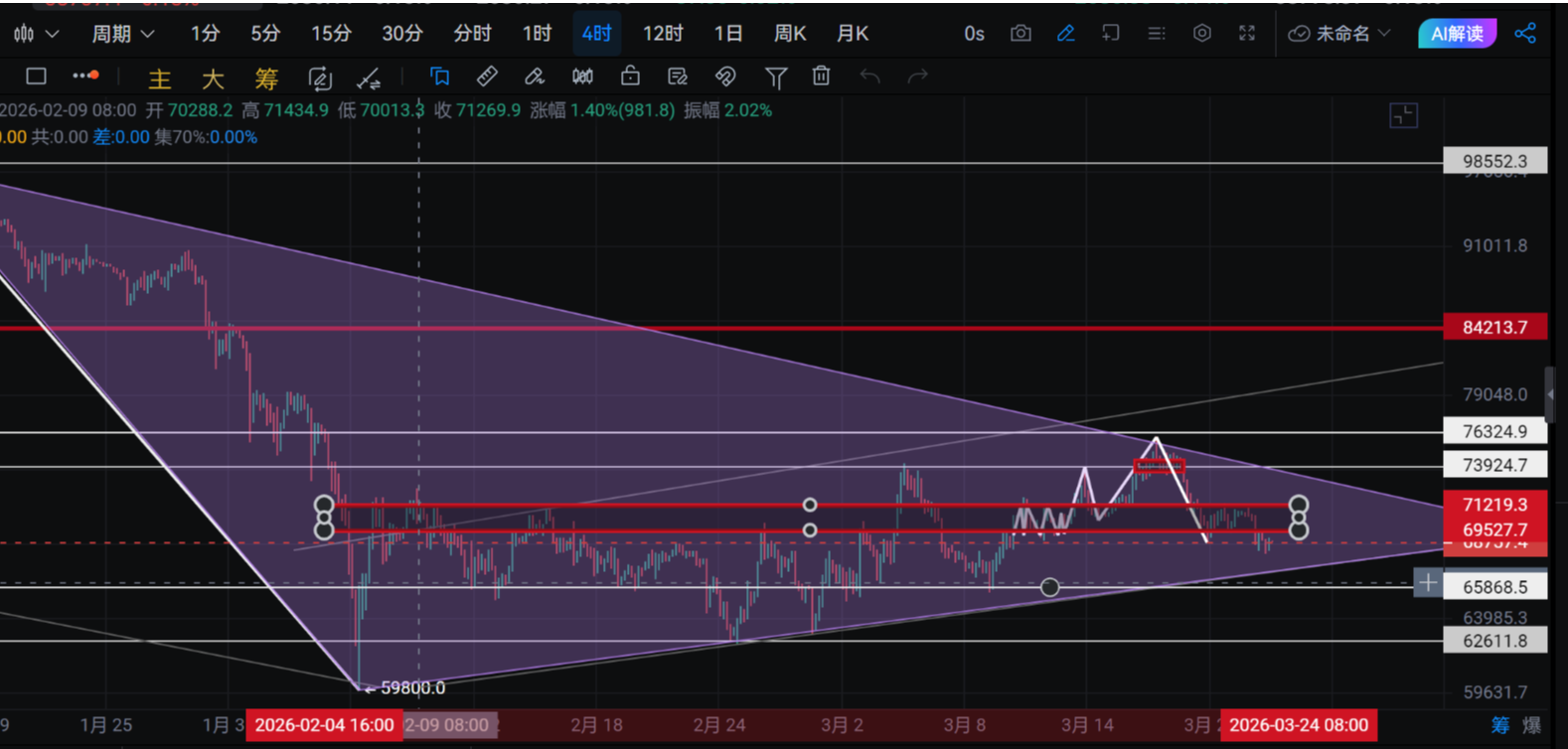
The tension between the United States and Iran has continued to escalate this week in the UTC+8 time zone, with Iran throwing out news of four countermeasures that quickly pushed market sentiment to a high. A single source states that Iran has even expressed a strong statement of "completely closing the Strait of Hormuz," a key passage now involved in the game, becoming a focus of global attention. At the same time, the reality for bitcoin miners is extremely cold—according to a single calculation model, the current mining cost is approximately $88,000 per coin, while the estimated loss on a single BTC at the current price is around $19,000. Under the shadow of war, one side sees a resurgence of safe-haven narratives, while the other side forces miners to "bleed" in operation within a high-cost environment. The pressing question is whether geopolitical conflicts are accelerating the narrative of crypto assets as "digital gold" or amplifying bearish sentiments, accelerating industry clearing, which has become an unavoidable central issue.
Chokepoint in the Hormuz: Energy and...
The Strait of Hormuz connects the Persian Gulf and the Gulf of Oman and is a critical throat for Middle Eastern crude oil and natural gas to the global market, long regarded as a barometer for global energy security. If this corridor faces a substantive blockage, even just an increase in risk expectation would be enough to raise the risk premium for oil and gas transport, triggering uncertainty in energy supply. Due to data limitations in the brief, we cannot provide a quantified supply gap or oil price increase, but directionally, it is almost a market consensus that energy prices are under upward pressure.
The rise in energy prices will directly transmit into the bitcoin mining industry, which is highly reliant on electricity costs. Variations in fuel, natural gas, and coal power costs in miner electricity prices will be reflected through electricity fees, cooling, and operational maintenance, thus squeezing the profit margin per unit of computing power for miners. When electricity prices lack a locking mechanism, miners find it challenging to hedge this external shock through short-term efficiency improvements and can only struggle with difficult choices between reducing production, increasing machine utilization, and selling coins to maintain cash flow.
Geographically, the Middle East and surrounding areas have recently taken on some of the computing power, primarily relying on relatively cheap energy and policy windows. With rising geopolitical risks, this portion of computing power not only faces realistic concerns over potential disruptions to electricity and infrastructure, but is also being reassessed by the market in terms of its "geopolitical security discount." Once conflict expectations persist, it could trigger a proactive relocation of mining operations and a redistribution of computing power to North America, Latin America, Central Asia, and other regions, further altering the global computing power map and the decentralized network landscape.
It is important to emphasize that the statement of "completely closing the Strait of Hormuz" currently only appears in a single source and belongs to a high-conflict scenario hypothesis rather than a concrete fact. The brief also clearly states that there is a lack of publicly available data regarding the specific timetable and action plan for U.S. and Iranian countermeasures; therefore, discussions about the Hormuz scenario should be regarded more as risk simulations rather than established conclusions.
Bitcoin Crosses $88,000 Cost Line...
In the context of this geopolitical game, bitcoin's own cost structure is also under pressure. The research brief cites a single calculation model claiming that the average cost of bitcoin mining is about $88,000 per coin, while miners are facing a loss of approximately $19,000 per coin at current prices. This means that even though the nominal price has approached or even briefly exceeded this "cost line," many miners still find it difficult to cover comprehensive costs such as electricity, maintenance, financing interest, and management expenses under actual cash flow standards.
The price oscillates around the cost line, appearing to be a "miner defense battle" on the surface, but it actually exposes the misalignment between cost models and real operations. On one hand, cost estimates are often based on average computing efficiency and standardized electricity prices, making them unable to reflect the fluctuating electricity prices, old machine depreciation, and individual financing costs in different regions; on the other hand, the expenditures miners need to pay in fiat currency are rigid, while price fluctuations and currency exchange restrictions make cash flow management more passive. The result is that, while appearing close to the breakeven point on the charts, many small-to-medium-sized mining operations are already in a state of deep losses.
With rising energy prices and the reduction of block rewards after halving, miners are forced to face a threefold squeeze: the pressure on coin prices slows down income, elevated electricity and operational expenses inflate the expenditure side, and halving directly compresses the output per unit of computing power. The brief indicates that the state of "serious losses" on the miner side has already become evident, often transforming this pressure into short-term waves of shutdowns, sales in the second-hand mining machine market, and increased selling of coins to maintain cash flows, thus creating additional selling pressure in the spot market.
In such an environment, the market begins to revolve around a key issue: is the forced selling by miners building a price floor, or is it brewing a new round of "miner clearing" trends? One view suggests that the current price range near the cost line will long limit sustainable capacity, creating a support akin to an "intrinsic value zone"; another viewpoint argues that only after genuinely undergoing a large-scale capacity clearing and a reshaping of computing power concentration can new marginal costs and robust miners be established, possibly completely rewriting the old cost line. These two forces alternate in the on-chain computing power data and miner behaviors.
Funds Migrate Under the Shadow of War: Safe Haven Narratives...
Historical experience shows that when geopolitical tensions escalate, traditional markets often undergo a repricing of "safe assets": falling government bond yields, rising gold and certain currencies, and pressured risk assets—a pathway that has been repeatedly validated through past crises. In this round of U.S.-Iran confrontation, the response of the crypto market presents a more complex picture—on one hand, some funds attempt to repackage bitcoin as "digital gold," pushing prices to rebound in a short window after news breaks; on the other hand, derivatives markets and highly leveraged funds have significantly amplified volatility, making its safe-haven attributes contentious.
In the context of sanctions, capital controls, and restricted cross-border settlements, the logic of some market participants viewing bitcoin as a "geopolitically neutral asset" is being reinforced. For entities potentially on the sanctions list, on-chain assets are not completely controlled by any single sovereign jurisdiction, partially alleviating concerns about frozen or liquidated funds; for regions seeking to avoid capital flow restrictions, the cost and efficiency of cross-border BTC transfers, in certain scenarios, are superior to traditional channels. This label of "neutrality" does not imply price stability but rather means that under extreme conditions, value transfer and settlement can still be completed.
Meanwhile, traditional safe-haven trades are quietly adjusting. The research brief mentions that the UK crypto investment firm Abraxas Capital is closing its gold short positions for a profit; this move is not a total rejection of gold but reflects some strategy funds reallocating weights between traditional safe-haven assets like gold and higher volatility assets. The successful profit-taking and closing of gold shorts contrast sharply with the cryptomarket's behavior of leveraging the "war narrative" to amplify volatility: the former is a systematic trading loop based on macro judgments, while the latter often carries a narrative marketing and liquidity gaming flavor.
At the on-chain and derivatives level, short-term funds are more directly utilizing panic sentiment and uncertainty premiums for operations. Surrounding sudden news, trading volumes for futures, options, and high leveraged trades rapidly expand, with some addresses frequently entering and exiting during high-volatility periods, leveraging liquidation and slippage to harvest opponents. These funds do not genuinely view bitcoin as a "long-term hedging asset" but regard geopolitical conflicts as amplifiers for creating volatility and stirring emotions, resulting in prices exhibiting a more severe spike-retracement structure in the short term.
The Dark Horse Soars 26 Times: SIREN...
As the narratives of bitcoin as a safe haven and the losses suffered by miners intertwine, some small-cap tokens have exploited the context of war to stage extreme markets. According to research briefs, the token SIREN surged about 26 times against the backdrop of conflict narratives, but this data comes from a single channel and lacks support from mainstream exchange quotes and depth. This implies that both the degree of increase and the trading volume may heavily rely on collusion among a few platforms and a few addresses, leading to fragile liquidity.
War, sanctions, and security are becoming high-frequency keywords packaged by some project parties and manipulators. By binding concepts like "resisting sanctions," "anonymous safety," and "wartime assets" on social media and trading communities, projects can attract attention and speculative funds in a very short time, raising buying expectations. Subsequently, after trading volumes are artificially created and price curves are straightened, early holders are provided with ample space to exit at high prices, converting narrative dividends into tangible cash outs.
The on-chain address and wallet aggregation data further reveal the structural risks of such markets. The brief points out the apparent clustering and high concentration of SIREN wallets, indicating that project parties or large holders have high control over circulating chips. In this control scenario, the depth of the order book is often extremely limited; once controlling parties change strategies and initiate large-scale selling, ordinary investors find it nearly impossible to escape at reasonable prices and are likely to encounter a cliff-like retracement in a short time.
In contrast, the safe-haven attribute of mainstream assets like bitcoin derives more from their network effects, liquidity depth, and global consensus rather than single narrative hotspots. The 26-fold surge of SIREN is essentially closer to the speculative script of "small-cap coins telling stories + manipulator control + short-term exit," rather than a "truly safe asset" in a war environment. In the amplified discourse of geopolitical conflicts, distinguishing between narratives and fundamentals, safety labels and liquidity quality becomes the first line of defense that participants must possess.
From "Without Security, There is No Prosperity"...
At the macro level, political figures are also using their language to set the tone for this game. The research brief references a quote that purportedly says: U.S. Treasury Secretary Yellen indicated that American citizens could exchange "50 days of temporarily rising prices" for "50 years of peace with Iran free of nuclear weapons"; she also suggested that "without security, there can be no prosperity." Regardless of the details of the original remark, this narrative of substituting short-term economic costs for long-term security is seeking social acceptance for inflation, sanctions, and geopolitical pressure.
At the micro level within the crypto industry, the predicament of miners in the current environment is almost a microcosm of this macro narrative. Currently, many miners are operating at a loss of around $19,000 per coin, essentially betting on a future revaluation of coin prices and network value through their persistent losses. They are using cash flow pressures to ensure that network security is not compromised by significant computing power going offline, carrying a part of the systemic risks on their balance sheets.
Regulations, sanctions, and technical security guidelines are also shaping an industry order of "first security, then prosperity." The brief mentions that China has released the "OpenClaw Safe Usage Practice Guidelines," and although its technical terms and details are not elaborated in the materials, it reflects an enhanced atmosphere of regulatory and safety compliance. This tightening of sanctions lists and compliance requirements in the U.S. together shapes the boundaries of activity space in the crypto industry: first establishing safety and regulatory bottom lines, and then discussing innovation and growth within that framework.
The broader context is that the three lines of geopolitical security, economic security, and on-chain security are increasingly resonating visibly together. From risks on Hormuz's shipping lanes, inflation, and price upsurge expectations, to on-chain hacking attacks and monitoring of cross-border capital flows, these issues have become challenging to separate. For investors, reevaluating the risk-return structure of crypto assets is no longer just about "how volatile it is" but must include war, sanctions, compliance, and technical security in the pricing framework.
The Shadow of War Yet to Disperse: Safe Haven Myths and...
In conclusion, the U.S.-Iran conflict and the risks in the Strait of Hormuz are jointly shaping the crypto market through three main lines of energy, computing power, and sentiment. Uncertainties on the energy side elevate mining costs and operational risks, while the geopolitical redistribution of computing power alters the physical basis of network security, and sentiment magnifies volatility through safe-haven narratives and panic amplifiers in both spot and derivatives markets. This is a chain reaction extending from oil tanker routes to power meters in data centers, and finally reflecting on trading terminals.
In this process, bitcoin is being repackaged by some funds as a safe haven, embracing the imaginations of "digital gold" and "geopolitical neutrality," on the one hand; on the other hand, the stark contrast between the "serious blood losses" faced by miners and the SIREN token's extreme rise illustrates sharply differing risk curves: the former struggles to maintain network operations amid high costs and reduced block rewards, while the latter indulges in high-leverage speculation using the war tag.
It is essential to remain clearheaded that, regarding specific military action timelines and technical details of U.S. and Iranian countermeasures, publicly available information is evidently insufficient; Iran's "four countermeasures" have also only stayed at the level of vague statements. Whether the Strait of Hormuz has genuinely been closed, or whether the conflict escalates into larger military actions, these key variables have yet to be determined. Market pricing is more based on expectations and panic than on reflections of established facts, which also explains why prices have experienced excessive fluctuations in the short term.
In this stage where the shadow of war has not yet lifted, simply equating geopolitical conflicts with "long-term benefits for crypto assets" is clearly a high-risk lazy conclusion. A more rational stance is to view conflicts as catalysts for volatility and repricing, rather than as one-way upward driving forces. For individual and institutional investors, what is currently needed is to control leverage and positions, avoiding chasing high prices and blindly bottom fishing during periods of extreme emotions, patiently waiting for information and prices to realign before reassessing genuine medium-to-long-term opportunities.
Join our community for discussions and to grow stronger together!
Official Telegram community: https://t.me/aicoincn
AiCoin Chinese Twitter: https://x.com/AiCoinzh
OKX Welfare Group: https://aicoin.com/link/chat?cid=l61eM4owQ
Binance Welfare Group: https://aicoin.com/link/chat?cid=ynr7d1P6Z
免责声明:本文章仅代表作者个人观点,不代表本平台的立场和观点。本文章仅供信息分享,不构成对任何人的任何投资建议。用户与作者之间的任何争议,与本平台无关。如网页中刊载的文章或图片涉及侵权,请提供相关的权利证明和身份证明发送邮件到support@aicoin.com,本平台相关工作人员将会进行核查。