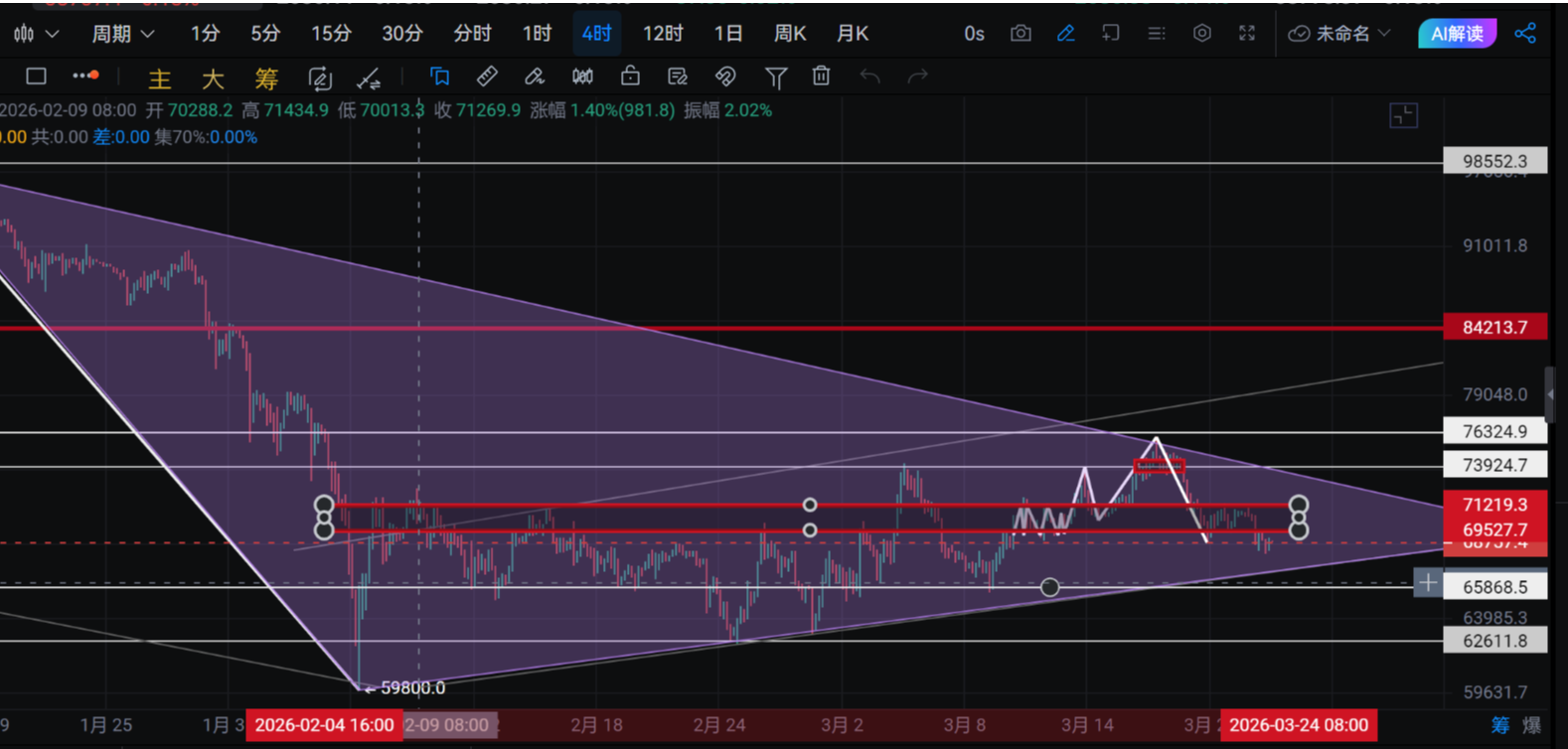
On March 22, the Islamic Revolutionary Guard Corps of Iran issued a significant threat: if its energy and strategic facilities within the country are attacked, it will initiate four retaliatory measures, one of which could include "completely closing the Strait of Hormuz." At the same time, the Speaker of the Iranian Parliament publicly stated that Middle Eastern energy facilities would be regarded as "legitimate targets," pushing this critical global oil and LNG corridor to the forefront of geopolitical competition. Within the same narrative context, sources have claimed that Iran may impose a transit fee of up to $2 million on each tanker passing through the Strait of Hormuz. This figure, which has yet to be verified by multiple parties, reinforces the notion of "exchanging control of the corridor for financial leverage." In stark contrast to the tense atmosphere surrounding conventional tankers is the explosive rise of a small cryptocurrency: according to HTX data, SIREN was temporarily driven up to an approximately 26-fold increase during the event window, with on-chain analysis showing that around 484.6 million SIREN, accounting for 66.5% of the total supply, were concentrated in a few addresses, indicating a high concentration of holdings. This comparison from Hormuz to the blockchain forms the core question of this article: how does geopolitical conflict reflect the imagination of risk premiums and speculative euphoria on a small cryptocurrency?
The Life-and-Death Line of Hormuz: The Confrontation of Tankers and Missiles
After March 22, the statements from Iran intensified. The Islamic Revolutionary Guard Corps emphasized in a statement that if the country's energy facilities are attacked, the Strait of Hormuz will be "completely closed," moving beyond mere deterrence to being packaged as an executable tool for retaliation. Almost simultaneously, the Speaker of the Iranian Parliament defined "Middle Eastern energy facilities" as "legitimate targets," meaning that everything from oil fields to pipelines, from LNG terminals to port tanks, is now included in the potential conflict list. Within this discourse framework, Hormuz is no longer an abstract maritime coordinate but a physical choke point where missile targeting intersects with tanker shipping routes.
The sensitivity of the Strait of Hormuz lies in its volume and irreplaceability in global crude oil and LNG transport. Although public data is not listed individually in this brief, the general market consensus is that a substantial proportion of global maritime crude oil and natural gas must pass through this narrow passage; any blockade, interference, or cost escalation would be akin to squeezing an artery, rapidly transmitting impacts to oil prices, freight rates, and downstream industrial products. The imagined threat of missile-targeted tanker shipping lanes is enough to create a "disaster scenario" for traders in pricing geopolitical risks, even if actual actions remain at a verbal level.
The statement regarding "charging each tanker a transit fee of $2 million" currently appears to come from a single source, lacking confirmation from multiple channels, making it far from established policy. The significance of this figure lies not in whether it will actually be enforced, but in the extreme "monetized threat" it suggests: directly pricing the control of the corridor, embedding quantifiable political premiums into every journey through Hormuz. It functions more like a psychological chip—communicating to the market that Iran can not only close the door but can also set the price for opening it.
In traditional finance and commodity markets, any escalation of tensions in the Middle East usually reflects quickly on crude oil, gold, related equity assets, and freight derivatives: oil prices jump first, gold attracts safe-haven buying, and shipping and airline assets come under pressure, leading to increased volatility in risk assets. This reaction path has been ingrained in the "muscle memory" of macro traders. Because of this familiar reaction chain, the violent movements of certain small-cap tokens within the context of the Hormuz game stand out—these tokens seem to have extracted a portion of emotional premium from the shadows of traditional commodities and rewritten the narrative on-chain.
Risk Premiums Shift On-Chain: Safe-Haven Narratives and Speculative Scripts
Looking back over a longer timeline, every significant geopolitical friction in history—from regional wars to sanctions escalation—has seen varying degrees of correlation between Bitcoin, gold, and crude oil. Gold and crude oil are typically the "first response assets" in the traditional sense, with the former absorbing safe-haven sentiments and the latter directly reflecting supply expectations. Bitcoin has sometimes been viewed as "digital safe-haven" by some funds, but this property has fluctuated in strength, intertwined with the macro liquidity environment. Under the current tension in the Middle East, the performance of the crypto market has been even more fragmented: mainstream coins have not exhibited the same coherent safe-haven rally as gold, while dramatically heightened volatility has been showcased in local small caps.
To understand this fragmentation, it is necessary to distinguish two types of fund motivations: "geopolitical safe-haven buying" and "event-driven speculation." The former is more concerned with preserving value and liquidity in extreme situations, often preferring targets that are deep enough and historically validated; the latter sees geopolitical events as narrative fuel, condensing them into stories that can be told clearly and speculated on in the short term, concentrating firepower on small-cap, easily manipulated tokens. In the eyes of some traders, the risks of Hormuz do not necessitate hedging through gold or Bitcoin but are instead interpreted as "a story that can be told in the crypto space."
If Iran attempts to leverage corridor control for financial incentives, then even without a specific policy timetable, it is enough to generate ongoing discussions in media and social platforms. Phrases like "closing the strait" and "raising transit fees," amplified by sensationalist headlines and secondary interpretations, easily become associated with "weaponization of energy" and "monetization of corridors," which are then packaged into the narrative frameworks of crypto influencers. On-chain capital flow plays an amplifying role: once a token related to event imagery is singled out, on-chain transfers, concentrated buying, and whale reallocations provide "screenshotable" evidence for the narrative, accelerating the migration of capital from observation to following the trend.
This also means that the transmission of geopolitical risk premiums on-chain is not a direct linear relationship like crude oil futures but is highly nonlinear and node-centric. Most tokens show no price reaction to the rhetoric surrounding Hormuz, but once a small coin is labeled as "shadow chip," risk premiums can be amplified exponentially by speculators in this small pool. What ultimately emerges is an emotional storm stirred up by a few narrative targets, rather than a rational repricing of conflict risk across the entire crypto market.
SIREN Goes Haywire: 26-Fold Surge and the Tsunami of a Closed Pool
During this event window, SIREN became the most typical "narrative carrier." According to HTX data, at the same time that Iran threatened Hormuz and market sentiment was heightened, SIREN's price was ignited from a previously flat consolidation state, briefly surging as much as 26 times. The candlestick pattern exhibited a textbook rhythm of "low-volume consolidation—sudden surge—continuous rise": early trading was extremely light, followed by a dramatic increase in trading volume over a very short time, with prices being pushed up almost unilaterally, only starting to show more significant turnover and volatility in the upper region.
What is even more noteworthy is the abnormal concentration of holdings. On-chain analyst Yu Jin provided data indicating that approximately 484.6 million SIREN were gathered into a few addresses, accounting for 66.5% of the total supply. This means that the vast majority of circulating sellable chips are concentrated under the control of a few entities, significantly reducing the actual selling pressure that can freely flow in the secondary market and suppress prices. In such a highly "trimmed" order book, any buying action that doesn't seem large, when executed concentratively within a short time, can quickly exhaust the order depth, creating a steep price rise.
The high concentration of chips results in a structural vulnerability in price depth: the sell orders hanging on the order book mostly only represent the tip of the iceberg, with the truly large volume held locked in a few addresses, not easily released. In this state, the market's apparent "liquidity" can be deceptive—while it appears that buying and selling can happen at any time, once directional buying pressure floods in, the real capacity of sell orders to absorb is insufficient to smooth out price fluctuations, leading to "small ripples turning into tsunamis." In a pool with extremely high closure, even a few large rocks thrown into the water can amplify the waves into terrifying torrents.
It should be emphasized that there is currently no evidence to suggest that the SIREN project is directly cooperating with or orchestrating events related to Hormuz; any narrative that binds the two as an "official linkage" is an overstretch beyond the current informational boundaries. A more rational definition is that this round of price surge is a combination of "narrative hitching" and "control game": on one hand, the market connects the news sentiments of Iran and the strait to a suitable small-cap token; on the other hand, a few addresses with absolute chip advantages leverage this narrative window to trigger extreme price fluctuations with limited funds.
From Tanker Transit Fees to Token Narratives: Shadow Pricing of Corridor Control
The rumor of Iran imposing a "transit fee of $2 million per tanker," even lacking multiple sources of confirmation, remains an extreme model worth analyzing: it provides a rough but intuitive "pricing" of corridor control in the real world—a strait that requires paying for geopolitical risk with every use. This direct pricing of strategic resources is more a psychological warfare against the market than a policy proposal: it forces all participants in global energy trade to incorporate the "Hormuz factor" into their pricing models.
On-chain, the narrative packaging logic of small-cap tokens somewhat replicates this process. Tokens like SIREN can be framed as "shadow chips" of Hormuz risk: they do not inherently possess any actual corridor rights or cash flow but are endowed with a referential function during the information dissemination process—when tankers in the real world are targeted by missiles, on-chain SIREN are taken by speculative funds as a vehicle to "bet on corridor tensions." Thus, the originally complex geopolitical game is simplified on-chain to a symbolic asset of "buy or not buy."
If we expand our vision further, Web3 infrastructure is already discussing similar issues: once energy, shipping, corridor usage rights, or even port berths are tokenized, how will the logic of clearing, settlement, insurance, and hedging migrate on-chain? Theoretically, journeys can correspond to on-chain contracts, actual passage counts can be written into immutable records, insurance payouts and risk premiums can be settled automatically through protocol rules, and can even be split and transferred in public markets. At that time, choke points like Hormuz will no longer just be terms in headline news but risk factors that can be traded in slices on-chain.
However, a huge gap still exists between reality and this vision. What we see now resembles a "non-official monetization experiment" conducted by speculators before actual policies: using a small token without sovereign backing to preemptively seize the narrative high ground on corridor risk, testing the market's sensitivity to such a story through price fluctuations. True financial engineering on a sovereign level—whether through whatever tools anchor corridor usage rights or how to reach settlement arrangements within a multilateral framework—remains highly uncertain and is constrained by multiple factors including law, diplomacy, and security.
Regulatory Shadows and Security Anxieties: The Cold Water Effect of Technological Narratives
On the same timeline where geopolitical risk and on-chain speculation soar together, China's release of the "OpenClaw Safe Usage Practice Guidelines" marks another narrative thread worth noting. This guideline focuses on the safe and compliant use of complex on-chain tools, from permissions management to risk control, attempting to delineate a set of "safety boundaries" for developers, institutions, and high-frequency participants. While it has no direct connection to Hormuz, it provides a cooling stream of air for this speculative frenzy—reminding the market that the complexity built upon technology already poses systemic risk.
In an environment fraught with geopolitical uncertainties and high-volatility assets, regulatory and safety guidelines are often seen as a "cooling signal" for strategies with high leverage and complexity. When one side has retail traders and speculative funds leveraging the narrative in small tokens, and the other side has regulators emphasizing compliance frameworks and tool risks, the tension between the two can lead to a contraction of risk exposure for some institutional funds. They see not "opportunities for getting rich," but an escalated probability of "black swans."
Abraxas Capital's closure of a $2.67 million short position on GOLD is a micro-sample of this risk-contraction posture. In the context of increased macro uncertainty and rising expectations of geopolitical conflict, maintaining a directional short on gold means betting against "safe-haven demand." Choosing to close this position during this period is a typical professional decision to "de-leverage and shrink risk": stepping away from the gaming table, withdrawing funds from high volatility assets, and reserving judgment for clearer trends.
In sharp contrast, on-chain retail traders and some high-risk funds are "chasing highs" in tokens like SIREN. While professional institutions are reducing short exposures and compressing leverage in real assets, emotional funds are amplifying leverage in a small-cap pool with high concentration and weak liquidity, attempting to capture excess returns in the subsequent period. This behavioral difference highlights the starkly different interpretations of the same risk environment by professional and emotional fund managers: the former focuses on tail risk and survival probability, while the latter is more concerned with the possibility of "doubling the price."
After Hormuz: The Next Risk Imagination to be Tokenized
Returning to the starting point, the connection between Iran's threats, the tanker corridor game, and SIREN's surge is not a rigorous deduction of cash flow and valuation but a narrative pathway concerning "imaginative risk." Hormuz being targeted provides a sufficiently dramatic geopolitical backdrop; the idea of charging each tanker $2 million renders corridor control into a "billing statement"; SIREN's 26-fold increase and the concentration of 66.5% of chips converts this risk imagination into an amplifying factor for price volatility on-chain. What persists throughout is not stable cash flow in the real world, but a collective imagination of conflict, blockades, and weaponizing corridors.
For investors, the greatest caution should be against equating such geopolitical conflicts with the "value support" of any single token. In this round of market activity, the core variable driving the violent fluctuations of SIREN is not substantial policy progress regarding Hormuz, but the high concentration of holdings and the space for control games. Geopolitical narratives provide the traffic and emotional entry points, but the slope of the price curve derives more from a deliberately "trimmed" order book and the structural draining of liquidity that results in technical vulnerabilities. Simplifying complex macro risks into the logic of "buying the right coin" itself represents a risk.
Looking ahead, the tokenization of more real-world assets and geopolitical risk scenarios is almost certainly a direction that will occur: from income rights of energy assets to usage rights of shipping corridors, and even to specific regional insurance pools and hedging products, Web3 could become the infrastructure housing these complex rights. However, to reach that point, the industry needs to find a balance between narrative efficiency and risk constraints: it must not leave everything at the "telling stories and speculating on small caps" stage, nor ignore the demands of on-chain tools for systemic stability.
At the strategic level, as market conditions driven by geopolitical events become the norm, investors need to learn to differentiate between "safe-haven assets" and "narrative chips." The essence of the former is depth and absorbing capacity, providing relatively reliable liquidity and value anchors even in extreme environments; the latter serves as volatility amplifiers, with price elasticity often stemming from concentrated holdings, control structures, and narrative heat. Before participating in any on-chain transactions related to geopolitical events, at a minimum, three tasks should be accomplished: assess trading depth and genuine liquidity, observe the concentration of holdings and the behavior of large addresses, and analyze the compliance environment of both the jurisdiction and the participating platforms. Only after these fundamental questions are addressed can a sustainable path between imaginative risks and speculative impulses be found.
Join our community to discuss and become stronger together!
Official Telegram community: https://t.me/aicoincn
AiCoin Chinese Twitter: https://x.com/AiCoinzh
OKX benefit group: https://aicoin.com/link/chat?cid=l61eM4owQ
Binance benefit group: https://aicoin.com/link/chat?cid=ynr7d1P6Z
免责声明:本文章仅代表作者个人观点,不代表本平台的立场和观点。本文章仅供信息分享,不构成对任何人的任何投资建议。用户与作者之间的任何争议,与本平台无关。如网页中刊载的文章或图片涉及侵权,请提供相关的权利证明和身份证明发送邮件到support@aicoin.com,本平台相关工作人员将会进行核查。