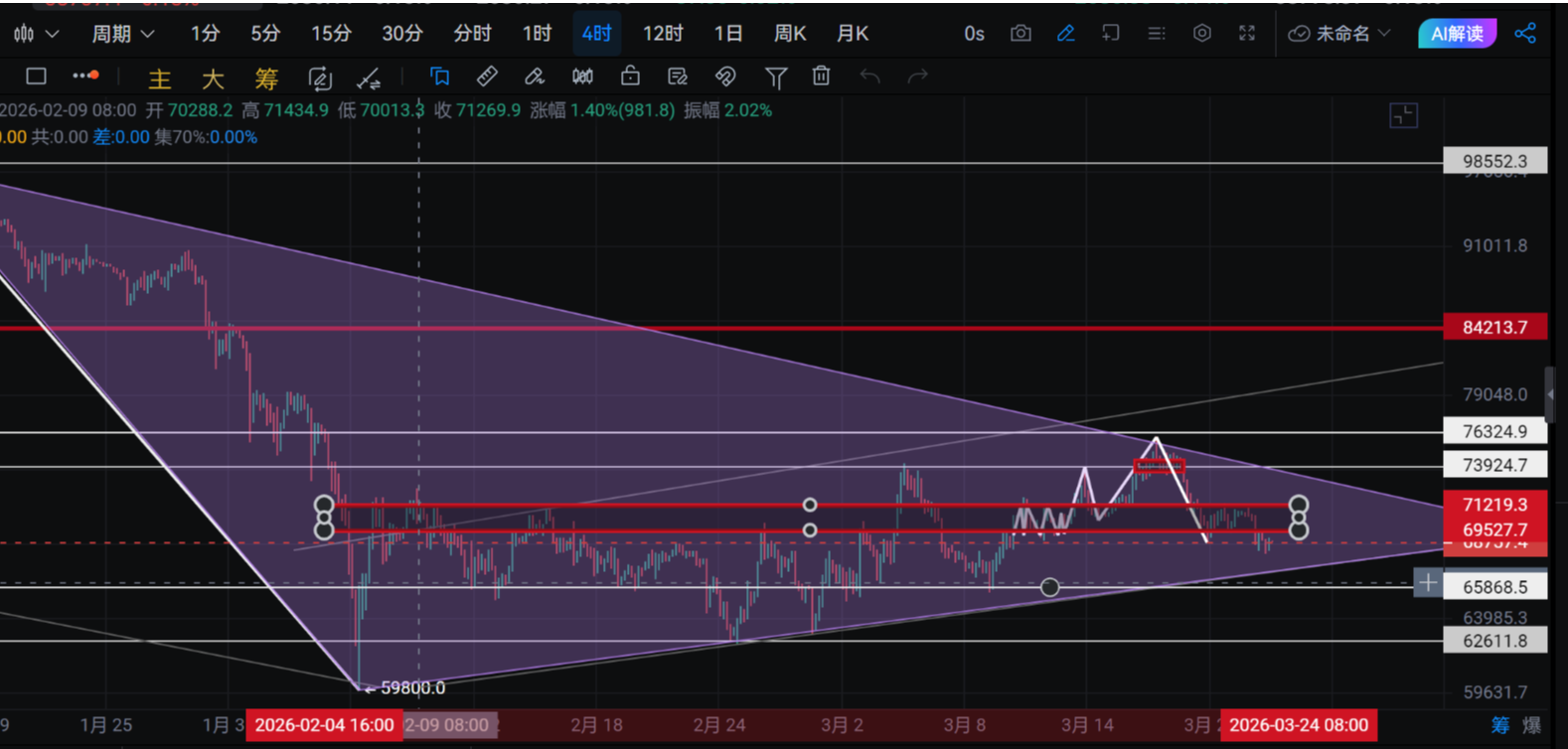
On March 22, Eastern Eight Time, the Hong Kong-listed gaming company Oriental Interactive (00434.HK) announced that it plans to seek shareholder authorization within the next 12 months to use no more than 70 million USD to continue increasing its holdings of cryptocurrency assets. Just prior to this, the company already held on its books 4,092 BTC (average price of 68,200 USD), 302 ETH (average price of 1,661 USD), and approximately 7,000,700 USDT. Based on previously disclosed figures, its total cryptocurrency asset position has reached approximately 280 million USD. Against the backdrop of overall valuation pressure on the Hong Kong stocks and the gaming sector generally experiencing growth anxiety, a traditional offline chess and card company has chosen to go against the trend and increase its exposure to assets like Bitcoin. This raises the most controversial question behind this announcement: Is it capitalizing on the trough of the cycle, or is it gambling shareholders' assets on a high-volatility financial experiment?
From Offline Chess to Cryptocurrency Vault: The Asset Allocation Shift of Oriental Interactive
The story of Oriental Interactive does not start on-chain. As a Hong Kong-listed company originating from online and offline chess and leisure games, it has relied on products like Texas Hold'em and Dou Di Zhu to achieve early user accumulation and has been listed on the Hong Kong capital market, with primary revenue coming from relatively stable gaming operation cash flow. This business model is typically seen as a "cash cow," making it easier for the company's management to maintain high dividends or conduct share buybacks regarding asset allocation, with large-scale involvement in high-volatility assets being rare.
The turning point occurred when the company began systematically purchasing Bitcoin and other cryptocurrency assets. According to data disclosed by the company, Oriental has gradually increased its holdings in BTC and ETH since its first purchase, currently cumulatively holding 4,092 BTC and 302 ETH, along with approximately 7,000,700 USDT as a liquidity buffer. Although the specific time and price of each transaction have not been fully disclosed, the average cost per BTC is around 68,200 USD and for ETH, about 1,661 USD, showing a characteristic of phased, gradual positioning rather than a one-time "all-in."
In the latest announcement, the company explicitly expressed the desire to “seize the opportunities presented during the current market downturn,” using this as a reason to seek shareholder approval for an additional no more than 70 million USD investment quota in cryptocurrency assets. This statement intuitively reflects management's judgment of the cycle: the current price range is closer to "depressed" rather than "bubble tail," and the risk-reward ratio is viewed as acceptable, even attractive, in their internal model. From an asset-liability structure perspective, once the shareholder meeting approves the authorization, this 70 million USD will join the existing approximate 280 million USD position, forming a highly concentrated cryptocurrency exposure in the company's asset side. This will produce a more direct amplifying effect on net asset sensitivity and the fair value fluctuations in the profit and loss statement, while also reshaping shareholders' expectations of the company—from a “stable gaming stock” to a “high-beta cryptocurrency vehicle.”
Buying Coin on Regulated Platforms: Compliance Boundaries for Hong Kong Companies
It is noteworthy that Oriental emphasized in its announcement that the planned cryptocurrency purchases “will be executed on regulated cryptocurrency trading platforms.” This seemingly simple statement is, in fact, a key signal for Hong Kong-listed companies seeking to find a balance between compliance and risk control. For a company subject to dual scrutiny from the Hong Kong Stock Exchange and auditing firms, choosing to trade on regulated platforms helps meet compliance requirements in terms of KYC, funding source audits, and transaction record retention, reducing the likelihood of disputes emerging in future information disclosure and auditing processes.
Looking at the overall regulatory environment in Hong Kong, in the past two years, a licensing system has been implemented for cryptocurrency trading platforms, gradually forming a framework of “licensed platforms can provide services to qualified investors.” In this context, if Hong Kong-listed companies want to allocate cryptocurrency assets on the asset side, their paths generally include: trading via regulated platforms, classifying assets as financial or intangible assets in financial reports, and disclosing information on significant fluctuations. In this process, the size of the authorized quota and the distinction between proprietary and operational funds will become key focuses for regulation and auditing: the larger the quota and the closer the funds are to “core operating capital,” the more likely they are to be questioned about liquidity safety margins and stress test assumptions.
Compared to traditional financial asset allocation, Oriental's choice to use cryptocurrency as a "treasury filler" is particularly striking. If equivalent funds were invested in bonds or high-rated notes, management could gain more predictable interest income and lower market value volatility; if used for stock buybacks, it would be a direct signal management of the company’s own value. Instead, by purchasing Bitcoin and other cryptocurrency assets, the logic shifts from "steady appreciation" to "high volatility betting": on one hand, it offers the possibility of significantly increasing net assets and market value during a bull market cycle; on the other hand, it leaves room during a bear market cycle for eroding shareholder interests, triggering accounting impairments and valuation discounts, which is also the core focus of potential skeptics.
4,092 BTC on the Books: De Facto "Mini Spot ETF"?
Zooming in on the assets themselves, Oriental currently holds 4,092 BTC and 302 ETH. Based on the disclosed average cost, its Bitcoin position costs about 68,200 USD/BTC and Ethereum costs approximately 1,661 USD/ETH. As market prices fluctuate above and below this cost range, the company's books will show significant unrealized gains and losses elasticity: when the BTC price is significantly higher than the cost, the unrealized gains on the asset side will become the pivot point for market narratives; conversely, if the price falls below this range, unrealized losses may be magnified in investor psychology. The accompanying approximately 7,000,700 USDT serves as "ammunition," enabling easy increase or adjustment of positions, but it still keeps risk exposure highly concentrated on Bitcoin's performance relative to the massive BTC position.
This model starkly contrasts with international cases like MicroStrategy. The latter has continuously increased its Bitcoin holdings for years, thereby binding its stock price highly to BTC prices and even being perceived by the market as a "substitute for Bitcoin spot ETF." From the perspectives of exposure, liquidity, and pricing transparency, directly holding assets in corporate treasury and Bitcoin spot ETFs show significant differences: the former's assets are controlled by a single company, liquidity is actively managed by the company, and information disclosure frequency is tied to financial reports and announcement rhythms; the latter facilitates daily circulation on exchanges, has a more transparent price discovery mechanism, and the redemption process somewhat constrains the extent of premiums and discounts.
In terms of market perception, when a public company holds a large amount of cryptocurrency, its stock price inevitably correlates strongly with Bitcoin’s price, making it easy for outsiders to regard it as a “mini spot ETF.” With Oriental’s existing approximately 280 million USD in cryptocurrency assets, if it adds a 70 million USD quota, once executed, the proportion of cryptocurrency in the company’s total assets will further elevate, causing daily stock price fluctuations to reflect Bitcoin markets to a greater extent rather than the fundamental gaming business. This “de facto ETF-ization” logic leads to a restructuring of the original valuation system: traditional price-to-earnings and price-to-book analysis must now overlay a lens of “cryptocurrency asset net value premium” and “management risk preference premium,” potentially altering the investor structure.
Empowered by Web3 Imagination: Narrative Resonance Between Gaming Business and Cryptocurrency Assets
From the perspective of Oriental's traditional gaming business, scrutinizing this cryptocurrency asset bet raises an unavoidable scenario: is management reserving chips for potential Web3 layouts? Chess and leisure games inherently feature high-interaction, virtual items, and point systems that can theoretically migrate to on-chain assetization and game economy models. For example, in-game chips and items could be on-chain, players could settle value through on-chain transactions, and even build new economic systems with on-chain NFTs and tokens—these fall within possible collaborative spaces. However, it is crucial to clarify that specific Web3 business routes have not been disclosed in the current public information; the above represents a projection based on industry trends, not the company's established plan.
Globally, more and more gaming companies and internet platforms are starting to embrace Web3, whether through the experimental launch of blockchain game projects or testing cryptocurrency asset allocation on the asset side. Compared to directly implementing significant product form transformations, initially positioning with Bitcoin and other assets on the asset side is more controllable in costs and shorter in decision-making chains for gaming companies: they can serve as an asset allocation strategy against domestic currency or fiat currency depreciation risks, while also reserving value anchors and settlement foundations for future potential on-chain projects. From this perspective, Oriental's choice to hold a significant amount of cryptocurrency can be interpreted as an early accumulation of "strategic resources" for possible future explorations in Web3.
Holding a large amount of cryptocurrency also amplifies brand narrative effects. For potential ecological partners or technology providers, a gaming company holding thousands of BTC on its books is often easier to be seen as a "crypto-friendly entity," holding bargaining advantages in cooperation negotiations, ecological joint marketing, and future on-chain settlement pilot programs. Meanwhile, assets like Bitcoin and USDT could play partial settlement and incentive roles in future cross-border collaborations and on-chain activities. However, in the absence of a specific Web3 roadmap disclosure at present, market interpretations of this capital increase action are bound to diverge: optimists might view it as a signal of preparing for Web3, while pessimists could see it merely as a financial gamble with limited synergy with core business, even worrying about management’s motives for “borrowing coins to tell stories” under competitive industry pressures.
Surge in Retail Investors Holding Coins: Resonance Between Corporations and Individuals on the Same Asset
Shifting the perspective from a single company to a global scale, cryptocurrency assets are accelerating their evolution from high-volatility speculative targets to a kind of “anti-inflation asset” and “value storage tool.” According to Bitcoin News data, approximately 17.2% of Vietnam's population holds Bitcoin and other cryptocurrencies, around 15.2% in Argentina, and about 14.0% in Turkey. These high holding rate countries often face real pressures of currency devaluation and high inflation, leading individual users to transfer part of their wealth onto the blockchain for both preservation and limited speculation.
In contrast, corporations' roles in cryptocurrency assets are naturally different. Individuals are more concerned with asset preservation and short-term speculative gains, while companies, when allocating such assets, inevitably release strategic signals to the market: do they see it as "digital gold" to hedge against macro risks, or as a high-risk, high-return capital operation experiment? This reflects management's judgments on future monetary systems and technological trends. When Oriental announces an additional 70 million USD cryptocurrency investment quota, it is essentially positioning itself within the context of the "corporate Bitcoin allocation trend"—it can be seen as following the global trend after cases like MicroStrategy or as seizing narrative high ground as a “cryptocurrency asset carrier” in the Hong Kong context.
The experiences of pioneers such as MicroStrategy illustrate that when corporations and retail investors are highly aligned on the same asset, market volatility and risk transmission can be significantly amplified. During bullish phases, corporate unrealized gains combined with retail FOMO form positive feedback loops, driving up asset prices and related stock valuations; conversely, during downturns, retail selling and expectations of passive impairments or even forced reductions from corporations can amplify panic sentiment. For gaming companies like Oriental, if their stock price is viewed as a "magnifying glass for Bitcoin prices," the interplay between traditional investors and crypto-oriented funds will manifest directly in daily trading. The fundamental analysis, originally based on user data and product flow, will inevitably become entangled with on-chain macro narratives.
Bottom-fishing or Gambling: The Next Year for Oriental Interactive
To sum up, the approximate 280 million USD cryptocurrency asset position currently held by Oriental Interactive, in addition to the proposed 70 million USD authorized quota, is reshaping the company’s valuation structure and market label. On one hand, the large cryptocurrency holdings provide leverage for the company to magnify net assets and market value in the next upward cycle of Bitcoin, attracting a group of investors willing to gain indirect exposure to cryptocurrency assets through stock holdings; on the other hand, this also means that its stock price fluctuations will more violently follow market emotions, with the original valuation framework based on gaming operations being gradually layered with a “cryptocurrency asset net value premium” and “management risk preference premium” filter, potentially altering the structure of investors.
In the coming year, Oriental will face multiple battlegrounds of competition and uncertainty regarding this strategy. On the regulatory front, Hong Kong's requirements for disclosures related to cryptocurrency assets and listed companies are still evolving, and how to continually expand holdings within compliance frameworks will test its communication abilities with auditing, exchanges, and regulatory bodies; on the accounting front, the classification, impairment testing, and methods of fair value fluctuation recognition for assets like Bitcoin in financial reports will directly affect the company's profit and loss statement and balance sheet's volatility; on the market sentiment front, Bitcoin's own cycles, the macro interest rate environment, and the overall risk appetite in Hong Kong markets will amplify or dampen the narrative effect of this holding in secondary markets.
Before the long-term cycle of Bitcoin, the Hong Kong regulatory stance, and Oriental's own Web3 business transformation pathways become clear, this decision essentially hovers between opportunity and risk. Once Bitcoin prices see a significant rebound in the next year, the current "aggressive allocation" might be retrospectively interpreted as precise bottom-fishing; if prices remain pressured or even retreat significantly, this high holding position could be viewed as a high-risk gamble on shareholder assets. For investors looking to track this main line, several key observational indicators are worth steady attention: firstly, the actual usage pace and price range of the subsequent 70 million USD quota, whether it reflects discipline and risk control boundaries; secondly, whether substantial progress emerges in Web3-related business, such as product trials, partnership announcements, etc., providing business synergy support for the current asset allocation; thirdly, the company's transparency in information disclosure, including changes in holdings, risk management measures, and responses to regulatory policy changes, all of which will determine the market's final inclination towards the narratives of “bottom-fishing” versus “gambling.”
Join our community to discuss and grow stronger together!
Official Telegram community: https://t.me/aicoincn
AiCoin Chinese Twitter: https://x.com/AiCoinzh
OKX benefits group: https://aicoin.com/link/chat?cid=l61eM4owQ
Binance benefits group: https://aicoin.com/link/chat?cid=ynr7d1P6Z
免责声明:本文章仅代表作者个人观点,不代表本平台的立场和观点。本文章仅供信息分享,不构成对任何人的任何投资建议。用户与作者之间的任何争议,与本平台无关。如网页中刊载的文章或图片涉及侵权,请提供相关的权利证明和身份证明发送邮件到support@aicoin.com,本平台相关工作人员将会进行核查。