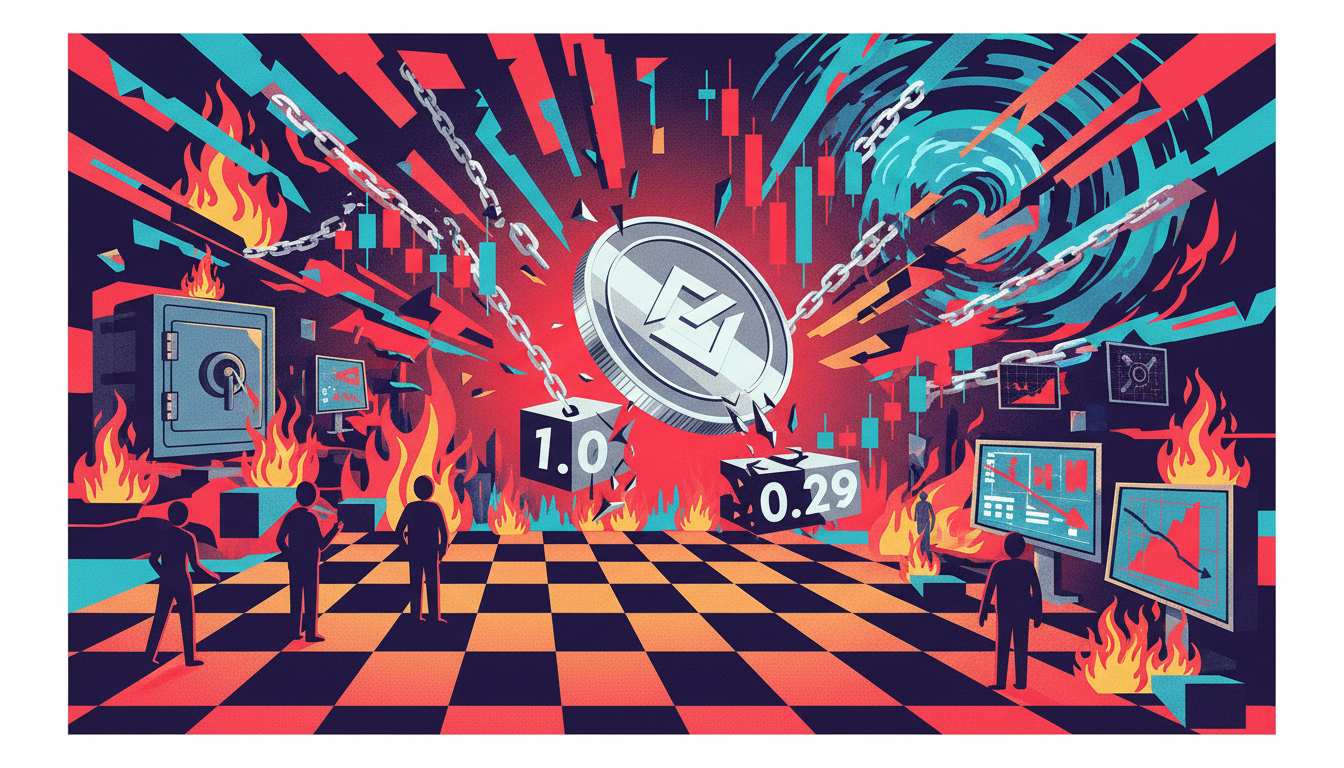
On March 22, 2026, a contract vulnerability surrounding the algorithmic stablecoin USR suddenly erupted, pulling Resolv Labs, Venus Protocol, and the two major Korean exchanges Bithumb and Upbit into the same risk chain. Initially, on-chain monitoring captured the attacker suspected of abnormal minting of approximately 50 million unsecured USR. Immediately, Resolv Labs urgently announced a suspension of all protocol functions. Venus promptly confirmed that Venus Core was unaffected and decisively hit the "emergency brake" on USR trading within its isolated market module Venus Flux. At the same time, Korean exchanges quickly issued red alert warnings. Around this risk transmission chain, spanning issuance protocols, lending markets, and centralized exchanges, a core question emerged: why, being part of the same chain, did the Venus core market survive while USR itself failed on a trust level?
The Terrifying Day of 50 Million Hollow Coins Minted
After the incident on March 22, the first thing that came into focus was the failure of the USR contract itself. The attacker allegedly exploited a vulnerability, details of which have not yet been disclosed, to mint approximately 50 million USR without corresponding collateral support. This figure comes from a single public source, but regardless of the final precise scale, the notion of “tens of millions of unsecured minting” itself is enough to tear apart a stable narrative reliant on algorithmic and collateral constraints.
As the abnormality was detected, Resolv Labs quickly opted for a "power shutdown" response—announcing a suspension of all protocol functions and putting the entire USR protocol into a frozen state to block further potential abnormal minting and arbitrage paths. This operation equated to acknowledging that the system contained major design or implementation flaws and indicated that, with the boundaries of vulnerabilities still unclear, the team preferred to “freeze” all functions to staunch the bleeding rather than patching things up locally.
Market sentiment turned sharply. Before the Korean exchanges issued their risk warnings, public discourse had already begun to express opinions such as “the abnormal minting of unsecured stablecoins exposes fatal flaws at the protocol layer,” directly targeting the internal security and design rationality of the USR protocol. For an algorithmic coin with a relatively “clean” background prior to this, suddenly being labeled as a “hollow coin” not only posed a price volatility risk but also symbolized a breach of its foundational credibility, especially under the amplified effect of the specific number “50 million,” leading the market to turn noticeably pessimistic about its future recoverability.
Venus Hits the Brakes on USR
Unlike Resolv Labs' complete shutdown, Venus Protocol chose “selective chain disconnection” on the timeline. After confirming the USR-related abnormalities, the Venus team immediately emphasized: Venus Core was unaffected, and the core market and funding pool of the lending protocol remained safe and available. At the same time, they quickly paused all USR trading and related operations in the innovative market module Venus Flux, isolating on-chain risks related to USR within the system's “side chamber” to avoid contaminating the main engine.
To understand the significance of this step, we need to return to the architecture of the Venus system itself. Venus Flux was designed as an isolating market module specifically for high-risk assets, physically and logically separating it from the main market in terms of risk exposure, collateral structure, liquidation parameters, and risk control thresholds. The idea is not to “contain garbage assets” but to put more volatile, complex, or still experimental assets together in a single locked “module,” so that if a particular asset encounters issues, risks can be contained locally by shutting down this isolated market.
In this USR incident, this design was tested in practice for the first time. In the official statement from Venus, it directly indicated that “Venus Flux, as an innovative market module, withstood the test of its risk isolation design in this event.” For the community, the symbolic meaning of this operational pathway far exceeds specific profit and loss figures: on one hand, it proved that under extreme conditions, the firewall between Flux and Core could effectively block the continued transmission of risks to the underlying lending market; on the other hand, it temporarily provided a real-world counterexample to long-standing doubts about whether “innovative markets would backfire on the main protocol.” Trust restoration is not achieved overnight, but within the same timeline of the stablecoin's breach, Venus won an extra point for its risk control framework with a clean and decisive “brake” action.
Korean Exchanges Issue Red Alerts: Off-chain Risk Control Chain Activated
While the on-chain protocol was “internally shutting down,” the risk control mechanisms in the off-chain market quickly came into operation. The two major Korean exchanges, Bithumb and Upbit, shortly after the incident, successively issued warnings regarding USR-related trading, advising users to stay alert to potential risks. In terms of wording, they did not directly assert that USR had “completely failed” or make premature judgments, instead using phrases like “monitoring abnormal situations” and “cautious trading recommendations” to maintain a balance between information disclosure and compliance caution.
This response rhythm aligns closely with the cultural handling of abnormal coins in the Korean market. Compared to trading platforms in other regions that might first hesitate, then classify an issue, Korean exchanges typically have a faster warning trigger mechanism for assets linked to “stability”: as soon as there are contract anomalies, mismatches between on-chain issuance and collateral data, or significant downtime announcements from project teams, the risk control system will prompt at least one round of public reminders, and in some cases may additionally impose temporary restrictions. In the USR incident, the attacker's alleged large-scale unsecured minting and Resolv Labs’ announcement of all functions being paused were seen as the core signals triggering this mechanism.
Looking at the bigger picture, this incident provides a sample of how “on-chain protocols actively shutting down and centralized exchanges issuing risk warnings” can collaboratively contain the spread of risks. On one end, Resolv Labs and Venus directly hit the pause button through the contract layer and market modules, blocking contract fulfillment and new transactions; on the other end, Bithumb and Upbit built a secondary line of defense through announcements and alerts for fiat deposits, leverage, and retail investors. The two are not strictly cooperative combat, but within the same time window, on-chain and off-chain formed a mutually complementary risk closure: the former contracted supply and liquidity, while the latter suppressed demand and speculative impulses, buying the market some time for calm risk evaluation.
Algorithmic Anchor Breached: Trust in Stablecoins Again Questioned
Before the vulnerability outbreak, USR was viewed in most narratives as a “case with no major incident record” for algorithmic anchoring. As an algorithmic coin launched by Resolv Labs, it had not been involved in significant negative events such as severe decoupling, cascading runs, or obvious hacker attacks, giving it a relatively “clean” background, which is why many users were willing to allocate a place for it between yield consideration and risk awareness.
The crux of this event lies not in the short-term price fluctuations but in the symbolic meaning of the term “unsecured minting.” Once large-scale new supply is allowed to be generated by contract anomalies without collateral backing, it indicates that the two basic constraints upon which algorithmic stablecoins rely—collateral constraints and supply constraints—can simultaneously fail under extreme scenarios. In other words, it is not market-induced runs breaking the peg, but the protocol itself opened the back door for “arbitrary printing,” which directly undermined the foundation of trust more than regular secondary market sell-offs.
Historically, trust crises surrounding algorithmic anchoring have occurred multiple times. Whether due to price collapses triggered by death spirals or mechanism collapses caused by governance failures, they continuously remind the market: purely algorithmic commitments often break first in extreme environments. USR's prior “no major incidents” record led it to be assumed as “at least safer than problematic projects” within many investment portfolios, but now, due to a single contract layer vulnerability, it is forced to confront a more fundamental question—when code and mechanisms are proven not unbreakable, can the previously accumulated “smooth operating record” still be seen as a reliable guarantee of future safety?
DeFi Risk Control Game: From Single Protocol Vulnerability to Multi-layer Firewalls
The starting point of this incident is a vulnerability exposed in Resolv Labs at the protocol design or implementation level that was sufficient to support “unsecured minting,” but its impact did not stop at a single protocol, rather spreading along the “assets—markets—platforms” path. If USR is at the innermost source, then the lending protocols, trading markets, and the underlying infrastructure that supports its pricing and clearing are all potential victims or points of transmission.
On this chain, Venus Protocol’s isolation market architecture provides an interesting firewall sample. By consolidating high-risk assets like USR into something like Venus Flux, Venus acknowledged at the architectural level the reality that “different assets carry different systemic risks.” Following the incident, the team only needed to partially shut down the Flux—pausing USR-related markets—to a significant extent cut off further risk transmission to Venus Core, thereby protecting the quality of collateral assets, liquidation stability, and overall reserve confidence of the main market. However, this design also has its limitations: it mainly reduces the probability of cascading effects through structural isolation rather than eliminate the foundational risks themselves, and if more high-risk assets concentrate in the isolation market, in the event multiple assets face issues simultaneously, Flux itself may also become a pressure concentration zone.
Extending the view to the entire DeFi ecosystem, the failure of a single protocol is forcing the industry to move from “single point security” to a “multi-layer firewall” approach. Apart from architectural isolation, the price oracle's responsiveness to abnormal large-scale minting and its ability to detect anomalies will determine whether clearing and collateral value adjustments can keep up with reality; liquidation rules allowing for more conservative discounts and buffers in extreme scenarios will impact the system's balance between exposing risks and protecting participants; while the asset whitelist system—who can be on-chain, whether they can enter main markets, and what kind of audits and historical records are needed—will set the tone for the entire risk control system at the entry point. As more protocols couple across chains and platforms, only these layered risk control mechanisms, when operating together, can lock risks into smaller spaces when the next black swan arises.
What the Market Can Learn Before the Next Black Swan
Looking back at the entire process, USR protocol, Venus isolation market, and Korean exchanges exhibited three different but interrelated response paths under the same event. Resolv Labs chose to acknowledge the issue and block risk increments by fully suspending all protocol functions, at the cost of short-term damage to the usability and trust of USR; Venus, relying on the isolation design of Venus Flux, confirmed that Venus Core was unaffected, and achieved localized damage control by pausing USR trading in Flux, seizing an opportunity for a “positive demonstration” of its risk control model; Bithumb and Upbit, off-chain, imposed additional safety barriers for retail and fiat entry by quickly issuing trading warnings. These three paths, one internal and one external, one main and one ancillary, together outline the current boundaries of the crypto market's capability to respond to black swans at the contract level.
The implication for the future is that the crypto industry must shift from “whether a certain line of code is secure” as a single-point issue to an overall perspective on asset and scenario tiered management. Whether algorithmic coins can enter the main market, what collateral tier they should be classified into, and whether they require additional oracle monitoring and auditing thresholds should no longer be discussions for remedial action afterward but should be embedded into the risk framework of protocols and platforms at the design stage. For DeFi protocols primarily comprising lending, leverage, and derivatives, how to delineate clear boundaries for “high yield but high uncertainty” assets between chasing returns and systemic robustness will also determine their survival space in the next round of black swans.
As for USR and its related assets, trust restoration in the short term is bound to be challenging. On one hand, the narrative of “50 million unsecured minting” has already inflicted significant damage on its brand; even if subsequent repairs are in place, the market will demand a higher “risk premium” to compensate for the exposed structural flaws at the valuation level. On the other hand, the risk disposal capabilities exhibited by protocols like Venus and Korean exchanges during this incident may to some degree be repriced by the market—those infrastructures that can maintain usability and order during a crisis are likely to gain higher trust in the next cycle. The real test will be whether the entire industry can transform this terrifying experience into architectural evolution before the next black swan arrives, rather than becoming another forgotten lesson.
Join our community, let's discuss and become stronger together!
Official Telegram community: https://t.me/aicoincn
AiCoin Chinese Twitter: https://x.com/AiCoinzh
OKX Benefit Group: https://aicoin.com/link/chat?cid=l61eM4owQ
Binance Benefit Group: https://aicoin.com/link/chat?cid=ynr7d1P6Z
免责声明:本文章仅代表作者个人观点,不代表本平台的立场和观点。本文章仅供信息分享,不构成对任何人的任何投资建议。用户与作者之间的任何争议,与本平台无关。如网页中刊载的文章或图片涉及侵权,请提供相关的权利证明和身份证明发送邮件到support@aicoin.com,本平台相关工作人员将会进行核查。