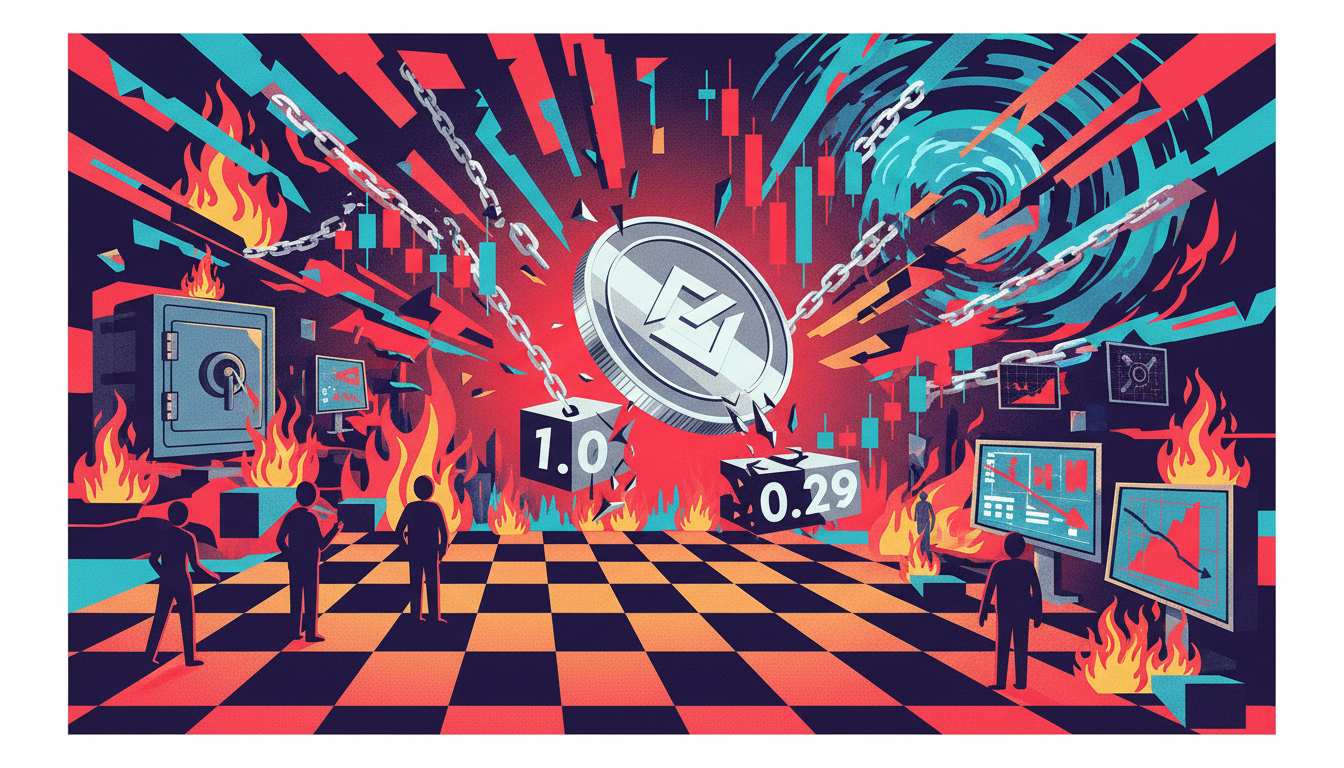
On March 22, 2026, a seemingly ordinary on-chain fund flow drew Venus Protocol, Resolv Labs, and South Korean exchanges Bithumb and Upbit into the same risk narrative: according to a single on-chain intelligence source, a suspected attacker started with 200,000 USDC, minted as much as 80 million USR in the USR contract, and exchanged it for 9,111 ETH in a short period of time. Shortly thereafter, Venus suspended USR trading on its Flux market, while the two major exchanges in South Korea issued a warning to exercise "extra caution" regarding assets related to Resolv/Resolve. As details about USR's decoupling and abnormal minting were pieced together, one question became increasingly sharp: when the issuing party's security mechanisms fail and DeFi platforms are forced to stem the bleeding, who ultimately bears the cost of this cross-chain financial experiment—the protocol, the platform, or the ordinary users caught in the middle?
Abnormal minting to ETH liquidation: a money route exchanging 200,000 for 9,111 ETH
According to the single-source data cited in the research brief, this incident began with 200,000 USDC flowing into USR-related contracts. Normally, this amount would be enough to mint a similar scale of USR, but on-chain records show that the contract unexpectedly produced a minting volume of 80 million USR, with a magnification ratio exceeding several hundred times. Since the brief did not disclose specific technical details of the contract's vulnerability, we can only confirm that at some stage in the issuance logic or security verification process, a gate that should have existed was easily bypassed, allowing space for abnormal minting to occur.
Even more striking is the speed and direction of the capital migration. The unusually generated USR did not linger on-chain for long but was quickly thrown into the market, ultimately being exchanged for approximately 9,111 ETH, according to the same source. This means that in a very short period of time, an originally limited USDC position was directly magnified into a position close to ten thousand ETH. For any mainstream on-chain trading environment that prides itself on depth and slippage, such concentrated sell-offs of a single asset and bulk buying of ETH would create pressure on the matching pool, routing paths, and slippage parameters in a short amount of time.
The extreme minting multiples coupled with short-term concentrated buying can be understood in terms of the pressure on on-chain depth from two dimensions: on one hand, a large amount of USR sell pressure will rapidly exhaust available buying, further pushing up the decoupling extent; on the other hand, an influx of nearly ten thousand ETH in net buying would quickly "drain" the depth of orders in the relevant DEX or matching pools, increasing transaction slippage. Even though we have not yet grasped the specific price curves of each routing segment, the magnification factors and time density alone are sufficient to indicate visible gaps in the issuance and risk control defenses of USR as an asset. This money route of "200,000 USDC—80 million USR—9,111 ETH" almost magnifies the weakest link in the issuer's security mechanism in the most extreme way before the entire network.
Venus hitting the brakes: the boundaries and vacuum of DeFi risk control
In the face of this series of abnormal capital behaviors, Venus Protocol chose to suspend USR trading on its Flux market, with the timing coinciding with the escalation of the March 22 incident. From the action itself, this is the most direct and "hard" risk control response that Venus can take within a controllable range: by hitting the emergency stop button, the flow of USR in the lending market as collateral or borrowing asset is interrupted, preventing further amplification of pricing abnormalities in the pool. This decision did not introduce complex tiered restrictions but directly pressed the pause button, reflecting the standardized emergency pathway of DeFi platforms in the face of sudden asset risks.
Along with the technical action, a highly concise official reassurance was released—"All user funds are safe." These few words outline the boundary of responsibility that Venus seeks to emphasize: on one hand, the platform wants to clarify to both lenders and borrowers that there has been no direct loss or liquidation chain reaction caused by abnormalities in USR within the pool; on the other hand, this statement also implies a premise—security incidents occurring in the USR issuance logic and cross-platform flow are not risks directly controllable at the smart contract level by Venus. While reassuring user emotions, the platform also uses wording to distinguish between "protocol security" and "external asset quality," two different dimensions of responsibility.
However, pausing trading of a single asset is not a cost-free choice. Once USR was frozen, the overall liquidity of the related lending pool passively shrank, users holding USR as collateral lost their repositioning and escape routes in the short term, and the strategies that originally relied on USR as a borrowing medium were forced to interrupt. This generates a chain reaction on collateral safety and liquidation risk—if the market's price expectations for USR further deteriorate, whether the pool needs to dynamically adjust discount parameters and liquidation thresholds for other assets becomes a new uncertainty. Venus' "emergency stop" showcases both its post-fact risk control execution capability and exposes the imbalance in pre-approval reviews of asset quality on DeFi platforms: when trust in external asset quality is based more on issuer branding and market liquidity rather than systemic stress testing, the real risk often can only be rectified post-fact with forced shutdowns.
Korean exchanges sound the alarm: the sensitivity and self-protection of the Asian market
Aside from on-chain risk control actions, two major domestic exchanges in South Korea, Bithumb and Upbit, almost simultaneously issued their risk warnings. According to the research brief, both platforms jointly or consistently warned investors to be "extra cautious with REOLV/Resolve related assets," with wording that carries a pronounced "quasi-regulatory" tone: it is neither a simple price volatility announcement nor a common project news forwarding, but a risk warning with behavioral guidance implications. For those long focused on the Korean market, this kind of expression reflects a consistent high sensitivity towards assets linked with stability and all emerging high-risk tokens.
This sensitivity did not arise from nowhere. Over the past few years, South Korean investors have experienced several significant loss incidents due to asset design flaws and risk control failures, resulting in a collective awareness in market memory that "high yield = high uncertainty." Against this backdrop, exchanges chose to speak out in advance after the USR incident, essentially imposing behavioral constraints on both retail investors and project parties: for retail investors, it serves as a clear "weather vane"—the related assets may be reassessed for risk, making hedging or reducing positions a rational option; for project parties and market makers, this signal means that platforms may raise margin requirements, restrict trading pairs, or further adjust listing policies at any time.
Compared to the response from on-chain DeFi platforms, the risk perception and response tempo of centralized exchanges present another logic. DeFi usually engages in stop-loss actions like pausing or parameter adjustments only after contract-level risks are triggered; while CEXs, which bear more centralized compliance responsibilities and user protection expectations, are more likely to issue warnings while risk signals are still propagating. This creates a subtle game between the two: on-chain maintains a neutral stance of "code equals rules," waiting until rules are breached to take action, while centralized platforms shape behavioral boundaries in advance through their influence. The USR incident amplifies this rhythmic difference in the context of the Asian market.
Can an abnormal buy trigger ETH sentiment?
Returning to that eye-catching figure—9,111 ETH. Given the context of current ETH's daily trading volume, this purchase might not be able to alter the overall market's mid to long-term trend, but in the single day, single timeframe price structure, its relative weight is not negligible: when this portion of buying is concentrated and released through certain DEX or routing channels, it is likely to amplify upward price volatility in a localized time window, creating short-term "passive chasing highs" and slippage stomping.
The direct consequence of concentrated buying is the subtle misalignment between local spot prices and the derivative markets. If a nearly ten thousand ETH-sized buy pushes spot prices up in a short time, the funding rate and perpetual contract long-short position structures will quickly adjust in response: some quantitative funds may capture temporary arbitrage opportunities between spot premiums and contract discounts amid emotions-driven bulls who may mistakenly interpret this type of abnormal buy as “institutional entry.” Should this batch of ETH be sold off in other scenarios later, it would create a concurrent selling pressure in another period, causing opposing squeezes on short-term price fluctuations and position leverage.
From the perspective of "black swan tail traces," large fund inflows triggered by a single-point anomaly often lead to a narrative that is continually rewritten: from "contract breached, minting a massive volume of tokens," to "whales buying ETH," and then to "on-chain speculative heat warming up." Each retelling attracts another round of short-term capital entering to try to "ride the wave," leaving a visible echo in on-chain trading volumes and Gas consumption data. However, without more detailed on-chain breakdown—such as specific trading pairs, transaction timing distributions, and subsequent ETH destinations—we can only remain at a level of interval deduction: it is sufficient to disturb the short-term structure, but whether it is enough to change mid to long-term trends lacks sufficient evidence to support any definitive conclusion.
The invisible resonance risk of cross-platform stablecoins
If we only focus on the abnormal minting itself, it is easy to interpret the USR incident as an isolated contract accident. However, the research brief repeatedly emphasizes one point: the real systemic risk comes from the "resonance" formed when such assets flow freely across multiple platforms. When a token designed and maintained by a specific issuer can appear simultaneously in DeFi lending protocols, DEX pools, CEX spot, and derivative markets, any single point contract defect has the opportunity to be magnified by cross-platform flow, diffusing what was originally a controllable local risk into a multi-dimensional stress test.
In this link, at least three layers of responsible parties can be clearly identified: the upstream party is the issuer responsible for designing, issuing, and maintaining the asset mechanism; the middle layer includes DeFi lending platforms like Venus that incorporate the asset into their collateral systems, yield strategies, or liquidity pools; the downstream is represented by centralized exchanges like Bithumb and Upbit, which bear the final compliance responsibility in matching, custodianship, and user protection. Each layer has the motivation to emphasize its limited liability ex-post, but as risks are transmitted down to lower layers, they are difficult to completely "kick down the road"—if issuance logic fails, both DeFi and CEX platforms have to face the objective reality of severe price fluctuations and liquidity exhaustion.
When a certain link fails, the other platforms are forced to bear the threefold challenges of asset access, risk control thresholds, and emergency plans: in terms of access, how does the platform redefine listing standards for similar assets after the incident? In risk control, should it increase margins, lower loan ceilings, or directly exclude them from the whitelist? In terms of emergency measures, should it pause, set limits, or exit in phases, ensuring protection for existing users while not causing greater panic? A stark answer that the USR incident provides is that in an era of multi-chain, multi-platform, and cross-protocol overlaps, users pursuing higher yields and more combination plays are subject to a whole set of invisible systemic risks—which do not always stem from price declines but often from a certain upstream contract that you may have even overlooked suddenly malfunctioning at a given moment.
Beyond stopping the bleeding after the fact: where will the next crisis penetrate?
In summary of the public information from the USR incident, two clear fault lines emerge: one on the issuance side—abnormal minting exposed obvious gaps in asset mechanisms and contract security; the other on the platform side—Venus' rapid suspension showcased risk control execution ability post-fact but also reflected the inadequacy in pre-approval of asset quality, risk assessment, and stress testing. The Korean exchanges on the CEX side raised local market vigilance with their wording of "extra caution," while on-chain funds had already exchanged 200,000 USDC for 9,111 ETH, completing a thrilling closed loop.
Looking ahead, responses at the regulatory and platform levels are likely to tighten in several directions: increasing the review thresholds and transparency requirements for such assets; establishing clearer whitelist and blacklist mechanisms for high-risk assets across major protocols and exchanges; and moving from the current point-to-point responses towards more systematic cross-platform interactions in information sharing and risk control collaboration. For ordinary participants, facing new tokens and complex DeFi combinations, the risk framework also needs to evolve: from simply asking "Who is my counterparty?" to more comprehensively questioning "How long is my counteracting link, and how many links are beyond my ability to assess?".
As for the more distant future, as the frequency of similar incidents rises, what assets and platforms will the market choose to retreat into for self-preservation? Will they return to more traditional top assets and top protocols, or shift towards those with stronger compliance endorsements and review mechanisms in closed ecosystems? Or will they continue to seek new high-yield experimental grounds on-chain, albeit with higher risk premiums? These questions remain unanswered. However, it is certain that each ripple caused by a single-point defect will leave a new mark in market memory, prompting a bit of instinctive vigilance before the next "panic" occurs.
Join our community to discuss and grow stronger together!
Official Telegram community: https://t.me/aicoincn
AiCoin Chinese Twitter: https://x.com/AiCoinzh
OKX Benefits Group: https://aicoin.com/link/chat?cid=l61eM4owQ
Binance Benefits Group: https://aicoin.com/link/chat?cid=ynr7d1P6Z
免责声明:本文章仅代表作者个人观点,不代表本平台的立场和观点。本文章仅供信息分享,不构成对任何人的任何投资建议。用户与作者之间的任何争议,与本平台无关。如网页中刊载的文章或图片涉及侵权,请提供相关的权利证明和身份证明发送邮件到support@aicoin.com,本平台相关工作人员将会进行核查。