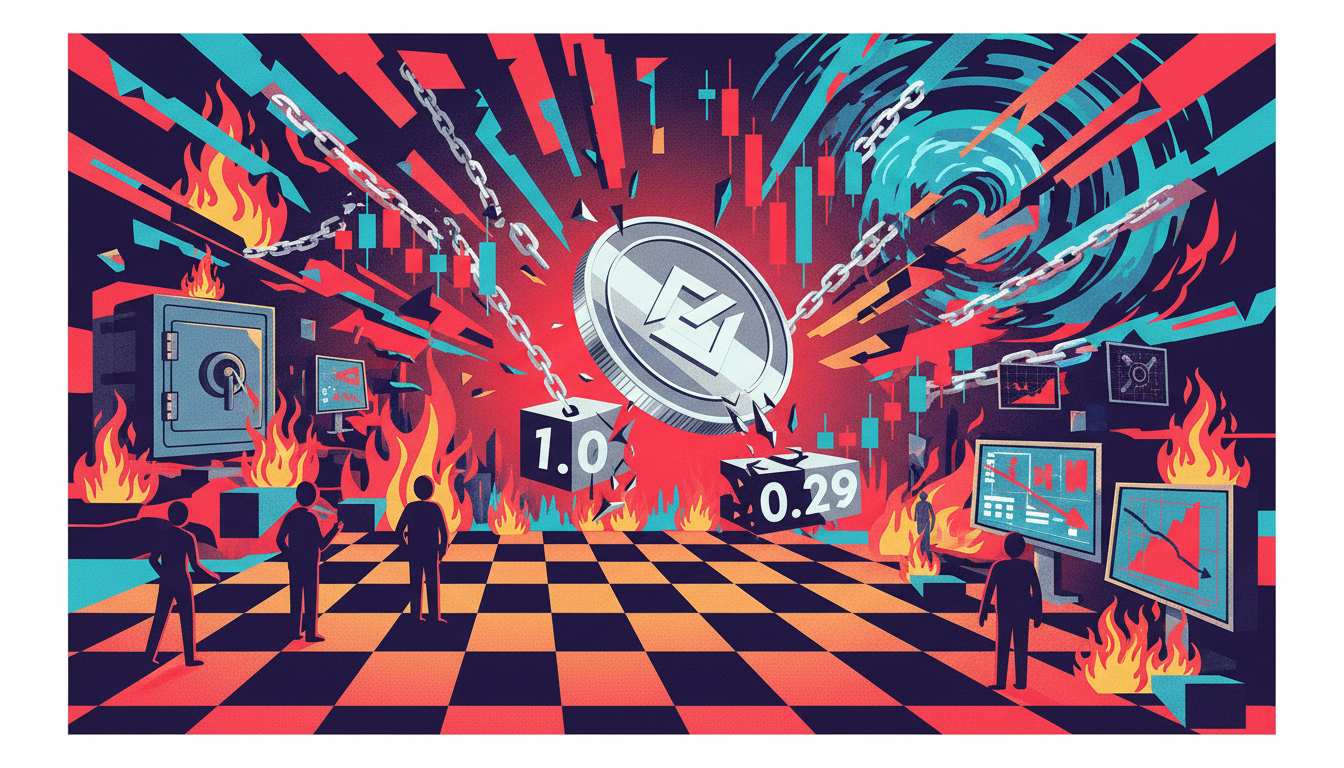
On March 22, 2026, a stable asset USR issued by Resolv Labs experienced abnormal minting, where an attacker used a mere 200,000 USDC to leverage 80 million USR, equivalent to approximately 80 million dollars. Before this mutation in the timeline on the chain, USR was still being minted and circulated according to the established logic, appearing normal; after the mutation, USDC was still staked, but the supply of USR exploded to two orders of magnitude. The price anchored at 1 dollar immediately plummeted to 0.257 dollars, while on the other end of the chain, 9,111 ETH of buy orders were quickly smashed out, creating a torn picture where one side saw the anchor collapse and the other side saw ETH chips being absorbed at low prices. The core of the conflict was exposed very directly: when the narrative of "1 dollar" instantaneously failed, the smart money chose to bottom out not in USR, but in ETH.
200,000 USDC leveraging 800...
Before this abnormal minting, the chain also provided a "seemingly reasonable" ratio: according to single-source data, there was an early minting record of 100,000 USDC→50 million USR, which already deviated from the conventional 1:1 pegging intuition, but it was still packaged as part of the mechanism design in the project narrative. As time progressed, the attacker used the shell of "normal interaction," first completing small, seemingly compliant minting actions, gradually figuring out the boundaries between collateral and issuance in the contract.
The real breakpoint appeared in the abnormal expansion of 200,000 USDC→80 million USR: still using USDC as collateral, the subsequent minting volume exhibited explosive amplification, far exceeding the early ratio of 100,000 USDC corresponding to 50 million USR. It was more like the attacker found a way to bypass or amplify the collateral constraints, where there were exploitable mismatches between collateral checks and issuance limits in the contract's minting permissions or verification logic. Although specific technical details have not been disclosed, the results are enough to explain: the amount of collateral did not double, yet the USR supply was amplified exponentially.
The anomaly was not initially revealed by market prices but by on-chain alarms from security monitoring. The security agency PeckShield was the first to issue a warning, directly pointing out the abnormal large-scale minting of USR and alerting participants to the liquidity risks that followed. This alarm effectively pressed the "public mode" button for the entire event—in that moment, the mismatches that originally only amplified within the contract were seen by the whole market and rapidly fed back into prices and confidence.
Exchanging USDC for USR and then into ETH...
From the attacker's perspective, this was a standard multi-hop arbitrage path: first, converting USDC into a large amount of USR through contract minting, and then further packaging these USR into wstUSR, utilizing the trading pairs and liquidity of the latter in different pools to complete the "wash-out" process. The research brief provided a clear path: USDC→USR→wstUSR→USDC/USDT→ETH, with each hop attempting to convert the "falling from the sky" USR into widely accepted high liquidity assets.
On-chain analyst Ai Yi clearly points out the role of wstUSR: wstUSR is not the destination, but a key transfer station in this cash-out chain. Through packaging and then unpacking, attackers can move chips between multiple pools, weakening a single market’s constraints on price and liquidity, increasing the success rate and efficiency of exchanging non-trust assets for mainstream assets. Simply put, wstUSR is the intermediary gateway that sends "problematic assets" into the mainstream liquidity scenario.
The final destination is ETH. Data shows that the attacker accumulated 9,111 ETH, worth about 17.24 million dollars at the time, accounting for approximately 21.5% of the total cash-out amount. This means that under the premise of being able to choose to fully exchange back into USDC, USDT, or other dollar-denominated assets, the attacker still staked more than one-fifth of the chips in ETH. This allocation may reflect trust in ETH's long-term liquidity and value-bearing capacity, while also indicating a sort of reverse bet against the credibility of dollar-pegged assets themselves—choosing to return to Ethereum instead of trusting the peg again right after a pegging mechanism has just been broken by the attacker is itself a stance.
The collapse scene of the peg: from 1 dollar to...
The price curve recorded the entire process of the collapse of the pegging illusion: USR fell from 1 dollar to 0.257 dollars in an instant, with a decline of 74.2%. For holders, this was not a typical fluctuation but an outright tearing up of the pegged narrative—the promise of "always equal to 1 dollar" became invalid almost in an instant, forcing holders to rush to sell in extreme slippage, turning panic escapes into a stampede. At this moment, regardless of what linked mechanisms or liquidation logic were written in the white paper, the price on the screen was the true trust vote.
What is more jarring is that afterward, the price rebounded from 0.257 dollars to 0.7847 dollars, achieving a short-term rebound of about 205%. This rebound was not a restoration of the peg, but more like a temporary balance after the collision of buying and speculative forces: some bet on the event being repaired, the project team backing it, or the market having mispriced, while others simply aimed to profit from the "return from extreme panic to emotional recovery." As the price was pulled back to nearly the middle range around 1 dollar, it instead amplified the uncertainty expectations for future trends—it was neither as desperate as 0.2 dollars nor had it returned to pegging.
The abnormal minting directly pierced the core trust of "1 dollar must be redeemable." Once the market realized that the contract could mint a massive amount of tokens out of thin air under insufficient collateral or abnormal logic, then every piece of USR already in circulation had to be re-examined: how much real asset support is behind it? From a liquidity risk perspective, the problem becomes even sharper—abnormal minting combined with insufficient depth in trading pools, when a massive sell-off floods in, slippage is amplified, and price declines would present a "waterfall effect" far exceeding the sell-off scale itself, with panic emotions being secondarily accelerated in this technical amplifier.
Silence in Crisis: The project team's absence...
As of the current publicly available information, the Resolv team has not provided a complete technical review of this abnormal minting, nor disclosed the detailed process of internal response. In a crisis triggered by the failure of contract logic, what is missing is not just a statement of "we are investigating," but a transparent definition of the causes of vulnerabilities, risk boundaries, and potential impacts; this information void leaves the market to fill in the gaps with the most pessimistic imaginations.
More critically, the project team has not provided a clear path for handling and compensation for the abnormal minted USR, nor is there currently a verifiable public plan for how to deal with affected holders economically. In the pegged asset system, "who is the last backer" is often more important than short-term price fluctuations; when this is long-term ambiguous, the trust foundation of USR is not only weakened but systematically eroded.
The delay in official communication directly reflects on the pricing in the secondary market: price rebounds rely more on speculation and gamesmanship rather than improvements based on clear, verifiable information. Panic expectations self-circulate in the vacuum period—since no one can clarify the problem boundaries, the safest choice is to leave the market first; for those daring enough to take the risk, their pricing models can only function under the framework of "high risk + high discount," directly adding risk premiums onto the USR.
In comparison with how other similar events in the industry have been dealt with, the rhythm differences become clearer: some stablecoin or DeFi projects, upon encountering security incidents, provide initial technical explanations within hours, publish detailed reviews within 24 hours, and simultaneously disclose asset snapshots, compensation ideas, and subsequent upgrade plans. Even if these plans are not perfect, a clear timetable and action framework provides "anchor points" for prices and emotions. However, in this USR event, such "crisis public relations rhythm" has still been absent.
From USR aftershocks to similar tokens...
The USR incident is not just an isolated contract alarm but has lowered the entire market's tolerance for the "pegging model." Numerous projects that utilize complex collateral, re-collateralization, and algorithmic adjustments inevitably find themselves under the spotlight again—investors begin to question: where is the collateral? Is the minting logic verifiable? Is there a path similar to USR where a small amount of collateral can leverage large-scale minting? In a period of trust contraction, any project with unclear answers will face markdowns.
On the capital side, a natural path is to gradually shift from niche, structurally complex pegged assets back to mainstream assets such as USDC and USDT, or further into high liquidity assets seen as "underlying carriers" like ETH and BTC. In this event, the attacker actively converted 21.5% of the proceeds into ETH, adding new evidence to this narrative of "returning to main chain assets." For ordinary market participants, when mechanism details are hard to discern, "steering clear of complex pegging and gravitating toward simple assets" becomes an instinctual choice.
On the ETH side, abnormal buy orders temporarily provide thrust to both price and narrative. The concentrated purchase of 9,111 ETH is not only a numerical increment but also story material: on one hand, it reinforces the imagination that "black swans can also provide a lifeline for ETH," and on the other hand, it provides a new case for "ETH as the ultimate carrier asset for systemic risk." However, this sentiment amplification is more about short-cycle emotions and does not mask the underlying reality of losses incurred by others and system failures.
From an industry perspective, what should be remembered more is the collective reflection on the transparency of contract audits and minting mechanism design. The USR incident exposed not just a single-point bug, but a whole set of systemic weaknesses related to minting permissions, collateral verification, limit control, and missing abnormal monitoring. In the future, merely having the label "audited by a certain firm" will be far from sufficient; the community will place greater emphasis on whether audit reports are public, whether issues are clearly marked, and whether minting and destruction logic can be independently verified. Otherwise, "1 dollar" pegging will increasingly resemble a shared illusion.
After the demise of the pegging myth: funds will remember...
Looking back at this incident, the deadly gaps concentrate on two levels: first, the minting mechanism itself lacks rigid constraints, allowing for an amplifiable mismatch between collateral and issuance; second, risk control and monitoring systems failed, failing to automatically cut off during the early stages of abnormal minting, allowing the attacker to complete a full arbitrage loop from USDC to USR and then to ETH. The combination of technical defects and governance deficiencies ultimately evolved into the collective collapse of the pegging myth.
For investors, this incident is undoubtedly an intuitive reminder: when facing high-yield, complex mechanism-packed pegged assets, one must establish their own risk control red line. At the very least, there should be clear bottom-line answers to several questions—Can one clearly state what the collateral is, where it is, and how it is managed? Is minting and redeeming verifiable on-chain? In extreme cases, who will provide the backing and in what manner? When these questions can only be filled by "trusting the team," any additional yield is just a payment of principal for invisible risks.
In the longer term, this incident will also compel the elevation of regulatory and audit standards. Whether it is the market supply of on-chain native audits or the capital, disclosure obligations, and risk reserve requirements for issuers of pegged assets under compliance frameworks, the thresholds are bound to be re-discussed and re-established. The pegged projects that can survive in the next cycle may not be the ones that tell the best stories, but those with the simplest transparency, and clearest risk boundaries.
In the short term, the market will continue to oscillate between "betting on rebounds" and "completely exiting," with prices still giving various dramatic fluctuations; but the long-term rebuilding of trust will be a long and costly road. The pegging myth that has been punctured once is unlikely to regain recognition in the same form—funds will remember the entire process where 80 million USR were minted in an instant, USDC was leveraged, and ETH was absorbed on a large scale. For the entire industry, this is both a wake-up call and a filter: who truly cares about mechanism safety and transparency, and who simply uses the shell of "1 dollar" to play more aggressive leverage, the answers are slowly revealing on-chain.
Join our community to discuss and become stronger together!
Official Telegram group: https://t.me/aicoincn
AiCoin Chinese Twitter: https://x.com/AiCoinzh
OKX welfare group: https://aicoin.com/link/chat?cid=l61eM4owQ
Binance welfare group: https://aicoin.com/link/chat?cid=ynr7d1P6Z
免责声明:本文章仅代表作者个人观点,不代表本平台的立场和观点。本文章仅供信息分享,不构成对任何人的任何投资建议。用户与作者之间的任何争议,与本平台无关。如网页中刊载的文章或图片涉及侵权,请提供相关的权利证明和身份证明发送邮件到support@aicoin.com,本平台相关工作人员将会进行核查。