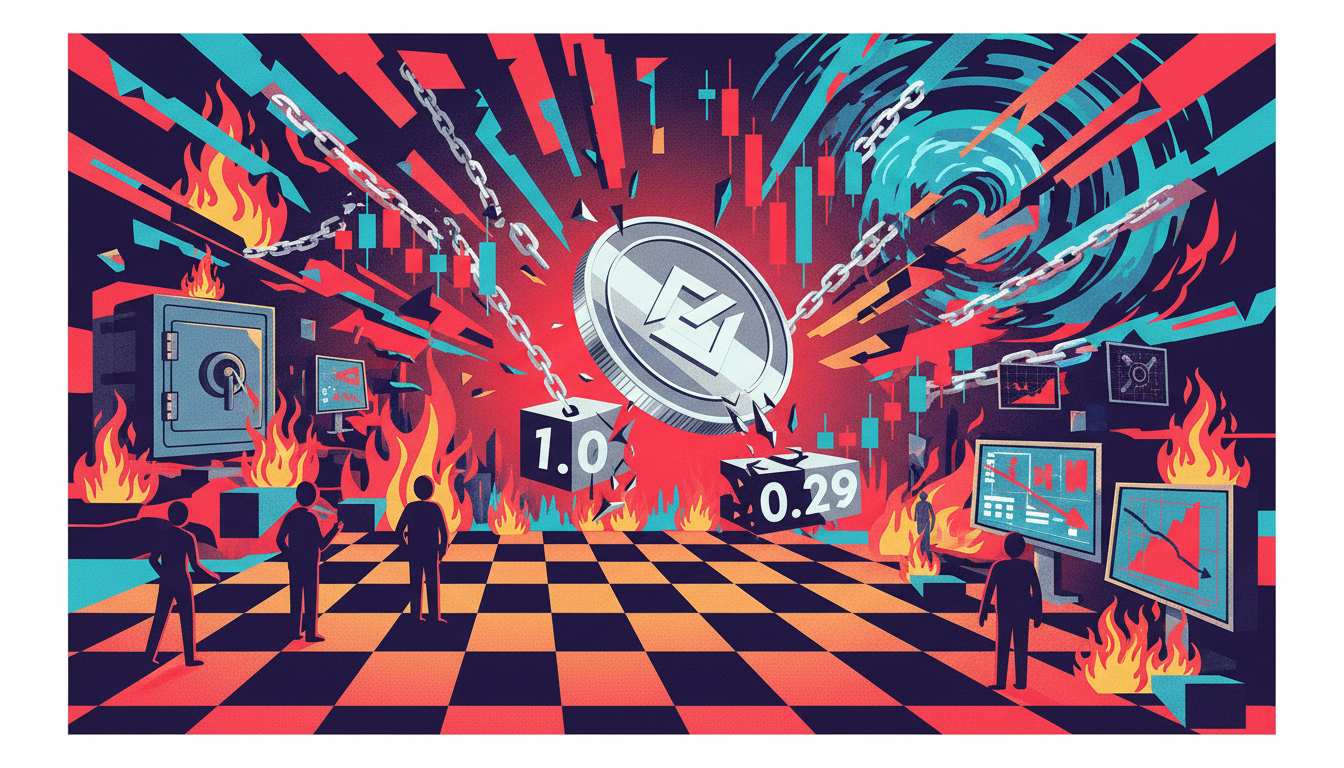
This week in UTC+8, the stablecoin USR under ResolvLabs experienced a complete uncontrolled chain reaction from abnormal minting to price collapse in a very short time: the attacker utilized only around 100,000 USDC to leverage an abnormal minting of 50 million USR, and subsequently converted most of it into derivative assets, exchanging back for approximately 4.55 million USD worth of ETH to exit. On-chain data and market conditions pointed to one conclusion: within hours of the contract being exploited, the peg of USR collapsed entirely, with the price plummeting by as much as 74.2%, instantly losing its pricing foundation as a token supposedly pegged to the dollar. What truly shocked the market was not just the vulnerability itself, but how it, without warning and lacking effective responses, completely pierced through the two pillars of "safety" and "pegging" that stablecoins rely on for survival, leaving behind a trust that was utterly destroyed.
100,000 U Leveraged 50 Million Coins
From public chain information, the starting point of this storm was an extremely asymmetric minting action. According to tracking by on-chain analyst Ai Yi, the attacker exploited a vulnerability at the protocol level, minting 50 million USR with only about 100,000 USDC, completely deviating from the basic principle of "equivalent minting" under normal pegging logic. This operation formed a clear flow of funds on the blockchain: a small input of stable assets corresponded to a large one-way output of USR, exposing a deadly gap in contract control and risk management design.
After the abnormal minting was completed, the attacker did not stop at USR, but quickly pushed for structural upgrades. On-chain data indicates that approximately 35 million USR was further converted into wstUSR and other derivative forms, also marked by Ai Yi in the on-chain path. This conversion enhanced the attacker's flexibility in mobilizing chips between different protocols and laid the groundwork for subsequent large-scale cashing out. In a short time, the total supply of USR was instantly amplified, far exceeding the protocol's original risk management assumptions; while the depth of the primary liquidity pool did not expand accordingly, leading to a sharp deterioration in market expectations under the logic of "supply surge—value dilution," and prices began to show visible loosening.
For any token claiming to be pegged to the dollar, such disproportionate minting is, in essence, a public tearing of the credibility of the issuance system. The total supply that should have been underpinned by real collateral and auditing was easily rewritten after a contract was exploited, breaking the balance between circulating structure, pool depth, and expected pegged price on the spot, leading the market to reprice "Is this still a trustworthy pegged asset?"
Cash Out of 4.55 Million USD Completed: A Fatal Blow from On-chain Amplification
After the abnormal minting and asset conversion were completed, the attacker's goal became more direct: to extract the chips in hand as mainstream assets. According to publicly available chain data and various compilations, the attacker gradually exchanged the held wstUSR and other assets for ETH, ultimately achieving a cashing out scale of approximately 4.55 million USD worth of ETH and completing the fund migration. The entire attack path—from injecting USDC, abnormal minting of USR, converting to wstUSR, to exchanging in batches for ETH—has been summarized by multiple media as "The attack path has been clearly restored on-chain", becoming a typical case that can be researched and reviewed.
However, for users providing liquidity for USR at that time, this "learnable path" meant something else: the liquidity pool faced a rapid depletion under the continuous assault of large sell orders. Due to the originally limited depth of the pool, when the attacker sold off large chips, the automated market maker mechanism was forced to constantly lower prices to absorb the orders, amplifying the slippage exponentially. Under the influence of this on-chain microstructure, even though the total cashing out by the attacker was only 4.55 million USD, the damage caused to the price and remaining assets in the pool far exceeded this absolute figure.
At every matching moment during the attack, the curve pricing logic was pushed to extremes: buying power was scarce, and selling pressure concentrated surged, leading to the rupture of the illusion of virtual liquidity within the protocol; the real funds available to absorb orders were far from sufficient, forcing the counterparties to take orders at continuously deteriorating prices. The liquidity pool's "depletion" and the "amplification" of slippage accelerated the free fall of prices and hastened the comprehensive exit of external funds from this asset.
Peg Collapse of 74%: A Free Fall of a Pegged Asset
As the abnormal minting and large-scale cashing out progressed in tandem, the price of USR began to deviate from the pegged range near 1 USD. According to data from sources such as techflow, USR experienced a maximum drop of 74.2% during this event, meaning it plummeted from close to the 1 USD pegged target to below one-fourth of its original level. The price curve first gently slipped from its peg and then, as the liquidity in the pool rapidly exhausted and sentiment shifted from wait-and-see to panic, evolved into a stampede-style decline—participants leaving later faced transaction prices increasingly close to the "liquidation price" rather than the "pegged price."
In market commentary, "exposing the serious risks of protocol security and stablecoin pegging mechanisms" became a frequent expression. On one hand, the exploitation of vulnerabilities indicated a clear gap in the contract-level defense; on the other hand, the deeper issue was: once an extreme event was triggered, the peg design of USR did not demonstrate sufficient self-repair capabilities. With no effective repurchase mechanism, no transparent and timely disclosure of collateral assets, and no emergency plans to supplement external liquidity in a short time, once the price fell below key psychological ranges, it could no longer be rescued.
Structurally, USR likely has an excessive reliance on internal liquidity and internal collateral structures. In the absence of sufficient high-quality external assets, independent custody and audit support, once overscaled minting breaks the collateral rate balance, it creates a significant gap of "paper collateral—realizable collateral." The collateral rate may still make sense on paper, but in on-chain reality, the high liquidity assets available to support repurchase and redemption are far from sufficient, rendering any promise about "pegging" rapidly ineffective in extreme scenarios.
The Cost of Project Silence: The Absence of Crisis Response
In this process from vulnerability exploitation to price plummeting, another issue that was constantly amplified was ResolvLabs' absence in public opinion and information. According to currently available materials, the official explanation, details disclosure, and repair path concerning this incident remain absent or severely delayed. For users experiencing price declines and asset shrinkage, "not knowing what happened" and "not seeing what the project team is doing" often proves more damaging than the bad news itself, as the information vacuum is rapidly filled with panic and rumors.
In contrast to the crisis response strategies of other pegged assets in the industry—such as initiating emergency repurchases in a short time, using reserve assets for subsidies, publicly providing third-party audit and collateral structure details, and collaborating with major exchanges to limit abnormal trading—the responses in this incident appeared particularly feeble. There was no clear technical explanation regarding the vulnerability exploitation, no compensation framework for affected users, and no timetable for subsequent governance and risk management upgrades, which further eroded already fragile trust.
In the absence of clear compensation and repair paths, the rational choice for funds often boils down to one: to vote with their feet and withdraw all exposures related to the protocol as soon as possible. This capital flight is not limited to USR itself, but may also affect other contracts and assets within the entire Resolv ecosystem—any protocol with a deep binding relationship will be viewed as a potential risk source. The silence during the crisis is not just a public relations blunder; it is a relinquishment of the entire ecosystem's credit structure.
Whale Activity and Macroeconomic Shadows: The External Context of This Explosion
If we broaden the perspective from a single protocol, we can see that prior to and after this incident, the overall market environment was also not lenient. The on-chain data service Onchain Lens pointed out that recently, whale addresses on the Ethereum network have been very active, with a particular address withdrawing a total of 8,662 ETH from exchanges in the past month, equivalent to about 18.23 million USD at that time's prices. This continuous outflow of large funds not only shows that big holders are reconfiguring their positions but also indirectly compresses the on-chain available liquidity, leaving smaller participants with an even tighter "buffer" when extreme events occur.
On a macro level, a research report from Xinda Futures mentioned that rising energy prices are pressuring the performance of gold, indicating that traditional safe-haven assets are also undergoing a tug-of-war between costs and returns. In such an environment, the overall pricing of risk assets becomes more conservative, and any commitments about "safety" and "pegging" are scrutinized by the market under higher standards. The USR explosion was not directly triggered by these macro and whale dynamics; however, it occurred in a time window where risk appetite was already tight and liquidity sensitivity was higher, undoubtedly amplifying investors' cautious sentiment toward all crypto risk assets.
Therefore, when the attack occurs, prices begin to get out of control, and large holders continue to maneuver their positions between mainstream assets, the originally supportive market condition reliant on "overall good sentiment" simply does not exist. The problem with USR is endogenous, but it detonates in a market that is less willing to give errors a second chance.
Lessons from the USR Explosion for the Survival Line of Next-Generation Pegged Assets
Looking back at the entire event, two core lessons can be clearly delineated. The first is the insufficient contract security and auditing: a vulnerability that can be leveraged by 100,000 USDC to mint 50 million USR fundamentally represents a failure of contract permissions and boundary design, as well as a result of the auditing and testing processes not covering extreme scenarios. The second is the lack of attack resistance design in the pegging mechanism: after experiencing abnormal minting and liquidity attacks, USR did not show sufficient self-repair capabilities, lacking from collateral asset disclosures to emergency repurchases, and from external liquidity support to the restarting of clearing rules—all of which were absent or severely delayed.
For the emerging pegged assets that will continue to surface, a more stringent observation framework is taking shape. First, there is transparency: whether there is real-time and verifiable disclosure of collateral assets and liabilities, rather than relying solely on white paper narratives. Secondly, external audits: whether security audits are conducted by multiple independent entities and continuously followed up after contract upgrades, rather than being a one-off job. Thirdly, the quality of over-collateralization: whether the collateral is sufficiently high liquidity, low discount, and can quickly be realized under market pressures to support repurchases. Finally, extreme scenario stress tests: whether the protocol has ever publicly disclosed emergency plans and simulation results for scenarios like "single-point large-scale minting, liquidity pool draining, and mainstream asset price shocks."
In the future, whether among regulators, institutional funds, or veteran DeFi users, there will be voting with their feet on these dimensions. Projects lacking transparency, audits, and high-quality collateral support may find it difficult to withstand the next wave of uncertainty, even if they grow quickly in scale in the short term. The protocols that can deliver high scores in contract security and pegging mechanisms may become survivors in the new generation of pegged asset landscapes after rounds of incidents and eliminations. The collapse of USR has sounded a more urgent alarm for this round of scrutiny.
Join our community, let's discuss and get stronger together!
Official Telegram community: https://t.me/aicoincn
AiCoin Chinese Twitter: https://x.com/AiCoinzh
OKX benefit group: https://aicoin.com/link/chat?cid=l61eM4owQ
Binance benefit group: https://aicoin.com/link/chat?cid=ynr7d1P6Z
免责声明:本文章仅代表作者个人观点,不代表本平台的立场和观点。本文章仅供信息分享,不构成对任何人的任何投资建议。用户与作者之间的任何争议,与本平台无关。如网页中刊载的文章或图片涉及侵权,请提供相关的权利证明和身份证明发送邮件到support@aicoin.com,本平台相关工作人员将会进行核查。