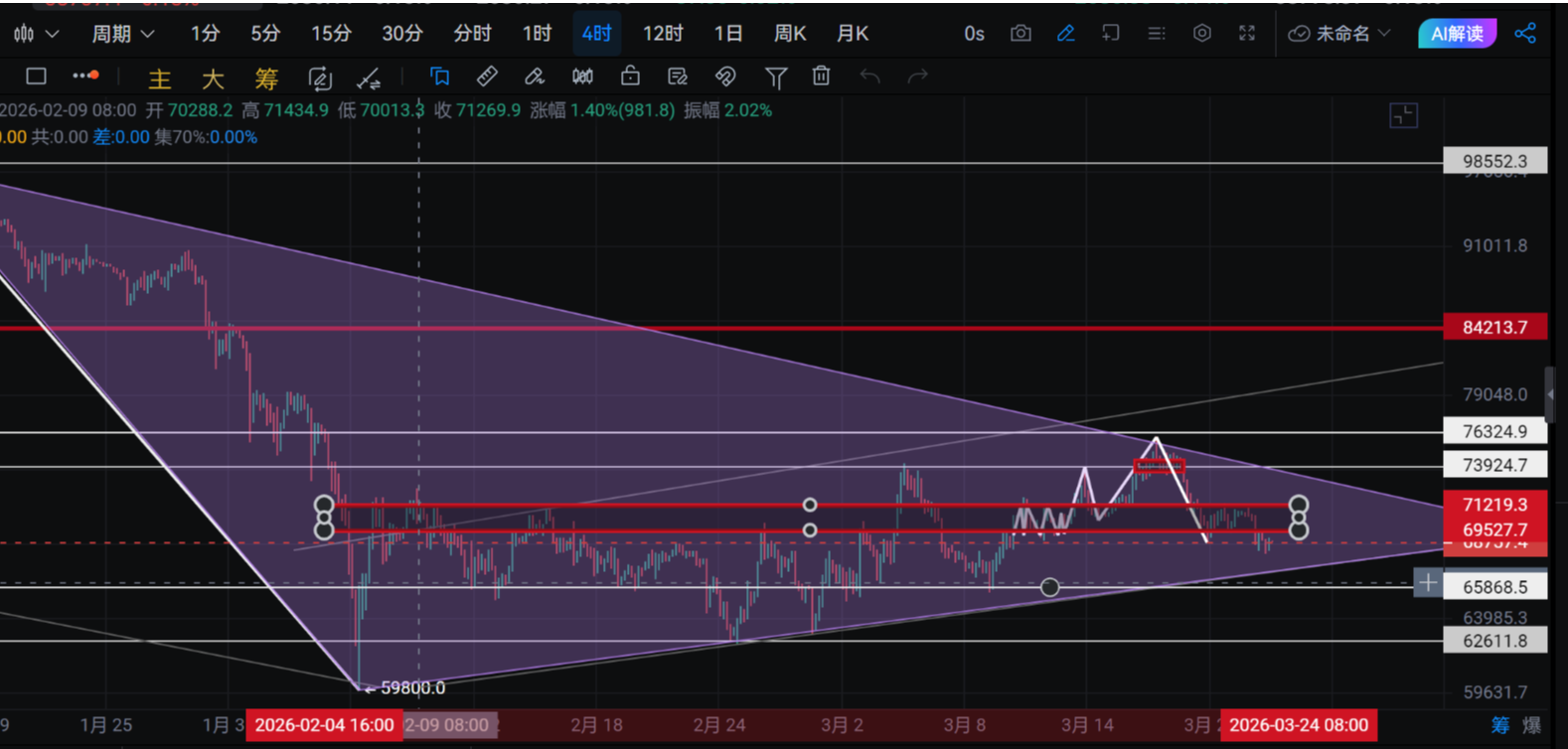
On March 22, at 8:00 AM UTC+8, a whale address on Hyperliquid, widely believed to be associated with Erik Voorhees, added a margin of 5 million USDC to its contract account, choosing to maintain, rather than reduce, a substantial long position ahead of increased volatility and regulatory thresholds. On-chain and media data indicate that the total nominal exposure of this address is approximately 298 million USD, corresponding to high-leverage long bets on ETH and BTC. This choice of staying exposed under 15 to 20 times leverage amplifies the risks of liquidation and passive position reduction, causing the entire market to remain on high alert for potential volatility and chain reactions. With the countdown to the new SEC and CFTC joint regulatory framework set to officially take effect on March 23, the defensive addition of margin raises the core suspense of whether it is self-preservation unwilling to exit passively during the window period or a gamble betting on minimal regulatory impacts.
A high-leverage combination of 120,000 ETH and 700 BTC
From the position structure, this Hyperliquid whale currently holds approximately 120,000 ETH long, with a leverage ratio around 15 times; additionally, it has accumulated about 700 BTC with a 20 times leverage long. Together, they form a nearly 298 million USD nominal long exposure, creating a highly symbolic concentrated bet on a single platform. According to media-disclosed data, this position shows that the ETH portion currently has an unrealized loss of about 309,000 USD, while the BTC portion holds an unrealized gain of approximately 403,000 USD, presenting a slightly neutral overall stance that could shift with minor price fluctuations.
On-chain analyst Ai Yi interprets this addition of 5 million USDC as a typical “defensive margin call” — not actively increasing leverage to amplify returns when trends are clear, but supplementing a safety cushion amid account volatility and regulatory uncertainties to avoid triggering liquidation. This operation implies controlling risks by increasing available margin, postponing the time for the system’s risk control to be activated, and providing more space for waiting for market reversal. However, these risks have not vanished, as high leverage and concentrated platform risks still loom overhead.
At the market level, such a position of nearly 300 million USD nominal value, concentrated on a single contract platform, naturally amplifies the overall volatility and potential chain reaction effects. Should the market trend adversely, passive position reduction or cascading liquidations from a single address could lead to severe price slippage on the Hyperliquid order book, which, in turn, could drive broader market volatility through cross-platform price discrepancies and sentiment transmission. This is why many institutions, when evaluating this position, not only focus on its absolute size but are also concerned about the systemic risk factors aggregated from leverage ratios and platform concentration.
From bottom fishing to dead holding: two interpretations of the whale's position trajectory
Tracing this whale's historical positioning, a clear trajectory of long-term heavy investment in ETH emerges. Public data statistics show that this address has cumulatively purchased 120,305.4 ETH, averaging a holding cost of about 2159.71 USD/each, indicating that its overall strategy is not short-term speculation but a continuous bet on ETH’s medium to long-term performance from an earlier stage. By March 22, at the critical moment of intertwining market volatility and regulatory countdown, this address further bought 2491.44 ETH at an average transaction price of approximately 2134 USD, lowering the cost of added chips closer to the lower end of the previous overall cost range, thus reducing the overall holding cost to some extent.
Comparing current prices with this historical cost curve reveals the whale's complex situation: on one hand, the long-term position has not deviated extremely from the overall cost, granting some space to “withstand volatility”; on the other hand, under high-leverage amplification, even if the current price is close to the average price, the erosion of margin consumption and floating gains/losses would still be magnified. The recent purchase and margin addition on March 22 raise the focus of market debate on whether it is an active position increase betting on a short-term rebound, or a “dead hold” under pressure unwilling to acknowledge mistakes.
From a strategic perspective, this action encapsulates both “defensive add-on” and “aggressive accumulation” interpretations. The defensive aspect lies in supplementing margin and slightly increasing holdings to push liquidation prices further away, seeking larger maneuvering space before volatility escalates; the aggressive aspect, on the other hand, takes the opportunity to increase bets near the cost range, which, if the market rebounds as expected, could repair unrealized losses and amplify profits. The impact of these two interpretations on market sentiment is entirely different: the former reinforces risk hedging and caution, warning smaller participants about leverage risks; the latter may be perceived by some speculators as a signal of “smart money bottom fishing,” driving a herding effect of increasing leverage, further accumulating systemic risks.
A high-leverage gamble ahead of regulatory countdown
Coinciding tightly with this position is a crucial regulatory milestone – on March 23, the new regulatory framework jointly released by the SEC and CFTC will officially take effect, replacing outdated regulations that have been in place since 2019. Symbolically, this marks the transition of the overall framework for US regulation of crypto derivatives and leveraged trading into a new phase, with markets widely expecting the new rules to adopt a more cautious stance on high leverage and complex derivatives, tightening rather than loosening compliance thresholds and risk control requirements.
Without touching on specific terms, the consensus surrounding this new framework indicates heightened regulatory sensitivity towards forms of risk exposure such as high leverage and complex cross-product combinations. This is why multiple media outlets quoting institutional comments note that maintaining a cross-product long combination with 15 to 20 times leverage during such a regulatory window is an “extremely risky” operation. It is not that these positions will immediately violate explicit prohibitions, but rather that the uncertainties of the regulatory environment itself will compound market volatility, compressing the survivability of high-leverage strategies and placing greater compliance and public pressure on relevant platforms and participants.
From a directional standpoint, if the new rules indeed manifest a "tightening" path at the execution level, then similar high-leverage cross-product long positions will likely face higher margin requirements, more stringent risk limits, and business restrictions in certain jurisdictions in the future. Platforms may increase risk control thresholds for large single exposures out of self-preservation, or even limit certain high-risk strategies; meanwhile, capital will consider restructuring leverage in more regulatory-friendly and transparent environments. This makes the current position resemble both the “tail” of the old regulatory era and an extreme probe into the boundaries of the new regulations.
A liquidity and sentiment vortex triggered by a single position
From Micro to Macro, this nearly 300 million USD nominal position held by a single address presents a high-pressure test for the order book depth and clearing engine within Hyperliquid. Concentrated high leverage on a single subject and single strategy may seem merely a numbers game on paper when the market trends favorably, but if price fluctuations hit critical thresholds, significant passive position reductions could swiftly drain local liquidity, amplifying slippage and short-term price deviations, creating immense pressure on the clearing system. Even though external observers may not grasp the specific risk parameters and clearing mechanism details of this platform, the nominal scale and leverage ratio alone suffice to recognize this as a heavyweight position capable of impacting local market structures.
If this whale is forced to significantly reduce positions or triggers a series of cascading liquidations, the influence will not be limited to just one platform. Arbitrage funds will quickly transport price differentials across major trading venues, amplifying price declines through quantitative strategies; the spot and other derivatives markets will be forced to drop further under panic and strong liquidation pressure, dragging overall liquidity down even more. On the sentiment level, the on-chain community and media have begun interpretations around the label of “defensive operation,” with both sides of the debate leveraging this position to support their narratives. Once the price movement verifies one side's predictions, this social narrative will further reinforce itself, leading to a classic self-fulfilling prophecy — either a legendary tale of "smart money weathering the regulatory storm," or a cautionary case of "high-leverage gambling being harvested during the regulatory window period."
At a deeper level, the highly concentrated, high-leverage positions expose the fragile reality of the overall industry's liquidity structure: who is footing the bill for whale leverage? On the surface, many institutions and retail investors provide counterparty liquidity and market-making depth, engaging in asymmetric bets over profits and risks; at a deeper level, there is an overwhelming dependence of the entire crypto derivatives market on a few large players — when these players are on the windward side, they provide liquidity and narratives; when they are on the leeward side, they leave behind passive participants enduring sell pressure and a reshaped risk appetite.
The ongoing regulatory game: the retreat and migration of the high-leverage era
In summary, the decision of the Hyperliquid whale to add 5 million USDC in margin on March 22, maintaining a high-leverage long position of nearly 300 million USD, coincides with the eve of the new regulatory framework by the SEC and CFTC taking effect on March 23, becoming a typical microcosm and barometer of the transition between old-era risk appetites and new-era regulatory logic. On one side rests a heavily weighted path of cumulative purchases of 120,305.4 ETH at an average cost of 2159.71 USD each, along with a “dead hold” posture; on the other side are the dual pressures of regulatory uncertainty and liquidity structural fragility, with high-leverage positions naturally becoming the most vulnerable and closely watched aspect of this round of the game.
In the short term, the market will struggle to rapidly find a new balance between regulatory expectations and liquidity realities. The formal implementation of new rules may mark an event node, but true adjustments are often gradual: platforms will repricing risks on limits and risk control strategies, institutions will recalibrate leverage levels amidst compliance costs and returns, and retail investors will reshape their acceptance of high leverage after witnessing several rounds of strong liquidations or gambling stories. During this tugging period, positions such as the Hyperliquid whale's will continue to be scrutinized under a microscope; every time they add to or reduce positions will influence layers of market sentiment and price fluctuations.
Looking ahead over a longer cycle, as the SEC and CFTC new regulatory framework gradually rolls out and becomes refined, leading players are likely to migrate away from today's highly concentrated, extreme leverage gamble model towards a more transparent, decentralized, and structured leverage configuration. This will include diversifying exposures across multiple platforms, reducing leverage multiples on single strategies, and introducing more hedging tools as normalized options after the restructuring. Traditional gambling models that rely on extreme multiples, bet on a single direction, and concentrate on a single platform will gradually be pushed to the margins — not because the market no longer loves risk, but because in the new order shaped by regulatory and liquidity realities, those who can survive and continue to bet are often no longer the most aggressive.
Join our community, let's discuss, and become stronger together!
Official Telegram community: https://t.me/aicoincn
AiCoin Chinese Twitter: https://x.com/AiCoinzh
OKX Rewards Group: https://aicoin.com/link/chat?cid=l61eM4owQ
Binance Rewards Group: https://aicoin.com/link/chat?cid=ynr7d1P6Z
免责声明:本文章仅代表作者个人观点,不代表本平台的立场和观点。本文章仅供信息分享,不构成对任何人的任何投资建议。用户与作者之间的任何争议,与本平台无关。如网页中刊载的文章或图片涉及侵权,请提供相关的权利证明和身份证明发送邮件到support@aicoin.com,本平台相关工作人员将会进行核查。