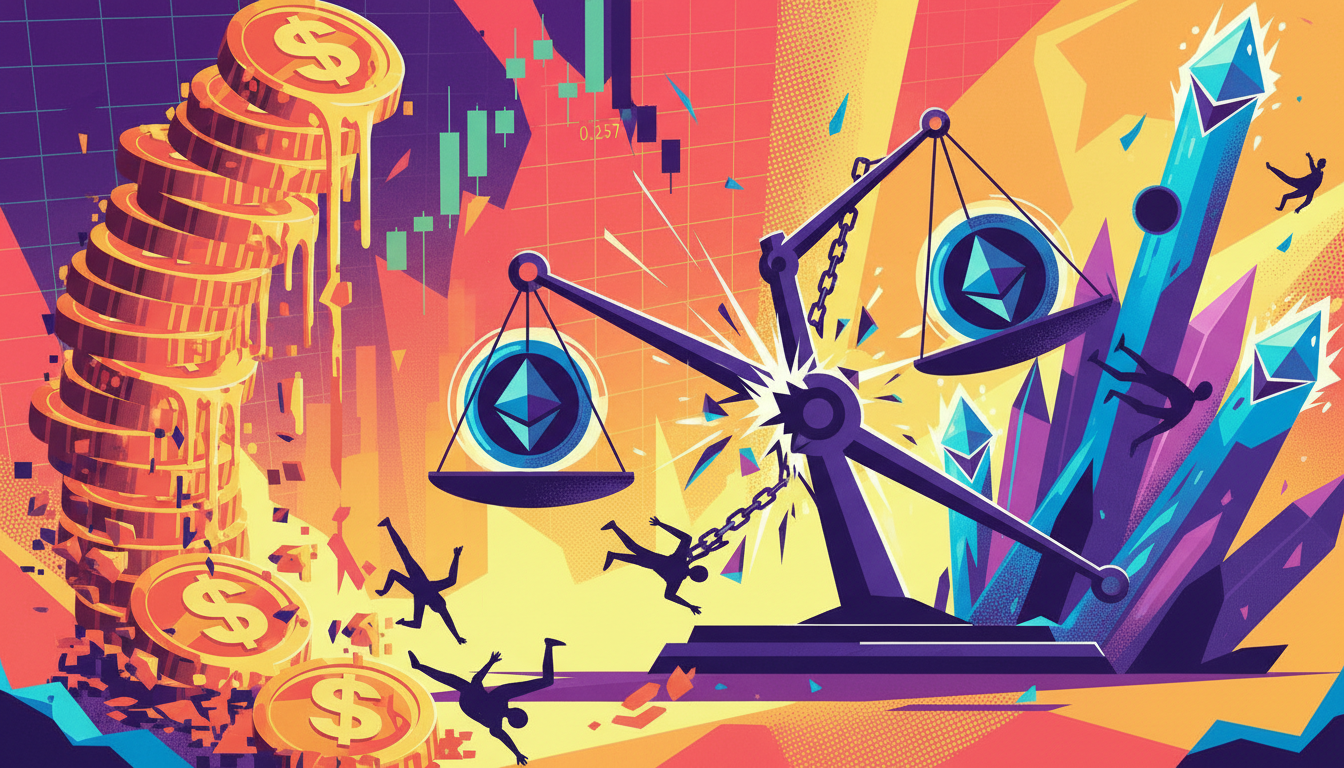
At 9 AM on March 23, East Eight Time, the Musk faction jointly announced the TERAFAB project, proposing an aggressive target of an annual production of 1 terawatt computing chips, where 80% will be used for space scenarios and 20% allocated to ground computing power, attempting to rewrite the computing landscape between orbit and the surface. Almost at the same time, defi.eth, once regarded as a totem of the DeFi spirit, was sold for 15 ETH, corresponding to about $32,337, which is a discount of up to 62.5% compared to its historical price of 40 ETH in 2022. On one side, space technology and semiconductor ambitions are accelerating toward their peak, while on the other side, the narrative premium of Web3 identity assets is cooling rapidly. This misalignment creates the most dramatic contrast at present: will the next round of technological dividends mainly flow to physical computing power and chips, or will it still feed back into crypto assets, forcing on-chain assets like ENS to undergo a round of deep repricing?
Musk Bets on Space Computing Power: 1 Terawatt Target Leverages Computing Landscape
At 8 PM Central Daylight Time on March 22 (9:00 AM Beijing Time on March 23), SpaceX and Tesla jointly unveiled TERAFAB, which is seen as Musk's first formal and public foray into chip manufacturing. The release scenario was not just a simple product showcase but was packaged as “the next key puzzle piece after Starlink,” using chip manufacturing to complete the computing power loop from rockets, satellites to data centers, with the time frame deliberately chosen during a global sensitivity period for AI and computing power.
The most impactful number thrown out by TERAFAB is its annual production plan of 1 terawatt-level computing chips, with a clear allocation ratio of 80% for space and 20% for ground. The former points to Starlink satellites, orbital data centers, and space edge computing, while the latter may penetrate traditional data centers and AI training scenarios. This “space-first” allocation structure directly pushes the computing landscape from traditional ground data centers and cloud vendors towards orbit and near-Earth space, leaving the market with enormous room for imagination: will high-value computing power first settle in space while the ground only receives a “spillover” of 20% allocation?
Industry observers have made definitive judgments, with some expressing that “TERAFAB could reshape the semiconductor supply chain”. The sensitivity of this matter is not in the performance of a single chip but in Musk binding “self-manufactured chips” with “private satellite constellations” and “self-built data centers,” attempting to merge upstream manufacturing with downstream computing power requirements within the same group system, thus altering the existing power balance centered around Taiwanese, Korean, and American giants in the OEM-design-cloud service chain.
This also marks the first direct entry of the Musk system into semiconductor manufacturing, meaning Tesla, SpaceX, and Starlink are no longer just major customers or system integrators, but might evolve into upstream suppliers, posing potential threats to traditional semiconductor giants and the AI computing power landscape. When a group that simultaneously controls rockets, satellites, and terminal applications starts manufacturing its own chips, the absolute advantages of NVIDIA, Taiwanese OEMs, and cloud giants in future computing power supply and pricing are being re-evaluated by the market.
From Identity Totem to Discount Chip: The Price Collapse of defi.eth
In stark contrast to the high-flying narrative of space chips, defi.eth’s latest transaction price has dropped to only 15 ETH, which, converted to current prices, is about $32,337. The data for this transaction is clearly trackable, embodying the speed of decline of Web3 identity assets: a top-tier ENS once viewed as “the ultimate domain for DeFi purists” can now barely benchmark a mid-tier NFT blue-chip side position in the public market.
If we rewind the timeline to 2022, the same defi.eth was sold for a high price of 40 ETH. At that time, mainstream sentiment viewed it as “the ultimate domain for DeFi fundamentalists,” with its price containing a massive narrative premium. In absolute terms, the fall from 40 ETH to 15 ETH represents a nominal pullback of 62.5%, which not only consumes all the gains from the bubble period but also impacts holders’ belief that “high-quality ENS will not suffer deep declines.”
Some NFT analysts bluntly state, “the discounted transaction of defi.eth reflects a liquidity crisis of .eth domain names”. The crux of this judgment lies not in the single price point itself but in: even such ENS domains considered “top-tier” must accept a price significantly lower than historical peaks to find a buyer, while also bearing the reality of extended transaction cycles and passive surrender of negotiation space. This indicates that the valuation system of ENS is being rewritten, with the market no longer willing to pay such high multiples for “stories” alone.
Over the past complete cycle, top ENS domains were widely regarded as symbols of on-chain identity, binding to Twitter IDs, DAO identities, and even project brands, heralded as “the .com of the Web3 era.” Holders were willing to pay high prices because they believed it represented certain discourse power and social capital within the community. But when such a symbol can ultimately only cash out in real-world gains, and at a severe discount, the psychological gap shifts from “I am guarding an identity label” to “I am merely dealing with a liquidity-strained chip.”
Emotional Shift: The Collapse of ENS Valuation and the Attention Contest of Computing Narratives
When even a quality ENS like defi.eth requires significant discounts to change hands, it serves as an intuitive reflection of the overall contraction of NFT and on-chain asset liquidity. If a domain once regarded as a “top-tier product” is this way, one can imagine the pressures on other mid-tier ENS and long-tail NFTs in liquidity and pricing. The price halving behind it reflects the disappearance of proactive buying and the rise of passive selling; the circulation channels remain, but bargaining power has clearly shifted toward buyers.
The traditional “narrative premium” is rapidly losing attention in this round of cycle switching. DeFi themes, identity symbols, and DAO tokens that were once protagonists are being pushed to the margins by new narratives like “AI + computing power” and “semiconductors + space infrastructure.” The focus of funds, media, and social discussions is increasingly concentrated on “real computing power” and “supply chain control,” rather than on a governance token of an abstract protocol or a catchy on-chain ID. This transfer of attention directly impacts the valuation of purely narrative-based ENS.
In contrast, the release of TERAFAB sparked extensive discussions in tech and investment circles, with keywords like “annual production of 1 terawatt” and “reshaping the semiconductor supply chain” naturally aligning with the current macro environment's risk appetite; while the on-chain data and transaction records of the ENS market are notably quiet, transactions like defi.eth have gained topicality precisely due to “discounts” and “exits.” One is a future infrastructure story pursued by capital and media, while the other represents a past identity asset being liquidated. The temperature of sentiment between the two is practically synchronously widening on the timeline.
In this environment, the valuation path for ENS is difficult to maintain solely based on narrative premiums. A more realistic possibility is to transition from emphasizing “totems and symbols” to valuing based on cash flow, usage frequency, and integration level. The ENS that can maintain relatively robust value in the future may not be the catchiest words but rather domain name combinations that are genuinely widely called upon by protocols, wallets, and applications, generating registration fees and renewal income. The pricing logic for on-chain identity assets will shift from “how nice it sounds” to “how much sustainable usage and income it can bring.”
Political Clouds and Technological Bets: Trump’s Approval Rating and Capital Hedging Paths
At a macro level, crypto media has repeatedly amplified Trump’s approval rating of about 34% as a symbol of “political uncertainty.” Regardless of the specific polling agencies and sample details, this number itself is enough to remind the market: there is considerable variability in the US political cycle and policy direction, and such uncertainty can easily transmit into the pricing of risk assets. For crypto capital, which is accustomed to pursuing high beta assets, external political fluctuations are forcing a reassessment of the “risk-return” ratio.
In this macro backdrop, institutions and large funds are more inclined to bet on those projects that possess physical assets and supply chain influence, such as computing infrastructure tightly linked to rockets, satellites, and chip manufacturing like TERAFAB. They not only carry the AI narrative but also can be directly embedded into real-world supply chains and national strategic needs, seen as assets that have “physicality, production capacity, and bargaining power,” making them easier to include in defensive or mid-to-long-term allocations compared to purely on-chain symbolic assets.
In contrast, ENS and other Web3 identity assets are facing double disadvantages in the current environment: on one hand, crypto regulation and tax frameworks still lack sufficient clarity, and the domain names themselves lack stable cash flow support, making it difficult to secure a position of “rigid income” in institutional asset allocation models; on the other hand, their value heavily depends on market sentiment and narrative intensity, while during times of heightened political and macro risks, sentiment often constricts toward tracks with tangible support, which makes the valuation of ENS more vulnerable to amplified impacts from liquidity withdrawal.
From a larger asset allocation perspective, capital is rebalancing its risk appetite between “space chips / AI computing power” and “on-chain identity assets”. The former is tied to grand narratives such as national security, technological sovereignty, and productivity enhancement; the latter remains more focused on “digitally native identities” and “community symbols.” When US political uncertainty is frequently emphasized, it becomes clear which type of asset is more likely to gain institutional trust and policy endorsement.
On-Chain Details and the End of Speculation: The Similar Exit of defi.eth and Hacked Funds
Returning to the micro level on-chain, the discounted transaction of defi.eth also reveals some noteworthy signals. Public records show that the buyer's address is 0x5716…0fdd, and the seller's address is 0x57b7…9e62, but the address format alone cannot and should not deduce the associated personal or institutional identities behind it. The only certainty is that both parties reached a consensus at the current price— the seller is willing to accept a cash-out at 15 ETH, and the buyer believes that taking over at this price still holds some value-for-money or future game space.
For these high-value ENS turnovers, it should be seen more as a cash-out and repositioning signal, rather than a long-term “faith” relay. Whether early investors or later buyers, when faced with more imaginative computing and AI themes, as well as more certain physical tech projects, selling an identity totem at a discount and reallocating to a new track is very typical behavior for funds. A reduced price does not mean the market completely denies the ENS narrative, but indicates that its priority in the current asset sequence has significantly declined.
Meanwhile, another intriguing action has emerged on-chain: Venus attackers transferred about $4.72 million in ETH onto the Ethereum chain. Without a complete timeline and technical details, we can only regard this as a shadow of fund migration under weakened risk appetite—whether to cover one's tracks or find a new liquidity exit, hacked funds chose a deeper and broader main chain environment rather than remaining in a local ecology or continuing participation in high beta speculation.
Viewing the discounted transaction of quality domains and the movement of hacked funds together reveals a hidden mainline: some funds care more about liquidity and exit channels rather than continuing to heavily invest in NFTs and long-tail tracks. As the market enters deleveraging and repricing phases, once regarded as “story chips” become like souvenirs in hand when the show ends, the primary task of holders shifts from “expecting appreciation” to “finding a way to smoothly exit.”
From Space to On-Chain: The Mainline and Observational Indicators of the Next Bull Market
In summary, the entity computing power and semiconductor narrative symbolized by TERAFAB is actively encroaching on the capital attention that belonged to purely narrative-based on-chain assets. From rockets and satellites to chips and data centers, this “space-computing-AI” chain possesses stronger macro narratives and real-world support, making it the “new infrastructure” in the minds of capital during risk repricing cycles. In contrast, Web3 identity assets represented by ENS are sliding from being hot speculative targets into phases of value reassessment and price return to use value.
This does not signify the end of the ENS narrative, but rather resembles a logical upgrade: in the future cycle, single NFTs or single domains are unlikely to carry full valuation premiums. What could truly cross cycles is likely the combination of “computing power + on-chain identity”. Computing power provides underlying productivity and AI infrastructure, while on-chain identity offers a unified entry and permission framework for users and machines. The overlap of both stands a chance to occupy core positions in the “real-world assets—data—identity” loop rather than existing in isolation as short-term speculative products.
Therefore, standing at the current point to anticipate the mainline of the next bull market, two indicators are worth continuous tracking: first, the actual landing progress of projects like TERAFAB, including capacity ramp-up, whether the allocation of space and ground computing power is advancing as planned, and the real impact on existing semiconductor supply chains; second, the actual application penetration rate of ENS, that is, the extent of its integration into protocols, default wallet display, application login, and permission management, as well as the sustainable cash flow generated from this. The intersection of these two dimensions will largely determine the new balance point of tech capital and crypto capital, providing investors with a realistic reference for reallocation between “space chips” and “on-chain identity.”
Join our community to discuss and strengthen together!
Official Telegram community: https://t.me/aicoincn
AiCoin Chinese Twitter: https://x.com/AiCoinzh
OKX Benefits Group: https://aicoin.com/link/chat?cid=l61eM4owQ
Binance Benefits Group: https://aicoin.com/link/chat?cid=ynr7d1P6Z
免责声明:本文章仅代表作者个人观点,不代表本平台的立场和观点。本文章仅供信息分享,不构成对任何人的任何投资建议。用户与作者之间的任何争议,与本平台无关。如网页中刊载的文章或图片涉及侵权,请提供相关的权利证明和身份证明发送邮件到support@aicoin.com,本平台相关工作人员将会进行核查。